Serpent vs Snake: What’s the Real Difference?
If you’ve ever wondered whether a Serpent is different from a snake, you’re not alone. These two words are often used interchangeably, but they don’t always carry the same meaning.
From a biological perspective, every serpent is a snake. However, language, religion, mythology, and literature have given the word serpent a deeper symbolic meaning over thousands of years. Today, snake is the preferred scientific and everyday term, while serpent is more commonly associated with ancient stories, sacred texts, symbolism, and dramatic writing.
Understanding the difference isn’t just useful for students or writers—it also helps explain why the Bible speaks of a serpent in the Garden of Eden, why medical organizations use a serpent on the Rod of Asclepius, and why many cultures see serpents as symbols of wisdom, danger, healing, rebirth, or transformation.
In this complete guide, you’ll discover the scientific facts, historical background, cultural significance, and practical writing tips that explain the real difference between serpent vs snake.
Quick Answer
A serpent and a snake are biologically the same type of animal. The difference lies mainly in language and context.
- Snake is the modern scientific and everyday word used to describe any legless reptile belonging to the suborder Serpentes.
- Serpent is an older literary word commonly used in religion, mythology, folklore, symbolism, and poetic writing.
In simple terms:
Every serpent is a snake, but the word “serpent” usually adds symbolic, historical, or religious meaning.
Quick Meaning Summary
| Feature | Snake | Serpent |
| Scientific term | ✅ Yes | ❌ No |
| Everyday English | ✅ Very common | Rare |
| Literature | Sometimes | Very common |
| Bible | Rare | Common |
| Mythology | Sometimes | Very common |
| Symbolism | Limited | Strong |
| Zoology | Standard term | Not a scientific classification |
| Modern writing | Preferred | Context-dependent |
Serpent vs Snake Comparison Table
| Feature | Snake | Serpent |
| Definition | A legless reptile | Usually another word for a snake |
| Scientific usage | Yes | No |
| Common conversation | Yes | Rare |
| Religious texts | Less common | Frequently used |
| Mythology | Sometimes | Very common |
| Symbolism | Moderate | Very strong |
| Tone | Neutral | Dramatic or symbolic |
| Writing style | Everyday language | Literary language |
What Is a Snake?
A snake is a long, limbless reptile belonging to the suborder Serpentes, part of the reptile order Squamata, which also includes lizards. Scientists recognize more than 4,000 living snake species, found on every continent except Antarctica.
Snakes vary widely in size, behavior, habitat, and diet. Some are venomous, such as cobras and vipers, while others, like pythons and boas, kill prey by constriction. Many species are harmless to humans and play an essential role in ecosystems by controlling rodent populations and serving as prey for larger animals.
Key Characteristics of Snakes
- Long, flexible body without limbs
- Covered with overlapping scales
- Forked tongue used for sensing chemicals
- No external ears
- Highly flexible jaws that allow swallowing large prey
- Cold-blooded (ectothermic)
- Found in forests, deserts, wetlands, grasslands, mountains, and oceans
Interesting Fact
Not all snakes are venomous. In fact, the majority of snake species pose little or no danger to people.
What Is a Serpent?
The word serpent is an older English term for a snake. Unlike snake, however, serpent often carries symbolic, religious, literary, or mythological meaning.
In many ancient cultures, serpents represented:
- Wisdom
- Temptation
- Renewal
- Healing
- Fertility
- Power
- Chaos
- Protection
Because of these associations, authors often choose the word serpent instead of snake when they want to create a more dramatic or symbolic tone.
For example:
- The serpent in the Garden of Eden symbolizes temptation.
- The feathered serpent Quetzalcoatl represents knowledge and creation.
- The Ouroboros, a serpent eating its own tail, symbolizes eternity and renewal.
Today, zoologists rarely use serpent in scientific writing, preferring the more precise term snake.
Are Serpents and Snakes the Same?
Yes. Biologically, there is no difference between a serpent and a snake.
The distinction is almost entirely linguistic.
Think of it this way:
- Every serpent is a snake.
- Not every use of the word serpent refers only to a physical animal—it may represent an idea, symbol, or mythical creature.
For example:
Scientific article
The snake belongs to the suborder Serpentes.
Literary sentence
The ancient serpent guarded the hidden temple.
Both refer to snake-like creatures, but the tone and purpose differ.
Scientific Classification
From a biological standpoint, snakes belong to a well-defined classification within the animal kingdom.
| Rank | Classification |
| Kingdom | Animalia |
| Phylum | Chordata |
| Class | Reptilia |
| Order | Squamata |
| Suborder | Serpentes |
| Common Name | Snake |
Notice something important:
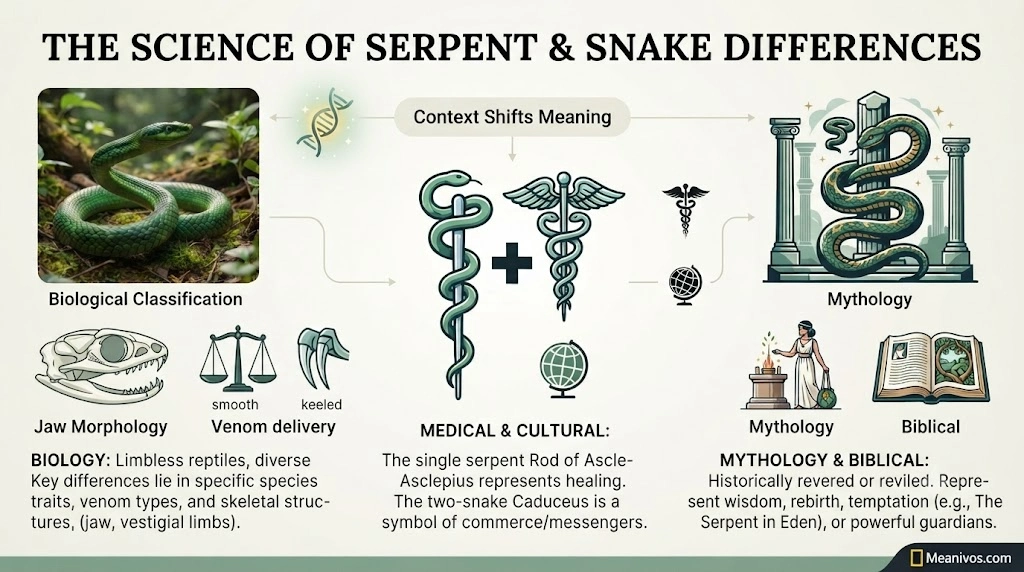
There is no scientific group called “Serpent.”
Scientists classify these animals as snakes, not serpents.
This is one of the biggest misconceptions found in many online articles.
Biological Characteristics
Although snake species differ greatly, they share several key biological traits.
Body Structure
Snakes have elongated bodies supported by hundreds of vertebrae and ribs, allowing remarkable flexibility. Most species lack external limbs, though some primitive snakes retain tiny vestigial pelvic structures.
Scales
Their bodies are covered in keratin scales, which reduce friction, help retain moisture, and protect against injury. Snakes periodically shed these scales as they grow—a process known as ecdysis.
Movement
Snakes move using several specialized methods, including:
- Lateral undulation
- Rectilinear locomotion
- Sidewinding
- Concertina movement
Each style is adapted to different environments, from deserts to dense forests.
Sensory Adaptations
Despite lacking external ears, snakes are highly sensitive to ground vibrations. Their forked tongue collects scent particles, which are analyzed by the Jacobson’s organ, helping them locate prey, mates, and navigate their surroundings.
Evolution of Snakes
Modern snakes evolved from ancient lizard-like ancestors more than 100 million years ago. Over time, evolutionary changes favored elongated bodies and reduced limbs, enabling movement through burrows, dense vegetation, and aquatic environments.
Fossil evidence suggests that early snakes still possessed small hind limbs, remnants of which can still be seen in modern boas and pythons.
Today, scientists recognize over 4,000 species, ranging from tiny threadsnakes only a few inches long to the massive green anaconda, one of the largest snakes in the world.
Why “Serpent” Is Not a Scientific Classification
One of the most common misconceptions is that serpent refers to a separate type of reptile.
This is incorrect.
In modern zoology:
- Snake is the accepted scientific and common term.
- Serpent is a historical, literary, or symbolic word.
- There is no taxonomic category named Serpent.
When reading scientific journals, wildlife guides, or biology textbooks, you will almost always encounter the word snake, not serpent.
Etymology: Where Did the Words Come From?
Understanding the origins of these words helps explain why they feel different today.
Origin of Snake
The English word snake comes from the Old English snaca, meaning a creeping or crawling reptile. Similar words appear in several Germanic languages, showing that the term has been used in everyday speech Serpent vs Snake for more than a thousand years.
Because it developed as the common name for the animal, snake gradually became the preferred word in science, education, and daily conversation.
Origin of Serpent
The word serpent comes from the Latin serpens, meaning “one that creeps” or “a crawling creature.” It entered English through Old French after the Norman Conquest.
Since Latin was the language of religion, scholarship, and law for centuries, serpent became closely associated with:
- Religious texts
- Medieval literature
- Poetry
- Myths
- Symbolic storytelling
This historical background explains why serpent often sounds older, more dramatic, and more symbolic than snake.
Timeline of the Two Words
| Period | Snake | Serpent |
| Ancient Latin | Not used in English | Serpens develops |
| Old English | Snaca appears | Rare |
| Middle English | Widely used | Borrowed from French |
| Medieval Era | Everyday animal | Religious and literary word |
| Modern English | Standard term | Mostly symbolic or literary |
Linguistic Differences
Although both words can refer to the same animal, they create different impressions.
| Snake | Serpent |
| Simple | Dramatic |
| Modern | Ancient |
| Scientific | Literary |
| Neutral | Symbolic |
| Everyday conversation | Religion and mythology |
Example
Scientific
The snake uses its forked tongue to detect chemical signals.
Literary
The ancient serpent watched silently from the temple ruins.
Both sentences are correct, but each creates a different tone.
Snake in Everyday English
Today, snake is the word most people use.
Examples include:
- Garden snake
- Pet snake
- Snake species
- Venomous snake
- Snake habitat
- Snake conservation
You’ll find this word in:
- Biology textbooks
- Wildlife documentaries
- Scientific journals
- News articles
- School lessons
If you’re describing a real reptile, a snake is almost always the best choice.
Serpent in Literature
Authors often choose serpent because it carries emotional and symbolic weight.
Instead of simply describing an animal, it may suggest:
- Danger
- Wisdom
- Mystery
- Evil
- Ancient knowledge
- Transformation
Classic literature frequently uses serpents when creating dramatic scenes.
Example:
The serpent emerged from the shadows, guarding forgotten treasure.
Replacing a serpent with a snake changes the atmosphere considerably.
Which Word Should You Use?
Use Snake When
- Writing scientific content
- Talking about wildlife
- Describing pets
- Discussing biology
- Teaching children
- Writing news articles
Example:
The snake shed its skin during spring.
Use Serpent When
- Discussing mythology
- Writing fiction
- Referring to biblical stories
- Explaining symbolism
- Creating poetic language
Example:
The serpent tempted Eve in the Garden of Eden.
Serpent in the Bible
The Bible almost always uses the word serpent instead of snake, especially in older English translations.
This choice reflects both language history and symbolism.
The biblical serpent represents more than an animal. It becomes a character associated with:
- Temptation
- Deception
- Sin
- Evil
- Spiritual testing
Because of this powerful symbolism, the word serpent remains deeply connected with biblical imagery.
The Garden of Eden Story
One of the world’s most famous serpents appears in the Book of Genesis.
According to the biblical account:
- Adam and Eve lived in the Garden of Eden.
- A serpent approached Eve.
- It persuaded her to eat the forbidden fruit.
- This act led to humanity’s fall from innocence.
Whether interpreted literally, symbolically, or allegorically, the serpent has become one of the most recognizable figures in religious history.
For many Christians, it represents temptation and disobedience.
Serpent Meaning in Christianity
In Christian tradition, the serpent often symbolizes:
- Satan
- Temptation
- Sin
- Deception
- Spiritual danger
However, Christian symbolism is more complex than many people realize.
For example, in the Gospel of Matthew, Jesus tells His followers to be:
“Wise as serpents and innocent as doves.”
Here, the serpent represents wisdom rather than evil.
This demonstrates that biblical symbolism depends on context.
Serpent Meaning in Judaism
Jewish interpretations vary across different traditions.
The serpent in Genesis is generally viewed as:
- A tempter
- A symbol of moral testing
- A participant in humanity’s first major choice
Unlike later Christian interpretations, some Jewish scholars focus less on identifying the serpent with Satan and more on its role within the narrative.
Serpent Meaning in Islam
The Qur’an tells the story of Adam and Hawwa (Eve), but it does not describe a serpent tempting them in the same way as many Christian traditions.
Instead:
- Satan (Iblis) is responsible for leading humans astray.
- The emphasis is on obedience to God rather than on the serpent itself.
As a result, serpents do not hold the same Serpent vs Snake central symbolic role in Islamic teachings as they do in much of Christian art and literature.
Serpent in Greek Mythology
Greek mythology features numerous serpent-like creatures.
Some of the best known include:
Python
Python guarded the sacred site at Delphi until being defeated by Apollo.
It represents:
- Ancient power
- Chaos
- Prophecy
Medusa
Although Medusa is not a serpent herself, snakes form her hair.
These snakes symbolize:
- Fear
- Punishment
- Supernatural Power
Hydra
The Hydra was a giant multi-headed serpent.
Each time one head was cut off, two more grew in its place.
It became a symbol of problems that Serpent vs Snake multiply when handled incorrectly.
Egyptian Serpents
Ancient Egyptians viewed serpents in both positive and negative ways.
Wadjet
A protective cobra goddess.
Symbolized:
- Royal authority
- Protection
- Divine power
The cobra appeared on the crowns of pharaohs.
Apep
A giant serpent representing:
- Chaos
- Darkness
- Destruction
Each night, the sun god Ra battled Apep before sunrise.
- Related To Other Article:https://meanivos.com/hwy-meaning-in-text/
Hindu Nagas
In Hinduism, Nagas are sacred serpent beings.
Unlike ordinary snakes, Nagas are often:
- Divine
- Wise
- Powerful
- Protective
They appear in many Hindu stories and are connected with:
- Water
- Fertility
- Prosperity
- Hidden treasures
The serpent king Shesha is believed to support the Serpent vs Snake universe and serve as the resting place of Lord Vishnu.
Chinese Serpents
Chinese culture generally views serpents more positively than many Western traditions.
Serpents often symbolize:
- Wisdom
- Longevity
- Intelligence
- Adaptability
Chinese dragons also share many serpent-like characteristics:
- Long bodies
- Scales
- Flowing movement
Unlike European dragons, Chinese dragons usually represent good fortune.
The Feathered Serpent
One of Mesoamerica’s most famous deities is Quetzalcoatl, the Feathered Serpent.
He symbolizes:
- Creation
- Learning
- Civilization
- Knowledge
- Wind
This shows that serpents are not universally viewed as evil.
In many cultures, they represent life and wisdom instead.
Norse Mythology
Norse mythology includes the enormous Jörmungandr, also known as the Midgard Serpent.
According to legend:
- It encircles the Earth.
- It is so large that it bites its own tail.
- During Ragnarök, it battles Thor.
This giant serpent symbolizes:
- Cosmic balance
- Fate
- Destruction
- Renewal
Symbolism Around the World
Across civilizations, serpents have represented many different ideas.
| Symbol | Meaning |
| Wisdom | Knowledge |
| Renewal | Shedding skin |
| Healing | Medicine |
| Fertility | Life |
| Eternity | Ouroboros |
| Danger | Venom |
| Power | Kingship |
| Temptation | Garden of Eden |
| Protection | Guardian spirits |
This diversity explains why serpents remain one of humanity’s oldest and most enduring symbols.
Medical Symbolism
One of the most recognized serpent symbols today appears in medicine.
Many hospitals and medical organizations use a staff wrapped by a single serpent.
The serpent represents:
- Healing
- Renewal
- Recovery
- Knowledge
Its connection to medicine dates back thousands of years.
The Rod of Asclepius
The Rod of Asclepius features:
- One staff
- One serpent
It represents healing and medical care.
It is often confused with the Caduceus, which has:
- Two serpents
- Wings
Although both symbols are widely recognized, the Rod of Asclepius is the traditional Serpent vs Snake emblem of medicine.
Ouroboros Explained
The Ouroboros is a serpent eating its own tail.
It symbolizes:
- Eternity
- Infinite cycles
- Rebirth
- Transformation
- Unity
The image appears in:
- Ancient Egypt
- Greece
- Alchemy
- Philosophy
- Psychology
It remains one of the world’s oldest symbolic designs.
Snake Symbolism Today
Modern interpretations vary depending on culture.
Positive meanings include:
- Wisdom
- Healing
- Transformation
- Intelligence
- Personal growth
Negative meanings include:
- Betrayal
- Deception
- Fear
- Hidden danger
Context determines which meaning is intended.
Common Misconceptions
Myth: Serpents are different animals from snakes.
Fact: They are the same biologically.
Myth: Every serpent symbolizes evil.
Fact: Many cultures associate serpents with healing, wisdom, and protection.
Myth: Scientists use the word “serpent.”
Fact: Scientific literature overwhelmingly uses snakes.
Myth: All snakes are venomous.
Fact: Most snake species are non-venomous and are Serpent vs Snake harmless to humans.
Serpent vs Snake in Writing
Although serpent and snake can refer to the same reptile, choosing the right word depends on your audience and purpose.
Use Snake for:
- Scientific articles
- Wildlife guides
- News reports
- School assignments
- Everyday conversations
- Nature documentaries
Examples:
- The snake crossed the hiking trail.
- Scientists discovered a new snake species in South America.
- The snake sheds its skin several times a year.
Use Serpent for:
- Religious writing
- Mythology
- Fantasy novels
- Poetry
- Symbolic discussions
- Historical literature
Examples:
- The ancient serpent guarded the sacred temple.
- The serpent became a symbol of temptation.
- Legends describe a giant sea serpent.
50+ Real-Life Example Sentences
Everyday Use
- I saw a snake in the garden.
- The snake disappeared into the grass.
- Some snakes are harmless.
- Snakes help control rodent populations.
- A snake can detect scents with its tongue.
- The snake was safely relocated.
- Many people keep snakes as pets.
- The snake curled beneath a rock.
- We watched a snake cross the road.
- Most snakes avoid humans.
Scientific Context
- Snakes belong to the suborder Serpentes.
- Scientists study snake behavior.
- Venomous snakes evolved specialized fangs.
- Snake diversity exceeds 4,000 species.
- Marine snakes live in tropical oceans.
- Fossils reveal early snake evolution.
- Some snakes give live birth.
- Snake venom varies by species.
- Pythons kill prey through constriction.
- Conservation protects endangered snakes.
Religious Context
- The serpent tempted Eve.
- The bronze serpent represented healing.
- The serpent appears throughout biblical literature.
- Ancient texts describe the crafty serpent.
- The serpent symbolizes temptation.
Mythology
- The serpent guarded hidden treasure.
- The sea serpent frightened sailors.
- Quetzalcoatl was the Feathered Serpent.
- The Midgard Serpent surrounded the world.
- The Hydra was a many-headed serpent.
Symbolic Use
- The serpent represented wisdom.
- The serpent symbolized transformation.
- Artists often paint serpents as guardians.
- The serpent appears in ancient temples.
- The serpent became a spiritual symbol.
Literature
- The serpent waited silently.
- A mysterious serpent appeared in the cave.
- The serpent watched the travelers.
- The hero defeated the giant serpent.
- The serpent vanished into darkness.
Education
- A serpent is simply another word for a snake.
- Modern biology prefers “snakes.”
- Literature often prefers “serpent.”
- Context determines the better word.
- Both terms can describe the same animal.
Modern Examples
- The movie featured a giant serpent.
- The museum displayed ancient serpent art.
- The logo contains a serpent.
- The novel describes an immortal serpent.
- The serpent represents renewal in many cultures.
Side-by-Side Examples
| Situation | Better Word |
| Biology class | Snake |
| Zoo sign | Snake |
| Wildlife documentary | Snake |
| Bible discussion | Serpent |
| Fantasy novel | Serpent |
| Ancient mythology | Serpent |
| Poetry | Serpent |
| Medical symbol | Serpent |
| Newspaper article | Snake |
| Children’s science book | Snake |
Serpent vs Dragon
People sometimes confuse serpents with dragons because many Serpent vs Snake myths feature long, scaled creatures.
| Serpent | Dragon |
| Usually a snake | Mythical creature |
| May be real or symbolic | Entirely mythical in most traditions |
| No limbs (typically) | Often has legs and wings |
| Exists in nature | Does not exist biologically |
| Appears in religion and mythology | Mostly appears in mythology and folklore |
Related Terms
Understanding similar words improves vocabulary and writing accuracy.
| Term | Meaning |
| Snake | Modern scientific term |
| Serpent | Literary or symbolic snake |
| Cobra | Venomous snake |
| Viper | Family of venomous snakes |
| Python | Large constricting snake |
| Boa | Non-venomous constrictor |
| Naga | Divine serpent in Hindu and Buddhist traditions |
| Wyrm | Dragon-like serpent in European folklore |
| Sea Serpent | Legendary ocean creature |
| Basilisk | Mythical serpent-like creature |
Common Mistakes
Mistake 1
Incorrect: A serpent is a different species than a snake.
Correct: Serpent is another word for a snake, usually used in symbolic or literary contexts.
Mistake 2
Incorrect: Scientists classify reptiles as serpents.
Correct: Scientists classify them as snakes (suborder Serpentes).
Mistake 3
Incorrect: Every serpent represents evil.
Correct: Many cultures associate serpents with healing, wisdom, rebirth, and protection.
Mistake 4
Incorrect: All snakes are venomous.
Correct: Most snake species are non-venomous.
Fun Facts About Snakes and Serpents
- More than 4,000 snake species are known worldwide.
- Antarctica is the only continent without native snakes.
- Some snakes can go months without eating.
- The green anaconda is among the world’s heaviest snakes.
- The reticulated python is the longest snake species.
- Snakes smell using their forked tongues.
- Snakes have flexible jaws that allow them to swallow large prey.
- The Ouroboros is one of the oldest serpent symbols in history.
- Ancient Egyptian kings wore a cobra symbol for protection.
- The Rod of Asclepius remains a global symbol of medicine.
People Also Ask
A:Yes. Biologically, a serpent is a snake. The difference is linguistic: snake is the modern scientific term, while serpent is used mainly in religious, literary, and symbolic contexts.
A:Older English Bible translations use serpent because it reflects the historical language and emphasizes the symbolic role of the creature in the story.
A:Yes. In modern English, serpent is less common in everyday speech but remains widely used in literature, mythology, and religion.
A:From a biological perspective, yes. However, in modern writing, people usually reserve serpency for symbolic or literary contexts.
A:Snake is the accepted scientific and zoological term.
A:Depending on the culture, a serpent may symbolize wisdom, healing, rebirth, eternity, protection, temptation, or danger.
A:The serpent on the Rod of Asclepius represents healing, renewal, and medicine, dating back to ancient Greece.
A:Not usually. Dragons are mythical creatures, while serpents generally refer to snakes or snake-like beings.
Topical Cluster Ideas
Create supporting articles around:
- Animal Meanings
- Biblical Symbols
- Mythological Creatures
- Ancient Civilizations
- Scientific Animal Guides
This helps search engines understand your site’s expertise on related topics.
Conclusion
Although serpent and snake describe the same type of animal, they serve different purposes in modern English. Snake is the preferred term in science, education, journalism, and everyday conversation because it is precise and widely understood. Serpent, on the other hand, carries centuries of cultural, religious, and literary meaning, making it ideal for discussions of mythology, symbolism, and sacred texts.
Knowing when to use each word improves both clarity and style. Whether you’re studying biology, reading ancient myths, interpreting religious passages, or writing fiction, understanding the distinction helps you communicate more effectively.
If your goal was to answer the question “Serpent vs Snake: What’s the difference?”, the simple takeaway is this:
Biologically, they are the same. Linguistically and culturally, “serpent” carries symbolic and historical meaning, while “snake” is the modern scientific and everyday term.