DeepSeek vs ChatGPT 2026: Research & Performance
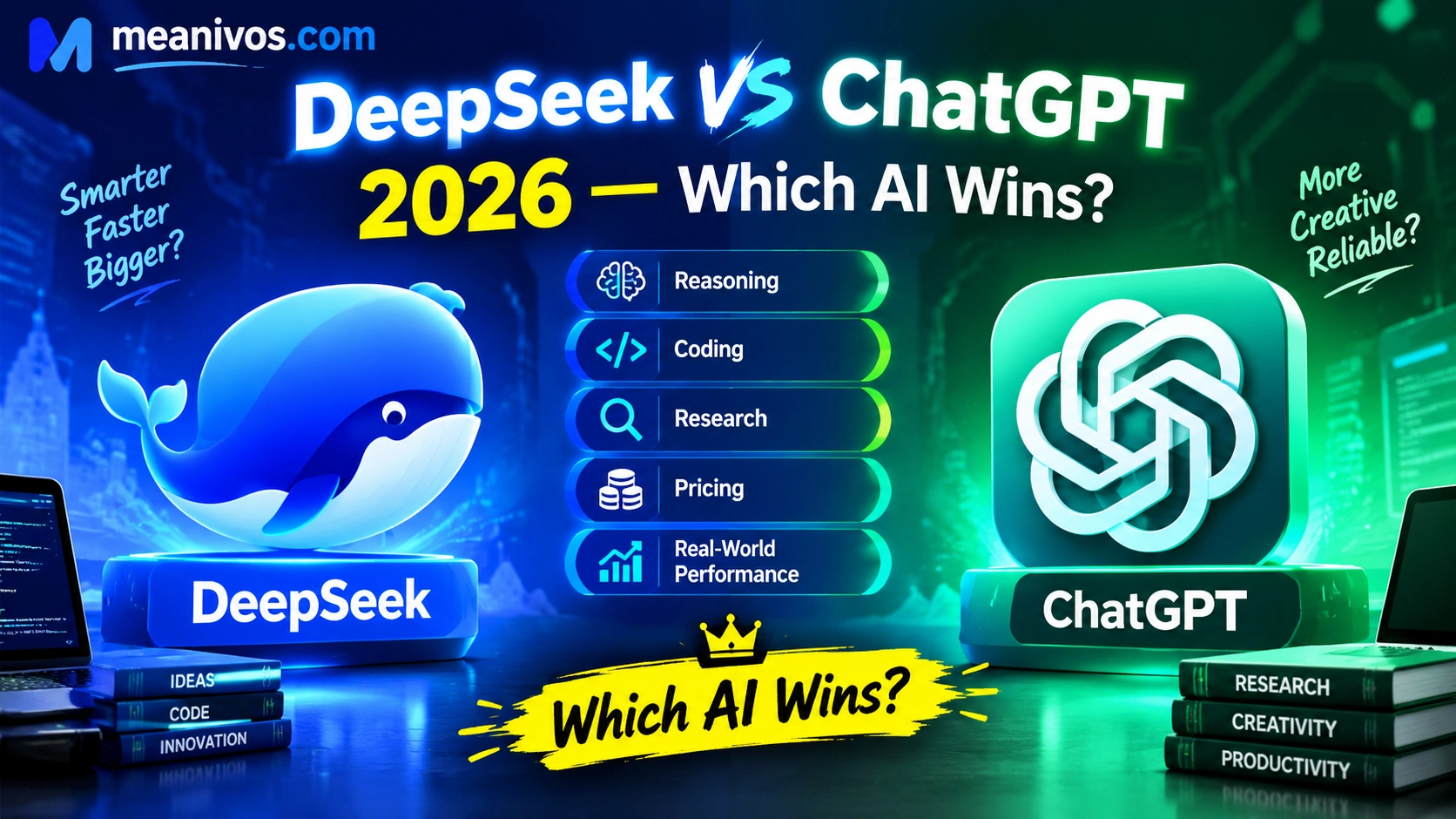
DeepSeek vs ChatGPT is one of the most important AI comparisons for 2026—but the answer is no longer as simple as choosing the “smarter chatbot.”
AI platform has evolved considerably with its V4 model family, while ChatGPT has expanded into a much broader AI workspace with research, web search, files, images, voice, memory, projects and custom AI assistants. DeepSeek’s current V4 documentation lists V4 Flash and V4 Pro with a 1 million-token context window, while OpenAI describes ChatGPT as a product with multiple integrated capabilities rather than a single model.
So which one is better?
DeepSeek is the stronger choice when low cost, open weights, long context and developer control are your priorities. ChatGPT is generally the stronger all-around choice when you want one polished AI workspace for writing, research, coding, files, images, voice and productivity.
But that doesn’t mean ChatGPT wins every task.
For some developers, researchers and technical users, DeepSeek can offer a much better cost-to-capability ratio. For someone who wants an AI assistant that can move from a web search to a PDF, image, voice conversation and organized project, ChatGPT has a much broader ecosystem.
The real question isn’t simply:
“Which AI is smarter?”
It’s:
“Which AI is better for what I need to accomplish?”
DeepSeek vs ChatGPT: Quick Answer
| Category | Winner | Why |
| Overall AI workspace | ChatGPT | Broader integrated tools |
| API cost | DeepSeek | Much lower current listed token prices |
| Open weights | DeepSeek | Open-weight V4 models |
| Self-hosting | DeepSeek | Open deployment options |
| Long context | DeepSeek | V4 supports up to 1M tokens |
| Writing | ChatGPT | Strong editing and creative workflow |
| Web research | ChatGPT | Integrated search and Deep Research |
| Image generation | ChatGPT | Integrated image generation |
| Voice | ChatGPT | Native voice experience |
| File analysis | ChatGPT | Strong integrated file workflow |
| Coding | Depends | Both are strong; cost/control favor DeepSeek |
| Mathematics | Depends | Task and model dependent |
| Large-scale API workloads | DeepSeek | Lower listed API pricing |
| General users | ChatGPT | Easier all-purpose ecosystem |
| Developers wanting openness | DeepSeek | Open weights and deployment flexibility |
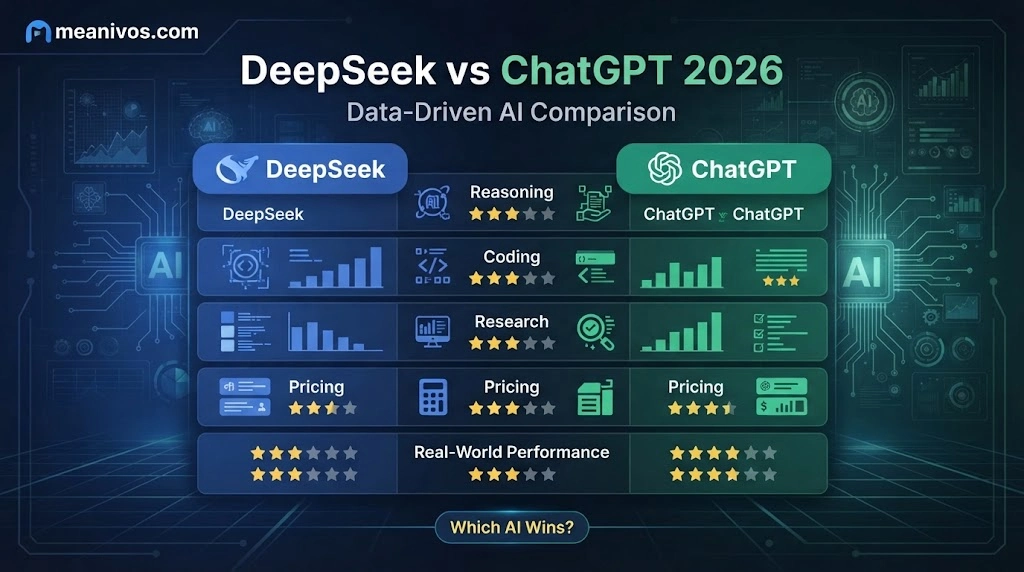
Bottom line: DeepSeek wins more often on cost and openness. ChatGPT wins more often on breadth and integrated productivity.
What Is DeepSeek?
DeepSeek is an AI company and model developer known for releasing highly capable models with an emphasis on efficiency, reasoning, coding and open-weight access.
The current V4 generation includes DeepSeek-V4-Flash and DeepSeek-V4-Pro.
According to DeepSeek’s official V4 announcement, V4 introduced a 1M-token context length, reasoning and non-reasoning modes, stronger agent capabilities and open weights. DeepSeek describes V4 Pro as its more capable model and V4 Flash as the faster, more economical option.
The official API documentation currently lists both models with:
- 1M context
- Thinking and non-thinking modes
- Tool calls
- JSON output
- OpenAI-compatible API access
- Anthropic-compatible API access
- Large maximum outputs
This makes DeepSeek especially interesting for developers and organizations that want to build directly on top of an AI model rather than simply use a consumer chatbot.
What Is ChatGPT?
ChatGPT is OpenAI’s general-purpose AI assistant.
It has grown far beyond basic question answering.
Depending on your plan, account and region, ChatGPT can provide capabilities including:
- Web search
- Deep Research
- Image input
- Image generation
- File uploads
- Data analysis
- Voice
- Canvas
- Memory
- Projects
- Custom GPTs
- Connected apps
OpenAI’s current capability documentation describes ChatGPT as a platform where these tools can work together inside a conversational workflow.
Projects, for example, allow users to keep chats, files and instructions together around a continuing objective.
That’s an important distinction.
DeepSeek is highly compelling as a model and AI service. ChatGPT is highly compelling as an AI workspace.
DeepSeek V4 vs ChatGPT: What’s the Real Difference?
The biggest mistake is treating this as:
A better comparison is:
AI model + product + tools + pricing + ecosystem + deployment.
DeepSeek’s V4 family is focused heavily on efficient reasoning, coding, long context and agentic workloads. Its official announcement says V4 Pro has 1.6 trillion total parameters with 49 billion active parameters, while V4 Flash has 284 billion total parameters with 13 billion active parameters.
ChatGPT takes a different approach.
It puts models inside an ecosystem where the user can search the web, analyze documents, create images, use voice, conduct deep research, organize work in Projects and use customized GPTs.
Therefore:
DeepSeek’s strength is model openness and cost efficiency.
ChatGPT’s strength is product breadth and workflow integration.
DeepSeek vs ChatGPT: Features Compared
| Feature | DeepSeek | ChatGPT |
| AI chat | Yes | Yes |
| Reasoning | Yes | Yes |
| Coding | Strong | Strong |
| Long context | Up to 1M tokens | Model/plan dependent |
| API | Yes | Yes |
| Tool calling | Yes | Yes |
| Open weights | Yes | Proprietary ChatGPT models |
| Self-hosting | Supported for applicable open models | Not for proprietary ChatGPT models |
| Web search | Product-dependent | Yes |
| Deep Research | More limited | Yes |
| File analysis | Available in supported workflows | Yes |
| Image generation | Limited compared with ChatGPT ecosystem | Yes |
| Voice | More limited | Yes |
| Memory | Product-dependent | Yes |
| Projects | No direct equivalent | Yes |
| Custom GPTs | No direct equivalent | Yes |
| Connected apps | More limited ecosystem | Yes |
| Large API workloads | Strong value proposition | More expensive |
| General productivity | Strong | Excellent |
OpenAI’s documentation confirms that ChatGPT’s ecosystem includes search, Deep Research, image generation, files, data analysis, voice, memory, Projects and custom GPTs.
DeepSeek vs ChatGPT: Pricing
Pricing is one of DeepSeek’s biggest advantages.
DeepSeek’s current official API documentation lists the following off-peak rates:
| Model | Input / 1M tokens | Output / 1M tokens |
| DeepSeek V4 Flash | $0.22 | $0.66 |
| DeepSeek V4 Pro | $0.66 | $1.98 |
Peak rates are currently higher, and cached input is substantially cheaper. DeepSeek explicitly says prices can change, so developers should verify the live pricing page before deployment.
This is important for applications processing millions or billions of tokens.
A small difference per million tokens can become a large difference at scale.
What about ChatGPT?
ChatGPT is a consumer product with multiple subscription tiers.
OpenAI currently lists ChatGPT Plus at $20 per month, while the API is billed separately from the ChatGPT subscription.
OpenAI also currently offers other ChatGPT consumer tiers, including Go and Pro, with pricing and availability varying by market.
Pricing winner: DeepSeek
If you’re comparing API inference cost, DeepSeek has the clear advantage based on its current published rates.
If you’re comparing overall consumer value, the calculation is different because ChatGPT’s subscription includes access to a much broader collection of tools.
DeepSeek vs ChatGPT for Coding
Coding is one of the closest battles.
DeepSeek V4 was specifically designed with agentic coding and tool use in mind. DeepSeek says V4 Pro delivers strong results on agentic coding benchmarks and has been optimized for agentic coding workflows.
ChatGPT, meanwhile, combines strong coding models with a larger productivity environment.
Choose DeepSeek for coding when you care about:
- Low API costs
- Open weights
- Self-hosting
- Large code contexts
- Agent experimentation
- Custom infrastructure
- High-volume automated coding
Choose ChatGPT when you care about:
- Interactive debugging
- Code explanation
- File-based development
- Architecture discussions
- Research alongside coding
- Broader developer tools
- Integrated AI workflows
Coding verdict
For developers building their own infrastructure: DeepSeek gets the edge.
For developers wanting a polished AI coding and productivity environment: ChatGPT gets the edge.
DeepSeek vs ChatGPT for Writing
Writing is less about raw benchmark performance and more about consistency, tone, editing and workflow.
ChatGPT is particularly useful for:
- Blog posts
- Editing
- Rewriting
- Marketing copy
- Brand voice
- Social media content
- Brainstorming
- Outlines
- Long-form documents
- Iterative editing
DeepSeek can produce strong writing too, especially where structured reasoning or technical material is involved.
But if your main goal is:
“Help me turn an idea into polished publishable content.”
ChatGPT is the better general-purpose choice.
Writing winner: ChatGPT
DeepSeek vs ChatGPT for SEO
For SEO professionals, the comparison becomes more nuanced.
DeepSeek can be useful for:
- Keyword clustering
- SERP pattern analysis
- Content outlines
- Large text processing
- Entity extraction
- Competitor-content analysis
- Technical brainstorming
- High-volume API workflows
ChatGPT is useful for:
- Search-intent analysis
- Content briefs
- Article drafting
- Editing
- Schema brainstorming
- Research
- Data analysis
- Image creation
- Content optimization
- Multi-step workflows
ChatGPT’s Deep Research feature can perform multi-step research and produce a structured report with citations or source links, which can be particularly useful when developing evidence-based content.
SEO verdict
DeepSeek for cost-efficient large-scale processing.
ChatGPT for end-to-end SEO content workflows.
For serious SEO work, however, don’t publish AI-generated claims without checking primary sources.
DeepSeek vs ChatGPT for Research
Research is one of ChatGPT’s strongest advantages.
OpenAI’s Deep Research is designed to:
- Plan a research task.
- Search multiple sources.
- Analyze information.
- Synthesize findings.
- Produce a documented report.
- Provide citations or source links.
It can also work with uploaded files and selected websites.
That doesn’t mean DeepSeek is poor at research.
DeepSeek can be excellent for reasoning over research material you provide.
But the distinction is:
DeepSeek can be a powerful reasoning engine.
ChatGPT can be a more complete research workflow.
Research winner: ChatGPT
DeepSeek vs ChatGPT for Long Documents
This is one of DeepSeek’s strongest advantages.
DeepSeek’s current V4 models support a 1M-token context window.
That can be valuable for:
- Books
- Large codebases
- Legal documents
- Research papers
- Technical documentation
- Large transcripts
- Multiple documents
- Long conversations
But remember:
A large context window doesn’t automatically mean better reasoning.
The real question is whether the model can accurately locate, understand and reason about the relevant information inside that context.
Long-context winner
DeepSeek has a major advantage on published V4 context capacity.
DeepSeek vs ChatGPT for Image Generation
ChatGPT has the stronger integrated experience here.
OpenAI currently documents both image understanding and image generation as ChatGPT capabilities.
This is valuable if your workflow involves:
Text → research → image → editing → final content
inside the same environment.
DeepSeek’s main competitive advantages are currently more concentrated around reasoning, coding, long context and open models rather than being an all-in-one image-creation platform.
Winner: ChatGPT
- Explore More: https://meanivos.com/wdym-meaning-in-text/
DeepSeek vs ChatGPT for Voice
ChatGPT has a mature integrated voice experience.
OpenAI describes ChatGPT Voice as a natural, free-form voice conversation where users can speak and receive spoken responses. The Live experience can also interact with web search, memory and supported visual results where available.
For someone who wants to:
- Brainstorm while walking
- Practice a language
- Ask questions hands-free
- Discuss documents
- Have a conversational assistant
ChatGPT is the stronger choice.
Winner: ChatGPT
DeepSeek vs ChatGPT for Students
Students usually care about:
- Price
- Explanations
- Mathematics
- Coding
- Research
- Documents
- Writing
DeepSeek’s low-cost access makes it extremely attractive for technical study.
ChatGPT’s broader toolset makes it useful for students who want to combine explanations with files, research, voice and other workflows.
Choose DeepSeek if:
You mainly need inexpensive reasoning, mathematics, programming and technical explanations.
Choose ChatGPT if:
You want an all-purpose study assistant that can work with documents, research, images and voice.
Student winner
It’s a tie depending on the student.
DeepSeek vs ChatGPT for Developers
This is arguably the most important audience for DeepSeek.
DeepSeek’s official documentation currently provides:
- V4 Flash
- V4 Pro
- 1M context
- Tool calls
- OpenAI-compatible APIs
- Anthropic-compatible APIs
- Open weights
- Self-deployment possibilities
That combination gives developers considerable flexibility.
ChatGPT/OpenAI is stronger when the developer values the wider ecosystem and integrated tooling.
Developer verdict
DeepSeek = cost + openness + control
ChatGPT/OpenAI = ecosystem + breadth + integrated capabilities
DeepSeek vs ChatGPT for Business
Business users should evaluate more than intelligence.
Consider:
- Data handling
- Compliance
- Administration
- Integrations
- Access control
- Reliability
- Vendor support
- Deployment requirements
- Cost
- Model performance
DeepSeek’s open-weight approach can make self-managed deployment attractive for organizations that want infrastructure control.
ChatGPT has a broad business ecosystem, including Projects and connected apps, with workspace-level controls depending on the plan. OpenAI’s documentation notes that business, Enterprise and Edu workspaces can use shared Projects and administrator controls.
Business verdict
For managed productivity: ChatGPT.
For organizations prioritizing model deployment control: DeepSeek may be more attractive.
The correct choice depends heavily on the organization’s compliance and infrastructure requirements.
DeepSeek vs ChatGPT: Privacy and Data
Privacy is a category where you should avoid simplistic claims.
“Open source” does not automatically mean:
“Your data is private.”
There’s an important distinction between:
using a hosted DeepSeek service
and
self-hosting an open DeepSeek model.
DeepSeek’s privacy policy states that information collected through its services is stored on servers in mainland China, subject to the exceptions described in its policy.
Meanwhile, OpenAI has separate consumer and business data controls and policies.
Therefore, organizations should ask:
- Where is data processed?
- Where is it stored?
- Is it used for training?
- How long is it retained?
- Can administrators control access?
- Can the model be deployed privately?
- What contractual protections apply?
Privacy verdict
There is no responsible one-word winner.
For self-hosted deployment, DeepSeek’s open-weight models provide substantially more infrastructure control.
For hosted business use, compare the exact OpenAI and DeepSeek plan, policy and contractual terms applicable to your organization.
DeepSeek vs ChatGPT: Open Weights
This is a major differentiator.
DeepSeek says it publicly releases model weights, parameters and inference tool code under the permissive MIT License.
That can enable developers to:
- Download models
- Run them independently
- Experiment with the architecture
- Build custom systems
- Deploy models on their own infrastructure
This is fundamentally different from using a proprietary hosted model where the provider controls the underlying model weights.
Winner: DeepSeek
For users who care about open-weight AI, this isn’t a small feature.
It’s a fundamental architectural difference.
Is DeepSeek Better Than ChatGPT?
For some tasks, yes.
But saying DeepSeek is simply “better” would be misleading.
DeepSeek is particularly compelling when your priorities are:
- Low API cost
- Open weights
- Self-hosting
- Large context
- Technical workloads
- Coding
- Agent experimentation
- Infrastructure control
ChatGPT is particularly compelling when your priorities are:
- General Productivity
- Writing
- Research
- Image generation
- Voice
- File analysis
- Memory
- Projects
- Custom GPTs
- Connected tools
So instead of asking:
“Is DeepSeek better than ChatGPT?”
Ask:
“Better for what?”
That is the question that actually determines the winner.
Can DeepSeek Replace ChatGPT?
For some people, absolutely. For everyone, no.
DeepSeek can replace ChatGPT if you mainly use an AI for:
- Questions
- Coding
- Mathematics
- Reasoning
- Summarization
- Technical writing
- Large-context analysis
The replacement becomes harder if your workflow depends on several ChatGPT capabilities at once.
For example:
Research → web search → PDF analysis → image creation → voice discussion → project workspace
is much closer to an integrated AI operating environment than a simple chatbot.
ChatGPT’s current documentation confirms support for these kinds of capabilities across its ecosystem.
DeepSeek vs ChatGPT: Which Should You Choose?
Choose DeepSeek if you are:
- A developer
- A researcher
- Building an AI product
- Cost-sensitive
- Interested in open weights
- Interested in self-hosting
- Processing large contexts
- Running high-volume inference
- Experimenting with AI agents
Choose ChatGPT if you are:
- A content writer
- An SEO professional
- A student
- A marketer
- A business user
- A researcher
- A creator
- A general AI user
- Someone who wants voice and images
- Someone who wants multiple AI tools in one workspace
Should You Use DeepSeek and ChatGPT Together?
For many advanced users, yes.
You don’t necessarily need to choose only one.
A practical workflow could look like this:
Step 1: Explore with DeepSeek
Use DeepSeek for:
- Technical brainstorming
- Large-context analysis
- Coding experiments
- Reasoning
- High-volume processing
Step 2: Research with ChatGPT
Use ChatGPT for:
- Web research
- Source comparison
- Document analysis
- Deep Research
- Structured reports
ChatGPT’s Deep Research feature is specifically designed for multi-step research and source-backed reports.
Step 3: Produce with ChatGPT
Use ChatGPT for:
- Editing
- Writing
- Images
- Voice
- Presentation
- Project organization
Step 4: Verify everything important
Regardless of the tool:
AI output should not automatically be treated as fact.
Check important claims against primary sources, especially for current prices, specifications, legal issues, financial information and technical documentation.
People Also Ask
A:DeepSeek can be better for low-cost API usage, open-weight models, self-hosting and large-context technical workloads. ChatGPT is generally stronger as an all-purpose AI workspace with integrated research, files, images, voice and productivity tools.
A:DeepSeek provides consumer access without the same subscription structure as ChatGPT, while its API is usage-based. API prices vary and should be checked on DeepSeek’s current pricing documentation.
A:Yes. OpenAI provides free ChatGPT access, alongside paid plans with higher limits and additional capabilities.
A:ChatGPT Plus is currently $20 per month, and API usage is billed separately.
A:DeepSeek describes its model weights, parameters and inference tool code as released under the MIT License. In this article, open-weight is the more precise term when discussing the model release.
Final Verdict
So, DeepSeek vs ChatGPT—which AI is better in 2026?
The honest answer is:
DeepSeek wins on openness, cost efficiency and developer control.
ChatGPT wins on breadth, integrated tools and general-purpose productivity.
If you’re a developer building an AI application and API cost matters heavily, DeepSeek deserves serious consideration.
If you’re a general user who wants one AI assistant for writing, research, files, images, voice and ongoing projects, ChatGPT is the more complete choice.
Our practical verdict
| You need… | Choose |
| Cheapest API | DeepSeek |
| Open weights | DeepSeek |
| Self-hosting | DeepSeek |
| 1M-token context | DeepSeek |
| High-volume inference | DeepSeek |
| General AI assistant | ChatGPT |
| Writing | ChatGPT |
| Deep research | ChatGPT |
| Image generation | ChatGPT |
| Voice | ChatGPT |
| File-based productivity | ChatGPT |
| Projects/workspace | ChatGPT |
| Broad consumer ecosystem | ChatGPT |
| Maximum infrastructure control | DeepSeek |
| Best combined workflow | Both |
The biggest lesson is that DeepSeek and ChatGPT are no longer simply competing chatbots.
They represent two different approaches to AI.
DeepSeek is pushing toward open, efficient, developer-controlled AI.
ChatGPT is pushing toward an integrated AI workspace where models, tools, research, files, images, voice and applications work together.
For that reason, the winner depends on your workflow—not just a benchmark score.