Claude vs Perplexity: Which AI Is Better in 2026?
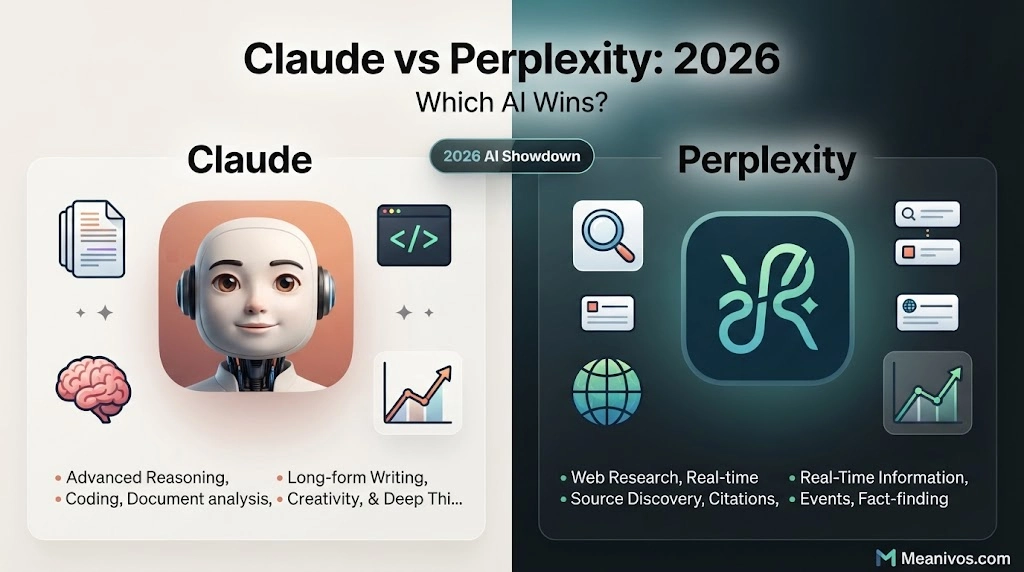
Claude and Perplexity are both powerful AI tools, but they approach AI from different directions.
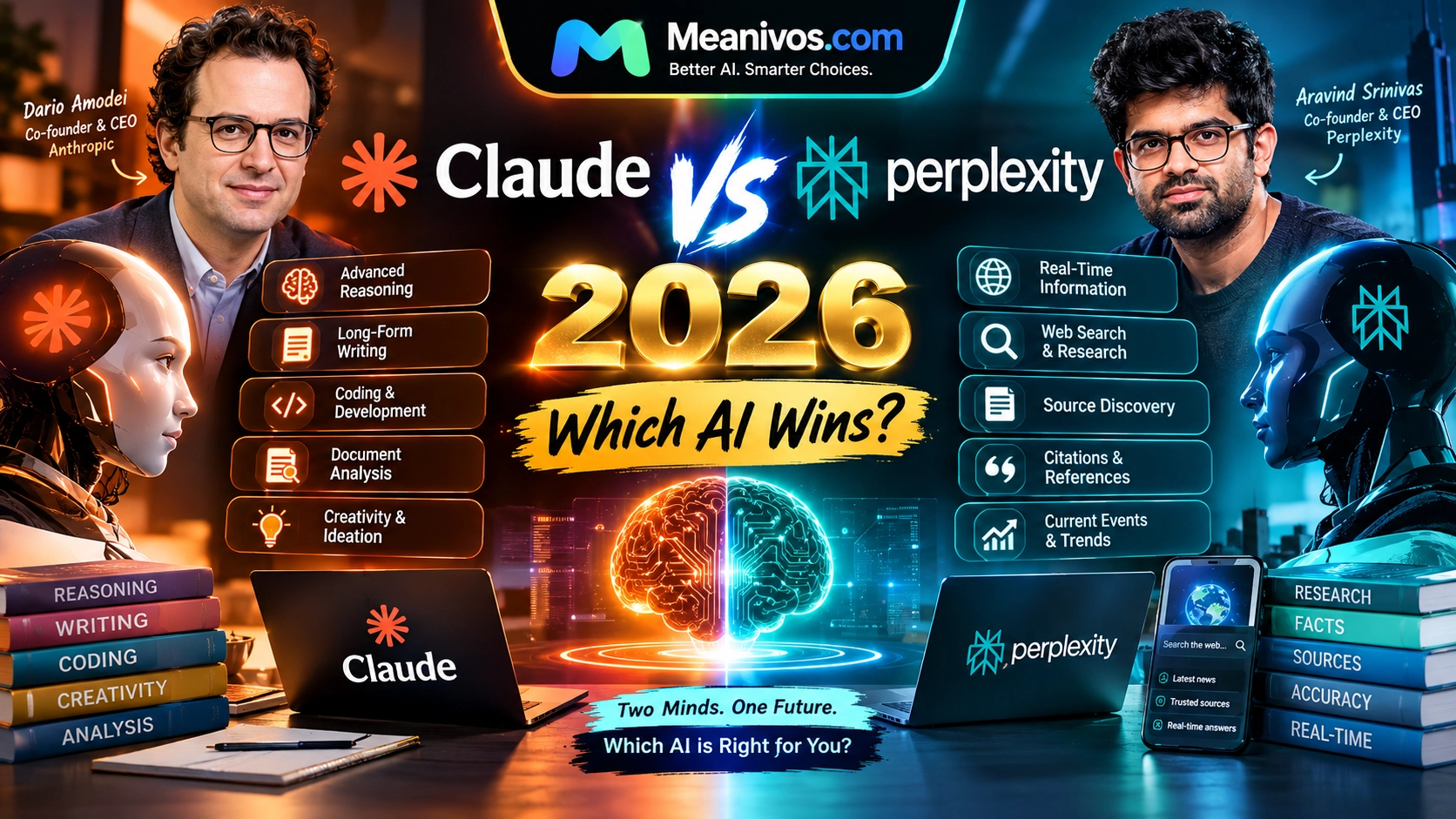
OpenAI is strongest when you want an AI assistant to reason, write, code, analyze information and work through complex tasks. Perplexity is strongest when you want to search the web, discover sources, investigate current information and receive source-backed answers.
But that distinction is no longer absolute.
Claude now offers web search and Research, while Perplexity can provide access to multiple AI models and has expanded its own research, creation and agent capabilities.
So the better question isn’t simply:
“Which AI is smarter?”
It’s:
“Which AI is better for the job I need to accomplish?”
For writing, coding, reasoning and document-heavy work, Claude is usually the better choice.
For web research, current information, source discovery and citation-heavy answers, Perplexity generally has the advantage.
And if you regularly do both, using the two together can make more sense than choosing only one.
Claude vs Perplexity: Quick Verdict
| Task | Better Choice |
| Long-form writing | 🏆 Claude |
| Creative writing | 🏆 Claude |
| Complex reasoning | 🏆 Claude |
| Coding | 🏆 Claude |
| Code development | 🏆 Claude |
| Document analysis | 🏆 Claude |
| Current web research | 🏆 Perplexity |
| Finding sources | 🏆 Perplexity |
| Citation-heavy research | 🏆 Perplexity |
| Quick factual web searches | 🏆 Perplexity |
| Research discovery | 🏆 Perplexity |
| Multi-source research | 🏆 Perplexity |
| Research + writing workflow | Both |
| General AI assistant | Claude |
| AI search experience | Perplexity |
Bottom line: Claude is generally the better creation and reasoning assistant, while Perplexity is generally the better search and research assistant.
What Is Claude?
Claude is Anthropic’s family of AI assistants and models.
It is designed for a wide range of knowledge-work tasks, including:
- Writing
- Editing
- Coding
- Reasoning
- Data analysis
- Document analysis
- Research
- Brainstorming
- Summarization
- Planning
- Software development
Claude has also expanded well beyond its earlier chatbot identity.
Anthropic’s current free plan lists web search, while Claude Pro adds features including Claude Code, Projects, Research, extended thinking and additional model access.
Anthropic also introduced Claude Opus 5 in July 2026, positioning it as a major improvement for coding and professional work.
That makes Claude particularly attractive when the user’s starting point is a problem, document, codebase or idea rather than a web search.
What Is Perplexity?
Perplexity is an AI-powered search and answer platform built around finding and synthesizing information.
Instead of functioning primarily like a conventional chatbot, Perplexity places much more emphasis on:
- Web Search
- Current information
- Sources
- Citations
- Research
- Source comparison
- Fact discovery
- Research reports
Its Pro Search feature is designed to synthesize information from multiple sources and provide more detailed answers to complex questions.
Perplexity’s Research mode goes further, performing multiple searches, reading sources and reasoning through the information before producing a report. Its current documentation says Research can perform dozens of searches and read hundreds of sources during a research task.
That makes Perplexity particularly useful when the starting point is:
“I need to find out what is currently known about this.”
Claude vs Perplexity: The Biggest Difference
The easiest way to understand the products is:
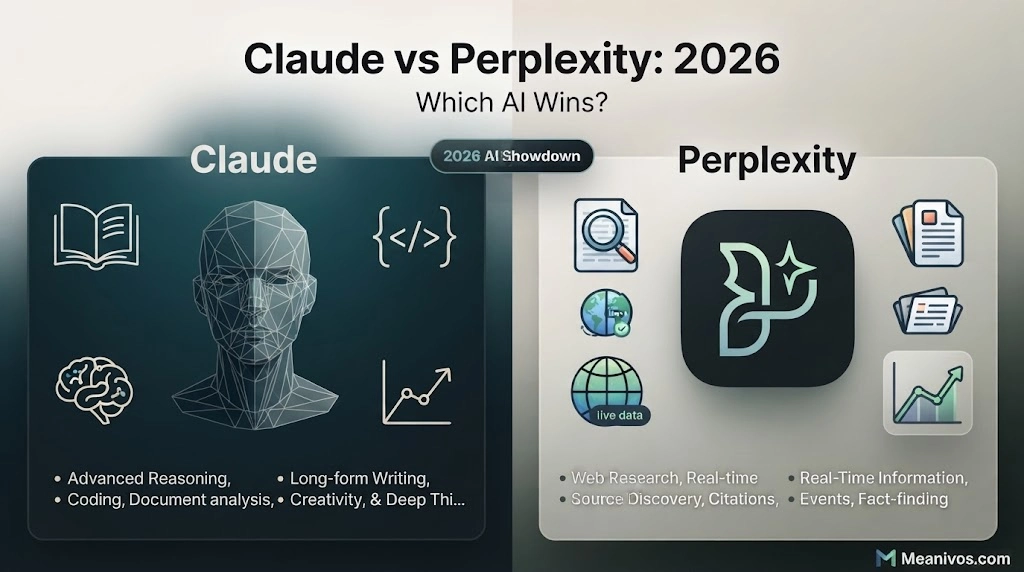
Claude = AI assistant first
Perplexity = AI search/research platform first
This difference influences how you use them.
When you already have a 50-page document and want someone to analyze it, Claude is a natural choice.
If you want to discover 20 reliable sources about a developing topic, Perplexity is a natural choice.
If you want to turn that research into a polished article, Claude may become the better tool.
The products increasingly overlap, however. Claude has web search and Research, while Perplexity can use multiple leading models, including Claude models on eligible plans.
Claude vs Perplexity for Research
Winner: Perplexity
If research means searching the live web, finding sources and comparing information, Perplexity has a strong advantage.
Its Pro Search system is specifically designed around multi-source synthesis.
Its Research mode can conduct iterative searches, read sources and produce a synthesized report.
For example, suppose you ask:
“What are the biggest changes in AI search during 2026?”
Perplexity is well suited to this because the answer depends on current information.
It can search relevant sources and expose the evidence behind its answer.
But Claude can research too
This is an important 2026 update.
It would be inaccurate to tell readers that Claude has no web access.
Anthropic’s current pricing page explicitly lists web search for Claude, and Research is included with Claude Pro.
So the more accurate conclusion is:
Perplexity has the stronger search-first workflow, while Claude has increasingly capable research functionality inside a broader AI-assistant workflow.
Claude vs Perplexity for Writing
Winner: Claude
Claude is generally the better choice when the main objective is creating or improving text.
Use Claude for:
- Blog posts
- Essays
- Reports
- Scripts
- Emails
- Product descriptions
- Content briefs
- Rewriting
- Editing
- Brand voice
- Storytelling
- Content expansion
The key advantage isn’t simply that Claude can generate words.
It’s that the workflow is centered around working with the material and refining it.
For example:
Perplexity: Find the latest evidence about AI search.
Claude: Turn that verified evidence into a well-structured 2,500-word article.
That division of labor can be extremely effective.
Claude vs Perplexity for Coding
Winner: Claude
Claude has become particularly important for coding and software-development workflows.
Anthropic’s current product ecosystem includes Claude Code, and Anthropic says Claude Opus 5 is designed for coding and professional work.
Claude can help with:
- Debugging
- Code generation
- Refactoring
- Architecture
- Code explanation
- Testing
- Documentation
- Large codebase analysis
- Development agents
Perplexity still has an important role for developers.
For example:
“What changed in this framework’s latest release?”
or:
“Find the official documentation for this API.”
That’s where Perplexity’s web-first workflow can be extremely useful.
Best developer workflow
Perplexity → discover current documentation
Claude → understand and implement it
Claude vs Perplexity for Accuracy
There is no honest universal winner for “accuracy.”
Accuracy depends on the:
- Question
- Model
- Sources
- Prompt
- Context
- Retrieval quality
- Verification process
For current factual questions, Perplexity’s search-and-source workflow provides an important advantage.
For reasoning over supplied material, Claude may be the better fit.
The key point is:
Citations make verification easier; they don’t automatically make every answer correct.
Even a cited AI answer can misinterpret a source.
For important claims, open the original source and verify the statement yourself.
Claude vs Perplexity for Citations
Winner: Perplexity
Citations are one of Perplexity’s defining strengths.
Its Pro plan currently advertises increased citation depth, and Perplexity’s entire search experience is designed around source-backed answers.
This is especially useful for:
- Academic research
- Journalism
- SEO research
- Market research
- Fact checking
- Competitive analysis
- Current affairs
Claude can also perform web searches, but Perplexity’s interface is more fundamentally designed around finding information and showing the sources behind it.
Claude vs Perplexity for Current Information
Winner: Perplexity
When your question contains words such as:
- Latest
- Today
- Current
- Recent
- 2026
- This week
- Newest
- Recently announced
A web-first tool is particularly useful.
Perplexity’s core workflow is built around searching current information and synthesizing sources.
Claude can now search the web too, so this is no longer an exclusive Perplexity capability.
But Perplexity remains more naturally optimized around current web discovery.
Claude vs Perplexity for Long Documents
Winner: Claude
If you already possess the information, Claude becomes particularly attractive.
Examples include:
- PDFs
- Reports
- Research papers
- Meeting notes
- Business documents
- Specifications
- Contracts
- Code
- Long manuscripts
The workflow is fundamentally different from web research.
You’re not asking:
“Find information.”
You’re asking:
“Understand this information.”
That’s where Claude’s assistant-style workflow is particularly useful.
Claude vs Perplexity for Deep Research
Close category
This is one of the areas where the two products have moved closer together.
Perplexity Research is designed to conduct iterative research, read sources and create comprehensive reports.
Its July 2026 Advanced Deep Research update also added capabilities around calculations, uploaded documents and broader web coverage.
Claude also offers Research through its paid plans.
Therefore, the old statement:
“Perplexity researches, Claude doesn’t.”
is outdated.
A better distinction is:
Perplexity is especially strong when research begins with open-web discovery.
Claude is especially strong when research becomes reasoning, synthesis, writing or a larger knowledge-work task.
- Explore More: https://meanivos.com/chatgpt-vs-grok/
Claude vs Perplexity for Students
Winner: Both
Students can benefit from both tools, but they solve different problems.
Use Perplexity for:
- Finding sources
- Discovering recent information
- Researching topics
- Exploring papers
- Comparing sources
- Building a research starting point
Use Claude for:
- Understanding difficult concepts
- Summarizing provided notes
- Explaining complicated material
- Brainstorming
- Structuring essays
- Reviewing writing
- Creating study material
Perplexity has also introduced Learn Mode, designed to make study more interactive rather than simply giving students an answer.
The best academic workflow is still:
Research → verify → understand → write in your own words → cite sources.
Claude vs Perplexity for SEO
Winner: Both
SEO professionals shouldn’t necessarily choose one.
Use Perplexity for:
- Competitor research
- SERP research
- Source discovery
- Current statistics
- Industry research
- News
- Content-gap research
- Fact checking
Use Claude for:
- Content briefs
- Article structures
- Drafting
- Editing
- Content expansion
- Brand voice
- Semantic coverage
- Content analysis
- FAQ development
For example, for the keyword “Claude vs Perplexity,” Perplexity can help discover current sources and competitors.
If can then help organize those findings into a comprehensive content strategy.
Claude vs Perplexity for Content Creation
Winner: Claude
Perplexity has expanded beyond search.
Its current Create capabilities can produce documents, presentations, spreadsheets and apps while incorporating research and visual material.
That means it is no longer accurate to describe Perplexity as “only a search engine.”
Nevertheless, Claude remains a strong choice when the central task is:
draft → revise → reason → polish → refine.
Perplexity is especially valuable when the central task is:
search → investigate → source → synthesize → report.
Claude vs Perplexity: Features Compared
| Feature | Claude | Perplexity |
| AI chat | ✅ | ✅ |
| Web search | ✅ | ✅ |
| Research | ✅ | ✅ |
| Source citations | Good | ⭐ Excellent |
| Current web information | Very good | ⭐ Excellent |
| Long-form writing | ⭐ Excellent | Very good |
| Reasoning | ⭐ Excellent | Very good |
| Coding | ⭐ Excellent | Good |
| Document analysis | ⭐ Excellent | Very good |
| Source discovery | Good | ⭐ Excellent |
| Research reports | ✅ | ⭐ Excellent |
| Multiple model providers | Claude ecosystem | ⭐ Yes on eligible plans |
| File creation | ✅ | ✅ |
| Search-first workflow | Good | ⭐ Excellent |
| Assistant-first workflow | ⭐ Excellent | Good |
Perplexity’s current Pro documentation says eligible subscribers can access several leading AI models, including Claude, GPT and Gemini models.
Claude vs Perplexity Pricing
Pricing changes frequently, so this section should be reviewed whenever you update the article.
Anthropic currently lists:
- Claude Free: $0
- Claude Pro: $20/month when billed monthly
- Claude Pro annual: $200 billed annually, equivalent to about $17/month
Claude Pro includes additional usage, Claude Code, Projects, Research, extended thinking and other capabilities.
Perplexity also has free and paid plans, with Pro positioned as its premium research subscription. Its current Pro documentation highlights increased citations, Research access, file uploads, advanced models and creation features.
Pricing takeaway
Don’t choose solely on the headline subscription price.
Ask:
What type of work will I perform most often?
If you’re paying for a writing/coding assistant, Claude’s feature set may make more sense.
If you’re paying primarily for research and web discovery, Perplexity may provide more relevant value.
Claude Free vs Perplexity Free
Both are worth trying before paying.
Claude Free
Best suited for:
- Writing
- Reasoning
- Coding
- General AI assistance
- Document analysis
- Web search
Anthropic currently lists web search among the Free plan capabilities.
Perplexity Free
Best suited for:
- Web Searches
- Quick research
- Source discovery
- Citation-backed answers
- General information discovery
Free-plan recommendation
Choose Claude if you primarily create and reason.
Choose Perplexity if you primarily search and research.
Claude Pro vs Perplexity Pro
This is a more interesting comparison.
Claude Pro is better suited to:
- Writers
- Developers
- Analysts
- Researchers who already have source material
- People working with long documents
- People using Claude Code
- People who want a general AI assistant
Perplexity Pro is better suited to:
- Researchers
- Journalists
- SEO professionals
- Students
- Analysts
- People researching current events
- Users who want multiple AI models
- Citation-heavy workflows
Perplexity says Pro includes access to multiple advanced models and extended Research capabilities.
Which Is Better for SEO: Claude or Perplexity?
If you’re an SEO professional, the answer is:
Use Perplexity for discovery.
Find:
- Competitor pages
- Supporting sources
- Statistics
- Recent developments
- Industry discussions
- Primary sources
- Search-intent clues
Use Claude for production.
Create:
- Content briefs
- Topic clusters
- Outlines
- Drafts
- FAQs
- Semantic coverage
- Content refreshes
- Editorial improvements
The strongest workflow isn’t Claude vs Perplexity.
It’s:
Perplexity + Claude.
Can You Use Claude and Perplexity Together?
Absolutely.
In fact, this may be the most useful conclusion of the entire comparison.
1: Discover
Use Perplexity to find current information.
2: Verify
Open important sources and check the original claims.
3: Analyze
Use Claude to compare the evidence, identify contradictions and develop conclusions.
4: Create
Use Claude to turn the verified information into:
- Articles
- Reports
- Strategies
- Presentations
- Briefs
- Documentation
5: Fact-check
Verify important claims again before publication.
This approach turns the two products into complementary tools rather than direct competitors.
Claude vs Perplexity: Pros and Cons
Claude Pros
- Excellent long-form writing
- Strong reasoning
- Strong coding capabilities
- Good document analysis
- Research functionality
- Web search
- Projects
- Claude Code
- Strong general-purpose workflow
Cons
- Heavy users can encounter usage limits
- Web research is not the core identity of the product
- Important current claims should still be verified
- Some advanced capabilities require paid access
Perplexity Pros
- Excellent search experience
- Strong citation workflow
- Current web information
- Source discovery
- Research mode
- Multiple model options on eligible plans
- File and document workflows
- Strong research reports
Cons
- Not always the first choice for deep long-form editing
- Search-based answers still require source verification
- Advanced capabilities vary by subscription
- Retrieved sources can influence answer quality
Claude vs Perplexity: Which One Should You Choose?
Use this simple decision framework.
Choose Claude if you say:
“I need help creating something.”
That could mean:
- An article
- Code
- A report
- A strategy
- An analysis
- A document
- A plan
Choose Perplexity if you say:
“I need to find something.”
That could mean:
- A source
- A statistic
- A recent event
- A company
- A product
- A study
- Current information
Choose both if you say:
“I need to find something, understand it and turn it into something useful.”
That’s where the combination becomes powerful.
Claude vs Perplexity: Best Tool by Use Case
| User Type | Recommendation |
| Blogger | Claude |
| Copywriter | Claude |
| Developer | Claude |
| Programmer | Claude |
| Student | Both |
| Academic researcher | Perplexity + Claude |
| Journalist | Perplexity |
| SEO professional | Both |
| Market researcher | Perplexity |
| Content strategist | Both |
| Business analyst | Both |
| Fact checker | Perplexity |
| Long-document analyst | Claude |
| Current-news researcher | Perplexity |
| General AI user | Claude |
Claude vs Perplexity: What About AI Models?
This is one of the biggest differences in the modern Perplexity experience.
Perplexity’s current Pro documentation lists access to multiple advanced models, including models from Anthropic, OpenAI and Google.
Its Pro Search documentation also says users can select among models such as Perplexity’s Sonar, GPT-5, Claude Sonnet 4.6 and Gemini 3.1 Pro.
That means buying Perplexity can sometimes mean buying access to a multi-model research environment, rather than simply buying one AI model.
Claude, by contrast, is centered around Anthropic’s own Claude ecosystem.
That difference matters if you like switching models depending on the task.
Is Claude Better Than Perplexity?
For writing, coding, reasoning and document-heavy work, Claude is generally the better choice.
But that doesn’t mean Claude is universally better.
Perplexity can be substantially more convenient when you need:
- Current web information
- Citations
- Source discovery
- Research reports
- Multi-source comparison
So the honest answer is:
Claude is better for creating and reasoning; Perplexity is better for searching and researching.
Is Perplexity Better Than Claude?
For web research and citation-focused search, Perplexity generally has the advantage.
But Claude is usually the stronger option when the job requires:
- Long-form writing
- Deep analysis
- Coding
- Document transformation
- Complex reasoning
- Sustained creative work
The answer depends on the task.
People Also Ask
A:Claude is generally better for writing, coding, reasoning and working with documents. Perplexity is generally better for web research, source discovery and citation-heavy answers.
A:For open-web research and discovering current sources, Perplexity has a strong advantage. Claude also offers web search and Research, so the difference is no longer absolute.
A:Claude is usually the better choice for long-form writing, editing, rewriting and maintaining a coherent argument.
A:Perplexity is generally more convenient because citations are central to its search experience.
A:Claude is generally the stronger choice for serious coding and software-development workflows, especially with Claude Code.
Final Verdict
So, Claude vs Perplexity: which AI is better in 2026?
There isn’t one universal winner.
Choose Claude when your job is to think, write, code, analyze or create.
Choose Perplexity when your job is to search, research, discover sources or investigate current information.
The gap between the two has narrowed, however. Claude now has web search and Research, while Perplexity has expanded into multiple-model access, deeper research and content creation.
So the simplest decision is:
Claude = creation + reasoning
Perplexity = search + research
And for people doing serious SEO, research, journalism, content creation or knowledge work:
Perplexity can find the evidence. Claude can help turn that evidence into something useful.
That is why, for many users, the real winner isn’t Claude or Perplexity.
It’s using the right tool at the right stage of the workflow.