ChatGPT vs Grok 2026: Which AI Is Better for You?
If you’re comparing ChatGPT vs Grok, there is no longer a simple answer such as “one is smarter.” Both are powerful AI assistants, but they have different strengths, tools, ecosystems, and ideal use cases.
ChatGPT is generally the better all-around choice for structured work, productivity, research, writing, coding, files, and the broader OpenAI ecosystem. Grok is particularly compelling for real-time web and X information, xAI workflows, long-running agents, and interactive or visual tasks.
The gap is much smaller than it used to be. OpenAI’s current ChatGPT lineup includes GPT-5.6 Sol and GPT-5.6 Luna, while xAI’s current flagship is Grok 4.6. OpenAI describes GPT-5.6 Sol as being designed for coding, knowledge work, research, cybersecurity, science, computer use, and design. xAI says Grok 4.6 focuses heavily on long-running agents and interactive and visual work.
So which should you use?
That depends on what you actually want the AI to do.
ChatGPT vs Grok at a Glance
| Category | ChatGPT | Grok |
| Developer | OpenAI | xAI |
| Current flagship | GPT-5.6 family | Grok 4.6 |
| Best overall use | Productivity and broad AI workflows | Real-time information and agentic workflows |
| Writing | Excellent | Excellent |
| Coding | Excellent | Excellent |
| Research | Excellent | Excellent |
| Real-time web | Yes | Yes |
| X information | Limited compared with Grok | Major advantage |
| Long-running agents | Strong | Major focus |
| Image generation | Yes | Yes |
| Video generation | Yes | Yes |
| Voice | Yes | Yes |
| Multimodal work | Yes | Yes |
| API | Yes | Yes |
| Best ecosystem | OpenAI ecosystem | xAI ecosystem |
| Best for X users | Good | Excellent |
| Best for general productivity | Excellent | Very good |
Bottom line: ChatGPT is the stronger general-purpose productivity platform, while Grok has a particularly strong position when your workflow depends on X, current online information, or xAI’s agentic tools.
What Is ChatGPT?
ChatGPT is OpenAI’s general-purpose AI assistant. It can help users with writing, research, coding, analysis, brainstorming, file-based work, image-related tasks, voice interactions, and other productivity workflows.
OpenAI’s current documentation says GPT-5.6 Sol is designed for complex work spanning coding, knowledge work and research, cybersecurity, science, computer use, and design. GPT-5.6 Sol Pro is positioned as the higher-capability option for difficult tasks and longer-running workflows, while GPT-5.6 Luna is becoming the default model for Free and Go users.
The important point is that ChatGPT is more than a model.
Its value comes from the combination of the underlying models, tools, integrations, interfaces, and workflows available through the product.
ChatGPT is especially useful for:
- Professional writing
- Research
- Coding
- Data analysis
- Studying
- Business work
- Document and file workflows
- Structured problem solving
- Creative projects
- General productivity
What Is Grok?
Grok is xAI’s AI assistant and model family.
Grok has developed from being primarily known for its integration with X into a broader AI platform. The current Grok 4.6 release focuses on long-running agents, coding, research, interactive work, and visual tasks.
xAI says Grok 4.6 can handle complex multi-step tasks such as researching a topic, analyzing information, working across a codebase, and turning an idea into a polished application or work artifact. xAI also reports that Grok 4.6 matches GPT-5.6 Sol on the Artificial Analysis Intelligence Index, although benchmark comparisons should be interpreted carefully because evaluation conditions and tools can differ.
Grok’s biggest practical distinction remains its relationship with X and real-time information.
That makes it particularly interesting for people who want to monitor:
- X discussions
- Trending topics
- Breaking developments
- Public reactions
- Social sentiment
- Current online conversations
ChatGPT vs Grok: What’s the Real Difference?
The simplest way to understand the difference is this:
ChatGPT is optimized around a broad AI productivity ecosystem, while Grok places particular emphasis on real-time information, X, agents, and xAI’s ecosystem.
That doesn’t mean ChatGPT cannot search the web or Grok cannot perform ordinary productivity tasks. Both can do many of the same things.
The difference becomes clearer when you look at how each tool fits into a workflow.
ChatGPT’s biggest advantage
ChatGPT is a strong choice when you want one AI assistant that can handle many different categories of work without building your workflow around a particular platform.
Grok’s biggest advantage
Grok becomes especially attractive when current online information, X content, agentic workflows, or xAI-specific tools are important to your work.
ChatGPT vs Grok for Reasoning
Both ChatGPT and Grok can solve complex problems, but benchmark scores should not be treated as a universal ranking.
A model can perform differently depending on:
- The benchmark
- The prompt
- Tool access
- Reasoning settings
- Context length
- Whether browsing is enabled
- Whether the model can use external tools
- How the benchmark is constructed
OpenAI positions GPT-5.6 Sol for demanding reasoning-heavy work across areas including science, cybersecurity, coding, research and computer use.
Meanwhile, xAI says Grok 4.6 achieves frontier-level results across several agentic coding and knowledge-work evaluations and matches GPT-5.6 Sol on the Artificial Analysis Intelligence Index.
Winner for general reasoning: ChatGPT
For most users who want reliable, structured reasoning across many everyday and professional tasks, ChatGPT is the safer overall choice.
But Grok is competitive
If your work involves long-running agents, technical tasks, current information, or xAI tools, Grok can be an excellent alternative.
ChatGPT vs Grok for Coding
Coding is no longer an area where one assistant can be declared the permanent winner.
Both platforms can help with:
- Writing code
- Debugging
- Refactoring
- Explaining code
- Creating applications
- Working through repositories
- Generating tests
- Finding bugs
- Technical documentation
- Agentic development
OpenAI positions GPT-5.6 Sol strongly around coding and complex computer-based work.
Grok 4.6 is similarly positioned around long-running coding and agentic workflows. xAI specifically highlights working across codebases and building applications as use cases for the model.
Which is better for coding?
Choose ChatGPT if you want a mature OpenAI-centered coding workflow.
Choose Grok if your development workflow benefits from xAI’s agentic tooling or current web/X context.
Coding verdict
ChatGPT: excellent
Grok: excellent
There is no meaningful reason to choose solely on the basis of a single benchmark.
ChatGPT vs Grok for Writing
Both can produce high-quality writing, but their output can feel different.
ChatGPT for writing
ChatGPT is particularly useful for:
- Blog posts
- Professional emails
- Reports
- Editing
- Rewriting
- Structured articles
- Business communication
- SEO content
- Educational material
Its strength is often structure and consistency.
Grok for writing
Grok can be appealing when you want:
- More conversational writing
- Punchier ideas
- Social-media-oriented content
- Alternative perspectives
- More informal interactions
- Creative experimentation
Writing verdict
Winner: ChatGPT for professional and structured writing.
Grok: excellent for conversational and experimental writing.
The quality of either system still depends heavily on the prompt, context, source material, and editing process.
ChatGPT vs Grok for Research
Research is one of the most important areas to compare because “having web access” doesn’t automatically mean that an answer is accurate.
A useful research assistant should be able to:
- Find relevant information.
- Identify high-quality sources.
- Compare conflicting information.
- Synthesize evidence.
- Explain uncertainty.
- Provide traceable sources.
- Separate facts from interpretation.
ChatGPT
ChatGPT is particularly strong when you need a structured research workflow involving analysis, synthesis, writing, and broader productivity tools.
Grok
Grok becomes particularly attractive when your research question involves current online conversations or X.
For example, someone researching a developing technology story might want to know:
- What companies officially announced
- What journalists are reporting
- What users are saying
- What is trending on X
- How sentiment is changing
That combination can make Grok useful for real-time social research.
Research verdict
Structured research: ChatGPT
X/social-current research: Grok
High-stakes research: verify both against primary sources.
ChatGPT vs Grok for Real-Time Information
This is one of Grok’s strongest areas.
Grok’s official pricing page currently advertises real-time web and X search even on its Free plan, while paid SuperGrok plans provide access to Grok 4.6 and additional features.
This gives Grok a natural advantage when the question is closely connected to X.
Examples
Suppose you ask:
“What are people on X saying about today’s AI announcement?”
Grok is particularly well positioned for that type of question.
Similarly:
“What is trending around this company right now?”
or:
“What are users saying about this product launch?”
Grok can be especially useful because X itself is part of its information environment.
Real-time information verdict
Grok wins for X-centric real-time information.
For broader research, ChatGPT remains highly competitive.
ChatGPT vs Grok for X and Social Trends
If you spend a lot of time on X, the choice becomes easier.
Grok is closely integrated with the X ecosystem and is designed to work with current web and X information.
That makes it useful for:
- Trending topics
- Viral discussions
- Public sentiment
- Creator conversations
- Breaking news discussions
- Technology trends
- Market commentary
- Social listening
Winner: Grok
For X-specific research and social trends, Grok has the clearer advantage.
ChatGPT vs Grok for Images and Video
Both ecosystems now extend beyond text.
Current Grok plans include image and video generation, with SuperGrok Plus offering higher usage and 1080p video creation.
ChatGPT likewise provides multimodal capabilities within its broader OpenAI product ecosystem.
However, the exact tools available to users can depend on:
- Subscription
- Region
- Model
- Account
- Product rollout
- Usage limits
Therefore, don’t judge either platform solely from a feature checklist.
Verdict
ChatGPT: strong general-purpose multimodal ecosystem.
Grok: increasingly strong for visual and interactive AI workflows.
ChatGPT vs Grok for Students
Students usually care about more than raw model intelligence.
They need help with:
- Understanding difficult concepts
- Summarizing material
- Brainstorming
- Research
- Writing
- Coding
- Studying
- Creating practice questions
- Explaining mistakes
Winner: ChatGPT
For most students, ChatGPT is the better all-around study assistant because of its broad productivity focus.
However, students researching breaking technology stories, current online discussions, or X trends may find Grok useful as a complementary tool.
ChatGPT vs Grok for Business
Businesses should evaluate more than answer quality.
Important factors include:
- Security
- Administration
- Integrations
- Reliability
- Data handling
- Team collaboration
- Enterprise controls
- Automation
- Cost
- Workflow compatibility
xAI currently offers business plans and enterprise options alongside its consumer products. Its business offering emphasizes working with spreadsheets, dashboards, connectors, and business analysis.
Winner for broad business productivity: ChatGPT
Winner for xAI-specific workflows: Grok
For a company making a serious purchasing decision, the correct approach is to test both systems against your actual workflows, rather than choosing based on marketing claims.
- Explore More: https://meanivos.com/deepseek-vs-chatgpt/
ChatGPT vs Grok Pricing in 2026
AI pricing changes quickly, so pricing should always be checked before making a purchasing decision.
Pricing checked: September 2026.
xAI’s current pricing page lists:
| Grok plan | Current price |
| Free | $0/month |
| SuperGrok | $30/month |
| SuperGrok Plus | $100/month |
The SuperGrok plan includes Grok 4.6, Grok Bot, connectors, higher rate limits, image and video generation, and other features. SuperGrok Plus adds significantly higher usage and 1080p video creation.
For business users, xAI currently lists a $30/month per-user Team plan, with Enterprise available through sales.
OpenAI’s available ChatGPT plans and features can vary by plan and rollout, so readers should consult OpenAI’s current official pricing information before purchasing.
Important pricing lesson
Don’t compare only the monthly subscription.
Also consider:
- Usage limits
- Model access
- Tool access
- API pricing
- File limits
- Image/video limits
- Agent capabilities
- Business features
- Whether your workflow actually uses the premium features
The cheapest subscription isn’t necessarily the cheapest useful AI.
ChatGPT vs Grok: Which Has Better Features?
Instead of asking which has more features, ask:
Which platform has the features you actually need?
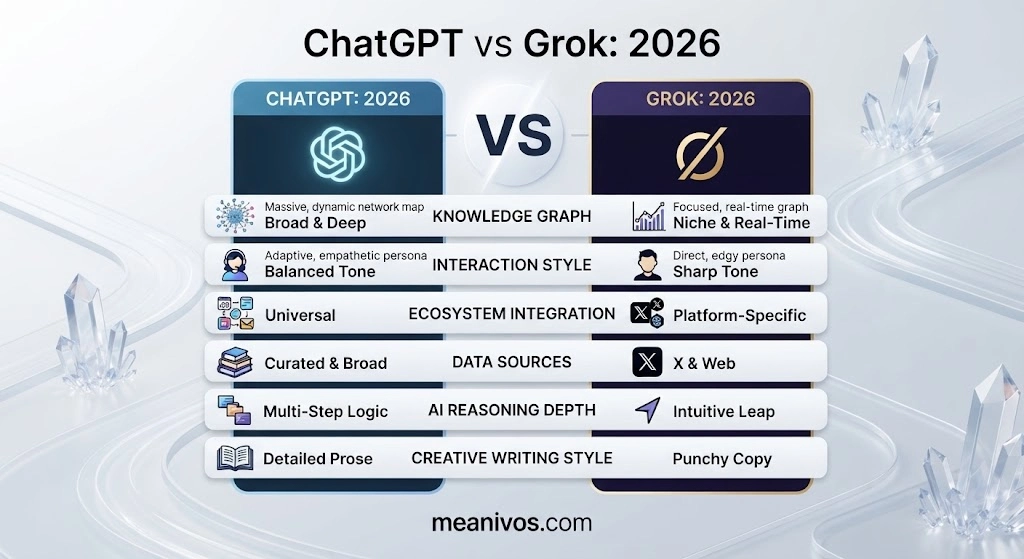
ChatGPT is stronger if you need:
- Broad productivity
- Structured workflows
- OpenAI tools
- Professional writing
- Research
- Coding
- Files and documents
- Business workflows
Grok is stronger if you need:
- X information
- Real-time social context
- xAI tools
- Agentic workflows
- Current online discussions
- Interactive and visual experimentation
10 Real-World Tasks to Test ChatGPT vs Grok
If you want a genuinely useful comparison, don’t rely only on benchmark tables.
Run both systems through the same tasks.
1: Blog outline
Give both models the same keyword and evaluate:
- Search intent
- Topic coverage
- Structure
- Originality
2: SEO article
Compare:
- Factual accuracy
- Readability
- Search-intent satisfaction
- Semantic coverage
- Repetition
3: Current-events research
Give both the same breaking topic.
Check:
- Source quality
- Recency
- Citations
- Contradictions
- Accuracy
4: Coding
Give both the same programming problem.
Measure:
- Correctness
- Bugs
- Explanation
- Maintainability
5: Debugging
Provide an intentionally broken application.
Compare how quickly each identifies the actual problem.
6: Mathematics
Use a multi-step problem and inspect the reasoning and final answer.
7: Data analysis
Give both the same dataset and ask for:
- Trends
- Outliers
- Summary
- Recommendations
8: Image understanding
Provide the same image and ask both systems to identify relevant details.
9: Creative writing
Use the same style constraints and compare:
- Voice
- Originality
- Consistency
- Creativity
10: Long-running workflow
Give each system a multi-step task and evaluate:
- Planning
- Tool use
- Error recovery
- Consistency
- Final result
Why this matters
A transparent test using identical prompts gives readers something that a generic benchmark table cannot:
evidence about how the tools perform in practical workflows.
Can You Trust ChatGPT and Grok?
Neither should be treated as an infallible source.
Both can produce incorrect information.
AI systems can:
- Misinterpret questions
- Invent details
- Misread sources
- Produce outdated information
- Make reasoning mistakes
- Present uncertain information confidently
This is particularly important for:
- Medical questions
- Legal issues
- Financial decisions
- Security
- Breaking news
- Scientific claims
For important claims, verify information using primary sources.
A good workflow is:
AI → source → verification → decision
rather than:
AI → decision
ChatGPT Pros and Cons
Pros
- Broad general-purpose capabilities
- Strong productivity workflows
- Excellent writing
- Strong coding capabilities
- Strong research capabilities
- Broad OpenAI ecosystem
- Multimodal functionality
- Useful for professional workflows
Cons
- Features and limits can vary by plan
- AI output still requires verification
- Some advanced capabilities require paid access
- Model availability can change
Grok Pros and Cons
Pros
- Strong real-time web capabilities
- Strong X integration
- Excellent for social trends
- Strong reasoning and coding
- Increasingly capable agents
- Strong visual and interactive direction
- Expanding xAI ecosystem
Cons
- Some capabilities depend on plan and product availability
- X-centric strengths may matter less to users who don’t use X
- AI-generated information still requires verification
- Product features are evolving rapidly
ChatGPT or Grok: Which Should You Choose?
Use this simple decision guide.
| Your priority | Best choice |
| General-purpose AI | ChatGPT |
| Professional productivity | ChatGPT |
| Structured writing | ChatGPT |
| Research and synthesis | ChatGPT |
| Coding | ChatGPT / Grok |
| Current X discussions | Grok |
| X trends | Grok |
| Real-time social research | Grok |
| Broad OpenAI ecosystem | ChatGPT |
| xAI ecosystem | Grok |
| Long-running agents | ChatGPT / Grok |
| Creative experimentation | Grok / ChatGPT |
| Business productivity | ChatGPT |
| X-heavy workflows | Grok |
5 Topical Cluster Ideas
1: AI Comparisons
- ChatGPT vs Grok
- ChatGPT vs Claude
- ChatGPT vs Gemini
- Grok vs Gemini
- Claude vs Gemini
2: ChatGPT
- ChatGPT features
- ChatGPT alternatives
- ChatGPT for students
- ChatGPT for coding
- ChatGPT for SEO
3: Grok
- What is Grok?
- Grok features
- Grok alternatives
- Grok for coding
- Grok for research
4: AI Productivity
- Best AI productivity tools
- Best AI research tools
- Best AI writing tools
- Best AI coding assistants
- Best AI tools for business
5: AI Search
- AI search engines
- ChatGPT search
- Grok search
- AI search vs Google
- Best AI search tools
So, Is ChatGPT Better Than Grok?
For most users, ChatGPT is the better all-around AI assistant.
Its advantage comes from the breadth of its productivity ecosystem and its ability to support many different workflows.
But that doesn’t make Grok inferior.
Grok is an excellent choice when real-time information, X, social trends, long-running agents, or xAI-specific capabilities are central to your workflow.
The current competition is much closer than older ChatGPT-vs-Grok comparisons suggest. xAI says Grok 4.6 matches GPT-5.6 Sol on its cited Artificial Analysis Intelligence Index, while OpenAI positions GPT-5.6 Sol around demanding coding, research, science, cybersecurity, and knowledge-work tasks.
People Also Ask
A:For most general-purpose productivity tasks, ChatGPT is the stronger all-around choice. Grok is particularly competitive for real-time web/X information, social trends, and xAI-oriented workflows.
A:Neither is universally better. Both are highly capable coding assistants. ChatGPT is attractive for OpenAI-centered development workflows, while Grok 4.6 is strongly positioned for long-running agentic coding tasks.
A:For X-centric real-time information, Grok has a clear advantage because X is deeply integrated into its ecosystem. For broader research, both can be useful.
A:ChatGPT is generally the better choice for structured research and synthesis. Grok can be especially useful when research requires current X discussions or social sentiment.
A:ChatGPT is usually the better choice for structured professional writing, editing, and business content. Grok is also capable and may appeal to users who prefer a more conversational or experimental style.
Final Verdict
There isn’t one universal winner.
Choose ChatGPT if:
You want a versatile AI assistant for writing, research, coding, productivity, files, analysis, and broad professional workflows.
Choose Grok if:
You care heavily about X, real-time online information, social trends, xAI tools, or agentic workflows.
Use both if:
AI is an important part of your work.
The smartest approach isn’t to ask:
“Which AI is smarter?”
Ask:
“Which AI is better for this particular job?”
That shift matters because today’s leading AI assistants are increasingly differentiated by their tools, integrations, search access, agents, ecosystem, and workflow, not just by the raw intelligence of the underlying model.
Our overall verdict: ChatGPT wins for broad everyday productivity; Grok wins for X-centric real-time intelligence. For coding, research, reasoning, and agentic work, the difference is close enough that your specific workflow should decide.