Propose vs Purpose: Meaning, Differences, Grammar Rules & Examples
Have you ever typed “I Propose A New Idea“ when you actually meant “I propose a new idea”? If so, you’re not alone. Many English learners—and even native speakers—confuse propose and purpose because the two words look and sound somewhat similar. However, they have very different meanings and grammatical roles.
The confusion becomes even greater because purpose is usually a noun but can occasionally appear as a verb in very formal or old-fashioned English. Meanwhile, propose is primarily a verb used when suggesting an idea, plan, solution, or even marriage. Understanding the Propose vs Purpose distinction is essential for writing clearly in school assignments, business emails, presentations, research papers, and everyday conversations.
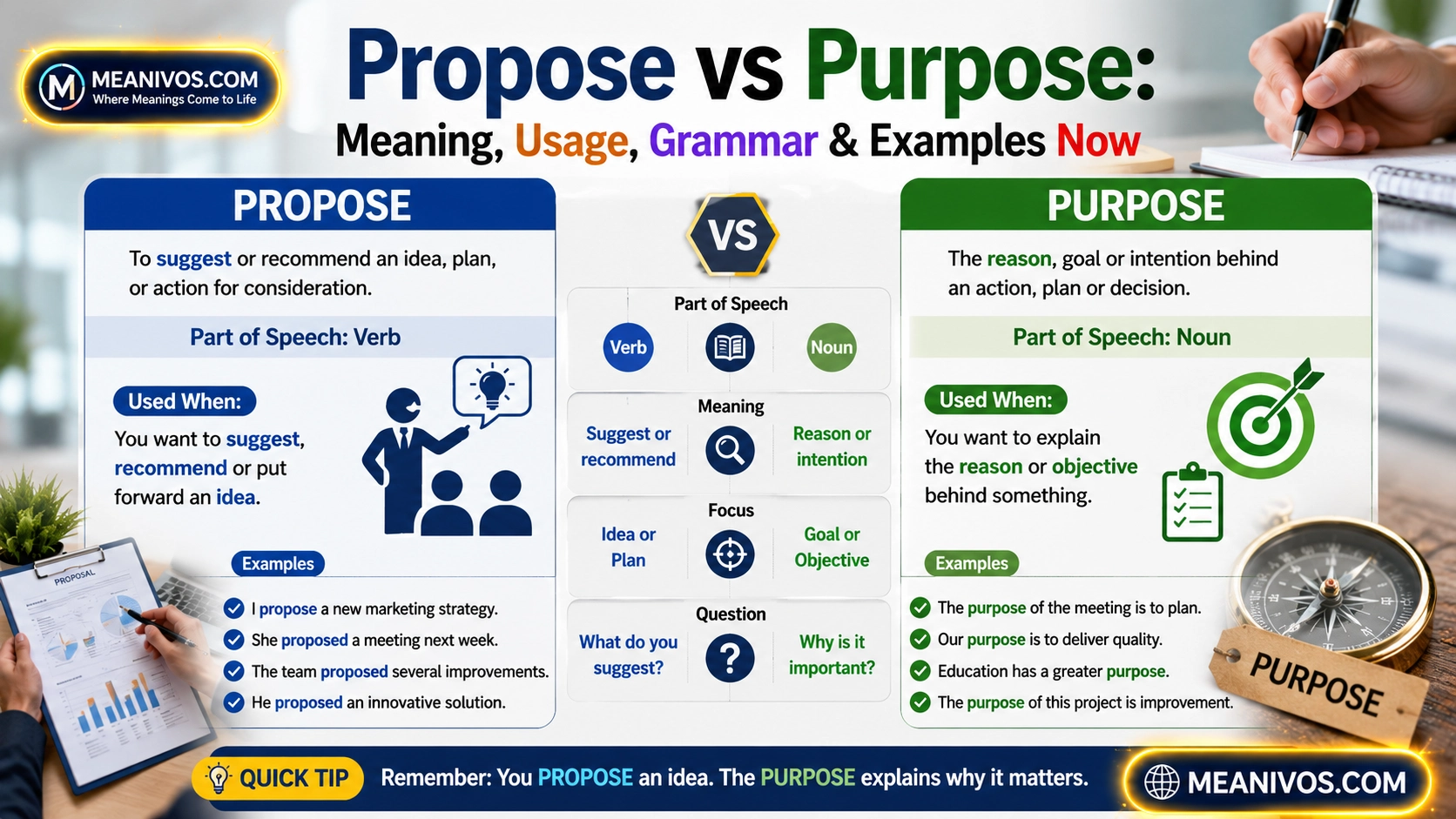
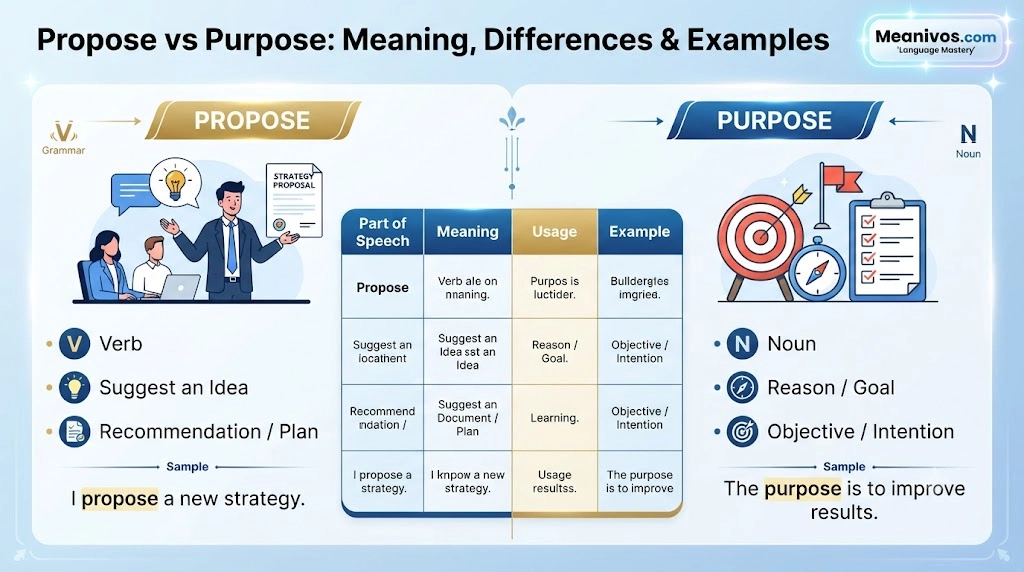
The short answer is simple:
You propose an idea. Everything has a purpose.
In other words, propose means to suggest or put forward something for consideration, while purpose refers to the reason, aim, or goal behind something. Once you understand this core difference, choosing the correct word becomes much easier.
This guide explains everything you need to know about propose vs purpose, including definitions, grammar rules, pronunciation, sentence structures, real-world examples, common mistakes, memory tricks, quizzes, and FAQs. Whether you’re a student, professional, or English learner, this article will help you use both words with confidence.
Quick Answer
Propose is a verb that means to suggest, recommend, or put forward an idea, plan, or offer.
Purpose is usually a noun that means the reason, aim, goal, or intention behind something. Although purpose can sometimes be used as a verb in very formal English, this usage is uncommon in modern everyday Propose vs Purpose communication.
Example
I propose a new marketing strategy.
The purpose of the strategy is to increase sales.
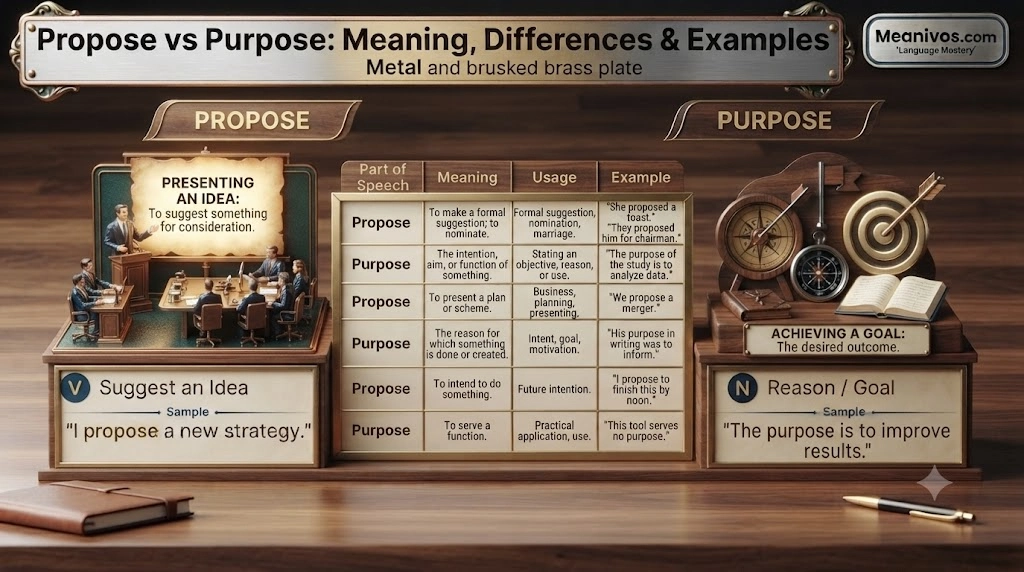
Quick Comparison Table
| Feature | Propose | Purpose |
| Part of Speech | Verb | Noun (rarely a verb) |
| Main Meaning | Suggest an idea | Reason or goal |
| Used For | Recommendations, plans, marriage proposals | Objectives, intentions, aims |
| Common in Everyday English | Yes | Yes |
| Rare Formal Verb? | No | Yes |
| Example | I propose a solution. | The purpose is clear. |
What Does “Propose” Mean?
Definition
Propose means to formally or informally suggest an idea, plan, solution, action, or offer for others to consider.
It can also mean:
- Suggesting an idea
- Presenting a recommendation
- Offering a plan
- Asking someone to marry you
Because it expresses an action, propose is almost always used as a verb.
Simple Definition
Propose = To suggest an idea or plan.
Pronunciation
IPA (UK): /prəˈpəʊz/
IPA (US): /prəˈpoʊz/
Pronounced like:
pruh-POHZ
The stress falls on the second syllable.
Part of Speech
Verb
Common Uses of Propose
People commonly use propose when they:
- suggest a solution
- recommend a project
- introduce an idea
- present a business plan
- make a motion during a meeting
- ask someone to marry them
Examples
Business
I propose reducing unnecessary expenses.
Meeting
She proposed a new schedule.
School
The teacher proposed changing the timetable.
Research
The study proposes a different approach.
Marriage
He proposed to his girlfriend last weekend.
Politics
The government proposed a new tax policy.
What Does “Purpose” Mean?
Definition
Purpose refers to the reason why something exists, is done, or is intended to achieve something.
Unlike propose, it usually functions as a noun.
Simple Definition
Purpose = The reason or goal behind something.
Pronunciation
IPA (UK): /ˈpɜː.pəs/
IPA (US): /ˈpɝː.pəs/
Pronounced like:
PUR-pus
The stress falls on the first syllable.
Part of Speech
Usually a noun
Occasionally a verb in very formal or literary English.
Common Uses of Purpose
People use purpose when talking about:
- goals
- objectives
- intentions
- reasons
- missions
- functions
Examples
Business
The purpose of the meeting is to discuss growth.
Education
The purpose of homework is to reinforce learning.
Technology
The purpose of this software is to improve productivity.
Healthcare
The purpose of the treatment is to reduce pain.
Daily Life
The purpose of exercise is to improve health.
Travel
The purpose of our trip is relaxation.
Propose vs Purpose Explained Simply
Although these two words look alike, they answer completely different questions.
Ask yourself:
Are you suggesting something?
Use propose.
Example:
I propose a new solution.
Are you talking about a reason or goal?
Use purpose.
Example:
The purpose of the solution is to save time.
Think of it this way:
- Propose = Action
- Purpose = Intention
One introduces an idea.
The other explains why the idea exists.
Everyday Example
Imagine your team is discussing a new company website.
You say:
I propose redesigning the homepage.
Your manager replies:
The purpose of the redesign is to improve user experience.
Here, propose introduces the idea, while purpose explains its goal.
Grammar Rules: When to Use Propose vs Purpose
Understanding the grammar behind these two words is the easiest Propose vs Purpose way to avoid mistakes. Although propose and purpose look similar, they play different grammatical roles in a sentence.
| Grammar Rule | Propose | Purpose |
| Part of speech | Verb | Usually a noun |
| Indicates | An action | A reason, aim or goal |
| Answers | What is being suggested? | Why does it exist? |
| Everyday use | Very common | Very common |
| Rare verb form | No | Yes (formal/literary) |
Grammar Rule 1: Propose Is a Verb
A verb expresses an action.
The action performed by propose is suggesting, recommending, or putting forward an idea.
Formula
Subject + propose + object
Examples
I propose a new strategy.
They proposed several solutions.
She proposed a compromise.
The committee proposed new regulations.
Our manager proposed a different budget.
Grammar Rule 2: Purpose Is Usually a Noun
A noun names a person, place, thing, or idea.
Here, purpose names the reason, goal, or intention behind something.
Formula
The purpose of + noun + is + infinitive
Examples
Purpose of this guide is to educate readers.
The purpose of the meeting is to solve the issue.
Purpose of the research is to collect data.
The purpose of this exercise is to improve grammar.
Grammar Rule 3: Don’t Replace One with the Other
Many learners accidentally swap these words because Propose vs Purpose they look alike.
Incorrect
I have a new business plan.
Correct
I propose a new business plan.
Incorrect
The purpose of this project is education.
Correct
The purpose of this project is education.
Grammar Rule 4: Purpose Can Be a Verb
Modern English almost always uses purpose as a noun.
However, formal, legal, historical, or literary English occasionally uses it as a verb.
Example
I intend to complete the work before Friday.
Meaning:
I intend to complete the work.
Although grammatically correct, most native speakers today would naturally say:
I intend to complete the work.
I plan to complete the work.
Modern Recommendation
Unless you’re writing literature, historical documents, or formal Propose vs Purpose legal text, avoid using purpose as a verb.
Grammar Rule 5: Different Questions
One simple trick is to ask yourself what question you’re answering.
If you’re answering…
“What should we do?”
Use:
Propose
Example
I propose changing the design.
If you’re answering…
“Why are we doing it?”
Use:
Purpose
Example
The purpose is to improve customer satisfaction.
Sentence Patterns
Understanding common sentence structures helps you use each word naturally.
Sentence Patterns with Propose
Pattern 1
propose + noun
Examples
I propose a new policy.
She proposed an alternative route.
They proposed a solution.
The company proposed a merger.
Pattern 2
propose that clause
Examples
I propose that we start early.
The committee proposed that everyone vote.
She proposed that the meeting be postponed.
Scientists proposed that the theory be revised.
Pattern 3
propose + to + verb
This pattern usually expresses someone’s intention.
Examples
I propose to investigate further.
He proposed to travel abroad.
We propose to expand next year.
The organisation proposes to launch a new programme.
Pattern 4
propose to someone
Marriage proposal
Examples
He proposed to Emily.
She said yes when he proposed.
He proposed during their holiday.
They became engaged after he proposed.
Pattern 5
propose doing something
Examples
I propose reducing expenses.
We propose hiring more staff.
They proposed increasing production.
The council proposed building a new park.
Sentence Patterns with Purpose
Pattern 1
the purpose of
Examples
Purpose of this article is education.
The purpose of the project is innovation.
The purpose of the meeting is planning.
Purpose of the app is communication.
Pattern 2
on purpose
Meaning:
Intentionally
Examples
She did it on purpose.
He broke the vase on purpose.
They ignored the email on purpose.
I didn’t laugh on purpose.
Pattern 3
with the purpose of
Examples
The campaign was created with the purpose of raising awareness.
The programme was designed with the purpose of reducing waste.
The charity was founded with the purpose of helping children.
Pattern 4
for this purpose
Examples
We bought new software for this purpose.
The room was built for this purpose.
The fund exists for this purpose.
Pattern 5
serve a purpose
Examples
Every tool serves a purpose.
This feature serves an important purpose.
Education serves many purposes.
Propose vs Purpose in Different Types of Writing
| Context | Propose | Purpose |
| Business | ✔ Very common | ✔ Very common |
| Academic papers | ✔ Very common | ✔ Very common |
| Emails | ✔ Common | ✔ Common |
| Meetings | ✔ Very common | ✔ Common |
| Research | ✔ Very common | ✔ Very common |
| Marketing | ✔ Common | ✔ Common |
| Legal writing | ✔ Common | ✔ Common |
| Daily conversation | ✔ Common | ✔ Very common |
Pronunciation Guide
Although these words look alike, they are pronounced differently.
| Word | IPA (UK) | IPA (US) | Stress |
| Propose | /prəˈpəʊz/ | /prəˈpoʊz/ | Second syllable |
| Purpose | /ˈpɜː.pəs/ | /ˈpɝː.pəs/ | First syllable |
Easy Pronunciation
Propose
Sounds like:
pruh-POHZ
The stress comes near the end.
Purpose
Sounds like:
PUR-pus
The stress comes at the beginning.
Pronunciation Memory Trick
Think:
ProPOSE
The “pose” part receives the stress.
PURpose
The first syllable is stronger.
Word Origins
Knowing where these words come from makes them Propose vs Purpose easier to remember.
Origin of Propose
Propose comes from the Latin word:
proponere
Meaning:
to put forward
It combines:
- pro- = forward
- ponere = to place
Literally:
place something before others
This explains why propose means to suggest or present an idea.
Origin of Purpose
Purpose developed through Old French and Medieval English from Latin roots connected with Propose vs Purpose intention and design. It came into English with the sense of a person’s aim, intention, or objective.
Over time, it became the standard word for the reason behind an action or the function of something.
Proposal vs Purpose
These two words are often confused because Propose vs Purpose they are related—but they are not interchangeable.
| Proposal | Purpose |
| A suggested plan | A reason or goal |
| Noun | Noun |
| Comes from propose | Independent word |
| Can be accepted or rejected | Explains why something exists |
Proposal Example
✔ The proposal recommends opening a new office.
Purpose Example
✔ The purpose of opening the office is to reach more customers.
Together
✔ I submitted my proposal yesterday.
✔ The purpose of the proposal is to increase sales.
Common Mistakes
Mistake 1
❌ I purpose a better solution.
✔ I propose a better solution.
Reason:
You’re suggesting an idea.
Mistake 2
❌ The propose of the project.
✔ The purpose of the project.
Reason:
You need a noun.
Mistake 3
❌ Our purpose is a new plan.
✔ Our proposal is a new plan.
Reason:
A proposal is the suggested plan.
A purpose is the reason behind it.
Mistake 4
❌ He proposed the meeting’s purpose.
✔ He explained the meeting’s purpose.
Reason:
You don’t “propose a purpose” in this context; you explain it.
Mistake 5
❌ I have many proposes.
✔ I have many proposals.
Reason:
The noun form of propose is proposal, not propose.
Quick Checklist
Before choosing the word, ask yourself:
Are you suggesting something?
Use propose.
✔ I propose hiring another designer.
Are you explaining the reason?
Use purpose.
✔ The purpose is to improve customer service.
Are you referring to the suggested document or plan?
Use a proposal.
✔ The proposal has been approved.
Memory Tricks
Trick 1: Think “POSE an Idea”
PROPOSE
Contains POSE.
Imagine placing (or “posing”) an idea in front of other people.
Propose = Put an idea forward.
Trick 2: Purpose = Your Reason
Imagine asking yourself:
“What is my purpose?”
You’re asking:
“What is my reason or goal?”
Trick 3: Action vs Intention
- Propose = Action
- Purpose = Intention
One starts something.
The other explains why.
Trick 4: The “Why” Test
If the sentence answers “Why?”, choose a purpose.
Example:
The purpose of the campaign is to educate people.
If the sentence answers “What should we do?”, choose a proposal.
Example:
I propose launching a new campaign.
Synonyms
Synonyms of Propose
- Suggest
- Recommend
- Present
- Offer
- Put forward
- Submit
- Advocate
- Introduce
- Nominate
- Move (formal meetings)
Example
“I propose a new policy.”
can become
“I suggest a new policy.”
Synonyms of Purpose
- Reason
- Goal
- Objective
- Aim
- Mission
- Intention
- Function
- Target
- Design
- End
Example
“The purpose of this project is education.”
can become
“The goal of this project is education.”
Antonyms
Propose
- Oppose
- Reject
- Withdraw
- Dismiss
- Refuse
Purpose
- Aimlessness
- Meaninglessness
- Accident
- Chance
- Randomness
- Pointlessness
Business, Academic, School, Daily Life, Meetings, Emails, Research, Marriage & Professional Communication
One of the best ways to master propose and purpose is to see them used in real situations. This section contains over 100 practical examples organised by context, helping you understand how native English speakers use these words in everyday conversations, professional writing, and formal communication.
Remember:
Propose = Suggest an idea or action.
Purpose = Explain the reason, aim, or goal.
Business Examples
Using Propose
- I propose launching the new product next month.
- The manager proposed reducing operational costs.
- We propose expanding into European markets.
- She proposed a new customer service strategy.
- Our finance team proposed a revised budget.
- The board proposed several policy changes.
- They proposed outsourcing non-core tasks.
- He proposed introducing flexible working hours.
- We propose improving our delivery process.
- The consultant proposed a digital transformation plan.
Using Purpose
- The purpose of the meeting is to finalise the budget.
- The purpose of this proposal is to increase revenue.
- Every department has a clear business purpose.
- The campaign’s purpose is to attract new customers.
- The purpose of our investment is long-term growth.
- The report explains the purpose of the new strategy.
- Customer satisfaction is the purpose of every improvement.
- The purpose of this policy is workplace safety.
- The company’s purpose is to create innovative products.
- The purpose of the training programme is employee development.
Academic Writing Examples
Using Propose
- This study proposes a new research model.
- The author proposes an alternative explanation.
- Scientists proposed a revised hypothesis.
- The paper proposes several improvements.
- Researchers propose further investigation.
- The professor proposed a new teaching method.
- The journal article proposes innovative solutions.
- We propose using qualitative analysis.
- The thesis proposes a different framework.
- The research team proposed another experiment.
Using Purpose
- The purpose of this study is to evaluate climate change.
- The purpose of the experiment is data collection.
- The purpose of the literature review is background analysis.
- Every research paper should state its purpose clearly.
- The project’s purpose is environmental protection.
- The purpose of the survey is measuring customer satisfaction.
- The introduction explains the study’s purpose.
- The research serves an educational purpose.
- The purpose of the methodology is accuracy.
- The purpose of peer review is quality assurance.
School Examples
Using Propose
- The class proposed organising a science fair.
- Our teacher proposed extra revision sessions.
- Students proposed changing the timetable.
- Emma proposed a fundraising event.
- The school council proposed new playground equipment.
- We proposed forming a study group.
- Jack proposed a class trip.
- The principal proposed a new attendance policy.
- Our group proposed another presentation topic.
- The student proposed improving the library.
Using Purpose
- The purpose of homework is to reinforce learning.
- The purpose of today’s lesson is grammar practice.
- Every assignment has a clear purpose.
- The purpose of the science project is observation.
- The purpose of the exam is assessment.
- The teacher explained the purpose of group work.
- The purpose of revision is better understanding.
- Reading has the purpose of expanding knowledge.
- The worksheet serves an educational purpose.
- The purpose of classroom rules is fairness.
Everyday Conversation Examples
Using Propose
- I propose ordering pizza tonight.
- She proposed meeting at the café.
- Let’s propose another travel destination.
- My friend proposed watching a film.
- Dad proposed leaving early.
- I propose taking the train instead.
- They proposed sharing the costs.
- We proposed a weekend picnic.
- He proposed inviting our neighbours.
- She proposed trying a new restaurant.
Using Purpose
- The purpose of the trip is relaxation.
- What’s the purpose of buying another phone?
- Every hobby has its own purpose.
- The purpose of exercise is better health.
- The purpose of sleep is body recovery.
- The purpose of the holiday is spending time together.
- The purpose of this conversation is honesty.
- The purpose of cooking at home is saving money.
- The purpose of planning ahead is reducing stress.
- Life without purpose can feel directionless.
- Explore More:https://meanivos.com/ong-meaning-in-text/
Meeting Examples
Using Propose
- I propose beginning with the budget report.
- Sarah proposed delaying the product launch.
- The chairman proposed a vote.
- We propose changing the meeting schedule.
- The team proposed another supplier.
- Management proposed hiring additional staff.
- Someone proposed combining two departments.
- The committee proposed revising the rules.
- We proposed extending the deadline.
- The chairperson proposed ending the discussion.
Using Purpose
- The Purpose of today’s meeting is planning.
- The purpose of the agenda is organisation.
- Everyone understood the meeting’s purpose.
- The presentation’s purpose is decision-making.
- The purpose of the discussion is solving the issue.
- Every agenda item has a purpose.
- The workshop serves a practical purpose.
- The purpose of brainstorming is creativity.
- The meeting achieved its purpose.
- The purpose of regular meetings is communication.
Email Examples
Using Propose
- I would like to propose a revised timeline.
- We propose scheduling another meeting next week.
- I propose discussing this during Friday’s call.
- Our team proposes several improvements.
- I propose updating the project documentation.
Using Purpose
- The purpose of this email is to confirm your appointment.
- The purpose of the attachment is to provide additional information.
- I’m writing to explain the purpose of the new policy.
- The purpose of this message is to request your feedback.
- The purpose of today’s update is transparency.
Research Examples
Using Propose
- Researchers propose an improved algorithm.
- The report proposes stricter regulations.
- Experts propose further testing.
- The committee proposes policy reforms.
- The paper proposes future research directions.
Using Purpose
- The purpose of the experiment is hypothesis testing.
- The purpose of the analysis is identifying trends.
- The research serves a scientific purpose.
- Every variable has a specific purpose.
- The study clearly states its purpose.
Presentation Examples
Using Propose
- Today I’d like to propose a new strategy.
- We propose simplifying the user experience.
- Our presentation proposes three recommendations.
- The speaker proposed a partnership.
- The consultant proposed automation.
Using Purpose
- The purpose of today’s presentation is to explain our findings.
- This slide explains the project’s purpose.
- The purpose of this chart is comparison.
- Every visual has a purpose.
- The presentation achieved its purpose.
Professional Communication Examples
Using Propose
- I propose implementing these recommendations immediately.
- We propose reviewing the contract annually.
- The director proposed restructuring the department.
- Our legal team proposes minor revisions.
- The consultant proposed a phased rollout.
Using Purpose
- The purpose of the contract is legal protection.
- The purpose of these recommendations is efficiency.
- Every policy should have a clear purpose.
- The document serves an administrative purpose.
- The purpose of professional communication is clarity.
Marriage Examples
Using Propose
- He proposed during a holiday in Italy.
- She happily accepted when he proposed.
- Alex plans to propose next month.
- He proposed with a diamond ring.
- They celebrated after he proposed.
Using Purpose
- The purpose of marriage is different for every couple.
- They discussed the purpose of their future together.
- The ceremony had a meaningful purpose.
- Family traditions often give weddings a deeper purpose.
- Every relationship should have trust and purpose.
Commonly Confused Sentence Pairs
Pair 1
I propose a new solution.
I propose a new solution.
Pair 2
The purpose of this report is education.
The purpose of this report is education.
Pair 3
She proposed the purpose.
She explained the purpose.
Pair 4
Our purpose is attached for your review.
Our proposal is attached for your review.
Pair 5
We purposely changed the policy.
We propose changing the policy.
Business Scenario Example
Imagine you’re presenting an idea to your manager:
You: “I’d like to propose introducing flexible working hours.”
Manager: “What’s the purpose of this change?”
You: “The purpose is to improve employee wellbeing and productivity.”
Notice how the proposal introduces the idea, while the purpose explains why it should be implemented.
Academic Scenario Example
A student writes:
“This paper proposes a new framework for analysing renewable energy policies.”
Later in the introduction:
“The purpose of this research is to evaluate the effectiveness of existing policies.”
Again, proposes presents the new idea, and purpose explains the study’s objective.
Everyday Scenario Example
You’re planning a weekend with friends:
Friend 1: “I propose going hiking on Saturday.”
Friend 2: “Sounds good. What’s the purpose of the trip?”
Friend 1: “The purpose is to relax and spend time together.”
Practice Exercises
Fill in each blank with a proposal, purpose, or proposal.
- I would like to __________ a better solution.
- The __________ of this project is education.
- Our __________ was accepted by the board.
- She will __________ several improvements.
- The __________ of exercise is better health.
- Scientists __________ a new theory.
- The __________ explains the new budget.
- Every lesson has a clear __________.
- We __________ hiring two new employees.
- What’s the __________ of today’s meeting?
Answer Key
- propose
- purpose
- proposal
- propose
- purpose
- proposed
- proposal
- purpose
- propose
- purpose
Printable Cheat Sheet
| If You Mean… | Use |
| Suggest an idea | Propose |
| Explain the reason | Purpose |
| Suggested document or plan | Proposal |
Remember:
You propose an idea. Every idea has a purpose. A written plan is a proposal.
Frequently Confused Words
If you’re learning English, you may also confuse these word pairs:
| Word Pair | Difference |
| Affect vs Effect | Verb vs noun in most contexts |
| Advice vs Advise | Noun vs verb |
| Complement vs Compliment | Complete vs praise |
| Accept vs Except | Receive vs exclude |
| Assure vs Ensure vs Insure | Promise vs make certain vs provide insurance |
| Farther vs Further | Physical distance vs additional extent |
| Principal vs Principle | Person/head vs rule |
| Stationary vs Stationery | Not moving vs writing materials |
| Lose vs Loose | Misplace vs not tight |
| Then vs Than | Time vs comparison |
Internal Linking Tip: Create dedicated guides for each pair to build topical Propose vs Purpose authority and strengthen your grammar content cluster.
People Also Ask
A:Propose means to suggest or recommend an idea, plan, or action. Purpose means the reason, goal, or intention behind something. One introduces an idea, while the other explains why it exists.
A:Propose is a verb. Its noun form is proposal.
Example:
We proposed a new policy.
Our proposal was accepted.
A:No. Purpose is usually a noun, but it can occasionally be used as a verb in formal or literary English. In modern everyday English, people normally use verbs like intend, plan, or aim instead.
A:Yes, but it’s uncommon.
Example:
I intend to return.
Most modern speakers would say:
I intend to return.
A:The words have similar spelling and pronunciation, but they have different meanings and grammatical roles. Learning that propose is an action and purpose is a reason makes the distinction much easier.
A:A proposal is a noun that refers to a suggested plan, recommendation, or formal offer. It comes from the verb propose.
A:The purpose of a proposal is to present an idea clearly, explain its benefits, and persuade others to consider or approve it.
A:No. The correct phrase is “on purpose,” which means intentionally.
Example:
✔ She ignored the message on purpose.
Topical Cluster Ideas
Build a complete “Frequently Confused Words” category on Meanivos.com:
- Loose vs Lose
- Principal vs Principle
- Elicit vs Illicit
- Historic vs Historical
- Farther vs Further
A well-linked cluster helps search engines understand your expertise in English grammar and increases the likelihood of ranking across related searches.
Conclusion
Although propose and purpose are often confused because of their similar spelling, they have distinct meanings and roles in English. Propose is a verb that means to suggest, recommend, or put forward an idea, plan, or action. Purpose, on the other hand, is usually a noun that refers to the reason, goal, or intention behind something. While purpose can occasionally function as a verb in formal or literary writing, this usage is rare in modern English.
The simplest way to remember the difference is:
You propose an idea. Every idea has a purpose.
Whenever you’re introducing a suggestion, choose propose. Whenever you’re explaining why something exists or what it aims to achieve, choose purpose. With the grammar rules, sentence patterns, real-world examples, quiz, and practice exercises in this guide, you’ll be able to use both words accurately and confidently in academic writing, business communication, and everyday conversations.