Plurals of Ox and Fox: Grammar Rules You Need to Know
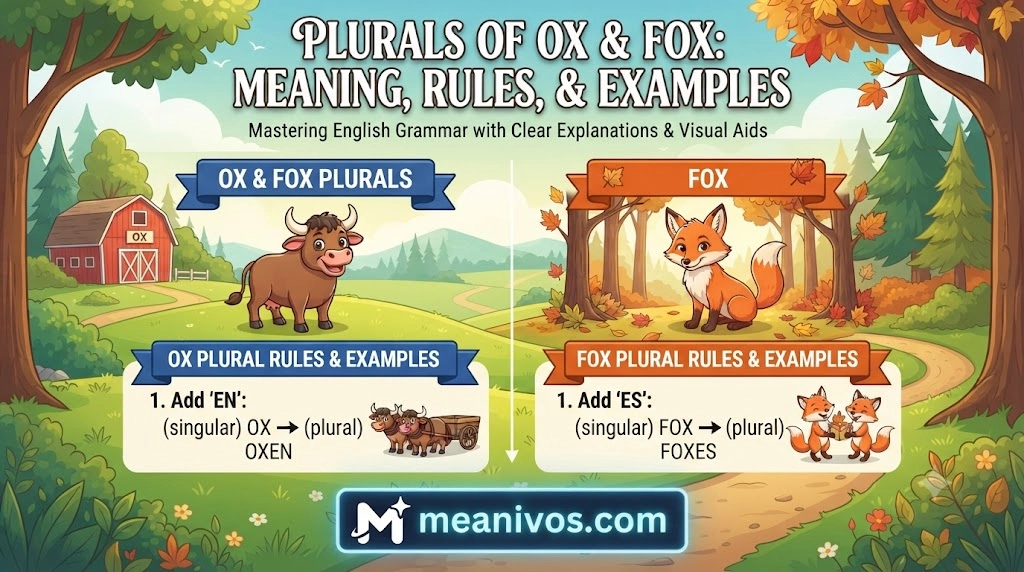
Wondering about the plurals of ox and fox? The correct forms are simple: ox becomes oxen, while fox becomes foxes. But why do two words that both end in -x follow different plural rules?
The answer comes down to the history of English Grammar. Oxen is an irregular plural that preserves an older English pattern, whereas foxes follows the regular modern rule used for many nouns ending in -x. This difference often causes confusion for English learners, students, writers, and anyone checking whether boxes or foxen is correct.
In this guide, you’ll learn the correct plural of ox and fox, why their forms are different, how to pronounce oxen and foxes, and how to use each word correctly in sentences. You’ll also find common mistakes, possessive forms, easy Plurals of Ox and Fox memory tricks, and practice examples.
The quickest rule to remember is:
One ox → two oxen
One fox → two foxes
Once you understand why oxen is irregular and foxes follow the standard -es pattern, the difference becomes much easier to remember.
What Are the Plurals of Ox and Fox?
The plurals of ox and fox are:
- Ox → oxen
- Fox → foxes
Although both words end in -x, they do not form their plurals in the same way.
Oxen is an irregular plural that preserves an older English plural pattern. Foxes is a regular plural formed with -es, following the normal modern rule for many nouns ending in -x. Cambridge confirms that oxen is the plural of ox, while its grammar guidance explains that nouns ending in -x generally form their plurals with -es.
So the easiest answer is:
One ox → two oxen
One fox → two foxes
If you have ever wondered why we say oxen instead of oxes, or why fox becomes foxes instead of foxen, this guide explains the grammar, history, pronunciation, examples, possessives, common mistakes, and memory tricks Plurals of Ox and Fox behind both forms.
Quick Meaning Summary
| Word | Singular | Plural | Plural Type |
| Ox | ox | oxen | Irregular |
| Fox | fox | foxes | Regular |
| One animal | one ox | one fox | Singular |
| More than one | two oxen | two foxes | Plural |
In simple sentences
- One ox is standing in the field.
- Two oxen are pulling the cart.
- One fox crossed the road.
- Two foxes disappeared into the woods.
The main thing to remember is that the similar ending -x does not force both nouns to use the same plural ending.
What Is the Plural of Ox?
The standard plural of ox is oxen.
Ox → Oxen
Use ox when you mean one animal:
The farmer owns one ox.
Use oxen when you mean more than one:
The farmer owns three oxen.
More examples include:
- The ox pulled the wooden cart.
- Two oxen pulled the cart together.
- The farmer bought an ox for farm work.
- Several oxen were working in the field.
- A strong ox stood beside the barn.
- A team of oxen pulled the plough.
- The farmer carefully fed the oxen.
- The ox moved slowly across the field.
Cambridge’s dictionary directly defines oxen as the plural of ox and gives British and American pronunciations.
Is “Oxes” the Plural of Ox?
For standard modern English, the normal plural is oxen, not oxes.
A learner might logically reason:
ox + es = oxes
That reasoning makes sense if you know that many nouns ending in -x take -es. However, ox is an established irregular exception.
Therefore:
Correct: The farmer has six oxen.
Not the standard plural: The farmer has six oxen.
What Is the Plural of Fox?
The standard plural of fox is foxes.
Fox → Foxes
Use fox for one animal:
A fox crossed the road.
Use foxes for more than one:
Several foxes crossed the road.
Examples:
- I saw one fox near the woodland.
- We saw two foxes near the trees.
- The fox disappeared into the grass.
- Several foxes live in the area.
- The foxes ran into the bushes.
- A red fox was walking across the field.
- Three foxes appeared after dark.
The regular plural pattern is:
fox + es = foxes
This is consistent with the broader English spelling rule for many nouns ending in -x. Cambridge’s grammar guidance gives Plurals of Ox and Fox examples such as box → boxes and explains that nouns ending in -x generally take -es.
Oxen vs Foxes: What’s the Difference?
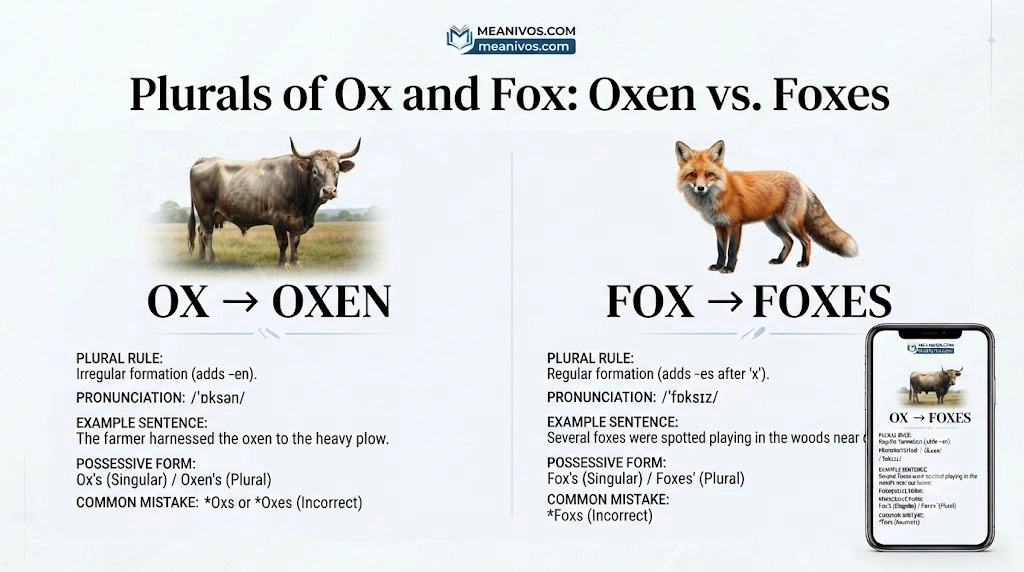
The most important difference is simple:
Oxen is irregular; foxes are regular.
| Feature | Ox | Fox |
| Singular | ox | fox |
| Plural | oxen | foxes |
| Type | Irregular plural | Regular plural |
| Ending | -en | -es |
| Example | two oxen | two foxes |
| Common wrong form | oxes | foxen |
The two words look similar because both end in -x, but English plural Plurals of Ox and Fox formation depends on more than spelling.
Fox follows a productive modern rule.
Ox preserves an older plural form.
That is why:
ox → oxen
but:
fox → foxes
Why Is the Plural of Ox “Oxen”?
The reason goes back to the history of English.
English has changed substantially over hundreds of years. Modern English mostly uses -s and -es to make nouns plural, but older stages of English used several different plural patterns.
The plural oxen is a survivor of an older -en plural pattern. Etymological evidence traces ox back to Old English oxa, whose plural form was oxan; the modern oxen is the surviving descendant of that older pattern.
This is why oxen should not be treated as a Plurals of Ox and Fox normal rule for all nouns ending in -x.
Instead, it is a historical irregular plural.
Modern English examples
We say:
- box → boxes
- fox → foxes
- tax → taxes
- mix → mixes
- suffix → suffixes
But:
- ox → oxen
The difference is historical rather than simply based on the final letter.
Why Doesn’t Fox Become “Foxen”?
This is one of the most common questions about the plurals of ox and fox.
If:
ox → oxen
then why not:
fox → foxen?
Because -en is not a productive modern English plural ending.
The -en in oxen is an inherited form that survived in this particular noun. English speakers do not normally add -en to modern nouns Plurals of Ox and Fox simply because they end in -x.
If it were a general rule, we might expect:
- fox → foxen
- box → boxen
- tax → taxen
- mix → mixen
But standard English uses:
- fox → foxes
- box → boxes
- tax → taxes
- mix → mixes
So the correct lesson is:
Do not copy the plural ending of an irregular noun and apply it to another word.
Learn ox → oxen as an irregular pair, while fox → foxes follows the normal modern rule.
Why Does Fox Become Foxes?
The plural foxes follow a standard English spelling pattern.
Cambridge’s grammar guidance explains Plurals of Ox and Fox that nouns ending in -ch, -s, -sh, -x, or -z generally take -es when forming the plural.
For example:
- box → boxes
- bus → buses
- brush → brushes
- watch → watches
- fox → foxes
Therefore:
fox + es = foxes
The same rule also helps explain the pronunciation.
The ending in foxes adds another syllable, making it approximately:
FOX-es
So the spelling and pronunciation both reflect the regular plural formation.
- Related To Other Article: https://meanivos.com/km-meaning-in-text/
Are Oxen and Foxes Regular or Irregular Plurals?
Oxen is an irregular plural
The word oxen does not use the normal modern -s/-es ending.
ox → oxen
Therefore, it is classified as an irregular plural.
Foxes is a regular plural
The word foxes follows the common plural spelling rule for nouns ending in -x.
fox → foxes
Therefore, it is a regular plural.
Easy comparison
Irregular:
ox → oxen
Regular:
fox → foxes
This difference is one of the best examples of how English contains both predictable modern grammar and older forms that have survived.
Ox vs Oxen: Singular and Plural Examples
Understanding singular and plural usage is Plurals of Ox and Fox easier when you see the words in context.
Ox: Singular
Use ox when referring to one animal.
- The ox pulled the heavy wagon.
- A large ox stood near the barn.
- The farmer bought an ox.
- That ox is very strong.
- We saw an ox in the field.
- The ox moved slowly.
- An ox was resting beside the fence.
- The farmer fed the ox before sunset.
Oxen: Plural
Use oxen when referring to two or more animals.
- The oxen pulled the wagon.
- Two oxen were standing in the field.
- The farmer owns four oxen.
- Several oxen worked together.
- The oxen pulled the plough.
- A team of oxen crossed the field.
- The farmer fed the oxen.
- The strong oxen pulled the heavy load.
The rule
One ox
Two oxen
Many oxen
Not:
One oxen
And not, in standard modern English:
Two oxes
Fox vs Foxes: Singular and Plural Examples
Fox: Singular
Use fox when talking about one animal.
- A fox crossed the road.
- I saw a fox near the trees.
- The fox ran into the bushes.
- A red fox appeared at dusk.
- That fox has a bushy tail.
- The fox disappeared into the grass.
- We watched a fox from a distance.
- A fox was walking near the woodland.
Foxes: Plural
Use foxes when talking about more than one.
- Two foxes crossed the road.
- Several foxes live in the area.
- The foxes ran into the bushes.
- We saw three foxes near the trees.
- The foxes disappeared into the woodland.
- Several foxes were moving through the field.
- The children watched two foxes from a safe distance.
- The foxes returned after dark.
The rule
One fox
Two foxes
Many foxes
How to Pronounce Ox and Oxen
Pronunciation can make the distinction even easier to remember.
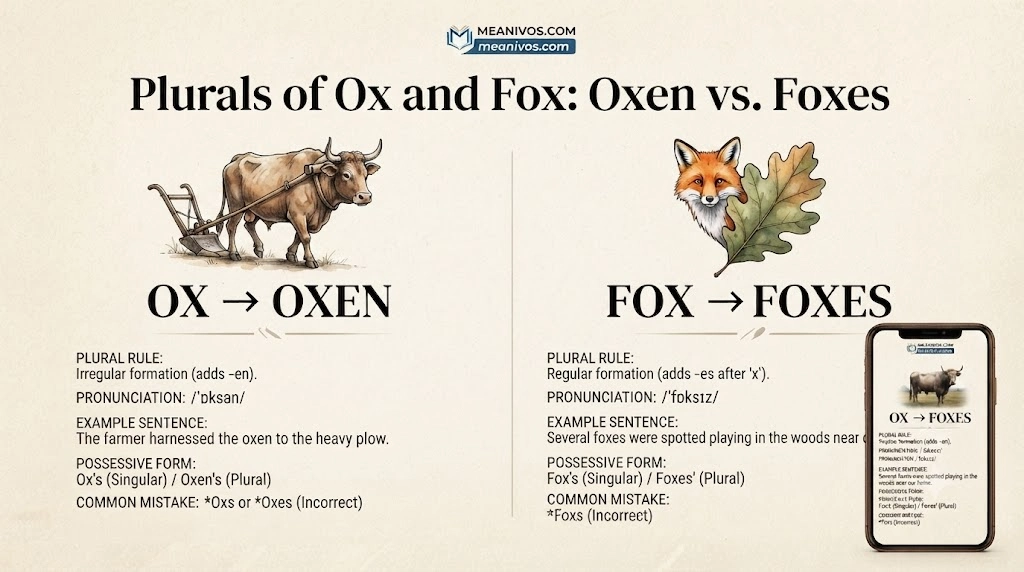
Ox
The word ox is pronounced approximately:
- British English: /ɒks/
- American English: /ɑːks/
Oxen
The word oxen is pronounced approximately:
- British English: /ˈɒk.sən/
- American English: /ˈɑːk.sən/
It has two syllables:
OX-en
Cambridge gives /ˈɒk.sən/ for British English and /ˈɑːk.sən/ for American English.
The final -en is not pronounced like a Plurals of Ox and Fox strong independent “en” syllable. It has a weak /ən/ sound.
How to Pronounce Fox and Foxes
Fox
The singular fox is approximately:
- British English: /fɒks/
- American English: /fɑːks/
Foxes
The plural foxes has two syllables:
FOX-es
The ending is pronounced approximately /ɪz/.
This is consistent with Cambridge’s explanation Plurals of Ox and Fox that the -es ending on nouns such as box is pronounced /ɪz/.
So pronunciation can help you recognise the difference:
- ox → one syllable
- oxen → two syllables
- fox → one syllable
- foxes → two syllables
Common Mistakes With Ox and Fox Plurals
Because ox and fox look similar, learners often make the same mistakes.
Mistake 1: Using “oxes”
❌ The farmer owns five oxes.
✅ The farmer owns five oxen.
The standard plural is oxen.
Mistake 2: Using “foxen”
❌ We saw three foxen in the forest.
✅ We saw three foxes in the forest.
Mistake 3: Using “oxen” for one animal
❌ There is an oxen in the field.
✅ There is an ox in the field.
Mistake 4: Using “fox” for multiple animals
❌ I saw five fox in the forest.
✅ I saw five foxes in the forest.
Mistake 5: Assuming all -x words use -en
❌ box → boxen
✅ box → boxes
❌ tax → taxen
✅ tax → taxes
❌ fox → foxen
✅ fox → foxes
The -en ending in oxen is an irregular historical survival, not a general plural rule.
Is “Oxes” Correct?
For normal standard English, oxen is the plural you should use.
The safest pattern to memorise is:
one ox → two oxen
Examples:
- one ox
- two oxen
- three oxen
- several oxen
- a team of oxen
Cambridge explicitly defines oxen as the plural of ox.
Why “oxes” seems logical
The spelling oxes looks logical because English commonly uses -es after -x.
For example:
box → boxes
fox → foxes
However, ox is an irregular noun with a historical plural that survived into modern English.
So:
oxen is the standard plural form.
Is “Foxen” Correct?
Foxen is not the standard plural of fox.
The normal plural is:
fox → foxes
This is because fox follows the regular modern Plurals of Ox and Fox plural spelling pattern for nouns ending in -x.
Therefore:
❌ foxen
✅ foxes
For schoolwork, professional writing, academic writing, websites, emails, and other standard English contexts, use foxes.
Possessive Forms of Ox and Fox
Plural forms can become slightly more complicated when you need to show possession.
Singular possessive of ox
For one ox:
ox’s
Example:
The ox’s harness was old.
Plural possessive of ox
For multiple oxen:
oxen’s
Example:
The oxen’s harnesses were ready.
Singular possessive of fox
For one fox:
fox’s
Example:
The fox’s tail was covered in mud.
Plural possessive of fox
For multiple foxes:
foxes’
Example:
The foxes’ tracks were visible in the snow.
Complete comparison
| Meaning | Correct Form | Example |
| One ox | ox | The ox is strong. |
| More than one ox | oxen | The oxen are strong. |
| Belonging to one ox | ox’s | The ox’s harness is old. |
| Belonging to multiple oxen | oxen’s | The oxen’s harnesses are ready. |
| One fox | fox | The fox is nearby. |
| More than one fox | foxes | The foxes are nearby. |
| Belonging to one fox | fox’s | The fox’s tail is bushy. |
| Belonging to multiple foxes | foxes’ | The foxes’ tracks are visible. |
Notice that oxen remains the plural even when possession is expressed.
Why Do Some English Plurals Look So Strange?
The ox → oxen example is part of a much larger story.
English has developed from several historical stages and has inherited different ways of forming plurals.
Most modern English nouns are predictable:
- book → books
- car → cars
- house → houses
- fox → foxes
- box → boxes
But some words preserve older forms:
- child → children
- man → men
- woman → women
- tooth → teeth
- foot → feet
- mouse → mice
- goose → geese
- ox → oxen
Cambridge describes several of these as important exceptions to standard plural spelling patterns.
This means that English learners sometimes need to memorise an irregular plural rather than derive it from a modern rule.
Other Irregular English Plurals
Here are some useful examples.
| Singular | Plural | Type |
| ox | oxen | Irregular |
| child | children | Irregular |
| man | men | Irregular |
| woman | women | Irregular |
| tooth | teeth | Irregular |
| foot | feet | Irregular |
| mouse | mice | Irregular |
| goose | geese | Irregular |
| fox | foxes | Regular |
| box | boxes | Regular |
The contrast between oxen and foxes is therefore part of a wider English grammar pattern.
Some nouns follow predictable rules, while others preserve historical forms.
Regular vs Irregular Plural Nouns
Regular nouns generally follow an established modern pattern.
Plural nouns
For example:
fox → foxes
box → boxes
book → books
car → cars
Irregular plural nouns
Irregular nouns do not follow the ordinary -s/-es pattern.
For example:
ox → oxen
child → children
mouse → mice
tooth → teeth
Why this matters
A learner who knows the rule for fox → foxes might incorrectly apply it to ox.
Likewise, someone who has learned ox → oxen might incorrectly apply -en to fox.
The correct approach is:
Learn the regular rule, then learn the irregular exceptions.
What Is the Rule for Nouns Ending in -X?
A useful general rule is:
Many nouns ending in -x form their plural with -es.
Examples:
| Singular | Plural |
| box | boxes |
| Fox | foxes |
| tax | taxes |
| mix | mixes |
| suffix | suffixes |
Cambridge’s grammar guide states that nouns ending in -ch, -s, -sh, -x, or -z generally take -es.
However, ox is not an example of that regular pattern.
It is an irregular historical noun:
ox → oxen
That is why it is important not to treat every noun Plurals of Ox and Fox ending in -x as identical.
Can “Ox” Ever Be Used as a Plural?
In standard contemporary English, oxen is the normal plural form of ox.
However, dictionary and historical evidence shows that forms such as oxes have existed in English. Etymonline notes that oxes appeared historically but did not survive as the standard modern plural.
For modern standard English, especially in Plurals of Ox and Fox educational, professional, and formal writing, the safest form is:
one ox → two oxen
So if you are answering a grammar question, writing an essay, or teaching English, use oxen.
Easy Memory Trick: Oxen vs Foxes
The easiest way to remember the difference is:
OX is the odd one out.
Most familiar nouns ending in -x take -es:
- box → boxes
- fox → foxes
- tax → taxes
But:
- ox → oxen
Memorise this sentence
One ox, two oxen. One fox, two foxes.
This gives you both forms at the same time.
Another quick trick
Think:
FOX = follows the rule
OX = old exception
It is not a complete linguistic explanation, but it is a useful memory aid for learners.
30 Real-World Examples of Ox, Oxen, Fox and Foxes
Ox
- The ox pulled the cart.
- An ox stood beside the barn.
- The farmer fed the ox.
- We saw an ox in the field.
- The ox moved slowly.
- A strong ox pulled the load.
- The farmer bought an ox.
- That ox belongs to the farmer.
Oxen
- The oxen pulled the wagon.
- Two oxen stood in the field.
- Several oxen worked together.
- The farmer owns four oxen.
- The oxen pulled the plough.
- A team of oxen crossed the road.
- The oxen were resting.
- The farmer carefully fed the oxen.
Fox
- A fox crossed the road.
- We saw a fox near the trees.
- The fox ran into the bushes.
- A red fox appeared at dusk.
- The fox disappeared quickly.
- That fox has a bushy tail.
- We watched a fox from a distance.
Examples with foxes
- Two foxes crossed the road.
- Several foxes live nearby.
- The foxes ran into the woodland.
- We saw three foxes near the trees.
- The foxes disappeared into the bushes.
- Several foxes appeared after dark.
- The children watched the foxes from a safe distance.
Oxen and Foxes in One Sentence
Sometimes the best way to understand a grammar difference is to place both words in the same sentence.
The oxen pulled the cart while the foxes watched from the woods.
Here:
- oxen = more than one ox
- foxes = more than one fox
Another example:
The farmer saw two oxen and three foxes near the field.
This sentence demonstrates both plural forms correctly.
Common Questions About Oxen and Foxes
What is the plural of ox?
The plural of ox is oxen.
One ox → two oxen.
It is an irregular plural form. Cambridge explicitly identifies oxen as the plural of ox.
What is the plural of fox?
The plural of fox is foxes.
One fox → two foxes.
It follows the normal plural spelling pattern for many nouns ending in -x.
Is oxen singular or plural?
Oxen is plural.
The singular form is ox.
Correct:
One ox is in the field.
Correct:
Two oxen are in the field.
Is boxes correct?
Oxen is the standard modern plural of ox.
Although oxen has existed historically, it is not the normal standard plural used today.
Is foxen a word?
Foxen is not the standard plural of fox.
Use:
fox → foxes
Why is ox plural oxen?
Oxen preserves an older English plural pattern involving an -en ending. It is a historical irregular form that survived into modern English.
Why are fox plural foxes?
Because fox follows the regular modern plural pattern for nouns ending in -x.
fox + es = foxes
Cambridge explains that nouns ending in -x generally take -es.
Why isn’t fox plural foxen?
The -en in oxen is not a productive rule for modern English. It is an inherited irregular form specific to ox.
What is the plural possessive of ox?
The plural possessive is:
oxen’s
Example:
The oxen’s harnesses were ready.
What is the plural possessive of fox?
The plural possessive is:
foxes’
Example:
The foxes’ tracks were visible.
Are oxen and foxes both plural nouns?
Yes.
Oxen is plural for ox, and foxes is plural for fox.
The difference is that oxen is irregular, while foxes are regular.
Practice Quiz: Ox or Oxen? Fox or Foxes?
Test what you have learned.
1. The farmer owns three ___.
A. ox
B. oxen
Answer: B — oxen
2. We saw two ___ near the woods.
A. foxes
B. foxen
Answer: A — foxes
3. One ___ was pulling the cart.
A. ox
B. oxen
Answer: A — ox
4. Several ___ were running through the field.
A. fox
B. foxes
Answer: B — foxes
5. The ___ pulled the wagon together.
A. oxen
B. oxes
Answer: A — oxen
6. A ___ crossed the road.
A. foxes
B. fox
Answer: B — fox
7. We watched four ___ from a distance.
A. foxes
B. foxen
Answer: A — foxes
8. The farmer bought two strong ___.
A. ox
B. oxen
Answer: B — oxen
9. The ___ were pulling the plough.
A. oxen
B. ox
Answer: A — oxen
10. Three ___ appeared near the woodland.
A. foxen
B. foxes
Answer: B — foxes
Score Yourself
9–10 correct: Excellent. You understand the difference.
7–8 correct: Very good. Review the singular and plural examples once.
5–6 correct: You understand the main idea but should practise the forms more.
Below 5: Remember the basic pair:
one ox → two oxen
one fox → two foxes
Why “Oxen vs Foxes” Is a Useful Grammar Example
At first, ox and fox appear to be almost identical from a spelling perspective.
Both end in -x.
But they demonstrate two different types of plural formation:
Ox
ox → oxen
This is an irregular historical plural.
Fox
fox → foxes
This is a regular modern plural.
This makes the pair particularly useful for English learners because it demonstrates an important grammar principle:
English plural rules have exceptions, and historical forms can survive alongside modern patterns.
Knowing the general rule is important, but so is recognising common irregular nouns.
Quick Cheat Sheet
If you only have a few seconds, remember this:
| If you mean… | Use |
| One ox | ox |
| More than one ox | oxen |
| One fox | fox |
| More than one fox | foxes |
| One ox’s property | ox’s |
| Several oxen’s property | oxen’s |
| One fox’s property | fox’s |
| Several foxes’ property | foxes’ |
The golden rule
One ox → two oxen
One fox → two foxes
Final Answer: Oxen and Foxes
The plurals of ox and fox are different:
Ox → oxen
Fox → foxes
The reason is grammatical and historical.
Oxen is an irregular plural that preserves an older English plural pattern. Foxes follow the regular modern rule in which nouns ending in -x generally take -es. Cambridge confirms oxen as the plural of ox and explains the general -es rule for nouns ending in -x.
So, when in doubt, remember:
One ox, two oxen.
One fox, two foxes.
Do not write oxes as the normal modern plural of ox, and do not change fox to foxen.
Once you understand that ox is the irregular one while fox follows the regular -es pattern, the difference becomes easy to remember.
People Also Ask
A:The standard plural of ox is oxen. Use ox for one animal and oxen for two or more.
Example: One ox is in the field. Two oxen are pulling the cart.
A:The standard plural of fox is foxes. It follows the common plural spelling pattern for nouns ending in -x.
Example: One fox crossed the road. Two foxes ran into the woods.
A:Oxen is an irregular plural that comes from an older English plural pattern. The -en ending is a historical form that survived into modern English.
A:Foxen is not the standard plural of fox. The -en ending in oxen is an irregular historical form, not a general rule for nouns ending in -x. The standard plural is foxes.
A:For standard modern English, oxen is the normal plural of ox.
The correct form is:
One ox → two oxen
Although boxes may appear in historical or specialised usage, it is not the standard form learners should normally use.
Conclusion
The English language does not always follow one simple plural rule, and Oxen Vs Foxes is a perfect example.
The correct forms are:
- ox → oxen
- fox → foxes
Oxen is an irregular plural inherited from an older English pattern, while foxes follows the regular plural formation used by many nouns ending in -x.
The most important distinction is:
One ox → two oxen
One fox → two foxes
If you are writing an essay, completing a grammar exercise, teaching English, or simply trying to improve your vocabulary, these are the standard forms to use.
Remember the simple trick:
OX is the odd one out.
FOX follows the -ES rule.
And if you remember only one sentence, make it:
One ox, two oxen; one fox, two foxes.