Forrest or Forest: Difference, Meaning & Correct Usage
Have you ever typed “forrest” instead of “forest” and wondered whether the spelling was correct? You are not alone. Forrest and Forest look almost identical, sound the same in many accents, and are often confused by English learners and writers.
The difference is simple:
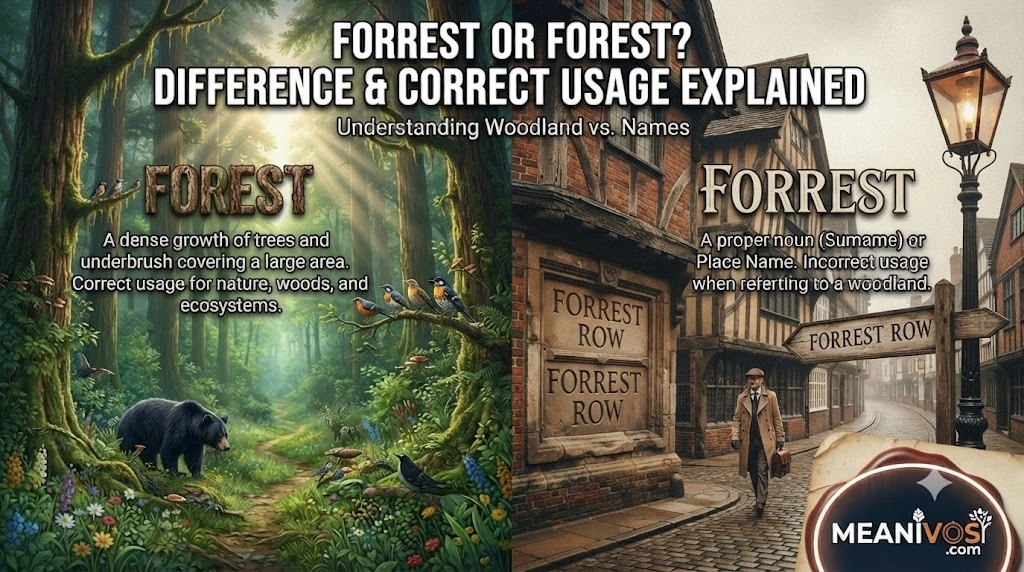
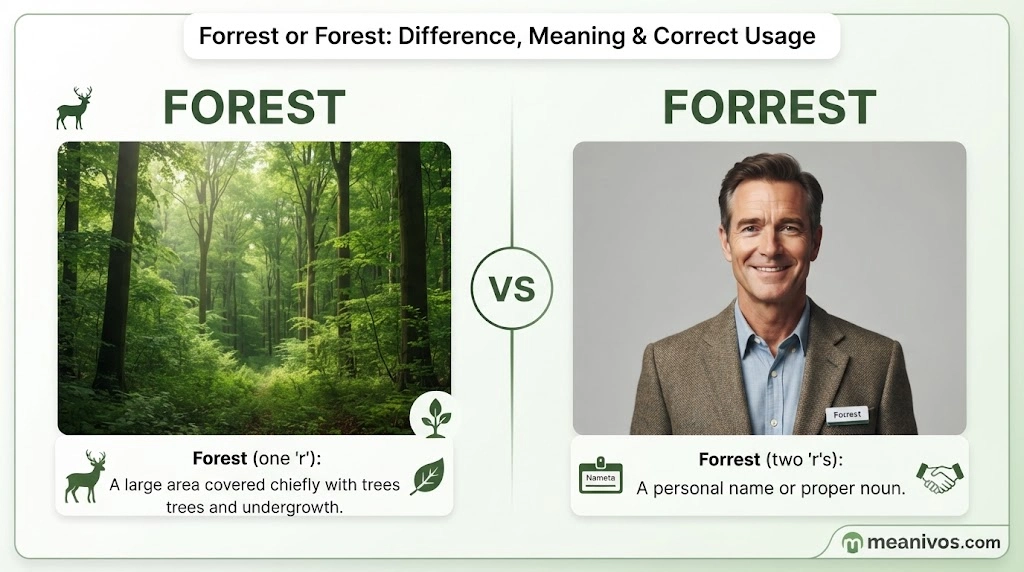
Forest is the correct word when you are talking about a large area filled with trees, plants, and wildlife.
Forrest is a real spelling, but it is mainly used as a personal name or surname.
For example:
We walked through the forest during our holiday.
Forrest is my neighbour’s first name.
Although these words differ by only one extra letter, using the wrong spelling can change the meaning of your sentence. This guide explains the difference between Forrest vs Forest, their meanings, pronunciation, history, examples, and common mistakes so you can always choose the correct word.
Quick Answer: Forrest vs Forest
| Word | Meaning | Type | Common Usage |
| Forest | A large area covered with trees | Common noun | Nature, environment, woodland |
| Forrest | A person’s name | Proper noun | First name or surname |
Simple Rule:
Talking about trees? Use Forest.
Talking about a person named Forrest? Use Forrest.
What Does Forest Mean?
Forest is a noun that means a large area of land covered mainly with trees, plants, and other forms of natural vegetation.
Forests are important ecosystems that provide homes for animals, support biodiversity, and help maintain the balance of the environment.
Examples of forests include:
- Tropical forests
- Rainforests
- Temperate forests
- Boreal forests
Examples:
- The Amazon forest contains thousands of plant and animal species.
- We went hiking in the forest last weekend.
- Many animals depend on the forest for survival.
Forest Definition
According to common dictionary definitions, a forest is:
A large area covered mainly by trees and other vegetation.
The word is commonly used in environmental, scientific, and everyday conversations.
Examples:
- Forest conservation
- Forest animals
- Forest ecosystem
- Forest protection
- Forest management
Origin and History of the Word Forest
The word forest has a long history in the English language.
It came into English through Old French from the Latin word “foresta,” which referred to an outdoor or wooded area.
Over time, the meaning developed from a general outdoor space into the modern meaning of a large woodland area.
Today, forest is used worldwide in discussions about:
- Nature
- Climate change
- Wildlife
- Environmental protection
What Does Forrest Mean?
Forrest is a correct spelling, but it is usually a proper noun, meaning it is used as a person’s name.
Unlike forest, it does not describe a group of trees.
Examples:
- Forrest is coming to dinner tonight.
- I met Forrest at university.
- Forrest Smith works as a writer.
Because names can have different spellings, Forrest became established as a personal name.
Forrest Name Meaning
The name Forrest is traditionally connected with the word forest, meaning:
- Woodland
- Woods
- A person associated with forests or nature
It is often considered a nature-inspired name.
The spelling with two “r” letters helps distinguish the name from the everyday word forest.
Is Forrest a Correct Spelling?
Yes, Forrest is a correct spelling, but its meaning depends on context.
Correct:
Forrest is my brother’s name.
I spoke with Forrest yesterday.
Incorrect:
We walked through the forest yesterday.
The correct sentence is:
We walked through the forest yesterday.
When describing trees, wildlife, or woodland, always use forest.
Why Do People Confuse Forrest and Forest?
There are several reasons why these two words are commonly mixed up.
1. They Look Almost Identical
The only spelling difference is an extra “r.”
Forest:
F O R E S T
Forrest:
F O R R E S T
Because the difference is small, people often add an extra letter by mistake.
2. They Sound the Same
In most English accents:
Forest
and
Forrest
are pronounced almost identically.
Pronunciation does not usually help you decide which spelling to use.
3. Names Influence Spelling
Many people have seen the name Forrest before, especially through famous examples in popular culture.
This can make people believe the double “r” spelling is also correct when talking about trees.
4. English Has Many Double Letters
English contains many words with repeated letters:
- running
- stopping
- beginning
- different
- Explore More: https://meanivos.com/soda-tab-meaning/
Because double letters are common, writers may accidentally add an extra letter.
Forrest vs Forest Pronunciation
Both words are usually pronounced the same.
Forest pronunciation:
FOR-ist
IPA:
/ˈfɔːrɪst/
Forrest pronunciation:
FOR-ist
IPA:
/ˈfɔːrɪst/
The pronunciation is not the difference. The meaning and spelling are what separate them.
Forrest vs Forest Examples
Examples Using Forest
Example 1:
The children explored the forest near their village.
Meaning:
A wooded natural area.
Example 2:
Many species live inside the forest.
Meaning:
Animals and plants living in woodland.
Example 3:
The government protects the forest from illegal cutting.
Meaning:
Environmental protection.
Example 4:
We planted trees to restore the damaged forest.
Meaning:
A natural ecosystem.
Examples Using Forrest
Example 1:
Forrest moved to Canada last year.
Meaning:
A person’s name.
Example 2:
I called Forrest after the meeting.
Meaning:
Someone named Forrest.
Example 3:
Forrest is studying English literature.
Meaning:
A student’s name.
Common Mistakes With Forrest and Forest
Mistake 1: Adding an Extra “R”
Wrong:
The Amazon forest is enormous.
Correct:
The Amazon forest is enormous.
Mistake 2: Using Forest as Someone’s Name
Wrong:
My friend’s name is Forest.
Correct:
My friend’s name is Forrest.
Note:
Forest can occasionally be used as a name, but Forrest is the traditional personal-name spelling.
Mistake 3: Thinking Forrest Is a Different Type of Forest
Wrong idea:
“Forrest means a special kind of forest.”
Correct:
Forrest usually refers to a person, not a natural place.
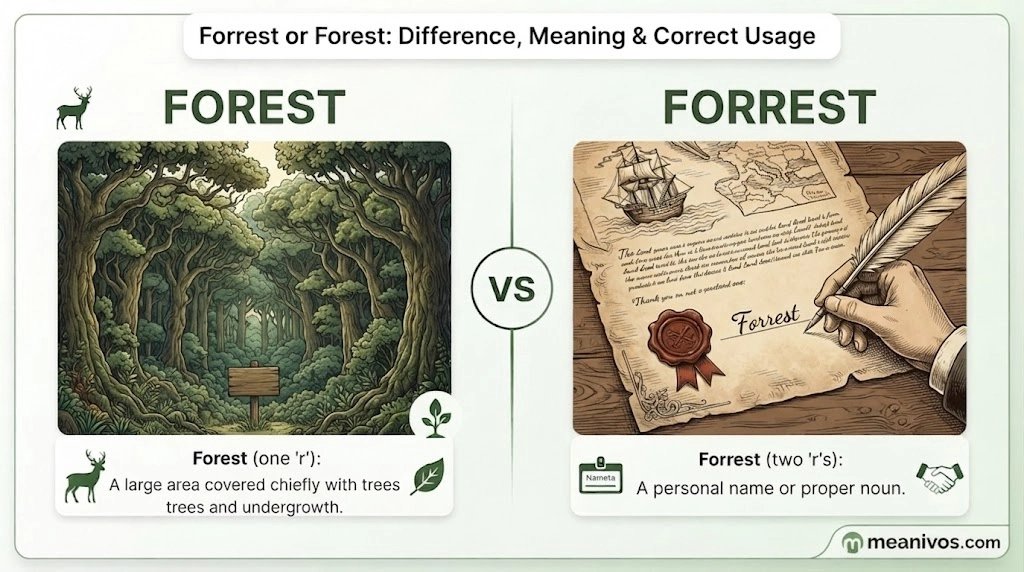
Easy Memory Trick: Forrest or Forest?
Use this simple trick:
Forest = Trees
Remember:
One “R” for real trees.
Forrest = Person
Remember:
Two “R’s” in Forrest because it is a person’s name.
Forest Related Words
Words connected with forest include:
- Woodland
- Woods
- Trees
- Nature
- Wildlife
- Rainforest
- Forestry
- Ecosystem
- Wilderness
- Habitat
Example:
“The forest ecosystem supports many forms of wildlife.”
Forrest or Forest: Quick Comparison Chart
| Feature | Forest | Forrest |
| Correct spelling | Yes | Yes |
| Refers to trees | Yes | No |
| Used as a name | Sometimes | Common |
| Type of word | Common noun | Proper noun |
| Pronunciation | Usually FOR-ist | Usually FOR-ist |
| Main meaning | Woodland area | Person’s name |
When Should You Use Forest?
Use forest when writing about:
- Nature
- Trees
- Wildlife
- Environment
- Hiking
- Conservation
- Geography
Examples:
Forest fires can destroy large areas.
The forest provides oxygen and shelter.
They studied forest ecosystems.
When Should You Use Forrest?
Use Forrest when referring to:
- Someone’s first name
- Someone’s surname
- A fictional character
- A specific person
Examples:
Forrest called me yesterday.
Forrest lives near London.
I watched a movie featuring a character named Forrest.
People Also Ask
A:No. Forrest is not a misspelling. It is a correct spelling mainly used as a personal name or surname. However, when you are talking about a wooded area with trees, the correct spelling is forest.
A:The main difference is meaning.
Forest means a natural area covered with trees, plants, and wildlife.
Forrest is usually a person’s name.
Example:
We walked through the forest.
Forrest is my friend’s name.
A:The spelling Forrest developed mainly as a personal name. The extra “r” helps distinguish it from the common English word forest.
A:Yes. In most English accents, both words are pronounced the same way:
FOR-ist
The difference is in spelling and meaning, not pronunciation.
A:Yes, Forest can also be used as a name, especially as a nature-inspired name. However, Forrest is a more traditional spelling for a personal name.
Common Questions Answered Quickly
Forrest or Forest: Which one should I use?
Use forest for nature and trees. Use Forrest when referring to someone’s name.
Is “forest” accepted in English?
Yes, but mostly as a proper name. It is not the standard spelling for a woodland area.
Do Forest and Forrest have the same meaning?
No. They may sound similar, but they are used differently.
Related Words and Similar Confusing Spellings
English has many words that look or sound similar but have different meanings.
Examples:
| Word Pair | Difference |
| Their vs There | Possession vs Location |
| Your vs You’re | Possession vs You are |
| Affect vs Effect | Influence vs Result |
| Then vs Than | Time vs Comparison |
| Weather vs Whether | Climate vs Choice |
Conclusion
Understanding the difference between Forrest and Forest is simple once you remember their meanings.
Forest is the correct spelling when you are talking about trees, wildlife, and natural woodland areas. It is a common English noun used in everyday writing, science, and environmental discussions.
Forrest is also a correct spelling, but it is mainly used as a person’s name or surname. Although both words are usually pronounced the same, their meanings are different.
The easiest way to remember:
Forest = trees and nature
Forrest = a person’s name
Using the correct spelling helps make your writing clearer and more professional. Whether you are learning English, writing an article, completing school work, or improving your vocabulary, knowing small differences like this can make a big impact.