Leafs or Leaves? The Correct Plural of Leaf Explained
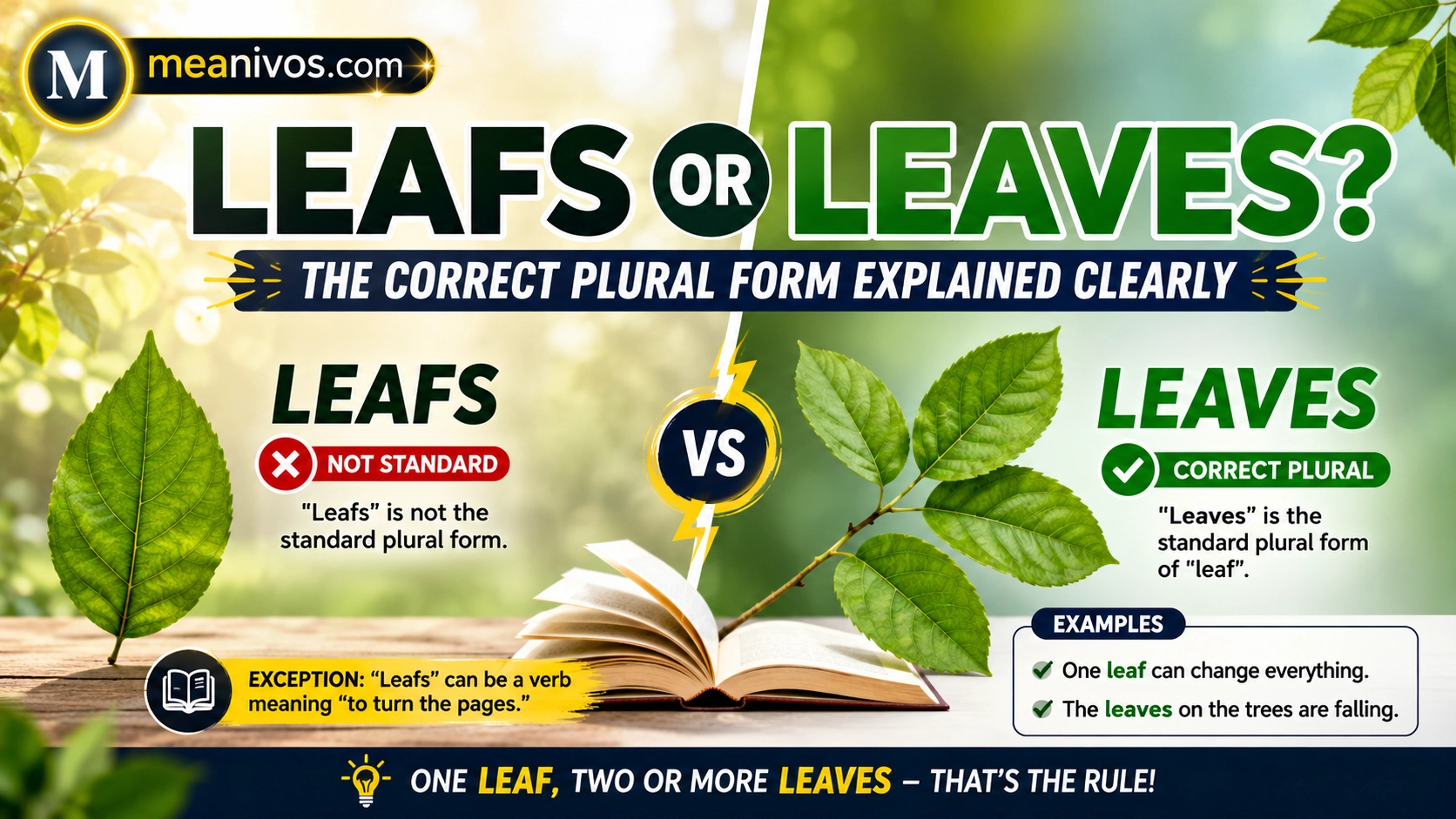
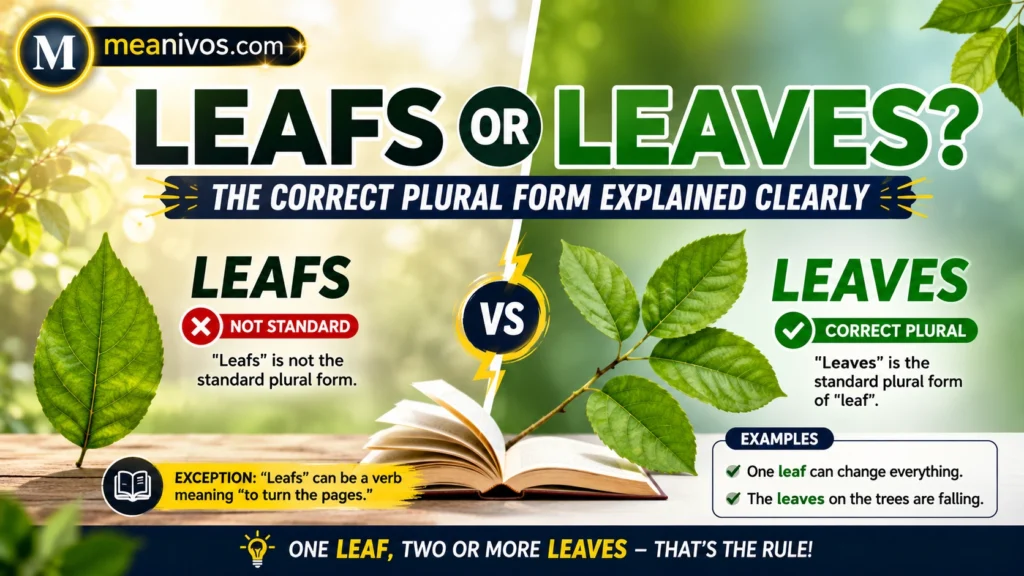
Leafs or leaves? If you’re talking about more than one leaf, the standard answer is Leaves.
For example:
The tree has hundreds of leaves.
But there’s a little more to the story. Leafs isn’t simply a word that never exists. Merriam-Webster lists leaves as the main plural of leaf and also records leafs as an alternative plural. It also lists leafs as a verb, as in “She leafs through a magazine.”
That distinction explains why you may see both spellings online.
There is also the proper name Toronto Maple Leafs, where Leafs is part of the team’s official name.
So the quick rule is simple:
One leaf → two leaves
For ordinary writing about trees, plants, autumn foliage, books, or similar objects, leaves is the form you should normally use.
Quick Answer: Leafs or Leaves?
If you mean the plural of the noun leaf, use leaves in standard everyday English.
Cambridge Dictionary explicitly gives leaves as the plural of leaf, while Merriam-Webster lists leaves and also records leafs as an alternative plural.
| Form | Grammar | Main use | Example |
| leaf | Singular noun | One leaf | A leaf fell down. |
| leaves | Standard plural noun | More than one leaf | The leaves are green. |
| leafs | Verb / alternative noun plural | Context-dependent | She leaves through a book. |
| leaf’s | Singular possessive | Belonging to one leaf | The leaf’s edge is dry. |
| leaves’ | Plural possessive | Belonging to multiple leaves | The leaves’ colours changed. |
| leaves | Verb | Third-person singular of leave | She leaves at six. |
The easiest rule
Remember:
Leaf = one
Leaves = more than one
So:
One leaf
Two leaves
Many leaves
What Is the Plural of Leaf?
The standard plural of leaf is leaves.
Cambridge Dictionary gives the plural as leaves and defines a leaf as the typically flat, usually green part of a plant attached to a stem or branch.
Examples include:
- one leaf
- two leaves
- green leaves
- autumn leaves
- fallen leaves
- dry leaves
- maple leaves
For example:
The tree lost most of its leaves during the storm.
The garden was covered with autumn leaves.
Several green leaves were growing from the stem.
The same noun can have other meanings, too. A leaf can refer to a sheet in a book, an extra section of a table, or certain movable parts of doors, shutters, and gates.
Why Does Leaf Become Leaves?
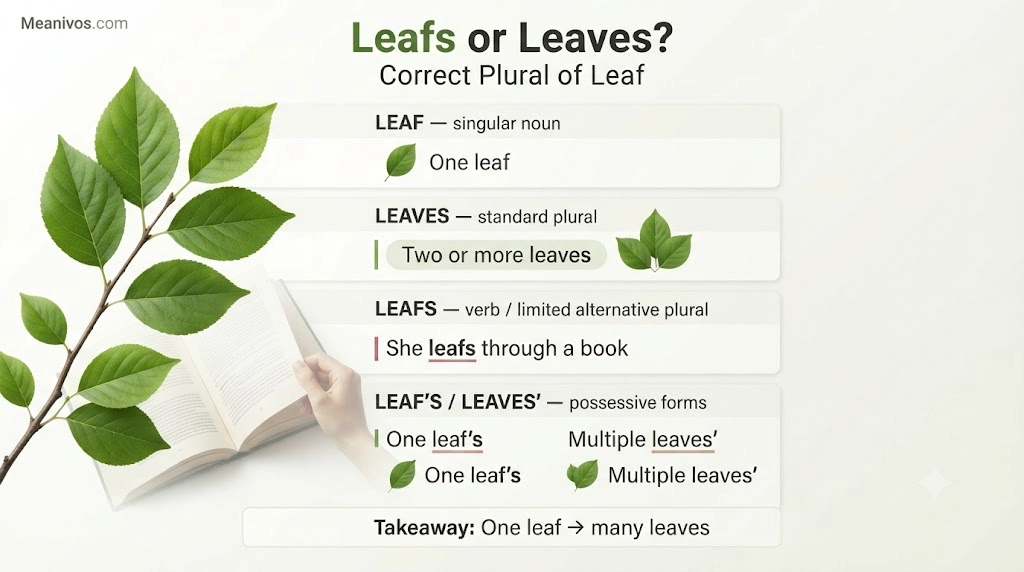
Leaf → leaves is an irregular plural form.
Instead of adding a simple -s, the spelling changes:
f → v + es
So:
leaf → leaves
This resembles other common English plural patterns:
- knife → knives
- wife → wives
- life → lives
- wolf → wolves
- shelf → shelves
- loaf → loaves
- half → halves
This is often described as an F-to-VES pattern.
However, don’t treat it as a universal rule.
English has many exceptions:
- roof → roofs
- chef → chefs
- belief → beliefs
- chief → chiefs
- proof → proofs
So it is better to learn common plural forms individually rather than assuming every word ending in f or fe changes to ves.
For leaf, however, the standard form is clear:
leaf → leaves
Is “Leafs” a Correct Word?
This is where a more accurate explanation is needed.
If you are asking:
“What is the normal plural of leaf?”
The answer is leaves.
But it would be inaccurate to claim that leafs can never be found or used.
Merriam-Webster currently lists:
plural leaves also leafs
So leafs is a dictionary-recorded alternative plural.
However, that does not mean it is the normal spelling you should choose whenever you’re talking about plant foliage.
In ordinary writing, these are natural:
The leaves are falling.
The tree has green leaves.
I collected the fallen leaves.
Using leafs for these ordinary meanings will generally look unusual to readers.
The practical rule
For schoolwork, articles, emails, essays, professional writing, and everyday English:
Use “leaves” when you mean multiple leaves.
There are other contexts where leafs is perfectly meaningful, especially as a verb or as part of a proper name.
When Should You Use “Leaves”?
Use leaves when leaf is functioning as a plural noun.
Plants and trees
The leaves on the tree are turning yellow.
The plant has large green leaves.
Dry leaves covered the path.
The wind blew the leaves across the garden.
Autumn foliage
The autumn leaves looked beautiful.
We walked through a carpet of fallen leaves.
Books and manuscripts
A leaf can also mean a sheet of a book or manuscript.
Several leaves of the old manuscript were damaged.
Tables
A leaf can be an extra section added to a table.
The dining table has two removable leaves.
Doors and shutters
The noun leaf can describe a movable section of a door, shutter, or gate.
The double doors have two leaves.
In these ordinary plural-noun situations, leaves is the safest and clearest form.
When Can “Leafs” Be Used?
There are three important contexts worth knowing.
1. “Leafs” as a verb
The most important distinction is that leafs can be a verb.
The verb to leaf through means to turn through the pages of a book, magazine, or similar item, often casually or quickly.
For example:
She leafs through the magazine while waiting.
He leafs through his notes before class.
My father leafs through the newspaper every morning.
Here, leafs is not a plural noun.
Compare:
The tree has many leaves.
with:
She leafs through the book.
The first is a plural noun.
The second is a verb.
Merriam-Webster lists leafs as one of the present-tense verb forms of leaf.
2. Proper names
You may also see Leafs in proper names.
The best-known example is the Toronto Maple Leafs, the Canadian professional ice hockey team. The NHL’s official history identifies the team as the Toronto Maple Leafs and traces the franchise’s name to the Toronto Maple Leaf Hockey Club.
So:
The maple leaves are falling.
but:
The Maple Leafs are playing tonight.
The first refers to plant foliage.
The second refers to a specific team name.
3. Alternative noun plural
Merriam-Webster also records leafs as an alternative plural of the noun leaf.
This is an important piece of dictionary evidence that many simplified grammar articles leave out.
Still, if you’re writing a normal sentence about several leaves on a tree, leaves is the conventional choice.
Leafs vs Leaves: Side-by-Side Comparison
| Word | Part of speech | What it means | Example |
| leaf | Noun | One leaf | I picked up a leaf. |
| leaves | Noun | More than one leaf | The leaves are dry. |
| Leafs | Verb | Turns through pages / produces leaves | She leafs through the book. |
| Leafs | Proper noun | Toronto hockey team | The Leafs are playing tonight. |
| leaf’s | Possessive noun | Belonging to one leaf | The leaf’s surface is wet. |
| leaves’ | Possessive noun | Belonging to several leaves | The leaves’ colours changed. |
| leaves | Verb | Third-person form of leave | She leaves work at five. |
This table resolves most confusion around leafs or leaves.
Leaf vs Leaves vs Leafs vs Leave vs Leaf’s vs Leaves’
These similar-looking forms have different grammatical functions.
Leaf
Leaf is the singular noun.
A leaf fell from the tree.
Leaves
Leaves is the standard plural noun.
The leaves fell from the tree.
But leaves can also be a verb.
She leaves home at eight.
In that sentence, leaves comes from leave, not leaf.
Leafs
Leafs can be the third-person singular form of the verb leaf:
He leafs through the newspaper.
It can also appear as a proper name or as an alternative noun plural recorded by Merriam-Webster.
Leave
Leave is usually a verb meaning to go away or depart.
Please leave the room.
It can also be a noun in contexts involving authorised time away from work.
Leaf’s
Leaf’s means something belongs to one leaf.
The leaf’s surface was wet.
Leaves’
Leaves’ means something belongs to multiple leaves.
The leaves’ colours changed after the frost.
Examples of “Leaves” in Sentences
Here are practical examples of the standard plural:
- The tree has bright green leaves.
- The wind blew the leaves across the road.
- We collected fallen leaves from the garden.
- The leaves began changing colour in autumn.
- Some plants have very large leaves.
- The wet leaves made the path slippery.
- The gardener removed the dead leaves.
- Birds were hiding among the leaves.
- The young tree has small leaves.
- The leaves provide shade in summer.
Books and manuscripts
- Several leaves of the manuscript were missing.
- The old book had fragile leaves.
- The damaged leaves were carefully restored.
Tables
- The table has two removable leaves.
- We added a leaf to make the table longer.
Examples of “Leafs” in Sentences
Because leafs has more than one possible use, context is important.
As a verb
She leafs through the magazine every morning.
He leafs through his notes before an exam.
My mother leafs through old photo albums.
As part of a proper name
The Toronto Maple Leafs are a professional ice hockey team.
As an alternative plural
Merriam-Webster records leafs as an alternative plural of leaf.
However, for ordinary plant foliage, leaves remains the better default:
The leaves are turning brown.
What Does “Leafs Through a Book” Mean?
The expression leafs through a book means that someone turns through its pages, usually to browse or skim.
For example:
Sarah leafs through the cookbook before choosing a recipe.
The verb forms can be understood like this:
- I leaf through the book.
- She leafs through the book.
- He leafed through the book.
- They are leafing through the book.
Merriam-Webster defines the verb leaf as turning over pages, especially to browse or skim.
So don’t confuse:
leaves = plural noun
with:
leafs = verb
That distinction is one of the most important answers to the search query.
Why Does “Leaf” Change From F to V?
The spelling of leaves reflects historical developments in English rather than a simple modern spelling trick.
Merriam-Webster traces leaf to Middle English leef and Old English lēaf, with the noun in use before the 12th century.
Over time, English developed several plural patterns involving changes in spelling and sound. This is why modern forms such as these exist:
- leaf → leaves
- knife → knives
- wife → wives
- life → lives
- wolf → wolves
- shelf → shelves
The pattern is useful, but it is not universal.
- Explore More: https://meanivos.com/4-fingers-mean/
Is the F-to-VES Rule Always Used?
No.
This is one of the most important grammar lessons connected with leafs or leaves.
Some words ending in f or fe use a -ves plural:
- leaf → leaves
- knife → knives
- wife → wives
- life → lives
- wolf → wolves
- shelf → shelves
But others use ordinary -s:
- roof → roofs
- chef → chefs
- belief → beliefs
- chief → chiefs
- proof → proofs
Therefore, the rule should not be memorised as:
“Every word ending in F becomes VES.”
A better rule is:
Learn the established plural of each word, while recognising common patterns.
For leaf, the standard answer remains:
leaf → leaves
What About the Toronto Maple Leafs?
The Toronto Maple Leafs are a particularly famous reason people wonder why leafs can be correct.
The NHL identifies the team officially as the Toronto Maple Leaf Hockey Club and traces the franchise’s naming history through the Toronto Arenas, Toronto St. Patricks, and then the Toronto Maple Leaf Hockey Club.
The spelling Leafs is therefore part of the established proper name.
Compare:
Plant:
The maple leaves are turning red.
Hockey team:
The Maple Leafs are playing tonight.
Don’t “correct” the team’s name to Maple Leaves. Proper names are preserved as established.
Common Mistakes With Leaf and Leaves
Mistake 1: Adding “s” to leaf
❌ The tree has many leafs.
✅ The tree has many leaves.
Mistake 2: Confusing leaves and leafs
❌ The tree has green leafs.
✅ The tree has green leaves.
But:
She leafs through the magazine.
Here leafs is a verb.
Mistake 3: Confusing leaves and leave
She leaves work at five.
This is a verb derived from leave.
It has nothing to do with the plural noun leaf.
Mistake 4: Confusing leaf’s and leaves’
The leaf’s edge is damaged.
One leaf → leaf’s
The leaves’ edges are damaged.
Multiple leaves → leaves’
Mistake 5: Applying F-to-VES to everything
Not every F-ending noun becomes VES.
Remember:
leaf → leaves
but:
roof → roofs
Is “Leafs” or “Leaves” Better for Formal Writing?
For almost all formal writing, choose leaves when you mean more than one ordinary leaf.
This includes:
- school assignments
- university essays
- business writing
- emails
- reports
- blog articles
- educational content
- general communication
For example:
The leaves of the plant were beginning to dry.
is the natural standard choice.
Use Leafs when it is part of an established proper name, such as Toronto Maple Leafs, and use leafs when it functions as the verb form of leaf.
Leafs or Leaves: Quick Decision Guide
Use this simple checklist.
Are you talking about multiple plant leaves?
Use leaves.
The leaves are falling.
Are you talking about multiple pages or book leaves?
Use leaves.
Several leaves of the manuscript were missing.
Are you talking about an expandable part of a table?
Use leaves.
The table has two leaves.
Are you describing someone turning through pages?
Use leafs as a verb.
She leafs through the book.
Are you talking about the Canadian hockey team?
Use Leafs.
The Maple Leafs won.
Are you showing possession?
Use:
- leaf’s = one leaf owns/has something
- leaves’ = multiple leaves own/have something
Leaf Plural Examples for Students and ESL Learners
The easiest pattern to memorise is:
Singular: leaf
Plural: leaves
Try these pairs:
One leaf is on the ground.
Two leaves are on the ground.
The leaf is green.
The leaves are green.
A leaf fell from the tree.
Many leaves fell from the tree.
Quick practice
Question: What is the plural of leaf?
Answer: Leaves.
Question: Is “leafs” the normal plural?
Answer: No. Leaves is the standard choice for ordinary writing.
Question: Is “leafs” ever correct?
Answer: Yes. It can be the verb form in “leafs through,” part of a proper name such as Toronto Maple Leafs, and Merriam-Webster also records it as an alternative noun plural.
A Simple Memory Trick
Use this:
One leaf → many leaves
Think:
F → V
leaf → leaves
You can also remember the pronunciation:
- leaf — /liːf/
- leaves — /liːvz/
The final consonant sound changes from f to v.
But don’t apply the same pattern blindly to every English word ending in f.
People Also Ask
A:Yes. Leaves is the standard plural of leaf. Cambridge Dictionary explicitly lists leaves as the plural, and Merriam-Webster lists it as the primary plural form.
A:Not in every context. For ordinary plant leaves, leaves is the standard choice. However, Merriam-Webster records leafs as an alternative plural and as a verb form.
A:For normal standard writing, use leaves:
The tree has many leaves.
Although leafs is recorded as an alternative plural, it is not the usual choice for ordinary plant foliage.
A:Leaf has an irregular plural. Its spelling changes from leaf to leaves, reflecting an established English plural pattern.
A:Yes. Leafs is the third-person singular present form of the verb leaf.
For example:
He leafs through the newspaper.
Merriam-Webster lists leafs among the verb’s forms.
5 Topical Cluster Ideas
1 — Commonly Confused Words
- leafs or leaves
- aerial vs Arial
- peak vs peek vs pique
- forest vs forrest
- affect vs effect
2 — Plural Grammar
- plural of leaf
- plural of knife
- plural of wolf
- plural of life
- plural of shelf
3 — Possessive Grammar
- leaf’s vs leaves’
- its vs it’s
- whose vs who’s
- their vs they’re vs there
4 — Spelling Questions
- common English spelling mistakes
- words people often misspell
- British vs American spelling
- irregular spelling patterns
5 — English Learner Guides
- irregular plurals
- noun plurals
- confusing English words
- common grammar mistakes
- English spelling rules
Final Thoughts on Leafs or Leaves
So, leafs or leaves—which is correct? In most everyday situations, the answer is leaves. If you are talking about more than one leaf from a tree, plant, book, table, or similar object, leaves is the standard plural form.
Remember the simple rule: one leaf → two leaves.
However, leaves are not always wrong. It can be the third-person singular form of the verb leaf, as in “She leafs through a magazine.” It is also part of the proper name Toronto Maple Leafs, and dictionaries record leafs as an alternative plural.
Understanding the context makes the difference. For ordinary writing, schoolwork, professional communication, and SEO content, leaves is the safest and most natural choice when referring to multiple leaves.
If you often get confused by similar English words and spelling patterns, explore more of our guides to learn the differences quickly and use each word with confidence.