Apposed vs Opposed: Meaning, Difference & Correct Usage
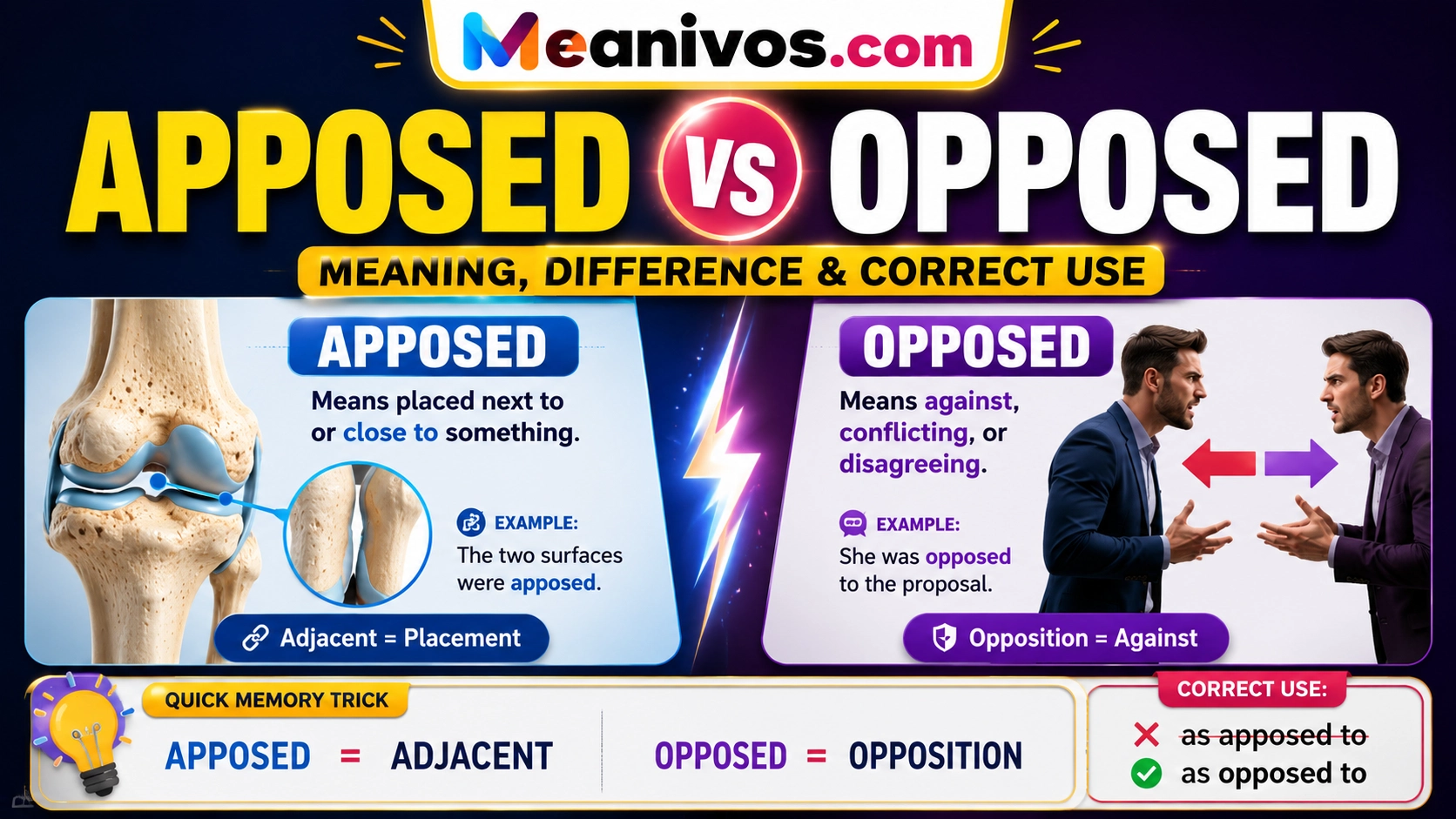
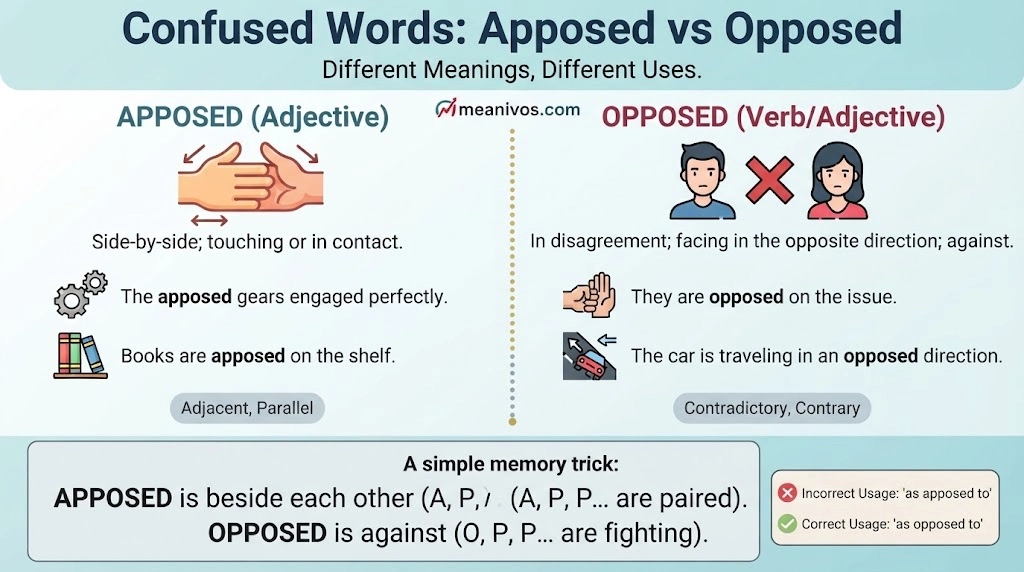
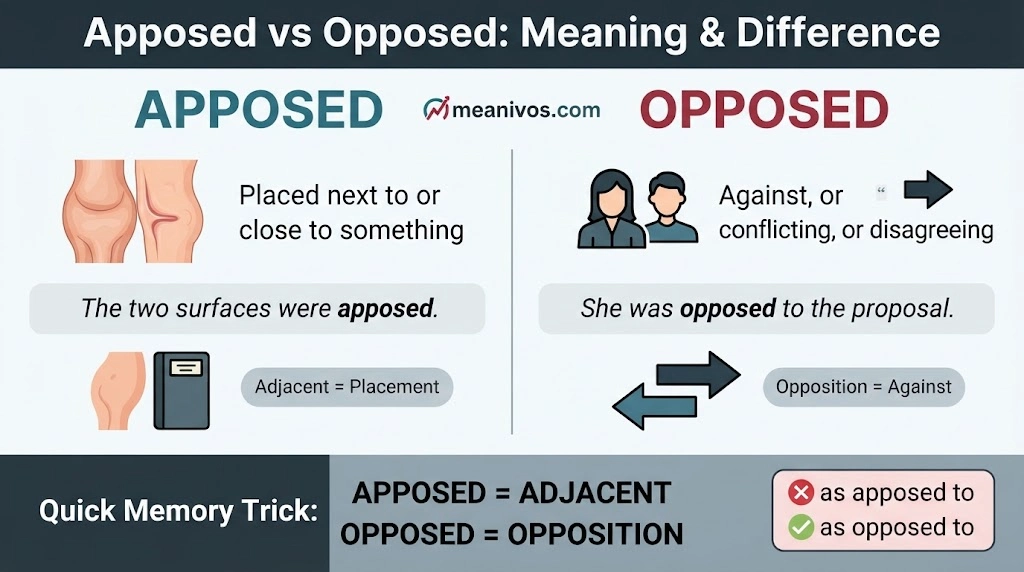
The Apposed Vs Opposed are easy to confuse because they look and sound almost identical, but they do not mean the same thing. Apposed generally means placed next to, close to, or alongside something, while opposed means against, resistant to, contrary to, or in disagreement with something.
For example:
- The two surfaces were apposed. → They were positioned closely together.
- She was opposed to the proposal. → She disagreed with the proposal.
In everyday English, opposed is far more common. Apposed is a legitimate but relatively uncommon word, especially useful in medical, anatomical, biological, scientific, and other technical contexts.
The most important rule is simple:
Apposed = adjacent or physically positioned together.
Opposed = against, conflicting, or contrary.
And if you are wondering whether to write “as apposed to” or “as opposed to,” the standard expression is as opposed to.
This guide explains the difference, correct usage, examples, common mistakes, pronunciation, technical meanings, and an easy way to remember which word to choose.
Apposed vs Opposed: Quick Answer
| Word | Meaning | Typical Context | Example |
| Apposed | Placed next to, close to, or alongside | Medical, scientific, anatomical, technical | The two surfaces were apposed. |
| Opposed | Against, resistant, contrary, or conflicting | Everyday, academic, professional | She was opposed to the plan. |
The easiest memory trick
APPOSED = ADJACENT
OPPOSED = OPPOSITION
If you are describing physical placement, think apposed.
If you are describing disagreement, resistance, conflict, or contrast, think opposed.
What Does “Apposed” Mean?
Apposed is the past tense and past participle of appose.
The verb appose means to place something next to, close to, or alongside another thing. The word is formal and is particularly useful when describing physical relationships between structures.
In simple English:
Apposed means physically positioned next to or close to something else.
For example:
- The two surfaces were closely apposed.
- The wound edges were carefully apposed.
- The membranes remained apposed.
- The anatomical structures were closely apposed.
The important point is that apposed describes physical or spatial positioning.
Is “apposed” a real word?
Yes.
Apposed is a legitimate English word, not simply a misspelling of opposed. It comes from the verb appose.
However, its specialised meaning means that many people encounter it much less frequently than opposed.
In ordinary conversation, people are more likely to say:
- next to
- beside
- close to
- touching
- placed against
- positioned alongside
This explains why someone may initially assume that apposed is a spelling mistake.
It is not.
What Does “Opposed” Mean?
Opposed is the past tense and past participle of oppose, and it is also commonly used as an adjective.
It can describe something that is:
- against something
- resistant to something
- contrary to something
- in disagreement with something
- conflicting with something
- different or opposite in position
In everyday English, opposed is usually the word you need when discussing disagreement or resistance.
Examples of “opposed”
She is opposed to the proposal.
This means she disagrees with or does not support the proposal.
Many residents are opposed to the development.
This means many residents do not support it.
The two candidates have opposed views.
Their views conflict or differ strongly.
The two theories are fundamentally opposed.
The theories conflict with each other.
Apposed vs Opposed: The Key Difference
The central distinction is:
Apposed describes placement. Opposed describes opposition.
Apposed = physical relationship
Use apposed when two things are positioned close together or alongside each other.
The two tissue surfaces were apposed.
The sentence describes their physical relationship.
Opposed = conflict or resistance
Use opposed when a person, idea, argument, policy, group, or position is against something else.
The committee was opposed to the proposal.
The committee disagreed with or resisted the proposal.
Compare the two
The two surfaces were apposed.
= They were physically positioned together.
The two groups were opposed.
= They had conflicting positions.
The difference is only one letter, but the meaning changes significantly.
Appose vs Oppose: Where the Difference Begins
Understanding the base verbs makes apposed vs opposed much easier.
Appose
Appose means to place something next to or close to something else.
Example:
The surgeon apposed the edges of the wound.
The action involves bringing or positioning physical structures together.
Oppose
Oppose means to resist, disagree with, challenge, or act against something.
Example:
Several members opposed the proposal.
The members disagreed with or resisted the proposal.
Easy comparison
Appose → placement
Oppose → resistance
Once you understand the two base verbs, the difference between apposed and opposed becomes much easier.
When Should You Use “Apposed”?
Use apposed when you are describing physical proximity, adjacency, or positioning.
It is particularly common in formal technical writing.
1. Anatomy
The two anatomical surfaces were closely apposed.
The word describes the physical relationship between the structures.
2. Medicine
The wound edges were carefully apposed.
Here, apposed describes bringing the edges together.
3. Biology
The cell membranes were closely apposed.
The word describes physical proximity between the membranes.
4. Scientific writing
The structures were apposed along the inner surface.
Again, the meaning concerns physical positioning.
5. Technical descriptions
The components were positioned with their edges apposed.
The components are being described in relation to their physical placement.
When “apposed” is useful
Think of apposed when discussing:
- anatomical structures
- tissue
- membranes
- biological structures
- surfaces
- wound edges
- layers
- physical components
- technical positioning
Your research specifically identifies medical, anatomical, biological, scientific, and technical writing as important contexts for this word.
When Should You Use “Opposed”?
Use Opposed when you mean against, resistant, conflicting, contrary, or disagreeing.
Example 1: Opinion
I am opposed to the idea.
Meaning: I disagree with the idea.
Example 2: Policy
Many residents are opposed to the proposed changes.
Meaning: They do not support the changes.
Example 3: Debate
The candidates have opposed views on education.
Meaning: Their views conflict.
Example 4: Conflict
The two theories are completely opposed.
Meaning: The theories contradict or conflict with each other.
Example 5: Contrast
She chose walking as opposed to driving.
Meaning: She chose walking rather than driving.
Is “As Apposed To” Correct?
This is one of the most important questions about apposed vs opposed.
The standard expression is:
as opposed to
Not:
❌ as apposed to
For example:
I prefer working from home as opposed to working in an office.
The study focuses on adults as opposed to children.
He chose the blue design as opposed to the red one.
When you are contrasting two alternatives, as opposed to is the standard form.
Why is “as apposed to” such a common mistake?
The mistake is understandable because apposed and opposed look and sound extremely similar.
A writer may also associate appose with the idea of something being physically “against” something else.
But these words have different functions.
Remember:
❌ as apposed to
✅ as opposed to
What Does “As Opposed To” Mean?
As opposed to is used to contrast one thing with another.
Depending on context, it can mean:
- rather than
- instead of
- in contrast with
- unlike
Examples
We studied grammar as opposed to literature.
The company chose quality as opposed to quantity.
She prefers tea as opposed to coffee.
The research examined adults as opposed to children.
He chose the traditional design as opposed to the modern version.
Quick test
If you can replace the phrase with “rather than” and the sentence still makes sense, as opposed to is probably the construction you need.
Is “Apposed To” Correct?
Yes, you can correctly use apposed to when appose describes physical positioning.
For example:
The surgeon apposed the membrane to the adjacent structure.
Here, the sentence describes the surgeon physically positioning the membrane close to the structure.
However, you should not confuse apposed to with opposed to.
Compare:
The surgeon apposed the membrane to the adjacent structure.
= The surgeon physically positioned the membrane close to it.
She opposed the proposal.
= She disagreed with or rejected the proposal.
= She disagreed with the proposal.
So:
apposed to = physically positioned next to or against
opposed to = against or disagreeing with
- Explore More: https://meanivos.com/gases-or-gasses/
Is “Opposed To” Correct?
Yes.
Opposed to is a standard and very common English construction.
It can express disagreement:
He is opposed to the proposal.
It can express conflict:
The two ideas are opposed to each other.
It can also appear in the common contrast phrase:
as opposed to
This is why opposed is much more useful in everyday English than apposed.
Can “Apposed” Mean “Against”?
It can, but the meaning of against matters.
If against means physically touching, positioned beside, or placed close to something, apposed may be appropriate.
For example:
The membrane was apposed to the surface.
This describes physical positioning.
But if against means disagreeing with, resisting, or not supporting an idea, use opposed.
She was opposed to the proposal.
So the distinction is:
| Meaning of “against” | Better word |
| Physically positioned against | apposed |
| Physically adjacent | apposed |
| Disagreeing with an idea | opposed |
| Resisting a proposal | opposed |
| Conflicting with an argument | opposed |
Apposed in Medical, Anatomical, and Scientific Writing
One reason apposed deserves special attention is that it is a genuine technical term rather than merely an unusual version of opposed.
In specialised writing, it can precisely describe physical relationships.
For example:
The wound edges were apposed.
This means the edges were brought together or positioned against each other.
Another example:
The membranes were closely apposed.
Here, the writer is describing physical proximity.
Why is “apposed” uncommon?
Most everyday situations do not require such a specialised word.
Instead of:
The two objects were apposed.
A general reader might naturally say:
The two objects were next to each other.
Or:
The two objects were touching.
Technical writing, however, often requires greater precision, which is why apposed appears more naturally in scientific and medical contexts.
Apposed vs Opposed in Academic Writing
Both words can appear in academic writing, but they perform different jobs.
Use “apposed” for:
- anatomical structures
- biological structures
- membranes
- surfaces
- tissue
- physical positioning
- technical relationships
Use “opposed” for:
- theories
- arguments
- policies
- opinions
- political positions
- competing ideas
- conflicting evidence
- contrasting approaches
Compare:
The two membranes were closely apposed.
But:
The two theories were opposed.
The first describes physical proximity.
The second describes intellectual conflict.
Apposed vs Opposed in Everyday English
In everyday English, opposed is much more common.
You might naturally say:
I’m opposed to that idea.
She is opposed to the proposal.
They are strongly opposed to the changes.
You are much less likely to need apposed unless you are discussing a specialised physical relationship.
Instead, everyday speakers generally use:
- next to
- beside
- close to
- touching
- alongside
- placed against
This difference in frequency explains why many readers may find apposed unfamiliar even though it is a legitimate English word.
Apposed vs Opposed vs Opposite
These three words look related, but they are not interchangeable.
Apposed
Means:
placed next to or close to something
Example:
The surfaces were apposed.
Opposed
Means:
against, resistant, contrary, or conflicting
Example:
She was opposed to the decision.
Opposite
Usually refers to something that is:
- contrary
- completely different
- located across from something
Example:
The pharmacy is on the opposite side of the street.
Easy memory
Apposed → beside
Opposed → against
Opposite → contrary/across
Apposed vs Opposed vs Opposing
Opposing creates another potential source of confusion.
Opposed
Usually describes a state or position.
They are opposed to the proposal.
Opposing
Often describes something actively conflicting with or resisting something else.
The opposing teams entered the field.
The researchers presented opposing arguments.
Apposed
Describes physical positioning.
The two surfaces were apposed.
So:
apposed = positioned together
opposed = against
opposing = actively conflicting
Pronunciation: Apposed vs Opposed
Another reason these words are frequently confused is pronunciation.
Apposed
Approximately:
uh-POHZD
Opposed
Approximately:
uh-POHZD
Their pronunciation is extremely similar, so spelling and context are especially important.
When speaking, listeners may need to rely on the surrounding sentence to understand which word is intended.
This is particularly relevant to the common spelling error “as apposed to.”
Why Are Apposed and Opposed So Easy to Confuse?
There are several reasons.
1. They look almost identical
Both contain:
-posed
The first part changes only slightly:
ap-posed
versus
op-posed
2. They sound very similar
Their pronunciation is close enough that they can easily be confused in speech.
3. Their meanings can overlap around physical positioning
The confusion becomes understandable because appose concerns placing things near each other, while oppose can involve setting something against something else.
4. “Against” has multiple meanings
English uses against for both physical relationships and disagreement.
For example:
The ladder is against the wall.
This is physical.
But:
I am against the proposal.
This expresses disagreement.
That difference helps us understand why apposed and opposed seem related even though we should not use them interchangeably.
A Simple Memory Trick
Use two associations:
A = Adjacent
APPOSED → ADJACENT
Think of two objects placed side by side.
O = Opposition
OPPOSED → OPPOSITION
Think of two people or ideas taking conflicting positions.
So remember:
APPOSED = ADJACENT
OPPOSED = OPPOSITION
This is one of the simplest ways to distinguish them.
How to Choose the Correct Word
When you are unsure, ask yourself one question:
Am I talking about physical placement?
If yes, consider:
apposed
Example:
The two surfaces were apposed.
Am I talking about disagreement or resistance?
If yes, use:
opposed
Example:
She was opposed to the proposal.
Am I contrasting two alternatives?
Use:
opposed, especially in the phrase:
as opposed to
Example:
We chose quality as opposed to quantity.
Apposed vs Opposed: Quick Decision Chart
| If you mean… | Use |
| placed next to | apposed |
| positioned close to | apposed |
| physically adjacent | apposed |
| physically positioned against | apposed |
| against an idea | opposed |
| disagreeing | opposed |
| resisting | opposed |
| Conflicting | opposed |
| contrary to | opposed |
| contrasting two choices | opposed |
| “rather than” | as opposed to |
Apposed vs Opposed Example Sentences
Its Apposed examples
1.The surgeon closely apposed the two surfaces.
2.The surgeon carefully apposed the wound edges.
3.The procedure left the membranes closely apposed.
4.The researchers positioned the structures with their borders apposed.
5.The surgeon brought the two layers together and apposed them.
6.The procedure kept the anatomical surfaces closely apposed.
7.The surgeon apposed the tissues after the procedure.
8.The technician positioned the two components with their surfaces apposed.
9.The researchers placed the cell membranes closely together and apposed them.
10.The surgeon carefully apposed the edges.
Opposed examples
- She opposed the decision.
- He strongly opposed the proposal.
- The groups have opposing interests.
- Their opinions oppose each other.
- The two theories oppose each other.
- They opposed the policy.
- I prefer tea to coffee.
- The candidates expressed opposing views.
- The two sides have goals that directly oppose each other.
- The evidence appears to contradict the original theory.
- The evidence opposes the original theory.
Apposed vs Opposed in a Sentence: Side-by-Side Examples
Pair 1
Apposed:
The two tissues were apposed.
They were physically positioned together.
Opposed:
The two researchers were opposed.
They disagreed.
Pair 2
Apposed:
The surfaces remained closely apposed.
They stayed physically close.
Opposed:
The committee was opposed to the proposal.
The committee disagreed with or resisted it.
Pair 3
Apposed:
The membranes were apposed to one another.
The membranes were positioned close together.
Opposed:
The two policies were opposed to one another.
The policies were contradictory or conflicting.
Common Mistakes With Apposed and Opposed
Mistake 1: “I am apposed to…”
❌ I am apposed to the plan.
If you mean that you disagree with the plan, this is incorrect.
✅ I am opposed to the plan.
Mistake 2: “As apposed to”
❌ The study focuses on adults as apposed to children.
✅ The study focuses on adults as opposed to children.
The standard contrast phrase is as opposed to.
Mistake 3: Assuming “apposed” is always wrong
❌ Apposed is just a spelling mistake.
That is incorrect.
Apposed is a legitimate word.
It simply has a different meaning and is much less common than opposed.
Mistake 4: Using “opposed” for physical placement
If you are describing two structures positioned close to each other, apposed may be the more precise technical term.
For example:
The two membranes were closely apposed.
This describes physical proximity.
That is different from:
The two membranes were opposed.
The second sentence can suggest opposition or a contrary relationship rather than simple physical adjacency.
What Does “Diametrically Opposed” Mean?
Diametrically opposed means completely opposite or strongly conflicting.
For example:
Their political views are diametrically opposed.
This means their views are at completely different positions.
More examples:
The two theories are diametrically opposed.
Their approaches are diametrically opposed.
The two sides hold diametrically opposed opinions.
This expression belongs with opposed, not apposed.
People Also Ask
A:Yes. Apposed is the past participle of appose, a formal verb meaning to place something next to, close to, or alongside something else.
A:Apposed means physically placed next to or close to something. Opposed means against, resistant to, contrary to, or in disagreement with something.
A:The standard expression is as opposed to.
Example:
I prefer tea as opposed to coffee.
A:If you mean that you disagree with something, use:
I am opposed to it.
Apposed would only be appropriate when describing a physical relationship.
A:Use apposed when describing things that are physically positioned next to, close to, or against each other, especially in formal scientific, medical, or anatomical writing.
Conclusion
Understanding apposed vs opposed becomes simple once you focus on their meanings. Apposed refers to things that are placed next to, close to, or physically against one another, and it is most often found in medical, anatomical, scientific, and technical writing. Opposed, on the other hand, means against, resistant to, conflicting with, or disagreeing with something.
The easiest way to remember the difference is “apposed = adjacent” and “opposed = opposition.” If you are describing physical placement, apposed may be the right choice. If you are expressing disagreement, resistance, or contrast, use opposed.
Most importantly, when comparing two choices, the correct expression is “as opposed to,” not “as apposed to.” Once you understand this simple distinction, you can confidently choose the right word and avoid one of the most common spelling and usage mistakes in English.