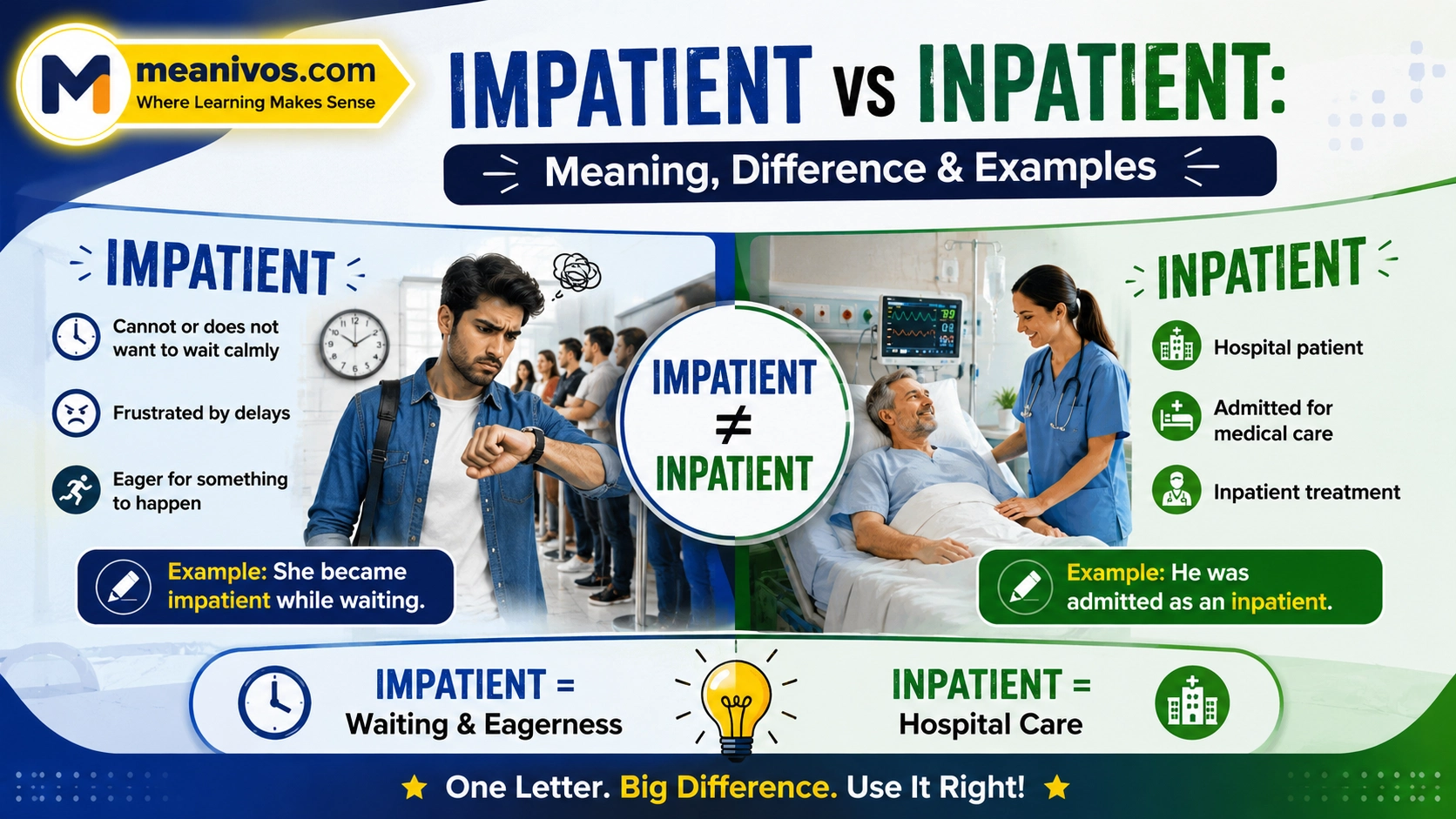
Impatient vs Inpatient: The Main Difference
The difference becomes easy when you separate emotion from healthcare status.
Impatient
Use impatient when you are talking about:
- waiting
- delays
- frustration
- restlessness
- eagerness
- someone’s behaviour
The customer became impatient after the long delay.
Inpatient
Use inpatient when you are talking about:
- Hospital Admission
- medical treatment
- staying in hospital
- hospital patients
- inpatient services
- inpatient facilities
The patient was transferred to an inpatient unit.
The easiest rule
Feeling or behaviour → impatient
Hospital or healthcare → inpatient
Impatient vs Inpatient Examples
Seeing the two words side by side makes the distinction clearer.
Example 1
❌ She became inpatient while waiting for the bus.
✅ She became impatient while waiting for the bus.
The sentence is about frustration caused by waiting.
Example 2
❌ He was admitted as an impatient.
✅ He was admitted as an inpatient.
The sentence is about hospital admission.
Example 3
❌ The hospital provides impatient care.
✅ The hospital provides inpatient care.
The phrase refers to healthcare for admitted patients.
Example 4
❌ She was inpatient for the results.
✅ She was impatient for the results.
She eagerly wanted the results.
Example 5
❌ The impatient unit has 30 beds.
✅ The inpatient unit has 30 beds.
The unit is part of hospital care.
How to Use Impatient Correctly
One of the biggest opportunities for a stronger article is explaining the grammar that follows impatience.
Three particularly useful structures are:
- impatient with
- impatient for
- impatient to + verb
Impatient With
Use impatience when someone is annoyed, frustrated, or dissatisfied with a person, situation, or thing.
Structure
impatient + with + noun/person
Examples:
- She is impatient with slow customers.
- He became impatient with the repeated delays.
- I am impatient with this process.
- The teacher was impatient with the noisy students.
- The manager grew impatient with the lack of progress.
Here, which introduces the person, thing, or situation causing the impatience.
Impatient For
Use impatient for when someone eagerly wants something.
Structure
impatient + for + noun
Examples:
- We are impatient for the results.
- Fans are impatient for the new album.
- She is impatient for the holidays.
- Investors became impatient for an announcement.
- The children were impatient for dinner.
This structure focuses on what someone is eagerly waiting for.
Impatient To + Verb
Use impatient to + verb when someone is eager to perform an action.
Structure
impatient + to + base verb
Examples:
- I am impatient to begin.
- She was impatient to leave.
- They were impatient to see the results.
- He is impatient to return home.
- We are impatient to start the project.
Merriam-Webster’s examples include constructions such as impatient to get home, supporting this usage pattern.
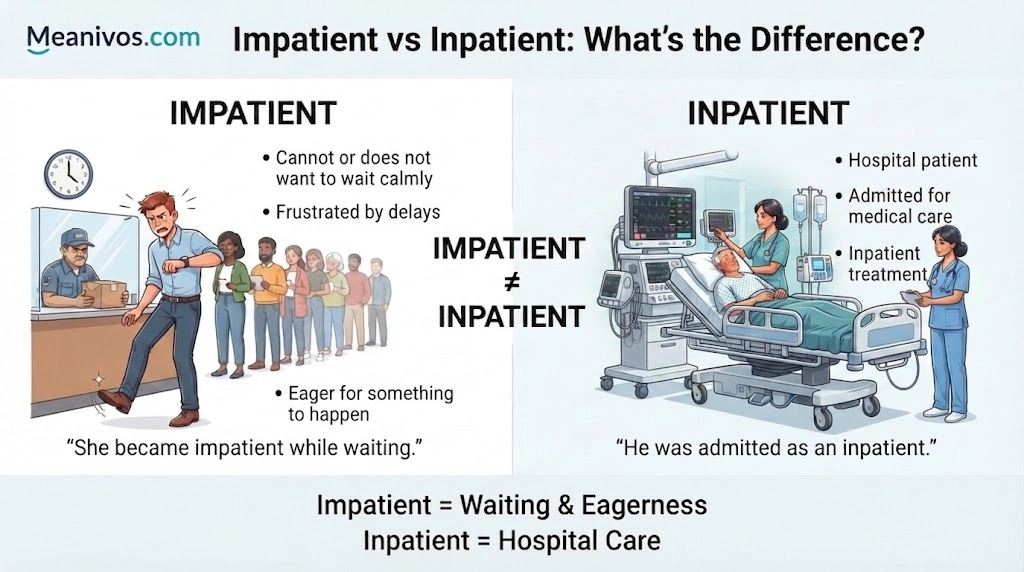
Impatient With vs Impatient For vs Impatient To
These three patterns are easy to confuse.
| Expression | What it tells us | Example |
| impatient with | What/person causes frustration | She is impatient with the delay. |
| impatient for | What someone eagerly wants | She is impatient for the results. |
| impatient to | What action someone wants to do | She is impatient to leave. |
Compare them
She is impatient with the slow service.
It is frustrated by it.
She is impatient for her food.
She eagerly wants it.
It is impatient to leave.
She wants to leave as soon as possible.
This distinction adds useful grammatical depth that a basic definition page often misses.
How to Use Inpatient Correctly
Inpatient is mainly used in healthcare contexts.
As a noun
He is an inpatient at the hospital.
The doctor examined the inpatient.
The ward currently has 25 inpatients.
Notice that when inpatient functions as a singular countable noun, it normally takes an article or another determiner:
an inpatient
not:
❌ an impatient
As an adjective
She needs inpatient treatment.
The hospital expanded its inpatient services.
He was transferred to an inpatient unit.
The adjectival use describes something associated with admitted patients or their care. Collins and American Heritage both document this use.
Inpatient vs Outpatient
Inpatient and outpatient are natural healthcare opposites.
An inpatient stays in a hospital while receiving treatment.
An outpatient receives treatment without staying in the hospital in the same way.
Oxford defines an outpatient as a person who goes to hospital for treatment but does not stay there.
| Term | Meaning | Example |
| Inpatient | Patient who stays in hospital while receiving treatment | He became an inpatient after surgery. |
| Outpatient | Patient who receives treatment without staying in hospital | She attended as an outpatient. |
Related phrases
Inpatient care
Healthcare provided to admitted patients.
Outpatient care
Healthcare provided without the same type of hospital admission.
Inpatient treatment
Treatment requiring or involving inpatient care.
Outpatient treatment
Treatment provided without an inpatient stay.
The exact admission criteria can vary between healthcare systems and institutions, so medical or insurance documents should follow the terminology used by the relevant provider or policy.
Are Impatient and Inpatient Homophones?
Not strictly in every pronunciation.
They are extremely similar in spelling and sound, which is why they are easy to confuse, but dictionary pronunciations show a meaningful stress difference.
Cambridge gives:
- impatient: /ɪmˈpeɪ.ʃənt/
- inpatient: /ˈɪn.peɪ.ʃənt/
The main stress falls differently: impatient has stronger stress on the second syllable, while inpatient has stronger stress on the first.
So it is safer to describe them as very similar-sounding, easily confused words, rather than automatically calling them exact homophones.
Pronunciation memory aid
imPATient
versus
INpatient
The stress pattern can help you distinguish them when speaking carefully.
Why Are Impatient and Inpatient Confused?
There are several reasons these words cause problems.
1. They look almost identical
Both contain:
patient
Only the beginning changes.
2. They sound similar
The words share the long -patient sound pattern.
3. Both connect visually to “patient”
This makes it easy for writers to type the wrong word.
4. Autocorrect can make the problem worse
A spelling correction may not understand whether your sentence refers to an emotion or healthcare.
5. Context determines the answer
Compare:
The patient became impatient.
The person became frustrated by waiting.
The patient became an inpatient.
The person became a hospital patient receiving admitted care.
The same root appears in both words, but the context completely changes the meaning.
Common Mistakes With Impatient and Inpatient
Mistake: “I am inpatient waiting for my order.”
Correct:
I am impatient waiting for my order.
Better:
I am impatient while waiting for my order.
Mistake: “He is impatient at the hospital.”
Correct:
He is an inpatient at the hospital.
Mistake: “The doctor recommended impatient treatment.”
Correct:
The doctor recommended inpatient treatment.
Mistake: “She became inpatient because of the delay.”
Correct:
She became impatient because of the delay.
Mistake: “The inpatient customer was angry.”
If you mean a customer who was annoyed, the intended word is probably:
The impatient customer was angry.
Inpatient would suggest a medical context.
Impatient vs Patient
Understanding patients makes impatience easier to remember.
When patient is an adjective, it describes someone who can wait calmly.
She was patient while waiting for the technician.
Impatient expresses the opposite attitude.
She became impatient while waiting for the technician.
| Patient | Impatient |
| Calm while waiting | Unwilling to wait calmly |
| Shows patience | Shows impatience |
| Tolerates delay | May become frustrated |
| “Take your time.” | “How much longer?” |
Impatient, Impatience, and Impatiently
These related words have different grammatical functions.
Impatient
Adjective
She is impatient.
Impatience
Noun
His impatience was obvious.
Impatiently
Adverb
She waited impatiently.
The relationship is:
impatient → adjective
impatience → noun
impatiently → adverb
This is useful for learners who understand the meaning but are unsure which form belongs in a sentence.
The Origin of Impatient
The history of impatience is different from the simple modern “im + patient” memory trick often presented online.
Merriam-Webster traces impatience through Middle English and Anglo-French to Latin impatient- / impatiens, from in- + patient- / patients. Its first known use is recorded in the 14th century.
This historical background explains the connection with the idea of being unable or unwilling to endure something patiently.
Important caution about the prefix
A common teaching shortcut says:
im- = not
and
in- = inside
That is useful as a memory device, but it should not be treated as a complete explanation of the historical development of the words.
In particular, inpatient is a medical compound whose meaning is connected with an admitted patient; it is not simply enough to decode every in- word as “inside.”
For SEO content, teaching the contextual distinction is more reliable than presenting the prefix rule as a universal law.
The Origin of Inpatient
Inpatient developed as a healthcare term for a patient receiving treatment while staying in a hospital or similar facility.
Merriam-Webster records its first known use as 1738.
Modern dictionaries consistently connect the word with hospital treatment and distinguish it from outpatient. Cambridge and Oxford both treat inpatient as a healthcare noun.
Is Inpatient One Word or Two?
The standard modern spelling is:
inpatient
It is normally written as one word.
Examples:
- Inpatient Care
- inpatient treatment
- inpatient unit
- inpatient rehabilitation
- inpatient admission
Some historical or specialised sources may show in-patient, but modern standard usage overwhelmingly supports inpatient as the solid form. Cambridge’s style guidance, for example, lists inpatient and outpatient among solid compounds.
For ordinary modern English, use:
inpatient
British vs American English
The core meanings and spellings of impatient and inpatient are essentially the same in British and American English.
The main differences you may notice concern:
- pronunciation
- healthcare terminology
- surrounding vocabulary
- style preferences
- Explore More: https://meanivos.com/apposed-vs-opposed/
Cambridge lists pronunciation information for both UK and US English for inpatient, while the spelling remains inpatient.
One separate British/American difference worth knowing is the phrase in hospital versus in the hospital, but this does not change the spelling or meaning of inpatient.
Can Impatient and Inpatient Be Used in the Same Sentence?
Yes.
In fact, this is one of the best ways to understand the distinction.
The impatient visitor waited outside while the inpatient received treatment.
Here:
- Impatient describes the visitor’s attitude.
- Inpatient identifies the hospital patient.
Another example:
The inpatient was becoming impatient with the long wait for test results.
Both words are correct in the same sentence because they describe completely different things.
This is a useful reminder that the words are not interchangeable.
Can “Impatient” Be Used in Medical Contexts?
Yes—but only when the intended meaning is impatient.
A hospital patient can certainly be impatient.
For example:
The patient became impatient after waiting for the doctor.
The word describes the person’s behaviour.
But if you mean the person’s hospital status, use:
inpatient
For example:
The patient was admitted as an inpatient.
Therefore, the setting alone does not determine the word. The meaning of the sentence determines it.
Is “Impatient Care” Correct?
Usually, if you mean medical care for admitted patients, the correct expression is:
inpatient care
For example:
The hospital provides specialised inpatient care.
Impatient care would normally be interpreted literally as care involving Impatient vs Inpatient someone who is impatient, rather than the established healthcare term.
This is an especially important distinction in medical, academic, insurance, and professional writing.
How to Remember Impatient vs Inpatient
Use this two-question method.
Question 1: Is someone struggling to wait?
Choose:
impatient
Think:
“I can’t wait!”
Question 2: Is someone receiving admitted hospital care?
Choose:
inpatient
Think:
“The patient is in the hospital.”
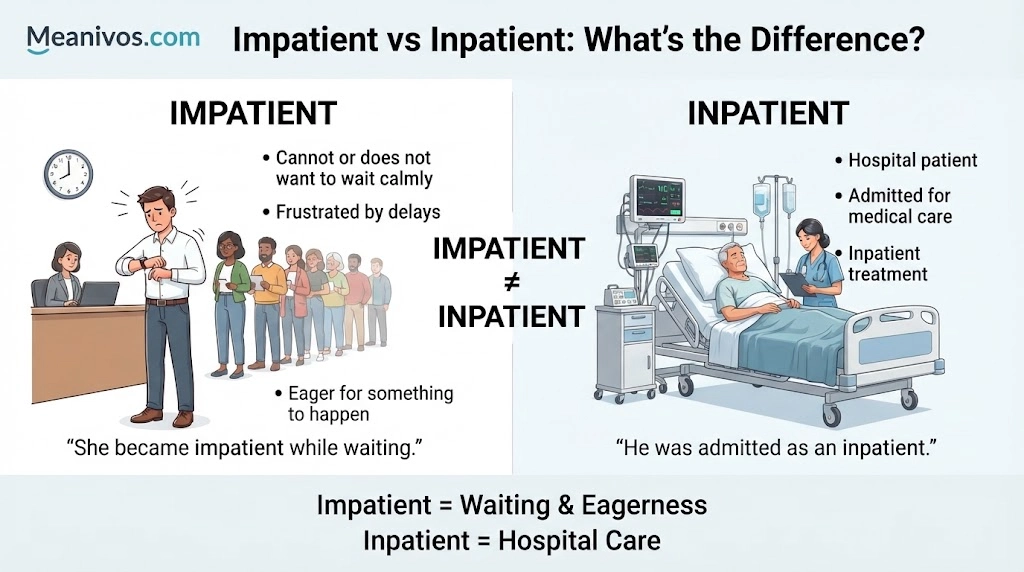
Visual memory trick
Imagine two scenes.
Scene A: A queue
Someone is checking their watch, tapping their foot, and asking:
“How much longer?”
That person is impatient.
Scene B: A hospital
A patient is staying in a hospital room for treatment.
That person is an inpatient.
One-line memory trick
Impatient = waiting. Inpatient = hospital.
That is much safer than relying only on the prefixes.
A 5-Second Decision Test
When you are unsure, replace the word with a simpler phrase.
If you can replace it with:
frustrated / restless / eager
→ use impatient
If you can replace it with:
hospital patient / admitted patient
→ use inpatient
For example:
She was ___ for the results.
Replace the blank with eagerness.
So:
She was impatient for the results.
Now:
He was admitted as an ___.
Replace the blank with a hospital patient.
So:
He was admitted as an inpatient.
20 Correct Example Sentences
Impatient examples
- She became impatient after waiting for an hour.
- The children were impatient during the long journey.
- He is impatient with slow service.
- I am impatient for the results.
- She was impatient to begin the meeting.
- The customer became impatient after the delay.
- Don’t be impatient; your turn will come soon.
- He grew impatient with the repeated excuses.
- We are impatient for the announcement.
- She was impatient to see the final design.
Inpatient examples
- He was admitted as an inpatient.
- The hospital has a dedicated inpatient unit.
- She received inpatient treatment.
- The doctor recommended inpatient rehabilitation.
- The inpatient remained under observation overnight.
- The hospital expanded its inpatient services.
- He spent three nights as an inpatient.
- The facility provides specialist inpatient care.
- The patient was transferred to an inpatient ward.
- The hospital manages both inpatient and outpatient services.
Impatient vs Inpatient: Common Sentence Corrections
| Incorrect | Correct | Why |
| She was inpatient while waiting. | She was impatient while waiting. | Waiting/frustration |
| He became impatient. | He became an inpatient. | Hospital patient |
| The hospital offers impatient care. | The hospital offers inpatient care. | Healthcare |
| I am inpatient for the answer. | I am impatient for the answer. | Eagerness |
| She is inpatient with delays. | She is impatient with delays. | Frustration |
| He was impatient after surgery. | He was an inpatient after surgery. | Medical status |
Related Terms You Should Know
Understanding these related words strengthens the distinction.
Patient
Can be a noun meaning a person receiving medical care.
The patient saw the doctor.
It can also be an adjective meaning calm and willing to wait.
She was patient with the children.
Impatient
The adjective describing a lack of patience or strong eagerness.
He became impatient.
Impatience
The noun describing the feeling or quality.
Her impatience was obvious.
Impatiently
The adverb.
He waited impatiently.
Inpatient
A patient receiving admitted hospital care.
He is an inpatient.
Outpatient
A person receiving healthcare without staying in hospital in the same way.
She attended as an outpatient.
Semantic Keyword Map
For readers and search engines, these terms naturally belong to the same topic:
Impatient cluster
impatient meaning, impatient definition, impatient with, impatient for, impatient to, impatiently, impatience, impatient person, impatient behaviour, impatient waiting, impatient synonym, impatient opposite
Inpatient cluster
inpatient meaning, inpatient definition, inpatient care, inpatient treatment, inpatient unit, inpatient rehabilitation, inpatient admission, inpatient hospital, inpatient services, inpatient vs outpatient, inpatient patient
Comparison cluster
impatient or inpatient, inpatient vs impatient, difference between impatient and inpatient, impatient vs inpatient examples, impatient spelling, inpatient spelling, how to remember impatient vs inpatient
People Also Ask
A:Impatient describes someone who is unable or unwilling to wait calmly, or someone who eagerly wants something to happen. Inpatient refers to a person receiving admitted healthcare, typically while staying in a hospital or similar facility.
A:Impatient is an adjective.
For example:
She is impatient.
The related noun is impatience.
A:Yes. Inpatient is commonly used as a noun for a person who stays in hospital while receiving treatment. It is also used adjectivally in phrases such as inpatient care and inpatient treatment.
A:Think:
Impatient = I can’t wait.
Inpatient = in hospital.
If the sentence is about waiting or eagerness, choose impatient. If it is about hospital admission or healthcare, choose inpatient.
A:Yes. Inpatient care is an established healthcare expression referring to care for patients receiving admitted treatment.
Final Verdict
The correct word depends entirely on what you mean.
Use impatient when you are talking about waiting, Frustration, restlessness, or eagerness.
She became impatient while waiting for the train.
Use inpatient when you are talking about a patient admitted for healthcare or care associated with admitted patients.
He was admitted as an inpatient.
The fastest memory trick is:
Impatient = cannot wait.
Inpatient = hospital patient.
If you are describing a feeling or behaviour, choose impatient.
If you are describing a medical status or type of healthcare, choose inpatient.
Once you connect each word to its context, the spelling difference becomes much easier to remember.