Spoilt vs Spoiled: British vs American English Explained
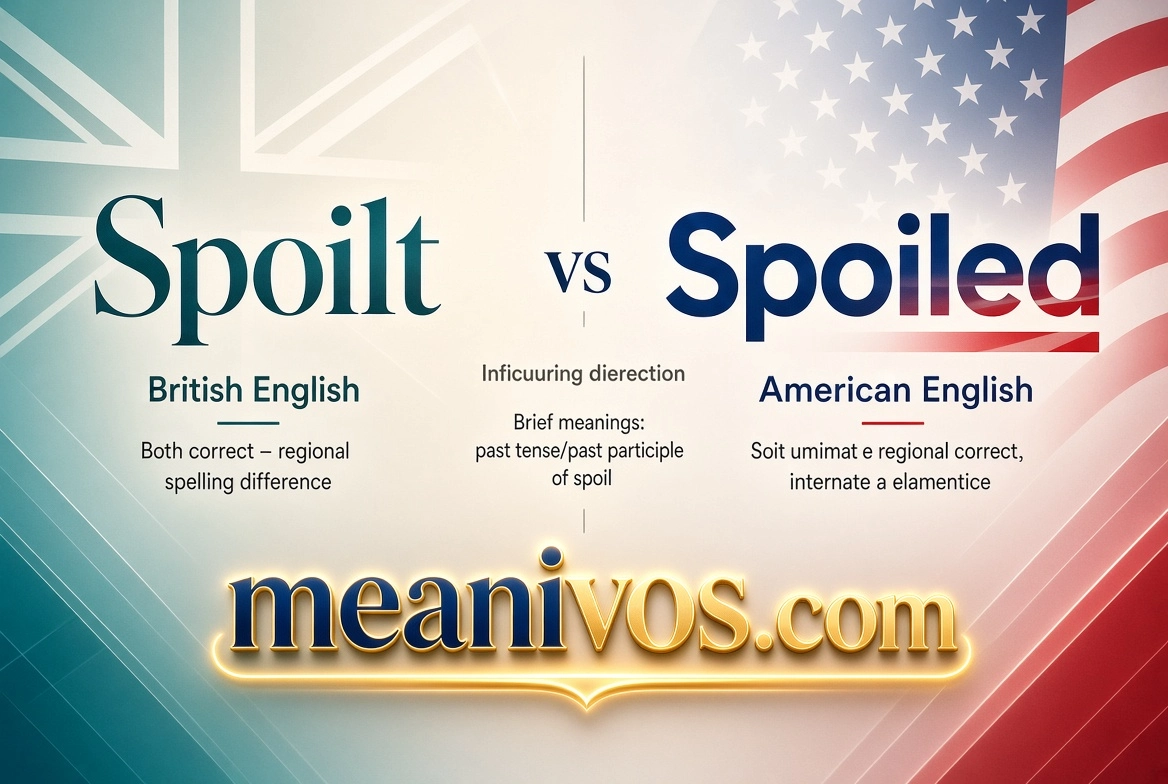
Spoilt vs Spoiled are both correct forms of the verb spoil. The main difference is regional: British English speakers mainly use “spoilt,” while American English speakers prefer “spoiled.”
If you are wondering, “Is it spoiled or spoilt?”, the answer is both.
For example:
- British English: The rain spoiled our holiday.
- American English: The rain spoiled our vacation.
The meaning does not change. Both sentences say that the rain ruined the holiday or vacation.
Cambridge Dictionary lists spoiled and spoilt as past forms of spoil and specifically labels spoilt as mainly UK. Merriam-Webster likewise records spoiled and spoilt, with spoilt identified as chiefly British.
This guide explains the difference between spoilt vs spoiled, including their meanings, grammar, British and American usage, examples, common expressions, and the easiest way to choose the right form.
Spoilt vs Spoiled: Quick Answer
| Form | Main association | Correct? | Example |
| spoilt | Mainly British English | Yes | The rain spoilt our picnic. |
| spoiled | Mainly American English | Yes | The rain spoiled our picnic. |
The simple rule
Use “spoiled” for American English.
Use “spoilt” when following a British-English style, although British English also accepts spoiled.
The important thing is to choose a consistent variety of English for your writing.
What Does “Spoilt” Mean?
Spoilt is a past-tense and past-participle form of spoil. It can ruin, damage, negatively affect, or make something less enjoyable.
It can also describe someone who has received too much attention, generosity, or indulgence.
Examples:
- The rain spoilt our picnic.
- The milk had spoiled.
- She was a spoiled child.
- Someone spoilt the surprise.
- The noise spoiled the atmosphere.
Cambridge defines spoilt as another spelling of spoiled and labels the form mainly UK.
Common meanings of “spoilt”
Depending on context, spoilt can mean:
- Ruined
- The bad weather spoiled the event.
- Gone bad or decayed
- The milk had spoiled.
- Overindulged
- He was a spoiled child.
- Negatively affected
- The argument spoilt their evening.
- Given unusually good treatment
- I felt completely spoiled on my birthday.
The context determines the exact meaning of the verb or adjective.
What Does “Spoiled” Mean?
Spoiled has essentially the same meanings as spoilt.
American English speakers use it especially often, while British and international English speakers also recognise it.
Examples:
- The food has spoiled.
- The rain spoiled our plans.
- She was a spoiled child.
- Someone spoiled the surprise.
- We were spoiled with excellent service.
Cambridge identifies spoiled as the past simple and past participle of spoil.It also gives adjective meanings that describe excessive indulgence and especially good treatment.
Merriam-Webster similarly lists spoiled and spoilt as forms of spoil.
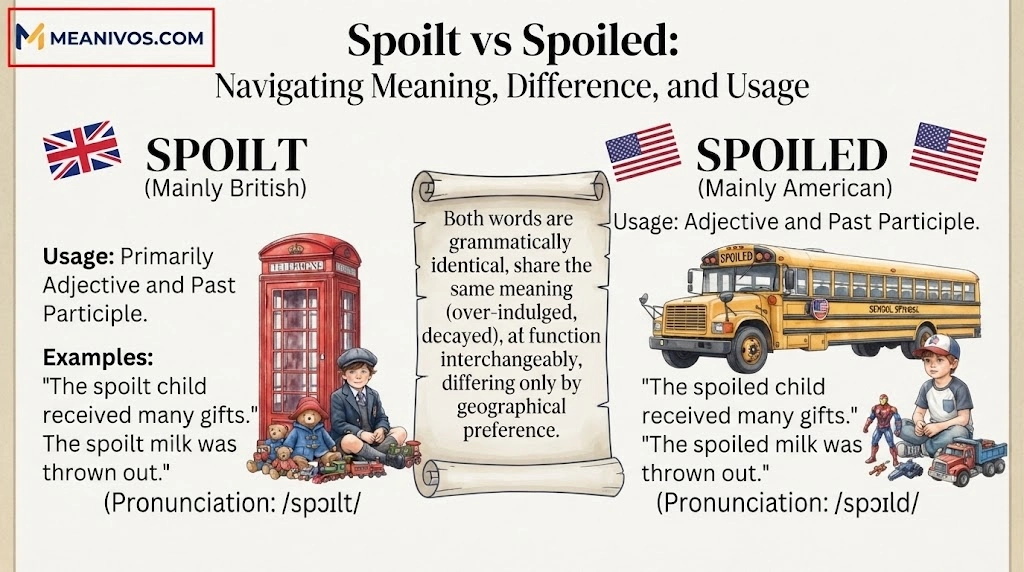
Spoilt vs Spoiled: What Is the Difference?
The biggest difference is regional preference, not meaning.
Spoilt
- Mainly associated with British English
- Common in British-style writing
- Frequently used in expressions such as spoilt child
- Correct standard English
- Also found in other varieties influenced by British English
Spoiled
- Especially common in American English
- Widely recognised internationally
- Correct standard English
- Also accepted in British English
Compare:
The child was spoiled by his grandparents.
The child was spoiled by his grandparents.
Both sentences are grammatically correct and mean essentially the same thing.
Cambridge explicitly presents spoilt as a mainly UK form rather than treating spoiled as incorrect in British English.
Is “Spoilt” Correct in English?
Yes. “Spoilt” is completely correct English.
It is not a spelling mistake or an incorrect version of spoiled. It is an established form of spoil, particularly associated with British English.
Examples:
- The rain spoiled the match.
- The food was spoiled.
- His behaviour spoilt the evening.
- The surprise was spoiled.
- The children were spoiled by their grandparents.
Cambridge describes spoilt as another spelling of spoiled, while Merriam-Webster identifies it as a chiefly British form.
Therefore, you should not automatically “correct” spoilt to spoiled.
Instead, consider the English variety being used.
Is “Spoiled” Correct in English?
Yes. “Spoiled” is completely correct.
Americans use it particularly often, but people in other countries use it too.
Examples:
- The milk has spoiled.
- The rain spoiled our plans.
- He is a spoiled child.
- Someone spoiled the ending.
- The heat spoiled the food.
Merriam-Webster lists spoiled as a standard past form of spoil and also records spoilt as a chiefly British variant.
So the claim that “spoiled is wrong” is incorrect.
Spoilt vs Spoiled in British and American English
Regional English is the main reason these two forms confuse learners.
American English: “Spoiled”
American English strongly prefers spoiled.
Examples:
- The milk has spoiled.
- She is a spoiled child.
- The rain spoiled the picnic.
- Someone spoiled the ending.
If you are writing specifically for an American audience, spoiled is normally the safest and most natural choice.
British English: “Spoilt” and “Spoiled”
British English recognises both forms, but spoilt has a stronger British association.
Examples:
- The rain spoilt our holiday.
- He was a spoiled child.
- The surprise was spoiled.
- The food was spoiled.
However, spoiled is not automatically wrong in British English.
The practical distinction is therefore:
American English → spoiled is preferred
British English → spoilt is a characteristic choice, but spoiled is also accepted
This is more accurate than saying that every British speaker uses spoilt and every American speaker uses spoiled.
Why Does English Have “Spoilt” and “Spoiled”?
English has several verbs with both -ed and -t past forms.
| Base verb | -ed form | -t form |
| spoil | spoiled | spoilt |
| learn | learned | learnt |
| burn | burned | burnt |
| dream | dreamed | dreamt |
| spell | spelled | spelt |
This helps explain why spoilt is perfectly legitimate even though it may look unusual to American readers.
It is not an invented shortening of spoiled. It is an established form of the verb.
Merriam-Webster records spoiled, spoilt, and pronunciation information for both forms.
Spoilt vs Spoiled as the Past Tense of “Spoil”
Both forms can function as the simple past tense.
With “spoilt”
The rain spoilt our plans.
With “spoiled”
The rain spoiled our plans.
The grammatical function and meaning are the same.
More examples:
- The argument spoilt the evening.
- The argument spoiled the evening.
- The noise spoiled the atmosphere.
- The noise spoiled the atmosphere.
Cambridge directly lists spoiled or spoilt as the past forms of spoil.
Spoilt vs Spoiled as a Past Participle
Both forms can also work as the past participle.
They can appear after words such as has, have, had, been, was, and were.
British-style example
The food has spoiled.
American-style example
The food has spoiled.
Another pair:
The surprise had been spoiled.
The surprise had been spoiled.
Both are grammatical.
Cambridge’s dictionary entry for spoil explicitly gives spoiled or spoilt as both the past tense and past participle.
Spoilt vs Spoiled as Adjectives
Both forms can also describe a person or thing.
For example:
- a spoilt child
- a spoiled child
- spoilt food
- spoiled food
When describing a person, spoiled or spoiled can suggest that someone has received too much attention, generosity, or freedom and may therefore behave badly.
Cambridge says that people use this adjective for someone who can have or do whatever they want, often leading to poor behaviour.
For example:
He is a spoiled child.
Or, in British-style usage:
He is a spoiled child.
The meaning remains essentially the same.
Spoiled Child vs Spoilt Child
Both expressions are correct.
American English
She is a spoiled child.
British English
She is a spoiled child.
A spoiled child or spoiled child is not simply a child who is happy, loved, or well cared for.
The expression usually suggests excessive indulgence that has negatively affected the child’s behaviour or expectations.
For example:
Her parents gave her everything she wanted, so she became a spoiled child.
Cambridge says that people often use the adjective for someone who can have or do whatever they want, often with negative effects on their behaviour.
Spoiled Food vs Spoilt Food
Both forms can describe food that has gone bad, decayed, or lost its freshness.
American English
The milk has spoiled.
British English
The milk has spoiled.
Both mean that the milk is no longer fresh and may not be suitable for use.
More examples:
- The meat has spoiled.
- The meat has spoiled.
- The fruit spoiled in the heat.
- The fruit spoiled in the heat.
Merriam-Webster defines spoil as losing valuable or useful qualities, commonly through decay, and gives food as an example.
- Explore More: https://meanivos.com/chillin-meaning/
Spoiled vs Spoilt When You Mean “Ruined”
Another common meaning of spoil is to ruin or damage something.
For example:
The rain spoiled our picnic.
British-style:
The rain spoilt our picnic.
In both cases, the meaning is:
The rain ruined our picnic.
Other examples include:
- The loud music spoiled the atmosphere.
- The loud music spoiled the atmosphere.
- The argument spoiled their evening.
- The argument spoilt their evening.
Cambridge defines spoil in this sense as destroying or reducing the pleasure, interest, or beauty of something.
Spoilt vs Spoiled for Movies and Surprises
People commonly use the verb “spoil” when someone reveals information about a movie, book, television show, or surprise.
The base form remains the same:
Don’t spoil the ending for me.
The past forms can differ regionally:
American English
You spoiled the movie.
British English
You spoilt the movie.
The same pattern applies to surprises:
- Someone spoiled the surprise.
- Someone spoilt the surprise.
So remember:
spoil → spoiled / spoilt
Cambridge includes the “ruin the enjoyment by revealing what happens” meaning among its definitions of spoil.
“Spoilt for Choice” vs “Spoiled for Choice”
Spoilt for choice is a particularly useful expression to understand.
It means:
Having so many good options that it becomes difficult to choose.
For example:
We were spoilt for choice when selecting a restaurant.
This does not mean that the choices were bad or damaged.
It means there were many attractive options.
Cambridge lists “are spoiled for choice” as a UK idiom and also recognises “be spoiled for choice” as an alternative.
Examples:
- We were spoilt for choice.
- We were spoiled for choice.
- Shoppers are spoilt for choice.
- Customers are spoiled for choice.
English speakers especially use the British form “spoilt for choice,” while they also use “spoiled for choice.”
20 Examples of Spoilt and Spoiled
The easiest way to understand the difference is to compare equivalent sentences.
British-style examples
- The rain spoilt our holiday.
- She was a very spoilt child.
- The milk had spoilt.
- The surprise was spoilt.
- The weather spoilt the picnic.
- The noise spoilt the atmosphere.
- We were spoilt for choice.
- His behaviour spoilt the evening.
- The heat spoilt the food.
- Someone spoilt the ending.
American-style examples
- The rain spoiled our vacation.
- She was a very spoiled child.
- The milk had spoiled.
- The surprise was spoiled.
- The weather spoiled the picnic.
- The noise spoiled the atmosphere.
- We were spoiled for choice.
- His behaviour spoiled the evening.
- The heat spoiled the food.
- Someone spoiled the ending.
The central lesson is simple: changing “spoilt” to “spoiled” normally changes the regional form, not the meaning.
Spoilt vs Spoiled: Quick Comparison Table
| Feature | Spoilt | Spoiled |
| Base verb | spoil | spoil |
| Correct English? | Yes | Yes |
| Past tense | Yes | Yes |
| Past participle | Yes | Yes |
| Adjective | Yes | Yes |
| Main association | British English | American English |
| Meaning | Same | Same |
| Can I describe ruined things? | Yes | Yes |
| Can you describe bad food? | Yes | Yes |
| Can I describe an overindulged person? | Yes | Yes |
| Used with “for choice”? | Yes | Yes |
| Common in American English? | Less typical | Yes |
| Common in British English? | Yes | Yes |
Common Mistakes With Spoilt and Spoiled
Mistake 1: Thinking “spoilt” is wrong
Some learners assume:
“Spoilt” is a spelling mistake.
That is incorrect.
Spoilt is a recognised English form, particularly in British English. Cambridge explicitly identifies it as another spelling of spoiled.
Mistake 2: Thinking “spoiled” is only American
This is also too simplistic.
American English speakers strongly associate “spoiled” with their variety of English, but British English speakers also recognise and use it.
Mistake 3: Assuming the meaning changes
Compare:
The rain spoilt the party.
The rain spoiled the party.
Both mean that the rain ruined the party.
Mistake 4: Mixing styles unnecessarily
A writer may use spoilt in one sentence and spoiled in another without a grammatical error.
However, if you are writing an article, essay, book, or professional document, consistent regional spelling usually makes the writing feel more polished.
Mistake 5: Thinking “spoilt” always means “happy”
Spoilt does not simply mean happy.
For example:
I was spoilt on my birthday.
This can mean that someone treated you especially well or gave you lots of gifts.
But:
I was happy on my birthday.
simply describes your emotional state.
Context determines the meaning.
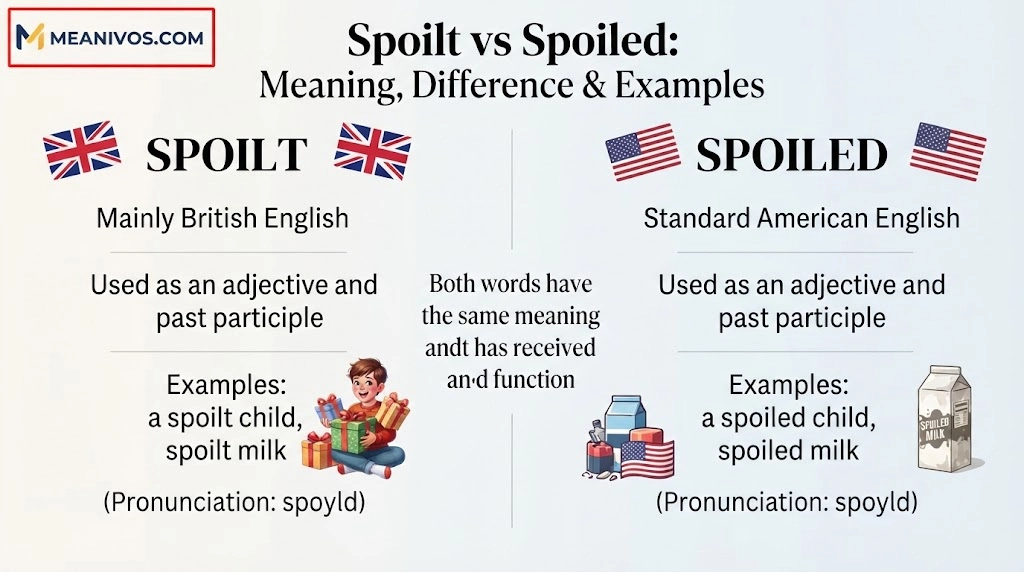
How to Choose Between Spoilt and Spoiled
Use this simple decision guide.
Are you writing American English?
Choose:
spoiled
Example:
The child was spoiled by his grandparents.
Are you writing British English?
Choose:
spoilt
Example:
The child was spoilt by his grandparents.
However, spoiled is also acceptable in British English.
Are you writing for an international audience?
Either form can work.
If you want a form that is especially familiar to American readers, choose spoiled.
If your website follows British English, choose spoilt.
The most important rule is:
Choose one English variety and use it consistently.
Is “Spoilt” More British Than “Spoiled”?
Yes.
The most accurate way to describe the distinction is:
British English speakers mainly use “spoilt,” while American English speakers especially use “spoiled.”
Avoid saying that British English exclusively uses spoilt. British English also recognises spoiled. Cambridge labels spoilt as mainly UK, which is more nuanced than an absolute regional rule.
This distinction matters because English varieties often overlap.
Is “Spoiled” More Common in American English?
Yes.
For American readers, spoiled is the normal choice in sentences such as:
The milk spoiled.
He was spoiled as a child.
The movie ending was spoiled.
Merriam-Webster lists spoiled as a standard form and identifies spoilt as chiefly British.
Are Spoilt and Spoiled Pronounced Differently?
Usually, the two forms are pronounced very similarly.
Both are generally pronounced approximately like “spoyld.”
The major difference is therefore in the written form and regional preference, not in everyday pronunciation.
That is one reason the distinction rarely causes a problem in conversation.
What Is the Past Tense of “Spoil”?
The verb spoil has two accepted past-tense forms:
- spoiled
- spoilt
Examples:
The food spoiled.
The food spoiled.
Both are correct.
Cambridge directly lists spoiled or spoilt as the past forms of spoil.
What Is the Past Participle of “Spoil”?
The past participle can also be:
- spoiled
- spoilt
Examples:
The food has spoiled.
The food has spoiled.
And:
The surprise had been spoiled.
The surprise had been spoiled.
Your choice largely depends on the English variety and style you follow.
Which Is Better: Spoilt or Spoiled?
Neither form is universally “better.”
The best choice depends on your audience.
Choose “spoiled” when:
- You are writing American English.
- Your audience is mainly American.
- You are following an American style guide.
- You want the form most familiar to US readers.
Choose “spoilt” when:
- You are writing British English.
- Your publication follows British spelling.
- Your audience is accustomed to British usage.
- You want a distinctly British form.
The key point
Do not treat one as correct and the other as incorrect.
Both are established English forms.
Does “Spoilt” Mean the Same as “Spoiled”?
Yes, in the relevant contexts.
For example:
The rain spoilt the party.
and
The rain spoiled the party.
Both mean that the rain ruined the party.
Likewise:
He is a spoilt child.
and
He is a spoiled child.
Both terms describe someone whom others have indulged excessively.
The spelling changes according to regional preference, while the underlying meaning remains the same.
Can You Use “Spoilt” in Formal Writing?
Yes.
If you are following British English, spoilt is perfectly acceptable in formal writing.
For example:
The unexpected delay spoiled the schedule.
There is no grammatical problem with the form simply because American English more commonly uses spoiled.
The style of English required by your publication, institution, audience, or examination should always be considered.
Can You Use “Spoiled” in British English?
Yes.
British English does not make spoiled incorrect.
While spoilt has a stronger British association, Cambridge recognises spoiled and spoilt in its English dictionary resources.
So:
The rain spoiled our holiday.
can be grammatically acceptable in British English.
Spoilt vs Spoiled in Different Contexts
| Context | British-style choice | American-style choice |
| Ruined plans | The rain spoilt our plans. | The rain spoiled our plans. |
| Bad food | The milk has spoiled. | The milk has spoiled. |
| Overindulged child | A spoilt child | A spoiled child |
| Movie ending | You spoiled the ending. | You spoiled the ending. |
| Holiday | It spoiled our holiday. | It spoiled our vacation. |
| Choice | Spoilt for choice | Spoiled for choice |
| Atmosphere | The noise spoiled the atmosphere. | The noise spoiled the atmosphere. |
People Also Ask
A:Both are correct. Spoilt is mainly associated with British English, while spoiled is especially common in American English.
A:Spoilt is mainly British. Cambridge specifically labels it as mainly UK.
A:Americans generally prefer spoiled. Spoilt can be understood, but it is much less typical in ordinary American English.
A:Yes. British English recognises spoiled as well as spoilt. Spoilt simply has a stronger British association.
A:Yes. Spoiled child is completely correct and is especially common in American English.
Final Verdict
The Spoilt vs Spoiled debate is not really about right versus wrong.
It is mainly about regional English usage.
Spoilt and spoiled are both accepted forms of spoil. They can function as the past tense, past participle, and adjective. The strongest regional distinction is that spoilt is mainly associated with British English, while spoiled is especially common in American English. Cambridge and Merriam-Webster both recognise the two forms.
Remember this:
British English → spoilt is common
American English → spoiled is preferred
Both forms → correct English
So if you write:
The rain spoilt our plans.
or:
The rain spoiled our plans.
you have not changed the basic meaning. You have chosen different regional forms of English.
For British-style writing, spoilt is a natural choice. For American English, spoiled is normally the better choice. In international writing, either can work, but consistency matters most.
Sources and Authority References
For editorial verification, the strongest references for this topic are:
- Cambridge Dictionary — definitions, grammatical forms, regional labels, and spoilt for choice.
- Merriam-Webster — verb forms, meanings, usage, and the chiefly British label for spoilt.