Loose vs Lose: What’s the Difference? Meaning, Pronunciation & Examples
Loose vs Lose is one of the most common spelling and grammar confusions in English. The words look almost identical, but they have different meanings, grammatical roles, and pronunciations.
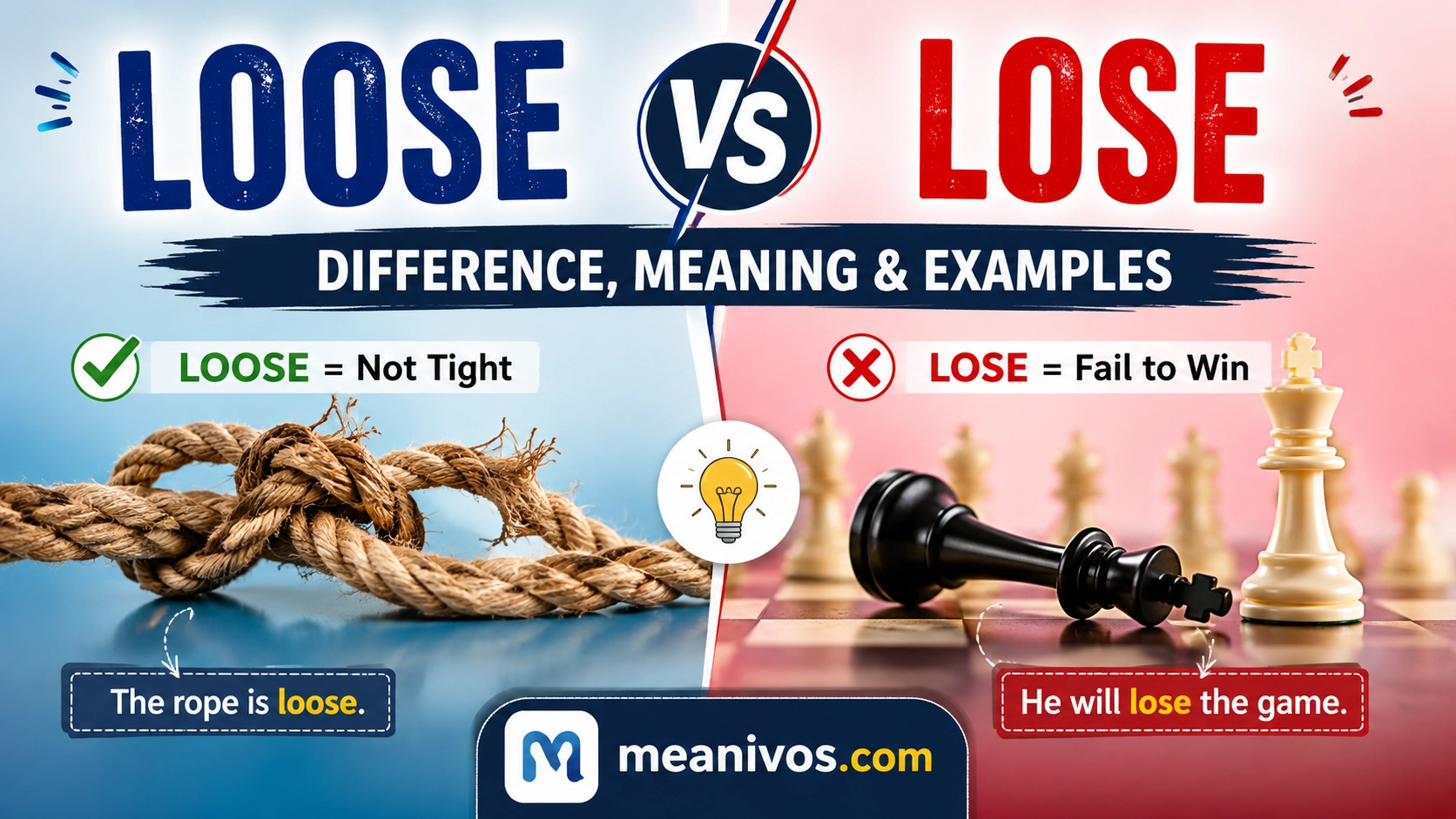
The quickest way to remember the difference is:
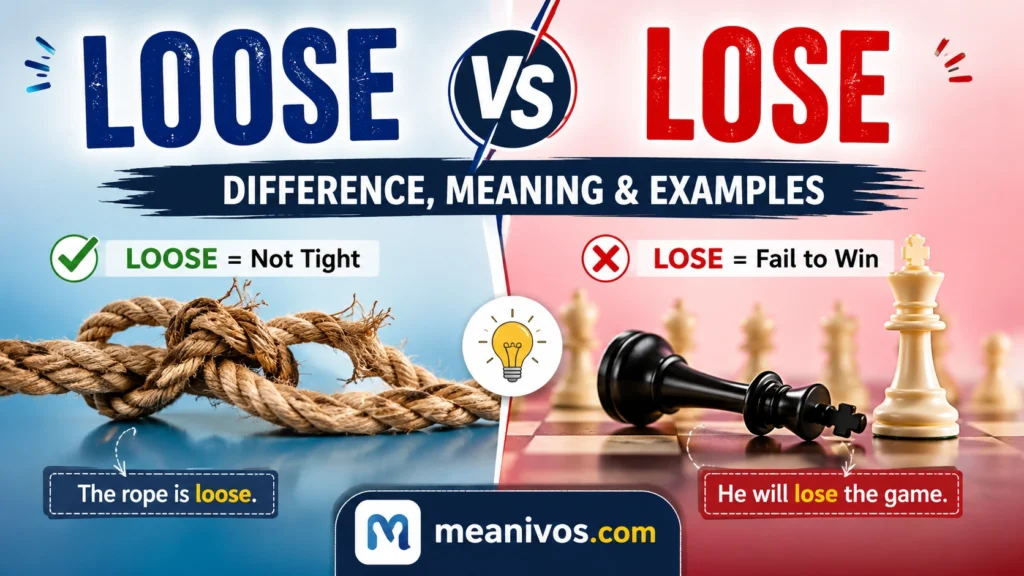
- Loose usually means not tight, not firmly attached, or free.
- Lose is a verb meaning to misplace something, no longer have something, or fail to win.
For example:
My shoes are loose.
Here, loose describes the fit of the shoes.
I don’t want to lose my shoes.
Here, lose describes an action—the possibility of no longer having the shoes.
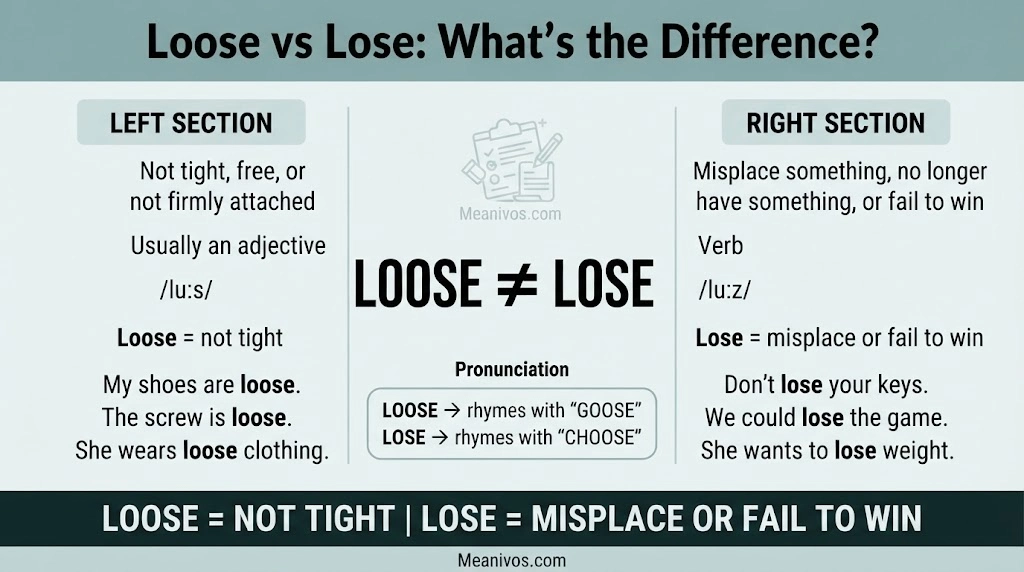
The extra o in loose can make the two words easy to confuse, especially when writing quickly. Their pronunciation also differs: loose ends with an s sound, while lose ends with a z sound.
This guide explains loose vs lose in simple language, with definitions, pronunciation, examples, common mistakes, related words, useful phrases, memory tricks, and a short practice quiz.
Loose vs Lose: Quick Answer
Loose means not tight, not firmly fixed, or free from restraint. It is usually an adjective.
Lose means to misplace something, no longer have something, or fail to win. It is a verb.
| Word | Part of speech | Main meaning | Example |
| Loose | Usually adjective | Not tight or securely fixed | My shirt is loose. |
| Lose | Verb | Misplace, no longer have, or fail to win | Don’t lose your shirt. |
There is an important exception: loose can also be a verb, although this use is much less common. As a verb, loose can mean to release, free, untie, or let something go.
What Is the Difference Between Loose and Lose?
The main difference is meaning, grammar, and pronunciation.
Use loose when you are describing something that is not tight, securely attached, or restricted.
Use lose when you are describing the action of misplacing something, no longer having something, or failing to win.
Compare these examples:
- The screw is loose.
- Don’t lose the screw.
- Her dress is loose.
- She doesn’t want to lose weight.
- The dog got loose.
- We might lose the game.
A simple rule is:
Loose = not tight.
Lose = misplace, no longer have, or fail to win.
This distinction is consistent with major English dictionaries and grammar references.
Loose vs Lose: Comparison Table
| Feature | Loose | Lose |
| Spelling | Two o’s | One o |
| Common part of speech | Adjective | Verb |
| Pronunciation | /luːs/ | /luːz/ |
| Basic meaning | Not tight or securely fixed | Misplace, no longer have, or fail to win |
| Example | The belt is loose. | Don’t lose the belt. |
| Rhymes with | goose, moose | choose, shoes |
| Comparative form | looser | — |
| Related forms | loosen, loosest | lost, losing, loser, loss |
What Does Loose Mean?
Loose usually means not tight, not firmly attached, not securely fastened, or free from restraint.
It is most commonly used as an adjective.
1. Loose Means Not Tight
Use loose when something does not fit tightly.
Examples:
- These pants are too loose.
- I prefer loose clothing in summer.
- His shirt is loose around the shoulders.
- The jacket has a loose fit.
- My shoes feel loose.
Cambridge defines loose in contexts including something that is not firmly held, fastened, or tight.
2. Loose Means Not Firmly Attached
Something can be loose when it is partly detached or not securely fixed.
Examples:
- The door handle is loose.
- One of the table legs is loose.
- There is a loose wire behind the computer.
- The tooth has become loose.
- The screw is loose.
3. Loose Means Free or Unrestricted
Loose can also describe something that is free from restraint.
Examples:
- The dog was running loose in the park.
- The horse broke loose from the fence.
- Her hair was hanging loose.
- The children were let loose in the playground.
4. Loose Can Mean Not Exact or Strict
The word can also describe something that is not precise, strict, or closely controlled.
Examples:
- The movie is a loose adaptation of the novel.
- He gave a loose interpretation of the rules.
- The report uses a loose definition of the term.
So loose does not always refer to physical objects. It can describe ideas, interpretations, rules, or relationships that are not tightly defined.
What Does Lose Mean?
Lose is a verb. It commonly means to misplace something, no longer have something, suffer a loss, or fail to win.
1. Lose Means to Misplace Something
Examples:
- Don’t lose your keys.
- I always lose my phone.
- She lost her wallet yesterday.
- He doesn’t want to lose his passport.
- Try not to lose your ticket.
In these examples, lose means that something can no longer be found or located.
2. Lose Means Fail to Win
Use lose when someone fails to win a game, match, competition, or contest.
Examples:
- Our team may lose the match.
- They lost the final.
- I don’t want to lose this game.
- Nobody likes to lose a competition.
3. Lose Means No Longer Have Something
You can also lose something valuable, important, or abstract.
Examples:
- She lost her job.
- He lost his confidence.
- They could lose the opportunity.
- The company may lose several customers.
4. Lose Means Have Less of Something
Examples:
- She wants to lose weight.
- The company lost money last year.
- We cannot afford to lose time.
- The machine is losing power.
One especially common mistake is writing “loose weight.”
The correct expression is:
lose weight
Not:
loose weight
How Do You Pronounce Loose and Lose?
Pronunciation is one of the easiest ways to distinguish the words.
Loose: /luːs/
Loose ends with an s sound.
It rhymes with:
- goose
- moose
- juice
Think:
loose → goose
Lose: /luːz/
Lose ends with a z sound.
It rhymes with:
- choose
- shoes
- blues
Think:
lose → choose
Cambridge gives loose the pronunciation /luːs/, while dictionary references distinguish lose with a final /z/ sound.
Pronunciation Memory Trick
Say these pairs aloud:
goose → loose
choose → lose
If the final sound is like goose, think loose.
If the final sound is like choose, think lose.
Loose vs Lose Examples
Examples With Loose
- My shoes are too loose.
- The screw is loose.
- She wore a loose sweater.
- The dog got loose.
- The button is loose.
- I like wearing loose clothing.
- There is a loose connection.
- The rope became loose.
- He has a loose grip.
- The film is a loose adaptation of the book.
Examples With Lose
- Don’t lose your keys.
- I don’t want to lose my phone.
- We could lose the game.
- She wants to lose weight.
- Try not to lose your temper.
- He might lose his job.
- Don’t lose hope.
- We cannot afford to lose time.
- She lost her wallet.
- The team lost the final.
Loose vs Lose in Sentences
| Loose | Lose |
| The rope is loose. | Don’t lose the rope. |
| My shoes are loose. | I might lose my shoes. |
| The button is loose. | Don’t lose the button. |
| Her dress is loose. | She wants to lose weight. |
| The dog is loose. | Don’t lose sight of the dog. |
| The screw is loose. | We could lose the screw. |
| His grip is loose. | He may lose control. |
The words may appear in similar situations, but they cannot normally replace each other.
- Explore More: https://meanivos.com/woman-vs-women/
Common Mistakes With Loose and Lose
Mistake 1: “I don’t want to loose my keys.”
❌ Incorrect: I don’t want to loose my keys.
✅ Correct: I don’t want to lose my keys.
Why? You mean misplace your keys, so the correct verb is lose.
Mistake 2: “My shoes are too lose.”
❌ Incorrect: My shoes are too lose.
✅ Correct: My shoes are too loose.
Why? You are describing the shoes as not tight.
Mistake 3: “I want to loose weight.”
❌ Incorrect: I want to loose weight.
✅ Correct: I want to lose weight.
Why? The standard expression is lose weight.
Mistake 4: “Don’t loose the game.”
❌ Incorrect: Don’t loose the game.
✅ Correct: Don’t lose the game.
Why? A team can win or lose a game.
Mistake 5: “The screw is lose.”
❌ Incorrect: The screw is lose.
✅ Correct: The screw is loose.
Why? The screw is not securely attached.
Mistake 6: “She is loosing her phone.”
❌ Incorrect: She is loosing her phone.
✅ Correct: She is losing her phone.
Why? The present participle of lose is losing, not loosing.
Loose vs Loosen: What’s the Difference?
Loose and loosen are related, but they are not interchangeable.
The Loose is usually an adjective describing something that is not tight.
The knot is loose.
Loosen is a verb meaning to make something less tight.
Please loosen the knot.
Compare:
- The belt is loose.
- Please loosen the belt.
- The screw is loose.
- He loosened the screw.
- Her grip became loose.
- She loosened her grip.
Dictionary references also recognize loose as a less-common verb meaning to release or set free, but loosen is the ordinary choice when you mean “make less tight.”
Lose vs Lost vs Losing
These are forms of the same verb.
Lose
Base/present form:
Don’t lose your ticket.
Loses
Third-person singular present:
He often loses his keys.
Lost
Past tense and past participle:
She lost her wallet yesterday.
Losing
Present participle:
I am losing patience.
Remember:
lose → lost → losing
Not:
loose → loosed → loosing
unless you actually mean the separate verb loose.
Looser vs Loser: What’s the Difference?
This is another common spelling confusion.
Looser
Looser is the comparative form of loose, meaning “more loose.”
These pants are looser than my old ones.
Loser
Loser is a noun related to lose. It can refer to someone who loses.
The loser left the competition.
Remember:
- loose → looser → loosest
- lose → loser
The extra o changes the word completely.
Common Phrases With Loose
Loose change
Small coins that you carry or keep separately.
I found some loose change in my pocket.
Loose clothing
Clothing that does not fit tightly.
She prefers loose clothing in hot weather.
Loose tooth
A tooth that is not firmly attached.
The child has a loose tooth.
Let loose
To release someone or something or allow them to move freely.
The children were let loose in the playground.
Break loose
To escape from restraint or control.
The horse broke loose from the fence.
Hang loose
An informal expression meaning to remain relaxed.
At loose ends
An idiom meaning to have nothing particular to do or to feel without a clear purpose.
Common Phrases With Lose
Lose weight
She is trying to lose weight.
Lose a game
Our team cannot afford to lose the game.
Lose money
The company could lose money on the deal.
Lose time
We cannot afford to lose time.
Lose your temper
Try not to lose your temper.
Lose your mind
I thought I was going to lose my mind.
Lose hope
Don’t lose hope.
Lose your way
We lost our way in the forest.
Lose control
He began to lose control of the situation.
Lose sight of
Don’t lose sight of your main goal.
Easy Ways to Remember Loose vs Lose
Trick 1: Count the O’s
Loose = two O’s = not tight.
You can imagine the two O’s as two loose rings.
Lose = one O = something is gone.
Think of the missing O as something that has been “lost.”
Trick 2: Use Rhymes
Loose → goose
Both have the s sound.
Lose → choose
Both have the z sound.
Trick 3: Think About the Meaning
If you are describing a condition such as something being not tight, use:
loose
If you are describing an action such as misplacing something or failing to win, use:
lose
Trick 4: Memorize “Lose Weight”
Always write:
lose weight
Never:
loose weight
Loose vs Lose: A Three-Question Decision Test
When you’re unsure which word to use, ask yourself these questions.
1. Does it mean “not tight”?
If yes, use loose.
The shirt is loose.
2. Does it mean “misplace” or “no longer have”?
If yes, use lose.
Don’t lose your phone.
3. Does it mean “fail to win”?
If yes, use lose.
They might lose the match.
The easiest sentence to remember
Wear loose clothes, but don’t lose your clothes.
Why Do People Confuse Loose and Lose?
The confusion is understandable because the words look extremely similar.
Both begin with lo-, contain the same main vowel sound, and differ in spelling by only one o. Their final consonant sounds are also different, but that distinction can be difficult for learners to notice when writing.
The key is to focus on meaning and grammatical role, rather than spelling alone.
This is why grammar resources consistently recommend learning the two words as a pair.
Is Loose a Verb?
Yes.
Although loose is most commonly an adjective, it can also function as a verb meaning to release, free, untie, or let something go.
For example:
The hunter loosed the arrow.
This use is legitimate but less common in everyday modern English.
For the ordinary meaning “make something less tight,” however, loosen is generally the word you want.
Is “Loosing” a Word?
Yes, but it is important to understand what it means.
Losing is the -ing form of lose:
I am losing my keys.
Loosing is the -ing form of loose, meaning releasing or setting free:
The soldier was loosing the arrow.
Therefore:
- lose → losing
- loose → loosing
For everyday sentences about misplacing something, losing is the correct form.
Loose vs Lose: Synonyms
Synonyms for Loose
Depending on context, loose can mean:
- slack
- free
- relaxed
- unfastened
- detached
- baggy
- unrestricted
- unsecured
Synonyms for Lose
Depending on context, lose can mean:
- misplace
- forfeit
- fail
- waste
- surrender
- miss
- decrease
- no longer have
Remember that synonyms are context-dependent. For example, “lose can mean “misplace” in one sentence and “fail to win” in another.
Loose vs Lose Practice Quiz
Choose loose or lose in each sentence.
1. I don’t want to ___ my wallet.
Answer: lose
2. These jeans are too ___.
Answer: loose
3. Don’t ___ the game.
Answer: lose
4. The door handle is ___.
Answer: loose
5. She wants to ___ weight.
Answer: lose
6. The dog got ___ from its leash.
Answer: loose
7. Be careful not to ___ your passport.
Answer: lose
8. One of the buttons is ___.
Answer: loose
9. We cannot afford to ___ time.
Answer: lose
10. He prefers a ___ shirt.
Answer: loose
Score Yourself
- 9–10 correct: Excellent—you know the difference.
- 7–8 correct: Very good, but review the pronunciation and memory tricks.
- 5–6 correct: You understand the basics but need more practice.
- 0–4 correct: Review the quick rule and examples above.
People Also Ask
A:It depends on the meaning.
Use loose when something is not tight, securely attached, or restrained. Use lose when you mean to misplace something, no longer have something, or fail to win.
A:Lose weight is correct.
I want to lose weight.
Use lose because the expression refers to reducing or no longer having some of your body weight.
A:No.
Loose rhymes with goose and moose.
Lose rhymes with choose and shoes.
A:No.
The usual opposite of loose is tight, secure, or firmly attached, depending on context.
The opposite of lose may be win, find, keep, or gain, depending on its meaning.
A:Loose usually describes something that is not tight.
The knot is loose.
Loosen means to make something less tight.
Please loosen the knot.
Related Words You Should Know
Once you understand loose vs lose, these related words become easier:
| Word | Meaning | Example |
| Loose | Not tight | The shirt is loose. |
| Loosen | Make less tight | Loosen the knot. |
| Looser | More loose | These pants are looser. |
| Loosest | Most loose | This is the loosest fit. |
| Lose | Misplace, no longer have, or fail to win | Don’t lose your phone. |
| Lost | Past form of lose | She lost her keys. |
| Losing | -ing form of lose | He is losing patience. |
| Loser | Someone who loses | The loser left the match. |
| Loss | The act or result of losing | The team suffered a loss. |
Final Takeaway
The difference between loose and lose becomes easy once you focus on what the word means.
Loose usually means not tight, not firmly attached, free, or unrestricted.
My shoes are loose.
Lose is a verb meaning to misplace something, no longer have something, or fail to win.
Don’t lose your shoes.
Remember these two rules:
LOOSE = NOT TIGHT
LOSE = MISPLACE OR FAIL TO WIN
And remember the pronunciation:
LOOSE → goose
LOSE → choose
If you remember the two O’s, the meaning, and the final pronunciation, you will be much less likely to confuse these commonly mixed-up words.