Freshmen vs. Freshman: Complete Guide to Meaning, Usage & Grammar
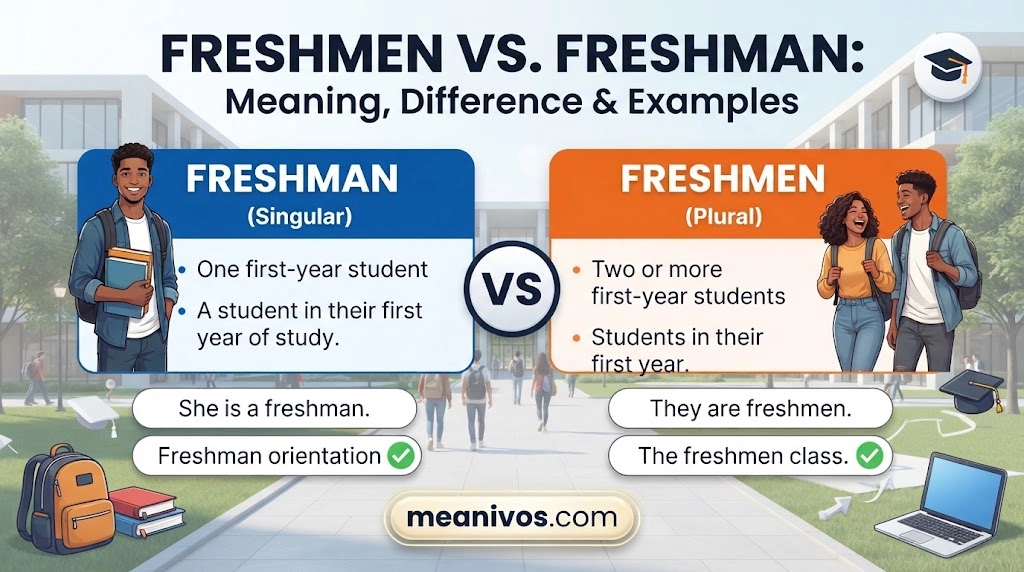
Freshman and freshmen have almost the same spelling and meaning, so it is easy to confuse them. The important difference is simple: freshman is singular, while freshmen is plural.
- Freshman = one first-year student
- Freshmen = two or more first-year students
For example, you would write, “She is a freshman,” but “They are freshmen.”
There is one additional rule that causes many grammar mistakes: freshman can also work as a modifier before another noun. That is why freshman year, freshman class, and freshman orientation are standard expressions.
So, if you’re wondering whether to use freshmen or freshman, first determine whether you’re talking about one student, multiple students, or using the word to describe another noun.
Let’s break down the difference with clear rules, examples, pronunciation, common mistakes, and an easy memory trick.
Freshmen vs. Freshman: Quick Answer
| Word | Number | Meaning | Example |
| freshman | Singular | One first-year student | She is a freshman. |
| freshmen | Plural | Two or more first-year students | The freshmen arrived today. |
The easiest rule
One student = freshman
Two or more students = freshmen
For example:
- One freshman joined the club.
- Five freshmen joined the club.
- She is a freshman.
- They are freshmen.
The plural is irregular. It follows the same internal-vowel pattern found in man → men, giving us freshman → freshmen.
What Does “Freshman” Mean?
A freshman is traditionally a student in the first year of high school, college, or university, particularly in American English. The word can also describe someone who is new to a job, organization, or activity. Cambridge lists both the student meaning and the broader “recently started” sense, while Merriam-Webster similarly defines a freshman as a first-year student or a beginner/newcomer.
Examples of “freshman”
- She is a freshman at the university.
- My brother is a freshman in high school.
- He was a freshman when he joined the team.
- The freshman athlete had an impressive first season.
- She became a freshman member of the organization.
When freshman refers to one person, it is a singular noun.
Freshman can also modify another noun
You will frequently see freshman before another noun:
- freshman year
- freshman class
- freshman orientation
- freshman housing
- freshman seminar
- freshman athlete
In these expressions, freshman is functioning as a modifier rather than as a plural noun referring to several students.
What Does “Freshmen” Mean?
Freshmen is the plural form of freshman. It refers to two or more first-year students.
Examples include:
- The freshmen attended orientation.
- Hundreds of freshmen moved into the dorms.
- The university welcomed its new freshmen.
- Several freshmen joined the debate club.
- The freshmen received their class schedules.
Because freshmen is plural, it normally takes a plural verb:
- ✅ The freshmen are excited.
- ❌ The freshmen is excited.
Merriam-Webster also explicitly identifies freshmen as the plural of freshman.
Freshman vs. Freshmen: The Main Difference
The primary difference is the grammatical number.
Use “freshman” for one person
Daniel is a freshman.
Daniel is one student, so the singular form freshman is correct.
Use “freshmen” for multiple people
Daniel and Alex are freshmen.
Daniel and Alex are two students, so the plural freshmen is correct.
Compare these examples:
| Sentence | Why? |
| She is a freshman. | One student |
| They are freshmen. | Multiple students |
| I spoke to a freshman. | One student |
| I spoke to several freshmen. | Multiple students |
| Every freshman received an email. | Each student individually |
| Many freshmen received emails. | Multiple students |
Once you identify whether the noun means one or more than one, the choice is usually straightforward.
Is “Freshman” Singular or Plural?
Freshman are singular.
Use it when you mean one first-year student.
Examples:
- She is a freshman.
- He became a freshman this fall.
- The freshman asked an interesting question.
- Every freshman received an identification card.
- One freshman volunteered to help.
You can commonly use freshman after words such as:
- a
- one
- each
- every
- another
For example:
Every freshman must attend orientation.
The word every refers to students individually, so the singular form is required.
Is “Freshmen” Singular or Plural?
Freshmen is plural.
Use it when referring to two or more first-year students.
Examples:
- The freshmen are attending orientation.
- Many freshmen live on campus.
- Several freshmen joined the club.
- The school welcomed its freshmen.
- Hundreds of freshmen arrived on campus.
Because freshmen is plural, avoid using the singular article directly before it.
- ❌ She is a freshmen.
- ✅ She is a freshman.
Why Is the Plural of “Freshman” “Freshmen”?
The standard plural of freshman is freshmen, not freshmans.
This is an irregular plural:
- man → men
- woman → women
- freshman → freshmen
English contains many nouns whose plural form does not simply add -s.
Therefore:
freshman → freshmen
Not:
freshman → freshmans ❌
For example:
The university welcomed 500 freshmen.
That is the standard form.
Why Is “Freshman Year” Correct?
This is one of the most important points when learning freshman vs. freshmen.
The standard expression is:
freshman year
not:
freshmen year ❌
Why?
Because freshman are functioning as a modifier before the noun year. It describes the type or stage of the year rather than acting as the plural noun for a group of students.
For example:
I had a great freshman year.
Here, year is the main noun. Freshman tells us which year of study is being discussed.
Cambridge itself gives freshman year as a standard example, and its Essential Dictionary also identifies freshman as an adjective in expressions such as my freshman year.
More examples
- My freshman year was challenging.
- During my freshman year, I joined the soccer team.
- She made many friends during her freshman year.
- His freshman year changed his career goals.
So remember:
freshman year = correct
- Explore More: https://meanivos.com/loose-vs-lose/
Freshman Year vs. Freshmen Year
If you’re asking, “Do I say freshman year or freshmen year?”, use:
✅ Freshman year
Examples:
- My freshman year was unforgettable.
- Her freshman year was difficult.
- I met my best friend during my freshman year.
❌ Freshmen year
In standard usage, freshmen year is not the normal expression when referring to a student’s first academic year.
The reason is grammatical: freshman is being used as a modifier.
Freshman Class vs. Freshmen Class
The standard expression is generally:
freshman class
For example:
The freshman class attended orientation.
Why doesn’t the word become freshmen even though the class may contain hundreds of students?
Because freshman is modifying class.
Compare:
The freshman class is large.
with:
The freshmen are attending class.
In the first sentence, freshman describes the class. In the second, freshmen is the plural noun referring directly to the students.
This distinction is one of the most useful ways to understand the difference between the two forms.

Freshman Student vs. Freshmen Students
The correct choice depends on what you are describing.
One student
She is a freshman student.
Here, freshman describes one student.
Multiple students
The freshmen students attended orientation.
Here, freshmen is plural and refers to multiple students.
However, in many situations, the simpler forms sound more natural:
She is a freshman.
The freshmen attended orientation.
You may also choose first-year students or first-year students, particularly in institutional or international writing.
Can “Freshman” Be Used as an Adjective?
Yes.
Freshman can function as a noun and can also be used as a modifier/adjective before another noun.
Examples:
- freshman year
- freshman class
- freshman orientation
- freshman housing
- freshman athlete
- freshman seminar
This explains why freshman year is correct even though an entire group of students may experience that year.
Think of the structure this way:
freshman + noun
The second noun is the main noun, while freshman describes it.
Freshman vs. Freshmen Pronunciation
Pronunciation can make this pair confusing because the two forms may sound very similar in ordinary speech.
Cambridge gives the pronunciation of freshman as approximately:
/ˈfreʃ.mən/
and lists the plural with essentially the same pronunciation pattern.
That means you should not rely entirely on sound when choosing the spelling.
Easy pronunciation tip
Think about the meaning rather than only the sound:
- freshman → one
- freshmen → more than one
When writing, always check the grammatical number.
Common Mistakes With Freshman and Freshmen
1. Using “freshmen” for one person
❌ He is a freshmen.
✅ He is a freshman.
Why? “He” refers to one person.
2. Using “freshman” for multiple students
❌ The freshman attended orientation.
If you’re referring to several students, write:
✅ The freshmen attended orientation.
3. Writing “freshmans”
❌ The university welcomed 500 freshmans.
✅ The university welcomed 500 freshmen.
The standard plural is freshmen.
4. Writing “freshmen year”
❌ My freshmen year was difficult.
✅ My freshman year was difficult.
Here, freshman modifies the noun year.
5. Using a singular verb with “freshmen”
❌ The freshmen is waiting outside.
✅ The freshmen are waiting outside.
Freshmen is plural, so it normally takes a plural verb.
6. Writing “a freshmen”
❌ She is a freshmen.
✅ She is a freshman.
The article a introduces a singular countable noun.
Freshman vs. First-Year Student
Freshman and first-year student often refer to the same academic stage, but they are not identical in style.
The Freshman is strongly associated with American English. Cambridge labels the student sense as U.S. usage.
First-year student is a more neutral alternative and can be particularly useful for international or institutional audiences.
For example:
She is a freshman at an American university.
or:
She is a first-year student at the university.
Both can communicate that the student is in the first year.
Merriam-Webster also discusses alternatives such as first-year, frosh, and other newer terms, while noting that freshman remains established.
American English vs. British English
Freshman/freshmen is especially associated with American educational terminology.
Cambridge identifies freshman as a U.S. term for a student in the first year of high school, college, or university.
In British contexts, you may encounter terms such as:
- first-year student
- first-year undergraduate
- first-year
- fresher in some contexts
For example, the University of Cambridge’s terminology glossary describes a first-year undergraduate as someone often referred to as a fresher.
So, if your audience is international, a first-year student can be a clearer choice.
Freshman and Freshmen Examples
High school examples
Singular:
My sister is a freshman in high school.
Plural:
The freshmen attended their first assembly.
College examples
Singular:
I am a freshman at the university.
Plural:
Thousands of freshmen arrived on campus.
Academic writing
Singular:
Each freshman must complete the orientation program.
Plural:
Freshmen often take introductory courses.
Email examples
Singular:
Every freshman should submit the form by Friday.
Plural:
All freshmen should attend the orientation session.
Everyday conversation
Singular:
My cousin is a college freshman.
Plural:
My friends are freshmen at different universities.
Freshman vs. Freshmen: Correct and Incorrect Examples
| Incorrect | Correct |
| She is a freshmen. | She is a freshman. |
| The freshmen is here. | The freshmen are here. |
| 300 freshman attended. | 300 freshmen attended. |
| My freshmen year was fun. | My freshman year was fun. |
| Several freshman joined. | Several freshmen joined. |
| Freshmans are arriving. | Freshmen are arriving. |
| A freshmen student asked me. | A freshman student asked me. |
An Easy Memory Trick for Freshman vs. Freshmen
The fastest memory trick is:
man → men
freshman → freshmen
Think of the vowel change:
One: freshman
Many: freshmen
For example:
One freshman
Ten freshmen
But don’t forget the second rule:
freshman year
The freshman class
freshman orientation
When a freshman modifies another noun, it stays in the singular form.
Quick Grammar Test: Freshman or Freshmen?
Choose the correct word in each sentence.
- Sarah is a ______ at the university.
- The ______ attended orientation.
- My ______ year was challenging.
- More than 500 ______ enrolled.
- Every ______ received an email.
- The ______ are meeting with their advisers.
- He became a ______ this fall.
- The ______ class is preparing for orientation.
Answers
- freshman
- freshmen
- freshman
- freshmen
- freshman
- freshmen
- freshman
- freshman
Numbers 3 and 8 are especially important because freshman are acting as a modifier.
People Also Ask
A:Freshman are singular. It normally refers to one first-year student.
Example: She is a freshman.
A:Freshmen is plural. It refers to two or more first-year students.
Example: The freshmen attended orientation.
A:The plural of freshman is freshmen.
Example: The college welcomed 1,000 freshmen.
A:No. Freshmans is not the standard plural form. Use freshmen instead.
A:The standard expression is freshman year.
Example: My freshman year was unforgettable.
Here, freshman functions as a modifier.
Final Verdict
The difference between freshman and freshmen is easy once you focus on grammatical numbers.
- Freshman = one first-year student
- Freshmen = two or more first-year students
- Freshman year = standard expression
- Freshman class = standard expression
- Freshman orientation = standard expression
- Freshmans = not the standard plural form
The most useful question to ask yourself is:
Am I talking about one student, multiple students, or using “freshman” to describe another noun?
If you’re talking about one student, use freshman.
If you’re talking about multiple students, use freshmen.
It freshman is describing another noun, it commonly stays singular:
freshman year
freshman class
freshman orientation
Once you understand these two basic rules, freshman vs. freshmen becomes much easier to use correctly.
Sources for further verification
For authoritative definitions and usage, consult Cambridge Dictionary and Merriam-Webster, both of which confirm the singular/plural distinction and established uses of freshman.