Damnit or Dammit: Correct Spelling, Meaning & Use
Have you ever typed “Damnit” and suddenly wondered whether it should be “dammit” instead? The two forms look and sound nearly identical, so the confusion is understandable.
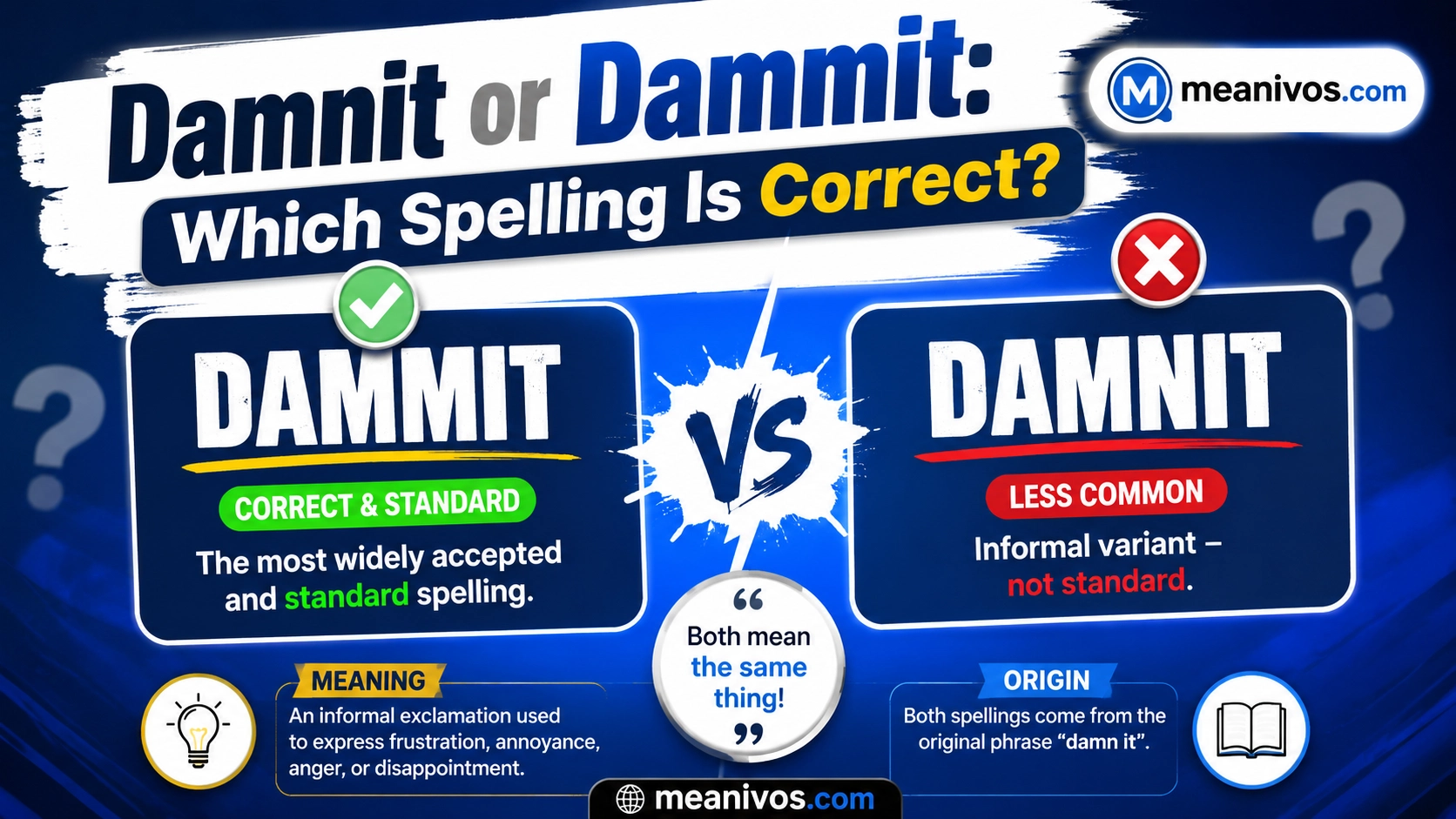
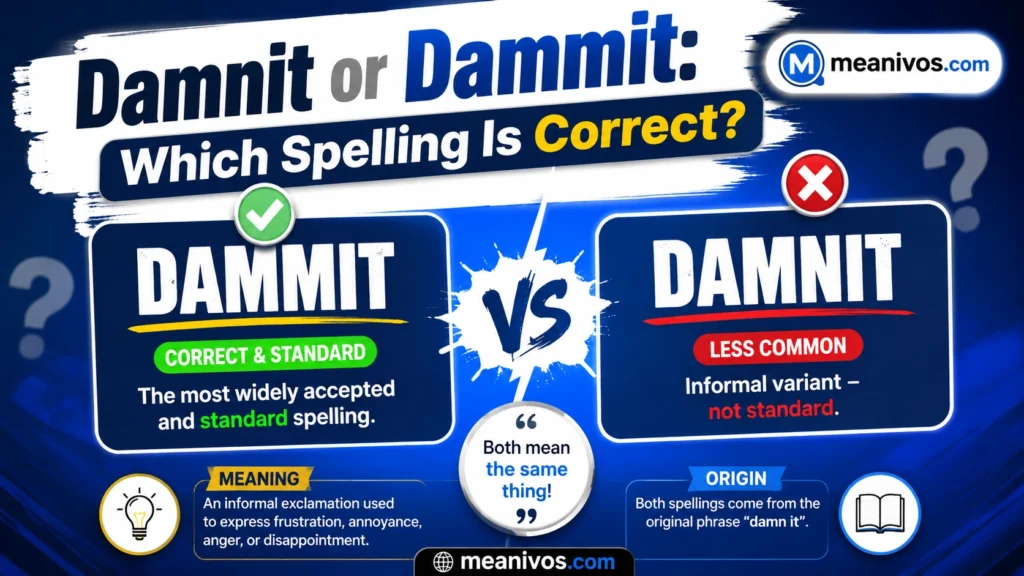
The short answer is: dammit is the safer and more conventional one-word spelling, while damnit is also recognized as a variant by Cambridge Dictionary. The original expression is damn it, written as two separate words.
So, if you’re choosing a spelling for ordinary writing, dammit is the best default.
But there’s an important nuance that many grammar articles miss. It is too simplistic to say that damnit does not exist. Cambridge lists it as an alternative form of dammit, while Wiktionary describes it as a nonstandard contraction of damn + it.
This guide explains damnit vs. dammit, what each form means, how dammit developed from damn it, how to use it naturally, and when you should avoid the expression altogether.
Damnit or Dammit: Quick Answer
If you only need the answer, here’s the simplest rule:
Use “dammit” when you want the conventional one-word spelling.
“Damnit” is a recognized variant, but it is less conventional.
“Damn it” is the original two-word expression.
| Form | Status | Meaning | Best Use |
| dammit | Established one-word form | Anger, frustration, annoyance, emphasis | Informal writing |
| damnit | Recognized variant; less conventional | Same basic meaning | Informal or intentional usage |
| damn it | Original two-word expression | Anger or annoyance | Informal speech and writing |
Cambridge Dictionary currently defines dammit as a very informal exclamation and explicitly gives damnit as another form. Merriam-Webster defines dammit as an interjection and gives its etymology as an alteration of damn it.
The easiest rule to remember
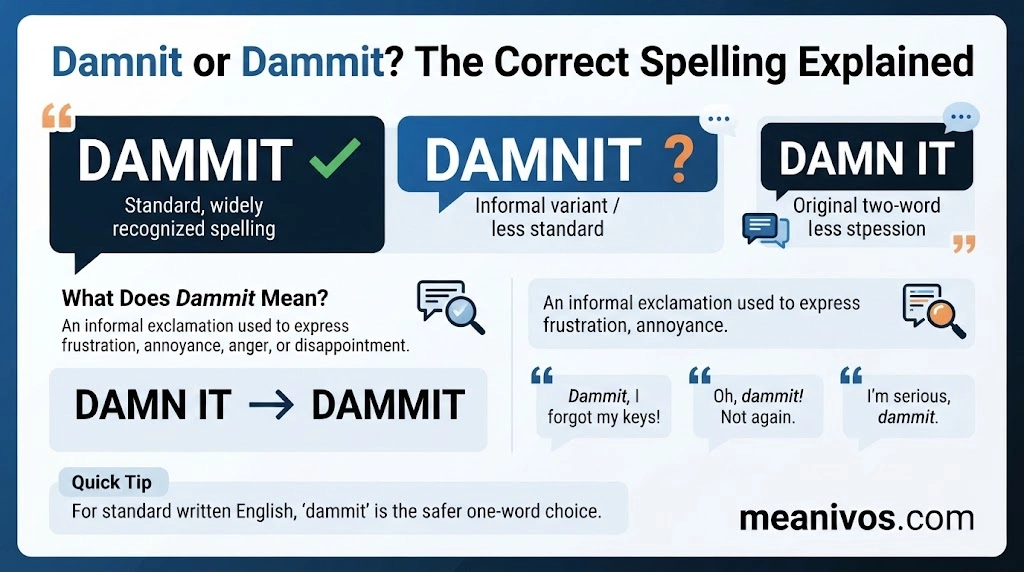
Damn it → dammit
If you’re unsure which one-word spelling to use, choose dammit.
What Does “Dammit” Mean?
Dammit is an informal interjection used to express a strong emotional reaction, especially:
- frustration
- anger
- annoyance
- disappointment
- irritation
- emphasis
For example:
Dammit! I forgot my keys.
The word does not describe the keys. Instead, it communicates the speaker’s emotional reaction to forgetting them.
You can also use it within a sentence:
Dammit, I thought we had more time.
Cambridge describes dammit as an expression of anger and also notes its use for emphasis. Merriam-Webster classifies it as a mild imprecation.
Is “dammit” a swear word?
Generally, yes. Dammit is an informal profanity or mild swear expression.
Its perceived strength varies depending on the speaker, audience, culture, and situation. It is usually milder than many stronger swear words, but it is still not appropriate for every setting.
Is “Damnit” a Correct Word?
This is where the answer becomes more interesting.
Some grammar websites state that damnit is simply a misspelling and recommend using only dammit. Current search results show several competing articles taking that position.
However, Cambridge Dictionary explicitly lists “damnit” as an alternative form of “dammit.”
Wiktionary also records damnit as a nonstandard contraction of damn + it, particularly identifying it as a synonym of dammit.
So the most accurate answer is:
“Damnit” is a recognized variant, but “dammit” is the safer conventional spelling.
That distinction matters.
Calling damnit universally “not a word” ignores dictionary evidence. At the same time, treating damnit and dammit as equally conventional would also be misleading.
For edited, polished, or general-purpose writing, dammit remains the better default.
Dammit vs. Damnit: What’s the Difference?
The main difference is spelling convention, not basic meaning.
Both forms can function as informal exclamations expressing frustration, anger, annoyance, or emphasis.
Dammit
Dammit is the established one-word form and the spelling most writers should choose when they want the conventional version.
Example:
Dammit, I missed the train.
Damnit
Damnit communicates essentially the same idea, but it is a less conventional variant.
Example:
Damnit, I missed the train.
A reader will normally understand both.
However, if you’re writing an edited article, professional publication, school assignment, or other polished text, dammit is the safer choice.
Side-by-side comparison
| Feature | Dammit | Damnit |
| Basic meaning | Frustration or anger | Frustration or anger |
| Part of speech | Interjection | Interjection/variant |
| Spelling | Conventional one-word form | Less conventional variant |
| Dictionary evidence | Yes | Recognized by Cambridge as a variant |
| Formality | Very informal | Very informal |
| Recommended default | Yes | Usually no |
| Can appear in dialogue? | Yes | Yes, especially when reproducing a variant |
Cambridge’s entry is particularly useful here because it directly places damnit alongside dammit as an alternative form.
Dammit vs. Damn It: What’s the Difference?
There is another distinction worth understanding.
Dammit and damn it are closely related, but they are not spelled the same way.
“Damn it”
Damn it consists of two words.
Example:
Damn it! I forgot my phone.
Merriam-Webster describes damn it as an informal and impolite phrase used to show anger or annoyance.
“Dammit”
Dammit is the established one-word form derived from damn it.
Example:
Dammit! I forgot my phone.
Merriam-Webster specifically gives the etymology of dammit as an alteration of “damn it.”
Simple way to remember the difference
Damn it → two words
Dammit → established one-word form
Damnit → recognized but less conventional variant
Why Is “Dammit” Spelled With Two M’s?
A common question is why the word is written dammit instead of damnit.
The safest explanation is historical rather than a made-up spelling rule.
Merriam-Webster identifies dammit as an alteration of damn it.
In other words, the one-word form developed from the spoken expression rather than being created by simply applying a universal rule to damn + it.
When damn it is spoken quickly, the two words can sound like a single unit. Over time, the expression became established in the written form dammit.
That also helps explain why damnit feels intuitive to many people. Someone hearing the expression may naturally try to represent the sound while retaining the spelling of damn.
So don’t rely on the claim that “English always doubles the final consonant when these words merge.” That’s not the best explanation for this particular word.
The dictionary evidence supports the simpler historical explanation: dammit developed as an alteration of “damn it.”
How Do You Use “Dammit” in a Sentence?
Dammit normally functions as an interjection.
It can appear in several positions.
At the beginning
Dammit, I forgot the tickets.
By itself
Dammit!
In the middle
I tried, dammit, but nothing worked.
At the end
I missed the deadline. Dammit!
The punctuation depends on the sentence and the intensity you want to convey.
An exclamation mark often makes the emotional force stronger, while a period can create a flatter or more restrained tone.
- Explore More: https://meanivos.com/cacoon-or-cocoon/
Examples of “Dammit” in Everyday Writing
Here are natural examples:
- Dammit! I left my wallet at home.
- Dammit, that was the last train.
- I knew I had forgotten something—dammit!
- Why won’t this thing work, dammit?
- Dammit, we were so close.
- I should have checked the address. Dammit.
- Dammit! The file didn’t save.
- I can’t believe I made the same mistake again—dammit.
- Dammit, I thought you were already here.
- The door is locked. Dammit!
In each example, the word expresses an emotional reaction rather than describing an object or action.
Can You Use “Damnit” in a Sentence?
Yes, damnit can be encountered in informal writing, particularly as a variant spelling.
For example:
Damnit! I forgot the appointment.
Or:
Just let me speak, damnit!
Cambridge itself uses damnit in example sentences on its dammit entry, which demonstrates that the variant is recognized in actual dictionary treatment.
Still, if you’re not deliberately reproducing someone’s spelling or style, dammit is generally the better choice.
Is “Dammit” Formal or Informal?
Dammit is very informal.
Cambridge explicitly labels it “very informal.”
That means it can work naturally in:
- casual conversations
- text messages
- social media
- informal emails
- fiction
- dialogue
- personal writing
- online comments
But it is generally inappropriate in:
- academic papers
- formal business correspondence
- official reports
- legal documents
- professional announcements
- formal applications
For example, instead of:
Dammit, the presentation file is missing.
a professional email could say:
Unfortunately, the presentation file appears to be missing.
The second version communicates the problem without informal profanity.
What Are Polite Alternatives to “Dammit”?
If you want to express frustration without swearing, you have plenty of options:
- Darn!
- Dang!
- Oh no!
- Shoot!
- Drat!
- Ugh!
- Seriously?
- That’s frustrating.
- What a shame.
- I can’t believe it!
For example:
Informal:
Dammit! I forgot my password.
Softer:
Darn! I forgot my password.
Neutral:
I can’t believe I forgot my password.
Choose the alternative according to your audience and desired tone.
When Should You Avoid “Dammit”?
Even though Dammit is relatively mild compared with stronger profanity, it remains an informal expression.
You should avoid it when your writing needs to sound neutral, respectful, or highly professional.
In a professional email
Avoid:
Dammit, the presentation is missing.
Better:
Unfortunately, the presentation appears to be missing.
In academic writing
Avoid:
Dammit shows frustration.
Better:
The interjection “dammit” can express frustration or anger.
In a formal report
Avoid:
Dammit, the system failed again.
Better:
Unfortunately, the system failed again.
The issue is therefore not just spelling.
Register matters.
Is “Damnit” a Misspelling?
The answer depends on what standard you’re following.
If your goal is conventional edited English, use dammit.
But saying that damnit is universally invalid goes further than the dictionary evidence supports. Cambridge currently lists damnit as an alternative form, while Wiktionary labels it a nonstandard contraction.
So the most useful distinction is:
- Dammit: preferred conventional spelling
- Damnit: recognized but less conventional variant
- Damn it: original two-word expression
This is more accurate than simply declaring one form “real” and the other “fake.”
Why Do People Spell It “Damnit”?
There are several understandable reasons.
1. It resembles the original phrase
People see:
damn + it
and naturally expect:
damnit
2. Pronunciation influences spelling
In fast speech, damn it can sound like a single unit.
That makes damnit seem like a logical phonetic spelling.
3. Online writing is flexible
Texting, social media, comments, and casual conversations often contain nonstandard spellings.
A person may write damnit simply because that is how they have seen it written.
4. The two forms sound essentially the same
This is one reason the spelling question persists.
The distinction is primarily visual and conventional rather than a major difference in pronunciation or meaning.
Is “Dammit” the Same as “Damn It”?
For practical purposes, the two expressions communicate the same basic emotional idea.
Damn it is the two-word phrase.
Dammit is the established one-word form.
Both can express anger, frustration, or annoyance. Merriam-Webster separately records damn it and identifies dammit as an alteration of that phrase.
The choice is therefore mainly about spelling, style, and presentation.
What About “Goddammit”?
You may also encounter:
- goddammit
- god damn it
These expressions are related but generally carry a stronger or more offensive tone than dammit.
If you want a relatively mild expression of frustration, dammit is usually the better choice.
Damnit or Dammit: Which One Should You Use?
Here’s the practical guide.
Choose “dammit” when:
- you want the conventional one-word spelling
- you’re writing edited content
- you’re writing casual dialogue
- you’re writing fiction
- you’re communicating informally
- you want the spelling most readers will recognize immediately
Choose “damn it” when:
- you want the original two-word expression
- you’re deliberately keeping the words separate
- the surrounding sentence calls for the phrase form
Use “damnit” when:
- you’re intentionally reproducing a variant spelling
- you’re discussing the spelling itself
- you’re reflecting someone’s individual writing style
- you’re quoting or representing a particular usage
For ordinary writing, dammit is the easiest and safest choice.
Damnit vs. Dammit vs. Damn It: At a Glance
| Question | Best Answer |
| Which one-word spelling should I normally use? | Dammit |
| Is damnit completely meaningless? | No |
| Is damnit recognized by Cambridge? | Yes, as an alternative form |
| Is dammit a dictionary-listed word? | Yes |
| Is damn it correct? | Yes |
| What does dammit mean? | An informal expression of anger, frustration, annoyance, or emphasis |
| Is dammit formal? | No; it is very informal |
| Is dammit a swear word? | Generally yes, though relatively mild |
| What is the easiest spelling rule? | Damn it → dammit |
Common Misunderstandings About “Damnit or Dammit”
Misunderstanding 1: “Damnit isn’t a word at all.”
That’s too absolute.
Cambridge currently lists damnit as an alternative form of dammit.
Misunderstanding 2: “Dammit is formal because it’s in the dictionary.”
Dictionary inclusion does not make a word formal.
Cambridge specifically labels dammit very informal.
Misunderstanding 3: “Dammit and damn it have completely different meanings.”
They don’t.
Both are expressions of anger or annoyance, with dammit functioning as the established one-word form of the phrase.
Misunderstanding 4: “Damnit and dammit are pronounced differently.”
In normal usage, they are essentially pronounced the same.
The primary distinction is spelling convention.
Misunderstanding 5: “You should use dammit in every type of writing.”
Not necessarily.
Even the conventional spelling is informal. A formal document may need a neutral alternative.
Related Terms and Similar Expressions
If you’re looking for expressions with a similar emotional function, you may encounter:
- damn it
- dammit
- damnit
- dang it
- darn it
- shoot
- drat
- ugh
- oh no
- goddammit
The appropriate choice depends on how strong, humorous, informal, or polite you want the expression to sound.
Topical Cluster Ideas
1: English Spelling
- Common spelling mistakes
- Words with multiple accepted forms
- British vs. American spelling
- Commonly confused words
2: Slang & Informal English
- Internet slang
- Texting abbreviations
- Casual English expressions
- Mild swear words and euphemisms
3: Word Meanings
- Dictionary meanings
- Word origins
- Pronunciation guides
- Formal vs. informal vocabulary
People Also Ask
A:Yes. Dammit is a dictionary-listed English interjection. Merriam-Webster defines it as a mild imprecation and traces its origin to damn it.
A:Damnit is recognized as a variant of dammit by Cambridge Dictionary, although it is less conventional and is described as nonstandard by some references.
A:Dammit is the safer conventional one-word spelling. Damnit is a recognized variant, so it is too simplistic to call it nonexistent or universally invalid.
A:Yes. Damn it is the original two-word expression used to show anger or annoyance. Merriam-Webster labels it informal and impolite.
A:Generally, yes. It is an informal profanity or mild swear expression. Its perceived offensiveness depends on the audience and context.
Damnit or Dammit
So, damnit or dammit—which is correct?
The most accurate answer is:
Dammit is the preferred and more conventional one-word spelling.
Damnit is a recognized variant, although it is less conventional.
Damn it is the original two-word expression.
Merriam-Webster traces dammit to damn it, while Cambridge explicitly lists damnit as an alternative form.
So if you’re writing and simply want the safest choice, use:
Dammit!
Remember it this way:
Damn it → Dammit
That simple transformation will help you choose the conventional one-word spelling whenever you’re unsure.