ChatGPT vs Meta AI 2026: Which AI Is Better?
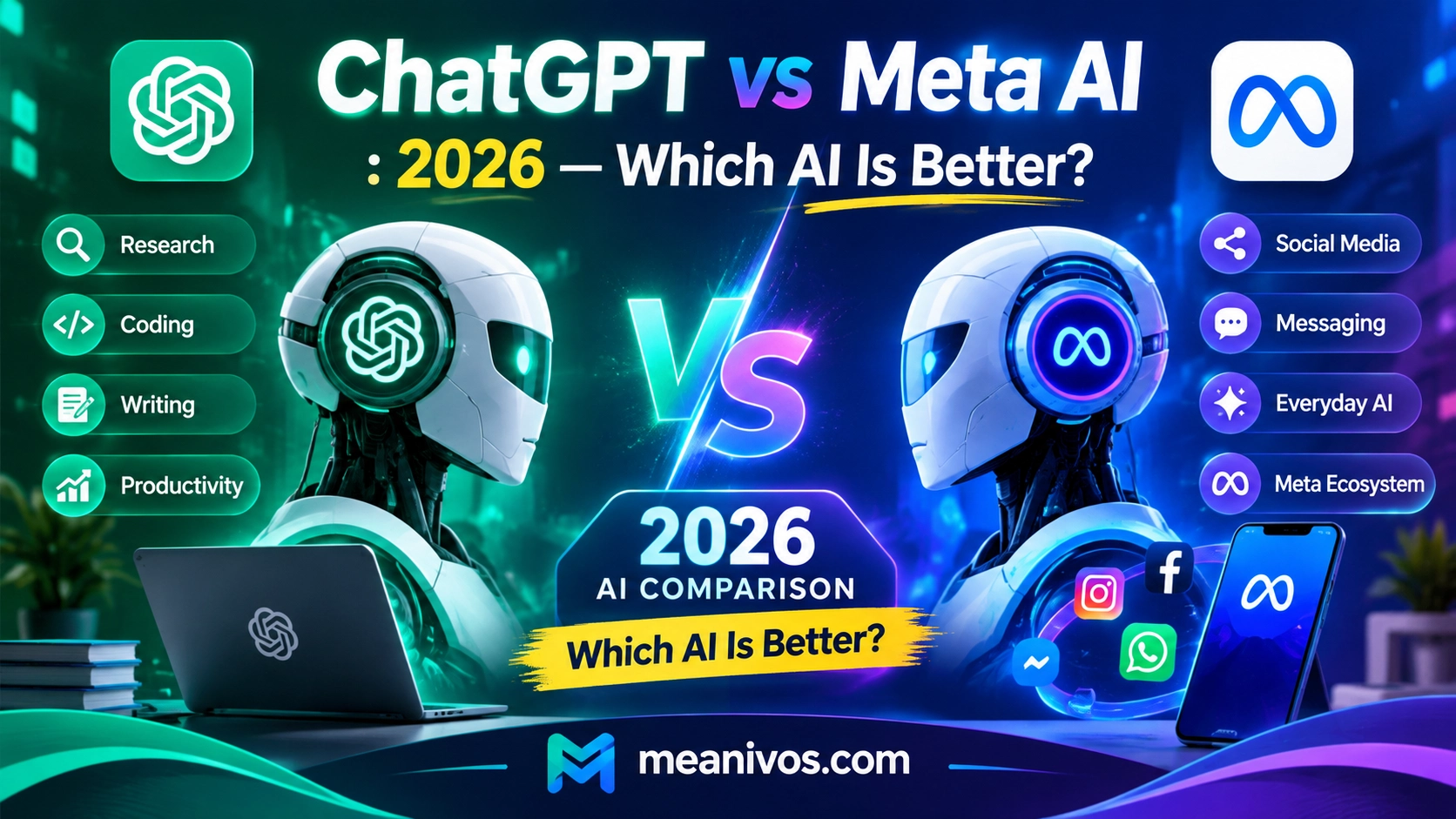
ChatGPT vs Meta AI is no longer a simple battle between two chatbots. In 2026, both AI assistants can answer questions, reason through problems, search for information, create content, work with images and support increasingly advanced workflows.
But they are built around different experiences.
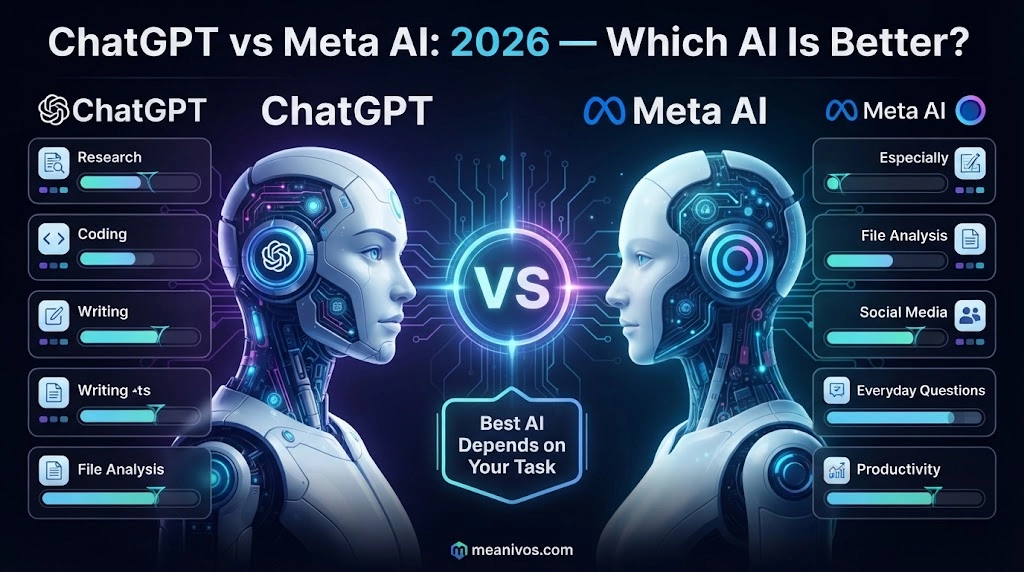
ChatGPT is generally the stronger choice for research, coding, professional writing, document analysis and structured productivity. Meta AI is particularly attractive for users who want an AI assistant connected closely to Meta’s ecosystem and social platforms.
The important question, however, is not simply:
“Which AI is better?”
It’s:
“Which AI is better for what I need to do?”
A student researching a difficult topic, a developer debugging code, an Instagram creator making social content and a WhatsApp user asking a quick question may reasonably choose different tools.
This guide compares ChatGPT vs Meta AI in 2026 across reasoning, research, writing, coding, images, video, voice, files, social media, pricing, privacy, students, business, content creation and everyday use.
Because both products change rapidly, capabilities, limits, pricing and availability can vary by plan and region.
ChatGPT vs Meta AI at a Glance
| Category | ChatGPT | Meta AI |
| Overall productivity | Excellent | Very good |
| Complex reasoning | Excellent | Excellent and rapidly evolving |
| Deep research | Strong | Improving |
| Coding | Strong | Rapidly improving |
| Professional writing | Strong | Strong |
| Image creation | Excellent | Excellent |
| Video/creative AI | Excellent | Excellent |
| Voice | Excellent | Excellent |
| File analysis | Strong | Available |
| Social-media integration | Good | Excellent |
| WhatsApp integration | Available in supported markets | Major advantage |
| Instagram integration | Limited compared with Meta ecosystem | Major advantage |
| Facebook integration | Limited | Major advantage |
| Standalone workspace | Strong | Strong |
| Free access | Yes | Yes |
| Best for | Research, work, coding and productivity | Social, everyday use and Meta-connected AI |
Quick verdict
Choose ChatGPT for demanding professional and productivity tasks.
Choose Meta AI for convenient AI assistance inside the Meta ecosystem and social-first workflows.
And if you use AI heavily, you don’t necessarily have to choose one.
What Is ChatGPT?
ChatGPT is OpenAI’s general-purpose AI assistant.
It can help with tasks such as:
- Answering questions
- Explaining concepts
- Writing and rewriting
- Brainstorming
- Coding
- Research
- Data analysis
- Image generation
- File analysis
- Voice conversations
- Planning and organization
One of ChatGPT’s biggest strengths is that it has evolved beyond a basic chatbot into a broader AI workspace.
Depending on the plan and available features, users can combine conversations with web search, Deep Research, file uploads, data analysis, image generation, voice, Projects and other tools.
That makes ChatGPT especially useful when a task requires several steps rather than a single answer.
What Is Meta AI?
Meta AI is Meta’s AI assistant and broader artificial-intelligence ecosystem.
It can be used as a standalone AI experience while also being connected to Meta’s products and services.
That ecosystem advantage is one of the most important differences between ChatGPT vs Meta AI.
Meta AI is designed to be useful for everyday questions, creative tasks, social experiences and increasingly sophisticated AI workflows.
More importantly for a 2026 comparison, Meta’s AI technology has changed significantly.
Meta now highlights its Muse family, including products such as Muse Spark, Muse Code, Muse Image and Muse Video.
This means articles that describe Meta AI only through its older Llama-era capabilities can quickly become outdated.
ChatGPT vs Meta AI: The Biggest Difference
The simplest way to understand the competition is:
ChatGPT is increasingly an AI workspace.
Meta AI is increasingly an AI assistant connected to an ecosystem.
That distinction affects how each product feels in real-world use.
Suppose you’re researching a business topic, analyzing documents, writing a detailed report and then turning the information into a presentation.
ChatGPT is designed around this type of multi-step productivity workflow.
Now imagine you’re already using WhatsApp or Instagram and want help with a caption, idea, image or quick question without leaving the environment you’re already using.
That’s where Meta AI becomes especially compelling.
Neither philosophy is automatically better.
It depends on your workflow.
ChatGPT vs Meta AI: Key Differences
AI Models
The underlying models are important, but model names alone don’t determine which product is better.
What matters to users is how well the system performs the task they actually care about.
ChatGPT has continued expanding its reasoning, coding, research and agent-style capabilities.
Meta has also accelerated its AI development through the Muse family.
For this reason, avoid judging the two products solely by older model comparisons.
Winner: Depends on the task
For broad productivity workflows, ChatGPT currently has a particularly mature ecosystem.
Meta’s newer Muse development makes this category much more competitive than older comparisons suggest.
Reasoning
Both platforms increasingly support advanced reasoning.
ChatGPT is particularly useful when reasoning is combined with tools such as:
- Web search
- Deep Research
- File analysis
- Data analysis
- Coding
- Image understanding
- Multi-step workflows
Meta is also developing more advanced reasoning and agentic capabilities through Muse.
The practical difference is therefore less about whether either system can “reason” and more about what the reasoning is connected to.
Winner: ChatGPT for complex productivity workflows
Meta AI is a rapidly evolving competitor, so this category should be revisited regularly.
Web Search
Both ChatGPT and Meta AI can help users obtain current information.
But web search quality involves more than simply finding a webpage.
Consider:
- Source quality
- Number of sources
- Citation quality
- Synthesis
- Freshness
- Ability to compare sources
- Ability to produce a structured result
ChatGPT’s search and research tools make it particularly useful for users who need source-backed information.
Winner for serious research: ChatGPT
Winner for quick everyday questions: Tie
Deep Research
Deep Research is one of ChatGPT’s strongest differentiators for research-heavy users.
It is designed for multi-step research tasks, where information from multiple online sources needs to be gathered, analyzed and transformed into a structured result.
This can be useful for:
- Market research
- Competitor research
- Academic research
- Product comparisons
- Business reports
- Literature reviews
- Strategic planning
Winner: ChatGPT
Meta AI is improving quickly in research-oriented workflows, but ChatGPT’s dedicated research experience makes it particularly attractive for users who regularly need documented research.
Writing
Both AI assistants can help write:
- Blog posts
- Emails
- Social-media captions
- Scripts
- Reports
- Product descriptions
- Stories
- Summaries
- Marketing copy
The difference becomes clearer when the project involves multiple documents, long instructions, extensive revisions or source material.
ChatGPT is especially useful when writing is part of a larger workflow involving research, files or structured planning.
Meta AI can be extremely convenient for short social-first writing.
Winner for professional writing: ChatGPT
Winner for quick social content: Meta AI can be more convenient
Coding
Coding is another important ChatGPT vs Meta AI comparison.
ChatGPT can assist with:
- Code generation
- Debugging
- Refactoring
- Testing
- Documentation
- Architecture discussions
- Programming explanations
- Multi-step development tasks
Meta is also investing heavily in coding through Muse Code and related developer capabilities.
That makes the old assumption that Meta AI is simply a social chatbot increasingly inaccurate.
Winner: ChatGPT for the broader coding workflow
Watch closely: Meta’s Muse Code
For developers, this is one of the categories most likely to change during 2026.
Image Generation
Both platforms have become serious creative AI tools.
You can use AI image generation for:
- Social posts
- Marketing concepts
- Illustrations
- Product ideas
- Visual experiments
- Creative brainstorming
- Image editing
Choose ChatGPT when:
- Image creation is part of a larger project.
- You need to combine images with research or documents.
- You want detailed iterative instructions.
- You need a broader productivity workflow.
Choose Meta AI when:
- You’re already working in the Meta ecosystem.
- You want fast creative experimentation.
- Your content is primarily social.
- Convenience matters more than a standalone production workflow.
Winner: Tie
The better choice depends heavily on your workflow.
Video Generation
AI video is changing particularly quickly.
Meta’s current AI portfolio includes Muse Video, while the broader OpenAI ecosystem also offers advanced generative-media capabilities.
Rather than making a permanent claim that one tool is always better, compare:
- Output quality
- Prompt adherence
- Editing
- Speed
- Consistency
- Availability
- Usage limits
- Commercial-use terms
- Regional availability
Winner: No universal winner
This is a category worth updating regularly.
Voice Conversations
Voice has become an important part of both AI experiences.
ChatGPT supports conversational voice interactions, while Meta AI also emphasizes conversational and live AI experiences.
ChatGPT may be preferable for:
- Learning
- Detailed discussions
- Productivity
- Standalone conversations
- Reasoning-heavy conversations
Meta AI may be preferable for:
- Social experiences
- Everyday assistance
- Meta-connected workflows
- Users already inside Meta products
Winner: Tie
The better option depends on where and how you want to use voice AI.
Files and Documents
Document analysis is one of the clearest productivity categories.
ChatGPT can work with supported files such as documents, PDFs and presentations, allowing users to summarize, extract information, analyze material and ask questions about uploaded content.
Meta AI has also expanded its file and document capabilities.
ChatGPT is especially useful for:
- Research papers
- Reports
- Business documents
- Data analysis
- Long-form analysis
- Structured document workflows
Winner: ChatGPT for mature productivity workflows
Meta AI is improving quickly.
- Explore More: https://meanivos.com/chatgpt-vs-copilot/
Social Media
This is where Meta AI has one of its biggest advantages.
Meta already operates major social and messaging platforms, including:
- Messenger
That makes Meta AI particularly attractive for social-first users.
You can imagine workflows such as:
Idea → caption → image → social post
without necessarily moving between multiple unrelated services.
Winner: Meta AI
For social-media creators who spend most of their time inside Meta’s ecosystem, this convenience can matter more than having the strongest standalone AI workspace.
ChatGPT vs Meta AI for Students
Students can use both tools for:
- Explaining difficult concepts
- Brainstorming
- Summarization
- Study planning
- Research
- Coding
- Language learning
- Writing practice
ChatGPT is stronger when students need:
- Detailed explanations
- Structured research
- Document analysis
- Coding assistance
- Multi-step learning support
Meta AI is useful for:
- Quick questions
- Everyday explanations
- Brainstorming
- Casual assistance
Winner: ChatGPT for serious study
The important point is that students should use AI as a learning assistant rather than simply submitting generated answers without understanding them.
ChatGPT vs Meta AI for Coding
For developers, ChatGPT currently has the stronger overall positioning.
It can support the development lifecycle from:
Idea → architecture → code → debugging → testing → documentation
Meta is increasingly challenging this advantage through Muse Code and agentic coding capabilities.
Winner: ChatGPT
Best alternative to watch: Meta AI with Muse Code
This could become a much closer competition as Meta’s developer ecosystem expands.
ChatGPT vs Meta AI for Research
If research is your primary reason for using AI, ChatGPT is the easier recommendation.
ChatGPT can combine web search, reasoning, source synthesis, document analysis and research workflows.
This is particularly useful for:
- SEO research
- Competitor research
- Market research
- Academic research
- Product research
- Business intelligence
Winner: ChatGPT
For casual information searches, however, Meta AI can still be perfectly useful.
ChatGPT vs Meta AI for Businesses
Businesses can use AI for:
- Research
- Writing
- Data analysis
- Customer support
- Coding
- Documentation
- Marketing
- Strategy
- Content creation
- Productivity
ChatGPT is particularly compelling when a business needs a broad productivity environment.
Meta AI becomes especially interesting for businesses whose workflows revolve around:
- Messenger
- Social content
- Community management
Overall business productivity winner: ChatGPT
Meta-centric social workflow winner: Meta AI
ChatGPT vs Meta AI for Content Creators
This category is much closer.
ChatGPT is useful for:
- Blog planning
- SEO outlines
- Long-form articles
- Research
- Scripts
- Content strategy
- Data analysis
- Repurposing content
- Detailed editing
Meta AI is useful for:
- Instagram content
- Facebook content
- Social captions
- Quick visual ideas
- Social-first creativity
- WhatsApp sharing
Winner: Depends on the creator
An SEO writer may prefer ChatGPT.
An Instagram-first creator may prefer Meta AI.
A creator who uses both platforms may get the best results by assigning different jobs to each.
ChatGPT vs Meta AI for Everyday Use
For everyday questions, the difference becomes smaller.
You might ask either AI to:
- Explain something
- Brainstorm dinner ideas
- Rewrite a message
- Summarize information
- Create a checklist
- Suggest a travel plan
- Help with homework
- Generate an idea
Winner: Tie
For ordinary questions, convenience may matter more than theoretical model performance.
ChatGPT vs Meta AI: Pricing
Pricing is one of the most important parts of this comparison.
ChatGPT has a free tier alongside paid options, with available plans and limits changing over time.
OpenAI introduced ChatGPT Go globally in 2026, with U.S. pricing announced at $8 per month, while Plus and Pro provide additional capabilities and higher limits.
Meta AI has a free core experience, although its feature availability and limits can vary.
Which Is Cheaper?
If your main objective is using AI without paying for a subscription, Meta AI’s free accessibility makes it highly attractive.
But free does not automatically mean better value.
The better question is:
How much time and effort does the AI save you?
For a casual user, free AI may be enough.
For someone doing research, coding, analysis or professional content production every day, additional capabilities can have considerably more value.
ChatGPT Free vs Meta AI Free
This is arguably the most important comparison for budget-conscious users.
| Need | Better Choice |
| Everyday questions | Tie |
| Social media | Meta AI |
| WhatsApp assistance | Meta AI |
| Instagram workflows | Meta AI |
| Professional writing | ChatGPT |
| Learning | ChatGPT |
| Coding | ChatGPT |
| Structured research | ChatGPT |
| Standalone productivity | ChatGPT |
| Social convenience | Meta AI |
Meta AI Free is best for:
- Everyday questions
- Social media
- Quick creative tasks
- Casual AI use
ChatGPT Free is best for:
- General questions
- Writing
- Learning
- Coding
- Research
- Productivity
- Supported creative tools
Verdict
Meta AI wins for social convenience.
ChatGPT wins for broader standalone productivity.
ChatGPT vs Meta AI: Privacy
Privacy should not be reduced to a simplistic statement such as “Company A is private and Company B isn’t.”
Instead, users should examine:
- What information is collected
- How conversations are stored
- Available data controls
- Whether conversations can be used for model improvement
- Connected-app permissions
- Account settings
- Business privacy policies
- Plan-specific differences
Privacy policies and product settings can change, so always review the current terms for the exact service and plan you use.
Verdict: No universal winner
The responsible approach is to compare the specific privacy controls relevant to your use case.
ChatGPT Pros and Cons
Pros
- Strong productivity environment
- Excellent research capabilities
- Strong Reasoning
- Powerful document workflows
- Strong coding support
- Professional writing
- Data analysis
- Broad tool ecosystem
- Useful for long-running projects
Cons
- Some advanced features depend on plan
- Usage limits can change
- More complex than necessary for some casual users
- Less deeply integrated into Meta’s social ecosystem
Meta AI Pros and Cons
Pros
- Convenient free access
- Strong Meta ecosystem integration
- Social-media advantages
- WhatsApp integration
- Instagram integration
- Facebook integration
- Strong creative capabilities
- Rapidly improving models
- Increasingly advanced reasoning and agentic capabilities
Cons
- Some capabilities and availability vary
- Professional productivity workflows may not be as mature
- Product capabilities change rapidly
- Users may still prefer a dedicated AI workspace for complex projects
Which Is Better: ChatGPT or Meta AI?
If you force the question into a single overall recommendation for 2026:
Choose ChatGPT if you need:
- Serious research
- Coding
- Professional writing
- Data analysis
- Document analysis
- Complex reasoning
- Long-form content
- Structured productivity
- Multi-step AI workflows
Choose Meta AI if you need:
- WhatsApp AI
- Instagram AI
- Facebook AI
- Social content
- Quick everyday answers
- Convenient creative tools
- A Meta-connected AI experience
Overall winner: ChatGPT
But there is an important qualification.
ChatGPT is the better overall productivity choice, not the winner of every category.
Meta AI can be the better choice for someone whose priority is social media, messaging and Meta’s ecosystem.
Can You Use ChatGPT and Meta AI Together?
Yes—and for many people, this is actually the smartest strategy.
You can use:
ChatGPT for:
Research → analysis → writing → coding → documents → productivity
And:
Meta AI for:
Instagram → Facebook → WhatsApp → social content → quick creative tasks
Instead of asking which company should handle everything, assign each AI the jobs it is best positioned to handle.
This turns the comparison from a competition into a workflow.
ChatGPT vs Meta AI: Which One Should You Choose?
Use this simple decision guide:
| If You Mainly Want… | Choose |
| Deep research | ChatGPT |
| Coding | ChatGPT |
| Professional writing | ChatGPT |
| Document analysis | ChatGPT |
| Data analysis | ChatGPT |
| Complex productivity | ChatGPT |
| Instagram assistance | Meta AI |
| Facebook assistance | Meta AI |
| WhatsApp AI | Meta AI |
| Social content | Meta AI |
| Quick casual questions | Either |
| Creative experimentation | Either |
| Maximum Meta integration | Meta AI |
| Broad AI workspace | ChatGPT |
The Real Winner: Depends on Your Workflow
The ChatGPT vs Meta AI debate becomes much easier when you stop asking which AI is universally better.
Ask what you actually need.
When you’re a developer, researcher, SEO professional, student or business user working on complex projects, ChatGPT is the stronger starting point.
If you’re a social-media creator or someone who spends a large amount of time inside Meta’s apps, Meta AI can be more convenient.
If you regularly perform both kinds of work, using both can be the most practical solution.
People Also Ask
A:For research, coding, professional writing, document analysis and structured productivity, ChatGPT is generally the stronger choice. Meta AI is particularly attractive for social, everyday and Meta-connected use cases.
A:Meta AI offers a free core experience, although specific capabilities, limits and availability can change over time.
A:ChatGPT is currently the safer overall choice for a broad coding workflow, while Meta is rapidly expanding its coding capabilities through Muse Code.
A:ChatGPT has a strong advantage for serious research because its research workflow is designed around multi-step information gathering and synthesis.
A:Meta AI has the clear ecosystem advantage because it is closely connected to Meta’s products and social platforms.
Final Verdict
So, ChatGPT vs Meta AI—which is better?
There is no single answer for every user.
ChatGPT is the stronger overall choice for research, coding, professional writing, document analysis, data work and complex productivity workflows.
Meta AI is the stronger choice for users who prioritize convenience, social-media workflows and close integration with Meta’s ecosystem.
The competition is also changing quickly.
Meta’s move toward the Muse family means older comparisons that describe Meta AI purely through its previous model lineup are increasingly outdated. Meanwhile, ChatGPT continues expanding its research, coding, productivity and agentic capabilities.
So the smartest recommendation is:
For serious work → ChatGPT.
For Meta-connected social use → Meta AI.
To maximum flexibility → Use both.
And if you’re comparing them for a specific task, don’t ask which AI is “best” in general.
Ask:
Which AI is best for this particular job?
That is the comparison that actually helps you make a better decision.