Bearable vs Bareable: Which Spelling Is Correct? Meaning, Examples & Easy Rule
Have you ever typed “Bareable” and then wondered whether it should actually be “bearable”?
You are not alone. The confusion is easy to understand because bear and bare sound alike in standard pronunciation, but they have completely different meanings.
Here is the quick answer:
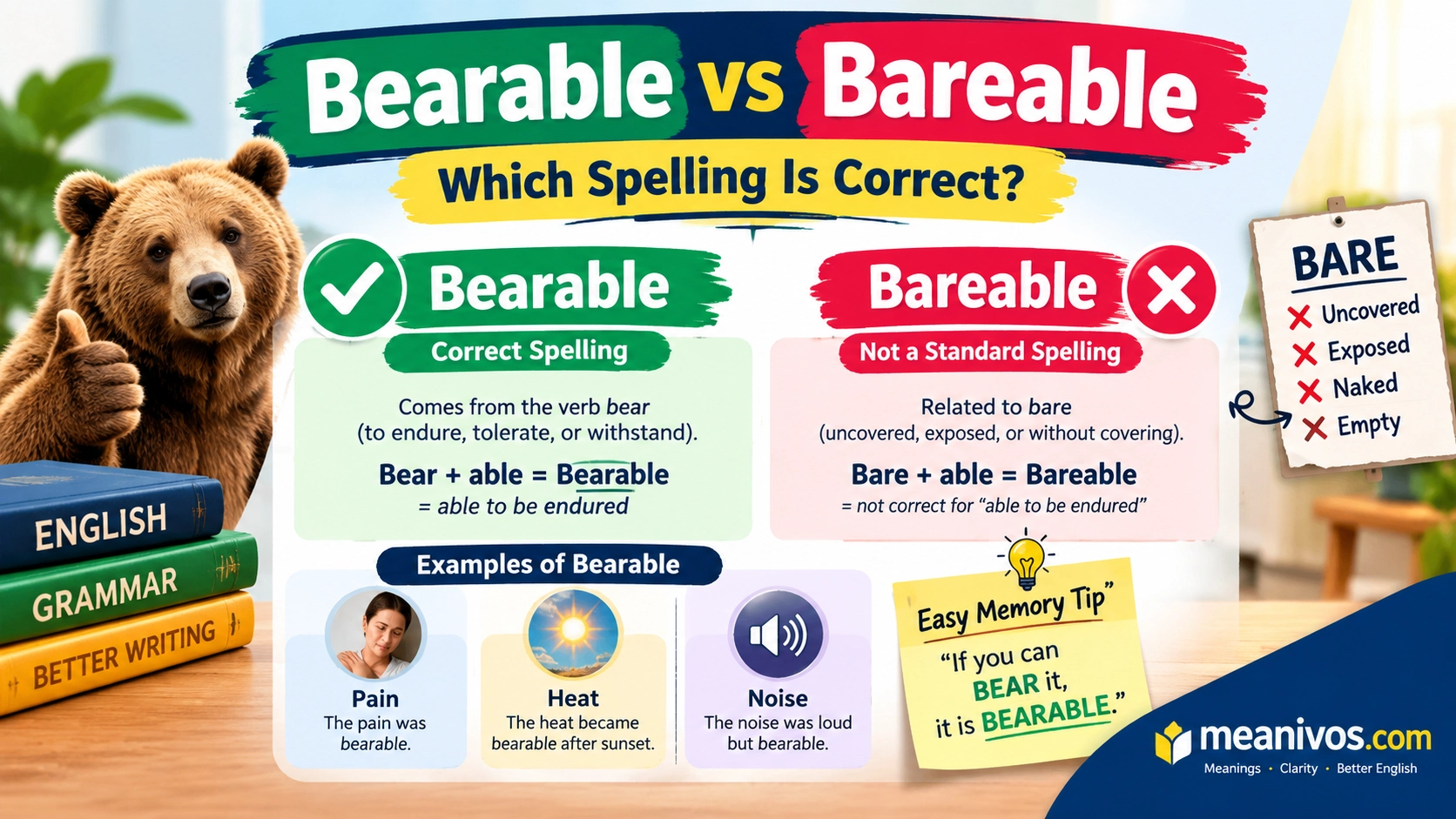
Bearable is the standard English spelling when you mean “capable of being endured, tolerated, or dealt with.” Bareable is generally considered a misspelling for this meaning.
Merriam-Webster defines bearable as “capable of being borne” and lists bearability and bearably as related forms. Cambridge similarly defines it as something unpleasant that you can accept or deal with.
So if you are writing about pain, heat, stress, noise, discomfort, pressure, or a difficult situation that can still be tolerated, choose bearable.
This guide explains the difference between bearable vs bareable, why the correct spelling uses bear, how the word is formed, examples, common mistakes, synonyms, and an easy rule you can remember.
Bearable vs Bareable: Quick Answer
| Spelling | Correct for this meaning? | Meaning |
| Bearable | ✅ Yes | Able to be endured, tolerated, or dealt with |
| Bareable | ❌ Generally no | Usually a misspelling of bearable |
The easiest rule
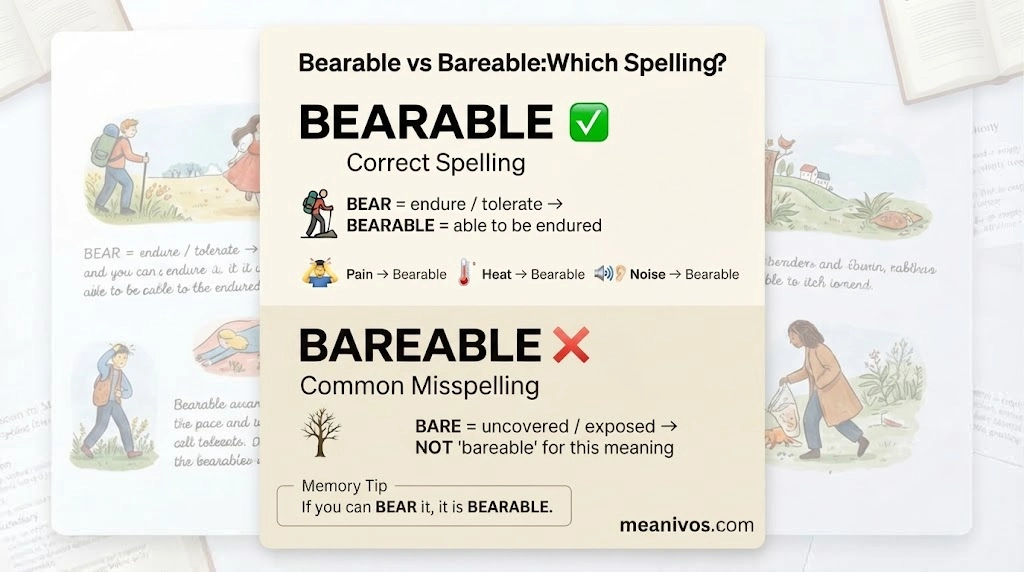
If you can bear it, it is bearable.
For example:
- The pain was difficult but bearable.
- The heat became more bearable after sunset.
- Her support made the situation more bearable.
Not:
- ❌ The pain was bareable.
- ❌ The heat was bareable.
What Does Bearable Mean?
Bearable is an adjective meaning capable of being endured, tolerated, accepted, or dealt with.
It normally describes something unpleasant, difficult, painful, stressful, or uncomfortable that has not become impossible to tolerate.
Merriam-Webster gives the definition “capable of being borne,” while Cambridge describes a bearable situation as one that you can accept or deal with. Both dictionaries list tolerable and related words in this semantic area.
Simple definition
Bearable = difficult or unpleasant, but still possible to endure.
Examples
- The pain was bearable.
- The noise was annoying but bearable.
- The workload became more bearable after the deadline changed.
- The summer heat was uncomfortable but bearable.
- Talking with friends made the difficult period more bearable.
Importantly, bearable does not mean pleasant. Something can be unpleasant and still be bearable.
Why Is Bearable the Correct Spelling?
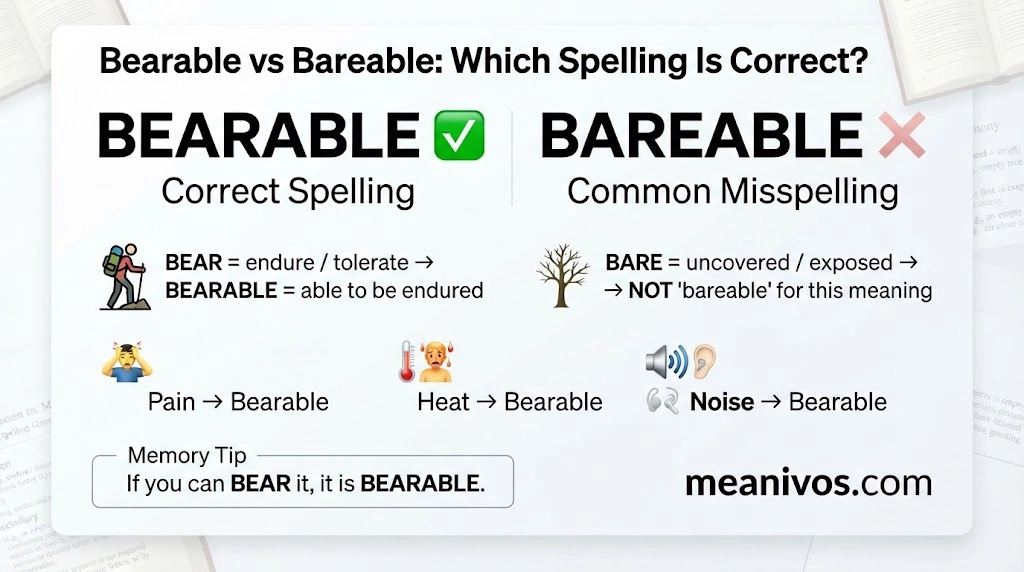
The spelling comes from the verb bear.
One meaning of bear is to endure, tolerate, or withstand something.
For example:
I cannot bear this noise.
She could not bear the pain.
He had to bear the responsibility.
When the adjective-forming suffix -able is added, we get:
bear + able = bearable
The result means something that can be borne or endured.
Merriam-Webster records bearable as an established adjective and dates its first known use in this meaning to around 1557.
What Does Bare Mean?
Bare is also a real English word, but it has a completely different meaning.
It commonly means:
- Uncovered
- Exposed
- Without clothing or covering
- Empty or sparsely furnished
- Minimal or lacking something
Examples include:
- bare feet
- bare hands
- bare walls
- bare branches
- the bare minimum
For example:
She walked across the floor with bare feet.
Here, bare means the feet have no shoes or covering.
That meaning has nothing to do with enduring pain or difficulty.
Bear vs Bare: What’s the Difference?
The easiest way to understand bearable vs bareable is to understand the root words bear and bare.
| Word | Meaning | Example |
| Bear | Endure, tolerate, carry, or withstand | I cannot bear the pain. |
| Bare | Uncovered, exposed, or without covering | She walked with bare feet. |
Bear and bare are commonly pronounced alike, making them homophones.
But they are not interchangeable.
Remember:
Bear = endure
Bare = uncovered
Therefore:
Bear + able = bearable
That is why the spelling is bearable, not bareable.
Is Bareable a Word?
For the intended meaning of “able to be endured,” bareable is generally treated as a misspelling rather than the standard form.
That distinction is important.
You may encounter unusual spellings online, in informal writing, creative wordplay, usernames, names, or other contexts. But if you are writing standard English and want to describe something that can be endured, the established form is:
bearable
Current dictionary sources recognize bearable and its related forms such as bearably and bearability.
So in professional writing, schoolwork, articles, emails, and other standard contexts, use bearable.
Bearable vs Bareable: Meaning Comparison
| Feature | Bearable | Bareable |
| Standard spelling for “tolerable” | ✅ Yes | ❌ No |
| Related root | bear | bare |
| Root meaning | Endure/tolerate | Uncovered/exposed |
| Describes something tolerable | ✅ Yes | ❌ No |
| Used in standard formal English | ✅ Yes | Not for this meaning |
| Related forms | bearably, bearability | — |
Bottom line
If your sentence means “able to be endured,” use bearable.
How to Use Bearable in a Sentence
1. Bearable for pain
- The pain became bearable after she rested.
- The injury was painful but bearable.
- The treatment made the discomfort more bearable.
2. Bearable for weather
- The heat became bearable after sunset.
- The cold was uncomfortable but bearable.
- Air conditioning made the summer weather more bearable.
3. Bearable for noise
- The construction noise was loud but bearable.
- Closing the windows made the traffic noise more bearable.
- After a few hours, the constant noise became almost unbearable.
4. Bearable for work
- The workload became more bearable after another employee joined the team.
- Short breaks made the long shift more bearable.
- The deadline was stressful but bearable.
5. Bearable for difficult experiences
- Her friends made the difficult period more bearable.
- Their support made the long wait bearable.
- Time gradually made the situation more bearable.
Bearable vs Unbearable
One of the easiest ways to remember bearable is to think about its opposite: unbearable.
Bearable
Something you can endure.
Unbearable
Something you cannot tolerate easily or that is extremely difficult to endure.
Examples:
The pain was bearable at first.
After several hours, it became unbearable.
The heat was bearable in the morning.
By afternoon, it was unbearable.
Cambridge explicitly lists unbearable as the opposite of bearable.
Spelling shortcut
Think:
un + bearable = unbearable
Remove un:
bearable
This is a useful way to reinforce the correct spelling.
Why Do People Confuse Bearable and Bareable?
1. Bear and bare sound alike
The main source of confusion is pronunciation.
Bear and bare are homophones, meaning they sound alike but have different spellings and meanings.
This is similar to other confusing pairs such as:
- their / there
- right / write
- see / sea
- flour / flower
Hearing the word alone does not tell you which spelling to use.
2. Bare is a familiar English word
People already know phrases such as:
- bare feet
- bare hands
- bare walls
- bare minimum
As a result, bareable may look visually plausible.
But the correct root depends on the meaning.
If the meaning is endure, the root is bear.
3. English spelling is not always predictable from pronunciation
English contains many words whose spelling cannot be determined simply by listening.
When two spellings sound alike, use the meaning and root word to decide.
For bearable, the root meaning provides the answer:
bear = endure
bearable = capable of being endured
- Explore More: https://meanivos.com/chatgpt-vs-meta-ai/
The Grammar Behind Bearable
The suffix -able is frequently used to create adjectives expressing the idea of being capable of something.
Examples:
| Base word | Adjective | Meaning |
| read | readable | able to be read |
| wash | washable | able to be washed |
| accept | acceptable | able to be accepted |
| depend | dependable | able to be depended on |
| bear | bearable | able to be endured |
So the formation is:
bear + able → bearable
This reinforces why bearable retains the letters bear.
Bearable Word Family
The spelling becomes even easier when you look at related forms.
Bearable
An adjective:
The situation was bearable.
Bearably
An adverb meaning in a bearable way.
The weather remained bearably warm.
Cambridge recognizes bearably as an adverb related to bearable.
Bearability
A noun referring to the quality or state of being bearable.
These related forms all preserve the bear root.
Bearable Pronunciation
It is commonly pronounced approximately like:
BAIR-uh-bul
The first part sounds like a bear.
This pronunciation contributes to the confusion because bear and bear can sound alike.
The important point is:
Similar pronunciation does not mean identical spelling.
Use the meaning to choose the spelling.
When Should You Use Bearable?
Use bearable when something is difficult, unpleasant, uncomfortable, or painful but can still be tolerated.
Common contexts include:
- Pain
- Heat
- Cold
- Noise
- Stress
- Pressure
- Long waits
- Difficult work
- Emotional hardship
- Uncomfortable conditions
For example:
The headache was bad but bearable.
The traffic was frustrating but bearable.
The waiting time was long but bearable.
The workload became more bearable after the team expanded.
When Should You Not Use Bearable?
Bearable should not be used simply to mean possible, usable, or good enough.
For example:
❌ The table is bearable.
That sounds unnatural unless there is a special context in which the table itself is something being endured.
Depending on what you mean, words such as these may work better:
- manageable
- suitable
- acceptable
- usable
- stable
- practical
The key idea behind bearable is endurance or tolerance.
Bearable Synonyms
Common synonyms include:
- Tolerable
- Endurable
- Manageable
- Supportable
- Livable
- Sustainable
- Survivable
Merriam-Webster’s thesaurus also lists words such as endurable, tolerable, sustainable, acceptable, and livable among related terms.
Bearable vs tolerable
These words are often interchangeable, but they can have slightly different emphasis.
Bearable focuses strongly on the ability to endure something difficult.
Tolerable can emphasize that something is acceptable enough to tolerate.
For example:
The pain was bearable.
The conditions were tolerable.
Both can be correct depending on context.
Antonyms of Bearable
The strongest and most common opposite is:
Unbearable
Other related opposites include:
- intolerable
- insufferable
- unmanageable
Examples:
The noise became unbearable.
The working conditions were intolerable.
The workload became unmanageable.
Common Mistakes with Bearable
Mistake 1: Writing bareable
❌ The pain was bareable.
✅ The pain was bearable.
The sentence is about enduring pain, so the correct root is bear.
Mistake 2: Assuming bearable means pleasant
Bearable does not mean enjoyable.
Something can be uncomfortable and still be bearable.
The journey was uncomfortable but bearable.
The speaker is saying the journey could still be endured.
Mistake 3: Confusing bear and bare
Remember:
Bear can mean endure.
I cannot bear the noise.
Bare means uncovered.
He walked with bare feet.
Mistake 4: Choosing spelling from pronunciation
Because the words sound alike, pronunciation alone cannot help.
Instead, ask:
What does the word mean?
If it means endure, choose bear.
Easy Memory Tricks for Bearable
Memory trick #1: If you can bear it, it is bearable
This is the simplest rule:
I can bear the pain → The pain is bearable.
Memory trick #2: Think of unbearable
Remember:
unbearable
Then remove un:
bearable
Memory trick #3: Connect bear with endurance
Think:
Bear → endure → bearable
Do not think:
Bare → uncovered → bareable
The second chain does not produce the standard spelling used for “tolerable.”
Bearable vs Bareable Examples
| Incorrect | Correct |
| The pain was bareable. | The pain was bearable. |
| The heat was bareable. | The heat was bearable. |
| The noise was barely bareable. | The noise was barely bearable. |
| The workload became bareable. | The workload became bearable. |
| Her support made the situation more bareable. | Her support made the situation more bearable. |
A Simple Test: Bearable or Bareable?
Ask yourself:
Am I describing something that can be endured or tolerated?
If the answer is yes, use:
BEARABLE
Examples:
Can pain be endured?
→ Bearable
Can noise be tolerated?
→ Bearable
Can heat be endured?
→ Bearable
Can a difficult situation be tolerated?
→ Bearable
The formula
Endure → Bear → Bearable
Bearable vs Bareable Quiz
Test yourself.
1. The pain became _____ after treatment.
A. Bearable
B. Bareable
2. The heat was uncomfortable but still _____.
A. Bearable
B. Bareable
3. The workload became more _____ after the team expanded.
A. Bearable
B. Bareable
4. If you can _____ the difficulty, it is bearable.
A. Bear
B. Bare
5. _____ feet means feet without shoes or covering.
A. Bear
B. Bare
Answers
- Bearable
- Bearable
- Bearable
- Bear
- Bare
Topical Cluster Ideas
If you want Meanivos to build authority around dictionary and word-confusion searches, this article can sit inside a broader cluster.
1: Homophones
- Bear vs bare
- There vs their vs they’re
- Your vs you’re
- To vs too vs two
- Its vs it’s
2: Common spelling confusion
- Definitely vs definately
- Separate vs seperate
- Occurred vs occured
- Receive vs recieve
- Accommodate vs accomodate
3: Word meaning comparisons
- Tolerable vs bearable
- Endurable vs bearable
- Acceptable vs tolerable
- Manageable vs sustainable
- Unbearable vs intolerable
People Also Ask
A:The standard spelling is bearable when you mean “capable of being endured or tolerated.” Bareable is generally considered a misspelling for this meaning.
A:Bearable means something can be endured, tolerated, accepted, or dealt with, even though it may be unpleasant or difficult.
A:For the meaning “able to be endured,” bareable is not the standard form. Use bearable in standard English.
A:It comes from bear, which can mean to endure or tolerate. Adding -able gives bearable, meaning “able to be borne or endured.”
A:Common synonyms include tolerable, endurable, manageable, supportable, livable, and sustainable, depending on context.
Quick Reference: Bearable vs Bareable
| Question | Answer |
| Correct spelling? | Bearable |
| Incorrect/common misspelling? | Bareable |
| Part of speech | Adjective |
| Meaning | Able to be endured or tolerated |
| Root verb | Bear |
| Related adverb | Bearably |
| Related noun | Bearability |
| Main synonym | Tolerable |
| Main opposite | Unbearable |
| Memory trick | If you can bear it, it is bearable. |
Final Verdict
The answer is straightforward:
Bearable is the correct standard spelling when you mean “able to be endured or tolerated.”
Bareable is generally a spelling error in that context.
The reason is simple:
Bear = endure
Bear + able = bearable
Meanwhile:
Bare = uncovered or exposed
So when you are talking about pain, heat, stress, noise, discomfort, pressure, or another difficult experience that can still be tolerated, use bearable.
Remember this one sentence:
If you can bear it, it is bearable.
That rule makes the spelling easy to remember and eliminates the confusion between bearable vs bareable.