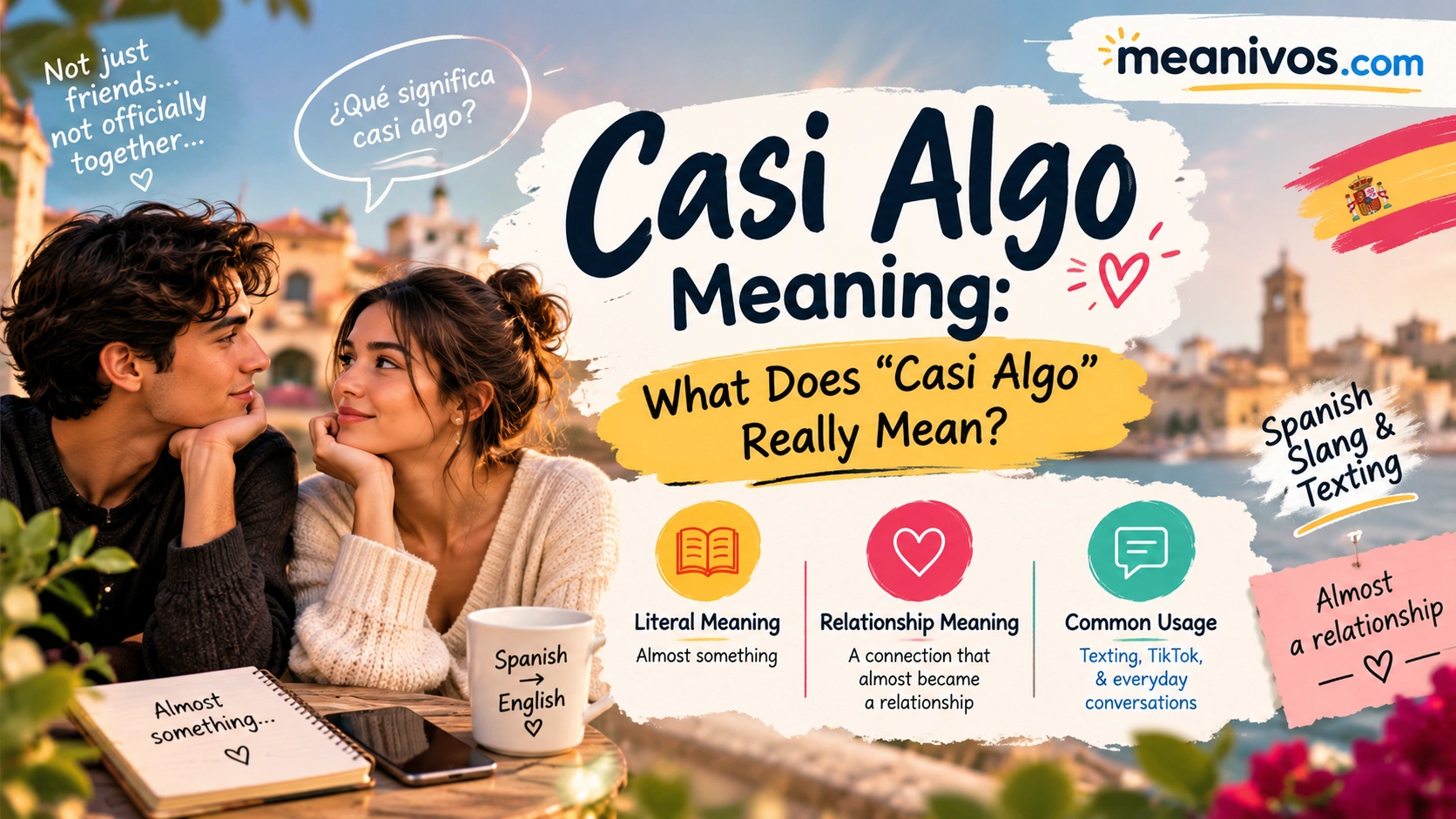
What Is Casi Algo? Meaning, Translation & Examples
If you’ve seen “Casi Algo” on TikTok, Instagram, in a text message, or during a conversation about dating, you may have wondered what the two Spanish words actually mean.
The simplest answer is:
Casi algo literally means “almost something” in English.
However, when the phrase is used in a romantic or relationship context, it usually refers to a person or connection that came close to becoming an official relationship but never quite got there.
In natural English, casi algo might therefore be translated as:
- almost something
- almost a relationship
- almost a couple
- someone I almost dated
- someone I had something with
The exact translation depends on context.
That’s an important distinction because casi algo does not automatically mean “situationship.” The literal Spanish phrase has a broader meaning, while its modern relationship use gives it the emotional sense many people encounter online.
Quick Answer: What Does Casi Algo Mean?
Casi algo is a Spanish phrase that literally means “almost something.”
In modern relationship conversations, it commonly describes a romantic or emotionally significant connection that never became an official relationship.
| Term | Meaning |
| casi | almost / nearly |
| algo | something |
| casi algo | almost something |
| mi casi algo | my almost something |
| Relationship use | an almost-relationship or undefined romantic connection |
The phrase can describe a connection that involves flirting, dates, emotional closeness, attraction, or romantic feelings without becoming an official couple.
What Does “Casi Algo” Mean Literally?
To understand casi algo, start with the individual Spanish words.
Casi = Almost
Casi means “almost” or “nearly.”
For example:
Casi terminé.
This means:
“I almost finished.”
Algo = Something
Algo generally means “something.”
For example:
Quiero algo.
This means:
“I want something.”
SpanishDictionary likewise gives the word-by-word translation of casi algo as “almost something.”
Therefore:
casi + algo = almost + something
The romantic interpretation comes from context, not from the two individual words themselves.
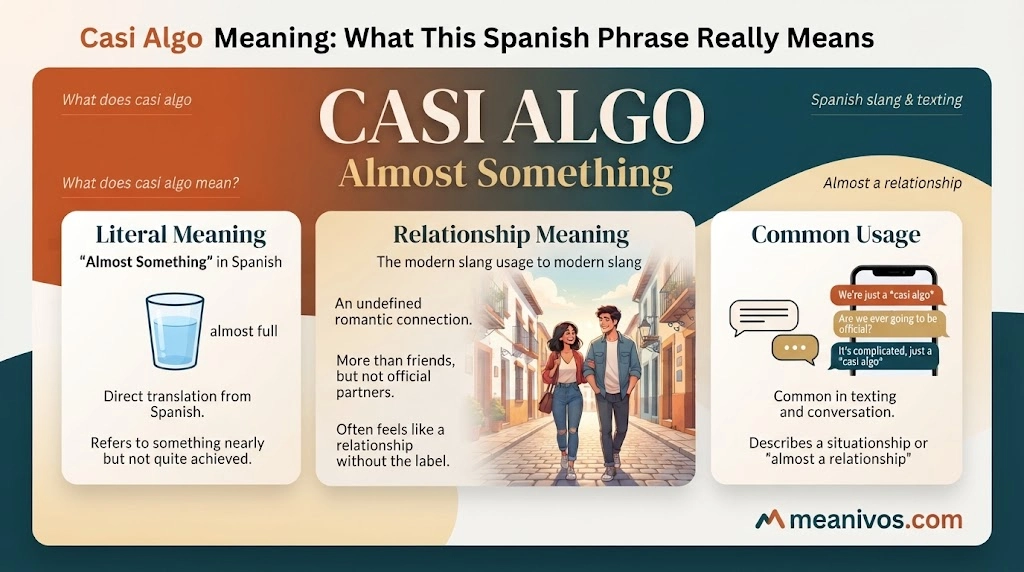
Casi Algo Meaning in English
When someone searches for “casi algo meaning in English,” they may want either the literal translation or the natural relationship meaning.
Literal translation
Casi algo = almost something.
Natural relationship translation
Depending on context, you could say:
- almost relationship
- almost a couple
- someone I almost dated
- someone I was almost with
- someone I had something with
- an unfinished romantic connection
There isn’t one perfect English equivalent.
For example:
Él es mi caso algo.
A literal translation is:
“He is almost my everything.”
But a natural English translation might be:
“He’s the guy I almost dated.”
That’s why translating the phrase word-for-word doesn’t always capture what a Spanish speaker intends.
What Is a Casi Algo in a Relationship?
In relationship language, a Casi Algo is usually a connection that exists somewhere between friendship and an official romantic relationship.
Two people might:
- Talk every day
- Flirt
- Go on dates
- Share personal secrets
- Spend lots of time together
- Have romantic chemistry
- Kiss or show affection
- Act like a couple
- Develop strong feelings
But they never officially become boyfriend and girlfriend—or otherwise define the relationship.
The phrase captures that “we were almost something” feeling.
Spanish-language coverage of modern dating specifically describes casi algo as a romantic connection that remains undefined, often alongside the concept of a situationship.
Mi Casi Algo Meaning
One of the most useful variations to understand is mi casi algo.
Word by word:
- mi = my
- casi = almost
- algo = something
So:
mi casi algo = my almost something
But natural English would usually be:
- my almost relationship
- my almost-boyfriend
- my almost-girlfriend
- the person I almost dated
- the person I almost had a relationship with
For example:
Casi algo me escribió anoche.
A natural translation could be:
“The person I almost dated texted me last night.”
The phrase doesn’t tell you whether the relationship ended happily, sadly, awkwardly, or simply faded away. The surrounding context determines the emotion.
What Does “Éramos Casi Algo” Mean?
Éramos casi algo literally means:
“We were almost something.”
Depending on context, natural English translations include:
- “We were almost a couple.”
- “We almost dated.”
- “We were almost in a relationship.”
- “We were kind of a thing.”
- “We had something, but it never became official.”
This is a particularly useful phrase because it describes an unfinished connection without requiring a formal relationship label.
Casi Algo vs. Situationship
Are casi algo and situationship the same?
Not always.
They overlap considerably, but they emphasize slightly different ideas.
| Term | Main idea | Official relationship? |
| Casi algo | Something that was almost a relationship | Usually no |
| Situationship | An undefined romantic relationship | Usually no |
| Ex | A former official partner | Yes, previously |
| Friend | Primarily platonic connection | Usually no |
| Dating partner | Someone you’re romantically dating | Not necessarily |
| Friends with benefits | Friendship with sexual intimacy | Usually no |
A situationship often emphasizes an ongoing undefined relationship.
A casi algo can emphasize what the connection almost became, including something that has already ended.
So:
Every casi algo isn’t necessarily a situationship, and “situationship” isn’t always the best translation.
Spanish-language sources explicitly compare situationship with casi algo, but their usage isn’t necessarily identical in every context.
Casi Algo vs. Ex
A casi algo isn’t necessarily an ex.
An ex is someone you were officially in a relationship with.
A casi algo usually describes someone with whom you never reached that official stage.
Example
Ex:
“We were together for two years before we broke up.”
Casi algo:
“We talked for months, went on dates, and liked each other, but we never became official.”
This difference can be emotionally important.
A breakup has a defined relationship and ending.
A casi algo may have neither a clear beginning nor a clear ending.
Casi Algo vs. Friend
A friend is generally someone you have a platonic relationship with.
A casi algo usually involves some degree of romantic possibility.
For example:
Friend:
“We’ve known each other for years and have always been friends.”
Casi algo:
“We were constantly flirting and going on dates, but never officially dated.”
Of course, real-life relationships can fall somewhere between these categories.
Casi Algo vs. Talking Stage
A talking stage and casi algo can also overlap.
The talking stage generally describes the period when two people are getting to know each other romantically.
A casi algo often carries a stronger sense that something meaningful almost happened or that the connection remained undefined.
Think of it this way:
Talking stage → exploring possibility
Casi algo → something almost became a relationship
The same two people could potentially be described by both terms at different points in their connection.
Signs Someone Might Be Your Casi Algo
There isn’t an official checklist, but these situations commonly fit the relationship meaning.
1. You behaved like a couple
People around you may have assumed you were dating.
2. You communicated constantly
Daily texting or frequent calls created emotional closeness.
3. There was romantic chemistry
The relationship felt like more than friendship.
4. You went on dates
You spent time together in ways that felt romantic.
5. You shared intimate details
You trusted each other with personal thoughts and feelings.
6. You never defined the relationship
The biggest clue may be the absence of a clear label.
7. You discussed the possibility of dating
The idea of becoming a couple existed but never materialized.
8. Something interrupted the connection
Distance, timing, conflicting expectations, or other circumstances got in the way.
9. You still wonder what could have happened
The “what if?” feeling is often central to the idea.
10. There was no traditional breakup
Sometimes the connection simply faded without either person ever being an official partner.
- Explore More: https://meanivos.com/bearable-vs-bareable/
Casi Algo Examples
Understanding the phrase becomes much easier through examples.
Example 1
Él es mi caso algo.
Natural English:
“He’s the guy I almost dated.”
Example 2
Éramos casi algo.
Natural English:
“We were almost a couple.”
Example 3
Nunca fuimos novios; éramos casi algo.
Natural English:
“We were never boyfriend and girlfriend; we were almost something.”
Example 4
“She wasn’t my ex. She was my casi algo.”
This means the person had a romantic connection with her but never officially became her partner.
Example 5
“I still think about my casi algo.”
This implies lingering feelings or thoughts about an unfinished romantic connection.
Casi Algo Meaning in Texting
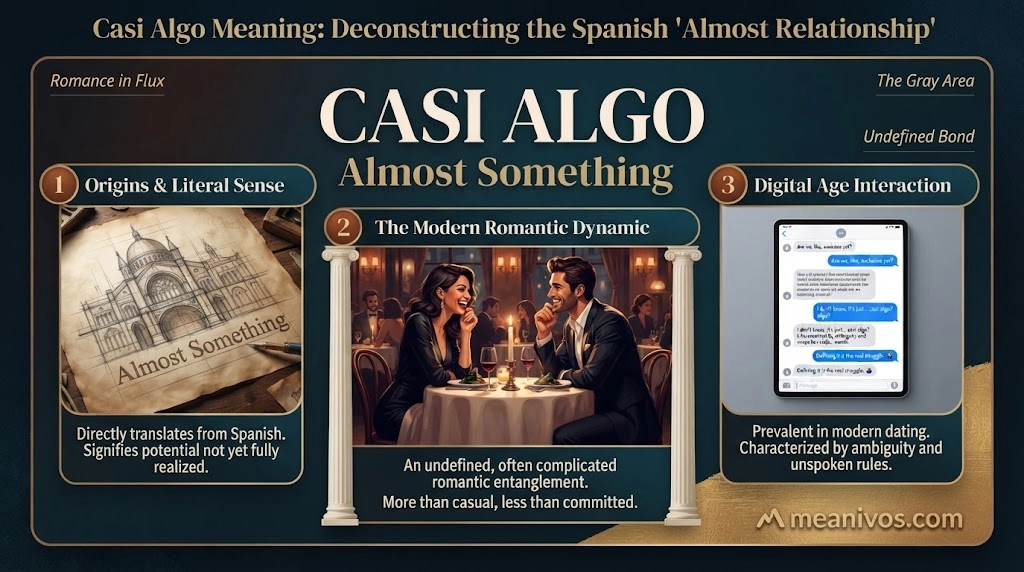
In texting, casi algo can be a convenient shorthand for a complicated relationship.
Instead of writing:
“We liked each other, talked constantly, went on dates, but never became an official couple.”
Someone can simply say:
“Mi casi algo.”
The phrase compresses a complicated relationship history into two words.
Depending on the conversation, it may sound:
- Romantic
- Funny
- Sad
- Nostalgic
- Frustrated
- Playful
Context is everything.
Casi Algo Meaning on TikTok and Instagram
Social media has helped relationship vocabulary travel quickly across languages.
When casi algo appears in a TikTok caption, Instagram post, comment, or meme, it commonly refers to an almost-relationship or emotionally complicated connection.
Typical topics include:
- “What if?” relationships
- Mixed signals
- Unrequited feelings
- Romantic nostalgia
- Missed opportunities
- Ghosting
- Almost dating
- Emotional attachment
- Unfinished relationships
However, it’s better not to assume that every appearance of casi algo online has exactly the same meaning.
The literal Spanish expression is broader than the relationship slang interpretation.
Why Is Casi Algo So Emotional?
The phrase is powerful because “almost” leaves room for possibility.
A normal relationship may have a recognizable path:
Meet → date → become a couple → relationship → breakup
An almost relationship can look like:
Meet → connect → develop feelings → remain undefined → disappear
That missing definition can leave someone wondering:
- What would have happened?
- Did they really like me?
- Why didn’t we become official?
- Was the timing wrong?
- Could it have worked?
- Should I have said something?
This is why a casi algo can sometimes feel emotionally significant even though it was never officially a relationship.
Does Casi Algo Always Mean Romance?
No.
This is one of the most important points to understand.
The literal words casi and algo don’t inherently describe romance.
SpanishDictionary’s examples show Casi Algo being used in ordinary contexts with meanings related to “almost something,” “almost a matter,” or similar constructions.
The romantic meaning is a contextual modern use.
So if you encounter the phrase in a Spanish sentence, don’t automatically translate it as “situationship.”
Look at the surrounding words.
If the conversation is about dating, love, or attraction, the relationship interpretation is likely.
If the conversation is about an object, event, task, or abstract idea, the literal meaning may be intended.
How Do You Pronounce Casi Algo?
A rough pronunciation for English speakers is:
CAH-see AHL-go
Think of it as two separate words:
casi → CAH-see
algo → AHL-go
For accurate Spanish pronunciation, listen to native speakers because pronunciation can vary across Spanish-speaking regions.
How to Use Casi Algo Naturally
Here are some common relationship-style constructions:
Mi casi algo
Meaning: My almost relationship / the person I almost dated.
Él es mi casi algo
Meaning: He’s the guy I almost dated.
Ella es mi caso algo
Meaning: She’s the girl I almost dated.
Éramos casi algo
Meaning: We were almost a couple.
Mi ex casi algo
This can be used informally to refer to a former almost-relationship, although the exact phrasing and naturalness can vary by speaker and context.
Common Misunderstandings About Casi Algo
“Casi algo” always means “situationship.
Not necessarily.
The concepts overlap, but casi algo can emphasize that something almost became a relationship.
It always means an ex.
No.
An ex was generally an official romantic partner. A casi algo typically never reached that official status.
It only describes physical attraction.
No.
The connection may involve emotional intimacy, romantic feelings, attraction, dating, or several of these.
It always refers to something currently happening.
No.
People can use it to describe a past connection.
“Almost something” is always the best translation.
Not in natural English.
It’s the literal translation, but “almost relationship” or “someone I almost dated” may communicate the intended meaning better.
Is a Casi Algo a Real Relationship?
This depends on what you mean by real.
If you’re asking whether it was an official relationship, usually no.
If you’re asking whether the emotions or connection were real, they certainly can be.
A person can experience:
- Attraction
- Affection
- Emotional attachment
- Jealousy
- Disappointment
- Nostalgia
- Heartbreak
without having an official relationship label.
So:
Unofficial doesn’t necessarily mean emotionally unimportant.
Can a Casi Algo Become a Relationship?
Yes.
A casi algo can eventually become an official relationship if both people decide they want the same thing.
For example:
Talking → Dating → Defining the relationship → Official couple
But that’s not guaranteed.
Some connections remain undefined, while others end because of timing, distance, incompatible expectations, or changing feelings.
The term describes the almost stage, not the final outcome.
Why Do People Say “Mi Casi Algo”?
People use mi casi algo because sometimes a normal relationship label doesn’t fit.
Calling someone a:
- friend may feel too distant,
- boyfriend/girlfriend may be inaccurate,
- ex may imply an official relationship that never existed.
Casi algo fills that linguistic gap.
It communicates:
“This person was important to me, but we never became an official couple.”
That’s one reason the phrase is so useful in modern relationship conversations.
Casi Algo Meaning: Quick Comparison
| Phrase | Natural English meaning |
| casi algo | almost something |
| mi casi algo | my almost relationship |
| éramos casi algo | we were almost a couple |
| casi algo romántico | almost something romantic |
| situationship | undefined romantic relationship |
| ex | former official partner |
| amigo/amiga | friend |
| pareja | partner/couple |
People Also Ask
A:There isn’t one perfect English word. “Almost relationship” or “someone I almost dated” is often more natural than the literal “almost something.”
A:Its individual words are ordinary Spanish, but casi algo has developed a recognizable informal relationship use in contemporary dating conversations.
A:Not necessarily. It can involve romantic feelings or attraction, but the phrase itself means “almost something.”
A:There isn’t a formal opposite, but an official relationship would represent the clearest contrast.
A:It can feel unresolved because there may be no formal relationship, breakup, or clear ending—leaving people focused on what might have happened.
How to Understand Casi Algo in One Sentence
If you only remember one thing, remember this:
Casi algo literally means “almost something,” and in relationship contexts it usually describes a romantic or emotional connection that never became official.
That’s the most accurate way to understand the phrase without confusing its literal Spanish meaning with its modern relationship usage.
Conclusion
Casi Algo is a small Spanish phrase with a surprisingly broad range of meaning.
Literally, it means “almost something.” The words themselves are straightforward: casi = almost and algo = something.
In modern relationship conversations, however, casi algo commonly describes something much more specific: a romantic or emotionally meaningful connection that came close to becoming a relationship but never became official.
It can describe someone you almost dated, an almost-couple, or a connection that existed somewhere between friendship and a committed relationship.
It can overlap with situationship, but the terms aren’t always interchangeable.
And perhaps that’s exactly why casi algo resonates so strongly: sometimes the hardest relationships to describe aren’t the ones that clearly began or clearly ended—they’re the ones that remained almost something.