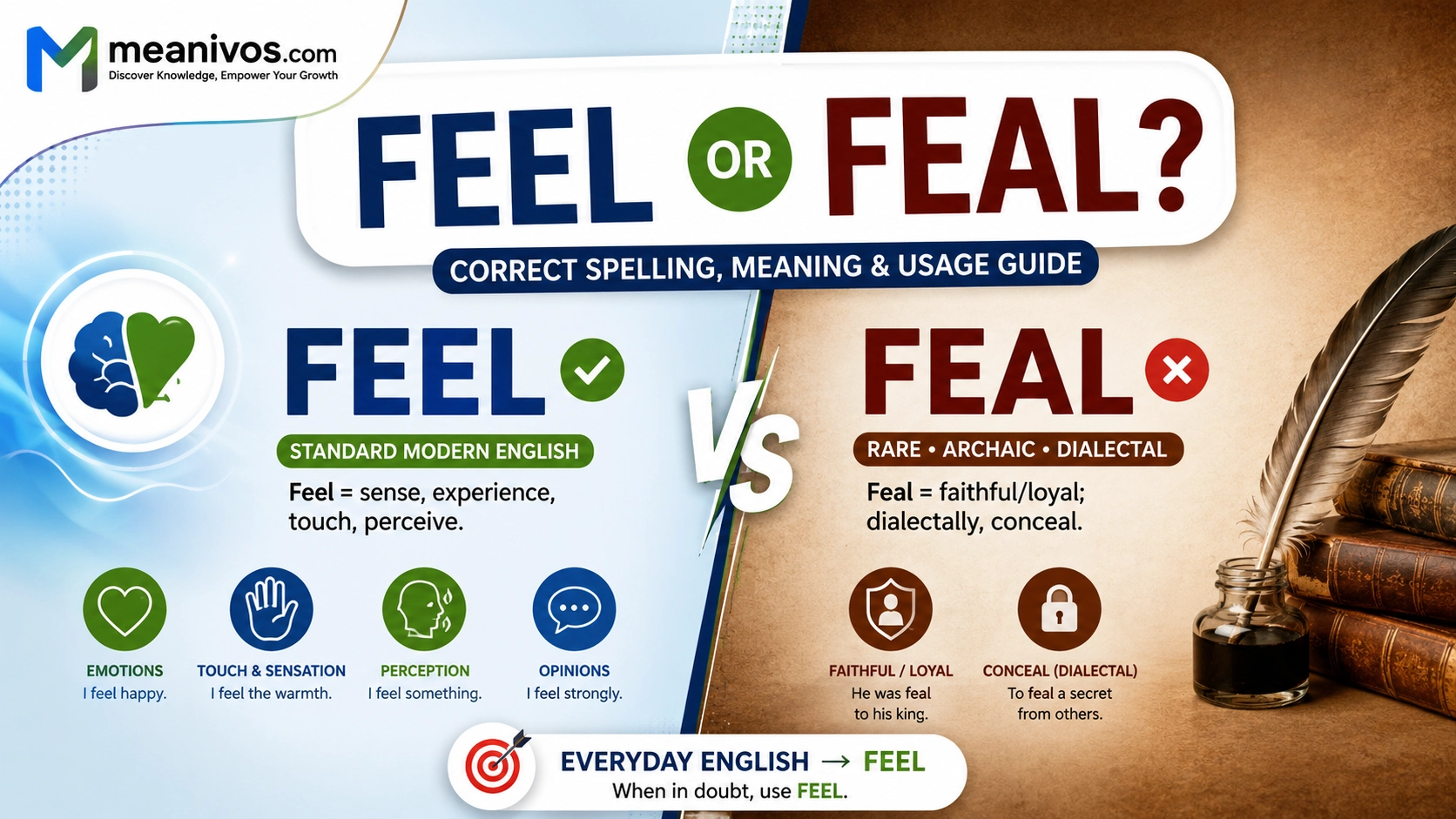
Feel or Feal? Correct Spelling, Meaning & Usage Explained
Feel or feal—which spelling is correct? In modern English, feel is the standard word when you mean to experience an emotion, notice a physical sensation, touch something, or express an opinion. Feal is also a genuine English word, but it is extremely rare and is mainly associated with archaic or dialectal English.
The most familiar historical meaning of feal is Faithful, loyal, or true. Merriam-Webster also records a separate dialectal verb feal meaning to conceal.
So, if you are writing a text message, email, school assignment, article, business document, or everyday conversation, feel is almost certainly the word you need.
Feel or Feal: Which One Is Correct?
The answer depends on the meaning and context.
For modern everyday English, use feel.
Examples:
- I feel happy today.
- I feel tired after work.
- Can you feel the cold air?
- I feel that we made the right choice.
- She felt nervous before the interview.
- This fabric feels soft.
Feal is not the normal modern spelling of feel. It is a separate, rare word with historical and dialectal meanings.
Quick answer
| Word | Status | Main meaning |
| feel | Standard modern English | Experience, sense, touch, perceive, or have an opinion |
| feal | Rare, archaic/dialectal | Faithful or loyal; dialectally, conceal |
The easiest rule
If you mean emotion, sensation, touch, or an opinion → use feel.
If you mean the archaic word “faithful/loyal” → feal may be correct.
This distinction is important because feal is a real word, even though most modern writers should not use it as a replacement for feel.
What Does Feel Mean?
Feel is one of the most common English words and has several meanings.
It can refer to:
- experiencing an emotion
- experiencing a physical sensation
- becoming aware of something
- touching or examining something
- having an opinion
- sensing an atmosphere or impression
Oxford lists feel as a verb pronounced /fiːl/ and records forms including feel, feels, felt, and feeling.
1. Feel means to experience an emotion
We use feel when talking about emotional states.
Examples:
- I feel happy today.
- She feels nervous before exams.
- They felt disappointed by the result.
- He feels excited about the trip.
- I feel much better now.
In these examples, feel describes an emotional experience.
2. Feel means to experience a physical sensation
Feel can also describe something experienced physically.
Examples:
- I feel the heat from the fire.
- She felt pain in her shoulder.
- Can you feel the wind?
- He felt the cold water on his hands.
- I could feel the sun on my face.
Oxford specifically documents feel for becoming aware of something through physical contact or effect.
3. Feel means to touch or examine
You can use feel when using your hands to examine something.
Examples:
- Feel this fabric. It is incredibly soft.
- She felt the surface of the table.
- He felt the material before buying it.
- I felt the wall to find the switch.
4. Feel can express an opinion
Feel can also mean think or believe.
Examples:
- I feel that this is the best option.
- She feels that the decision was unfair.
- We feel the company should improve its service.
- He felt that something was wrong.
Oxford specifically records this opinion-related meaning of feel.
5. Feel can describe an atmosphere or impression
We also use feel to describe the character or atmosphere of something.
Examples:
- This room feels peaceful.
- The restaurant feels welcoming.
- The city feels different at night.
- The website has a modern feel.
As a noun, feel can describe the impression or atmosphere created by a place or situation.

What Does Feal Mean?
Feal is a real English word, but it is not a normal modern substitute for feel.
It has more than one historical or dialectal sense.
The two meanings most relevant to this comparison are:
- Feal = faithful or loyal — archaic adjective
- Feal = conceal or hide — dialectal verb
Merriam-Webster records both senses separately.
Feal meaning “faithful” or “loyal”
In its archaic use:
feal = faithful / loyal / true
Collins identifies feal in British English as an archaic adjective meaning faithful.
For example:
The feal servant remained loyal to his lord.
In modern English, we would normally write:
The faithful servant remained loyal to his lord.
Or:
The loyal servant remained loyal to his lord.
The word therefore belongs mainly to historical, literary, or deliberately archaic language.
Feal meaning “conceal”
Merriam-Webster also records feal as a dialectal English transitive verb meaning conceal.
This meaning is even less likely to appear in everyday modern English.
For modern writing, use:
- hide
- conceal
- cover
- keep secret
rather than feal.
Why this matters
It would be inaccurate to tell readers:
“Feal is not a word.”
A more precise explanation is:
Feal is a genuine but rare archaic or dialectal word, while feel is the standard modern English word.
That distinction is one of the most important points in understanding feel vs feal.
Feel vs Feal: Key Differences
| Feature | Feel | Feal |
| Modern usage | Very common | Extremely rare |
| Standard English | Yes | No, not in its archaic/dialectal senses |
| Part of speech | Verb and noun | Mainly archaic adjective; also dialectal verb |
| Common meaning | Sense, experience, touch, perceive, think | Faithful/loyal; dialectally conceal |
| Everyday conversation | Common | Almost never |
| Text messages | Common | Usually inappropriate |
| School writing | Appropriate | Usually inappropriate |
| Professional writing | Appropriate | Usually inappropriate |
| Historical writing | Appropriate | May be appropriate |
| British English | feel | feal exists historically/dialectally |
| American English | feel | Rare/archaic |
| Past tense | felt | Not the past tense of feel |
The key difference in one sentence
Feel is a normal modern English word; feal is a rare historical or dialectal word with different meanings.
Is Feal a Real Word?
Yes, feal is a real word.
This is where many spelling guides become too simplistic.
Because modern readers overwhelmingly encounter feel, they may assume feal is simply a typo. In ordinary writing, that assumption is understandable. However, dictionaries record feal as a genuine word.
Merriam-Webster lists:
- feal as an archaic adjective meaning faithful or loyal
- feal as a dialectal English verb meaning conceal
Collins also identifies feal as an archaic British adjective meaning faithful.
Is “I feal happy” correct?
No.
If you mean that you experience happiness, write:
I feel happy.
Not:
I feal happy.
Is “feal” a spelling variant of “feel”?
No.
Feal and feel are separate words.
They can sound the same or very similar, but their meanings and modern usage are different.
Is Feal the Past Tense of Feel?
No.
This is a common spelling mistake.
The correct forms are:
feel → felt → felt → feeling
Examples:
- Today I feel tired.
- Yesterday I felt tired.
- I have felt tired all week.
- I am feeling better now.
Oxford identifies felt as the past tense and past participle of feel.
Therefore:
❌ I feal tired yesterday.
✅ I felt tired yesterday.
Why Do People Confuse Feel and Feal?
There are several reasons.
1. They look very similar
Compare:
feel
feal
Only the vowel combination changes.
That small visual difference can easily cause typing or spelling mistakes.
2. They can sound alike
Feel is pronounced /fiːl/. Oxford gives the same basic pronunciation pattern for the common word.
Because spelling cannot always be determined from pronunciation, someone who hears the word may wonder whether it should be spelled feel or feal.
3. English has unpredictable spelling patterns
English contains many words where pronunciation and spelling do not line up perfectly.
Compare:
- feel
- heel
- meal
- real
- seal
- steel
- wheel
- Related To Other Article : https://meanivos.com/leafs-or-leaves/
A learner may naturally wonder whether feal is another normal spelling pattern.
4. Feal actually exists
The confusion is especially understandable because feal is genuinely recorded in English dictionaries.
The problem is not that feal is imaginary.
The problem is that its uses are rare, archaic, or dialectal, while feel is the standard modern word.
Feel vs Feal Pronunciation
feel → /fiːl/
It rhymes with words such as:
- see
- tree
- free
- steel
- wheel
Feal
The rare word feal is also pronounced with a long “ee” sound in dictionary records, which helps explain why the two spellings are easily confused.
Why pronunciation does not solve the spelling problem
If someone says:
I feel happy.
The sound alone does not tell you which spelling they intended.
Context does.
In ordinary modern English, the overwhelming choice is:
feel
Is Feal British English?
No, feal is not the British spelling of feel.
This distinction is important.
Both British and American standard English use:
feel
Examples:
- I feel tired.
- She feels happy.
- We felt cold.
- They are feeling better.
Collins labels feal as an archaic word in British English meaning faithful, but that does not make it a modern British spelling variant of feel.
British English
feel = standard modern spelling
feal = rare archaic/dialectal word
American English
feel = standard modern spelling
feal = rare archaic/dialectal word
So the correct spelling does not change from feel to feal simply because you are writing for a British audience.
Feel as a Verb
Feel is an irregular verb.
Present tense
- I feel
- You feel
- We feel
- They feel
- He feels
- She feels
- It feels
Past tense
- I felt
- She felt
- They felt
Past participle
- felt
-ing form
- feeling
Oxford gives the principal forms as feel, felt, felt, feeling.
Examples
- I feel fine.
- She feels nervous.
- They felt cold.
- We have felt this way before.
- He is feeling better.
Feel as a Noun
Feel can also function as a noun.
It can describe the quality of something experienced through touch or the overall impression created by a place or situation.
Examples:
- I like the feel of this fabric.
- The room has a warm feel.
- The website has a modern feel.
- This restaurant has a relaxed feel.
- I like the feel of the leather.
Feel vs feeling
These words are related but are not always interchangeable.
Feel can describe the quality or impression of something:
The room has a comfortable feel.
Feeling often refers to an emotion, sensation, or belief:
I have a strange feeling about this.
Oxford documents feeling as a noun for emotions, sensations, beliefs, opinions, and atmospheres.
Common Expressions With Feel
The word feel appears in many common expressions.
Feel like
Feel like can mean wanting something or experiencing an impression.
Examples:
- I feel like going for a walk.
- I feel like eating pizza.
- It feels like rain.
- I feel like something is wrong.
Oxford records feel like in everyday English for wanting to do or have something.
Feel free
Feel free means that someone is allowed or welcome to do something.
Examples:
- Feel free to ask questions.
- Feel free to contact me.
- Feel free to take a seat.
Feel for
Feel for someone means to have sympathy for them.
Example:
I really feel for her after what happened.
Oxford specifically defines feel for somebody as having sympathy for that person.
Feel up to
Feel up to means feeling well or energetic enough to do something.
Examples:
- I don’t feel up to going out tonight.
- Do you feel up to another meeting?
Feel good
Feel good means to experience a positive physical or emotional state.
Examples:
- I feel good today.
- It feels good to finish the project.
Feel or Feal Examples in Sentences
Correct modern uses of “feel”
- I feel happy today.
- Can you feel the wind?
- She feels nervous before presentations.
- I felt something touch my hand.
- They feel that the decision was unfair.
- This blanket feels soft.
- The room feels comfortable.
- I feel better after resting.
- He felt cold during the night.
- We are feeling optimistic about the future.
Historical or archaic uses of “feal”
- The knight was feal to his king.
- The old text describes him as a feal servant.
- The poet praises his feal companion.
Here, feal is being used in its archaic sense of faithful or loyal.
Incorrect modern spelling
I feal happy today.
Correct modern spelling
I feel happy today.
Feel or Feal in School and Academic Writing
For school assignments, exams, university work, and ordinary academic writing, choose feel when you mean to experience, sense, touch, or believe something.
Correct:
I feel that the evidence supports this conclusion.
Correct:
Students may feel nervous before examinations.
Correct:
The participants felt more confident after the training.
Incorrect in ordinary modern usage:
I feal that the evidence supports this conclusion.
Unless your assignment is specifically discussing historical English, feal is likely to look like a spelling error.
Feel or Feal in Text Messages and Social Media
In everyday digital communication, feel is the natural choice.
Examples:
- I feel so tired today.
- I feel you.
- I feel like going out.
- I feel much better now.
- Do you feel the same way?
You would almost never need feal in an ordinary text conversation.
If someone writes:
I feal so happy rn
the intended modern spelling is:
I feel so happy rn.
The word feal does not become a texting abbreviation or modern internet slang simply because someone types it online.
Feel vs Feal: Common Mistakes to Avoid
Mistake 1: Writing “feal” when you mean “feel”
❌ I feal tired.
✅ I feel tired.
Mistake 2: Thinking “feal” is the British spelling
❌ Feal is the British spelling of feel.
✅ Feel is the standard spelling in both British and American English.
Mistake 3: Using “feal” as the past tense
❌ Yesterday, I feal sick.
✅ Yesterday, I felt sick.
Mistake 4: Saying “feal” is never a word
❌ Feal is not a real English word.
✅ Feal is a real but rare archaic or dialectal English word.
Mistake 5: Using “feal” in normal professional writing
Unless you intentionally need historical or dialectal vocabulary, use feel.
This applies to:
- emails
- essays
- reports
- websites
- schoolwork
- business writing
- social media
- everyday messages
How to Remember Feel vs Feal
Use this simple memory trick:
FEEL = emotions and sensations
You can feel:
- happy
- sad
- cold
- tired
- nervous
- pain
- excitement
- pressure
- texture
Think:
I feel what I experience.
FEAL = faithful
For the rare archaic adjective, remember:
Feal = faithful / loyal.
Easy rule
Modern everyday English → FEEL
Historical or archaic “faithful” → FEAL
That one distinction will solve almost every modern spelling question.
Feel or Feal: Which Should You Use in Everyday Writing?
Almost always, choose feel.
Use feel when you are writing:
- I feel happy.
- I feel sick.
- I feel cold.
- I feel nervous.
- I feel better now.
- I feel that you are right.
- I can feel the texture.
You may encounter feal in specialised contexts such as:
- historical literature
- older texts
- archaic vocabulary discussions
- dialect studies
- historical language research
- literary writing that deliberately uses old-fashioned language
The most accurate rule is therefore:
Feal is a legitimate but rare word; feel is the standard modern word.
Feel or Feal: Quick Decision Guide
When you are unsure, ask what you mean.
Are you talking about an emotion?
Use feel.
I feel happy.
Are you describing a physical sensation?
Use feel.
I can feel the cold.
Are you talking about touching something?
Use feel.
Feel this fabric.
Are you expressing an opinion?
Use feel.
I feel that we should wait.
Are you describing an old word meaning faithful or loyal?
Feal may be appropriate.
He remained feal to his lord.
Are you writing normal modern English?
Use feel.
Feel or Feal: 20 Quick Examples
| Meaning | Correct example |
| Emotion | I feel happy today. |
| Physical sensation | I feel the heat. |
| Touch | Feel this fabric. |
| Opinion | I feel that we should wait. |
| Awareness | I could feel the wind. |
| Past emotion | I felt nervous yesterday. |
| Present third person | She feels tired. |
| -ing form | He is feeling better. |
| Atmosphere | The room has a warm feel. |
| Desire | I feel like pizza. |
| Permission | Feel free to ask. |
| Sympathy | I feel for her. |
| Energy | I don’t feel up to going out. |
| Historical loyalty | The knight was feal to his king. |
| Modern spelling error | ❌ I feal happy. |
| Correct past tense | I felt happy. |
| British English | I feel tired. |
| American English | I feel tired. |
| Academic writing | I feel the evidence supports this. |
| Historical language study | Feal can mean faithful. |
Feel vs Feal: What About British and American English?
There is no standard modern UK/US spelling split here.
| Variety | Standard modern spelling |
| British English | feel |
| American English | feel |
| Canadian English | feel |
| Australian English | feel |
| Everyday international English | feel |
Feal should not be treated as a British alternative spelling.
Its British dictionary history reflects its archaic or dialectal status, not a modern spelling preference. Collins specifically labels it an archaic British adjective meaning faithful.
What Is the Origin of Feal?
The history of feal is particularly interesting because its different meanings have different etymological histories.
For the adjective meaning faithful, feal comes through Old French and is ultimately related to Latin fidelis, meaning faithful or loyal.
The dialectal verb meaning conceal has a different history. Merriam-Webster traces it through Middle English and Old Norse roots associated with hiding or concealing.
This means that the two dictionary senses of feal should not necessarily be treated as one modern word with a single straightforward history.
That historical distinction is another reason simply saying “feal means feel” is incorrect.
Does Feal Mean Feel?
No.
They are separate words.
Feel is the common modern word associated with:
- physical sensation
- emotion
- touch
- awareness
- opinion
- impression
Feal has rare historical or dialectal meanings, especially:
- faithful
- loyal
- conceal
So:
Feel ≠ feal
They may sound alike, but their meanings are different.
Is “Feal” Still Used Today?
Very rarely.
You may encounter feal in:
- historical texts
- literary works
- dictionaries
- etymology discussions
- dialect research
- writing that deliberately imitates older English
It is not a normal replacement for feel in modern conversation.
If a modern writer says:
I feal tired.
readers will almost certainly interpret it as a spelling mistake rather than as an intentional use of an archaic word.
Why “Feal Is Wrong” Is an Oversimplification
For everyday writing, telling someone to replace feal with feel is usually practical advice.
However, the statement:
“Feal is wrong.”
is not completely accurate.
A better explanation is:
“Feal is a real but rare archaic or dialectal word. Feel is the standard modern English spelling when you mean to experience or sense something.”
That wording gives readers both the practical answer and the dictionary-level nuance.
It also explains why someone might encounter feal in an old text without assuming the dictionary or author made a spelling mistake.
People Also Ask
A:Feel is correct for almost all normal modern English situations. Feal is a real but rare archaic or dialectal word.
A:Yes. Dictionaries record feal as an archaic adjective meaning faithful or loyal. Merriam-Webster also records a dialectal verb meaning conceal.
A:No. They are separate words. Feel is the common modern word for sensation, emotion, touch, awareness, and opinion.
A:No. The past tense and past participle of feel are felt.
feel → felt → felt → feeling
A:No. Feel is the standard modern spelling in both British and American English. Feal is a separate archaic/dialectal word.
Feel or Feal: Final Verdict
If you are asking “feel or feel?” because you want to describe an emotion, sensation, physical experience, touch, or opinion, choose feel.
Feel is the standard modern English word:
- I feel happy.
- I feel cold.
- I feel nervous.
- I feel the texture.
- I feel that you’re right.
Feal is a genuine English word, but it is very uncommon. Its best-known archaic meaning is faithful or loyal, while Merriam-Webster also records a dialectal verb meaning conceal.
The easiest rule to remember
Feel = standard modern English.
Feal = rare, archaic, or dialectal English.
So for everyday writing, schoolwork, professional communication, websites, texting, and social media:
Use “feel.”
Conclusion: Feel or Feal?
When choosing between feel or feal, the correct word for almost all modern English writing is feel. Use it when you are talking about emotions, physical sensations, touch, opinions, or how something seems.
Feal is a genuine English word, but it is extremely rare and mainly appears in archaic or dialectal contexts. It can mean faithful or loyal, while some dictionaries also record a dialectal meaning related to concealing something.
The easiest rule to remember is simple:
Feel = standard modern English
Feal = rare, archaic, or dialectal English
So, if you are writing an email, essay, school assignment, website, text message, or social media post, feel is almost certainly the spelling you need.
Understanding this small difference can help you avoid a common spelling mistake while also recognising feal when you encounter it in historical or specialised English.