Kick Rocks Meaning: What It Means, Origin & How to Use It
Have you ever received a message saying “kick Rocks” and wondered whether the person was joking or actually telling you to leave?
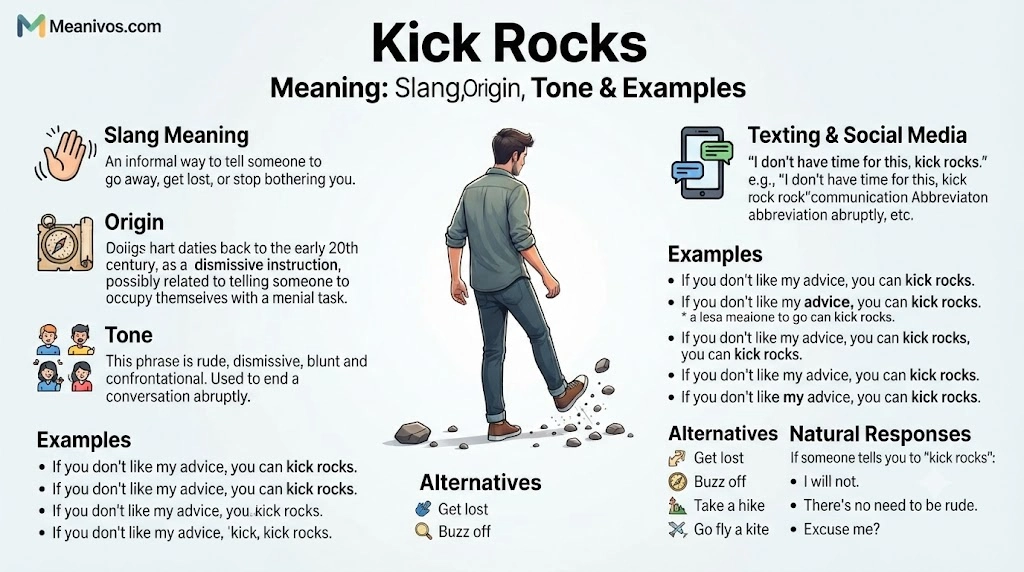
“Kick rocks” is an informal English slang expression that usually means “go away,” “leave me alone,” “get lost,” or “stop bothering me.” It is generally dismissive, but the exact tone depends on the situation. Friends may use it playfully, while someone in an argument may use it seriously.
For example:
“If you don’t like my decision, you can kick rocks.”
Here, the speaker is not literally telling someone to kick stones. They are telling that person to go away or stop arguing.
The phrase is common in casual American English and can appear in conversations, text messages, comments, memes, and social media. Because written messages do not always show facial expressions or voice tone, “kick rocks” can sometimes be difficult to interpret.
In this guide, you’ll learn what kick rocks means, whether it is rude, how it is used in texting, where the expression may have come from, and what to say if someone tells you to kick rocks.
What Does “Kick Rocks” Mean?
“Kick rocks” means to go away, leave someone alone, get lost, or stop bothering them.
It is an informal and usually dismissive expression.
In simple English:
Kick rocks = Go away.
Depending on context, it can also mean:
- Leave me alone.
- Stop bothering me.
- Get lost.
- Go somewhere else.
- Find something else to do.
- I don’t want to deal with you.
- I’m not interested.
- I’m done with this conversation.
The phrase is normally used in casual speech and informal online communication, rather than professional or formal situations.
Quick definition
Kick rocks: An informal slang phrase used to tell someone to go away, leave you alone, or stop bothering you.
Example
“I’ve already answered your question. Kick rocks.”
The speaker means:
“Stop bothering me and go away.”
Kick Rocks Meaning in Simple English
If English is not your first language, “kick rocks” can be confusing because its literal meaning is different from its idiomatic meaning.
Literally, someone could kick a rock with their foot.
But when a person says:
“Go kick rocks!”
they usually mean:
“Go away and leave me alone.”
It is similar to telling someone to “get lost” or “take a hike.”
The phrase creates a funny mental image of someone walking away while kicking small rocks. That imagery gives the expression its colourful, informal character.
In one sentence
“Kick rocks” is a casual way to tell someone to leave, go away, or stop bothering you.
Quick Meaning Summary
| Phrase | Meaning | Typical tone |
| Kick rocks | Go away or leave me alone | Dismissive |
| Go kick rocks | Go away / get lost | Dismissive or sarcastic |
| Kick rocks! | Leave me alone | Can be rude or playful |
| You can kick rocks | I reject your request or opinion | Firm |
| Tell them to kick rocks | Tell them to go away | Informal |
The important thing to remember is that tone and context can change how strong the expression sounds.
What Does “Go Kick Rocks” Mean?
“Go kick rocks” is simply a more explicit version of “kick rocks.”
It generally means:
“Go away,” “get lost,” or “leave me alone.”
For example:
“You don’t want to help? Fine. Go kick rocks.”
The speaker is dismissing the other person.
Compare these two expressions:
- “Kick rocks.” → Go away.
- “Go kick rocks.” → Go away and find something else to do.
Both are informal and can sound dismissive.
Is “Kick Rocks” Rude or an Insult?
It can be rude, but it is not necessarily a serious insult.
The phrase is primarily dismissive. It tells someone that the speaker does not want to continue dealing with them.
For example:
“I’m trying to work. Go .”
This sounds annoyed and unfriendly.
However, close friends may use the same phrase as a joke:
“You ate the last slice of pizza? !”
If the person is laughing, the expression may simply be playful teasing.
How rude is “kick rocks”?
| Situation | Likely tone |
| Close friend laughing | Playful |
| Friend using 😂 | Probably joking |
| Argument | Angry or dismissive |
| Stranger saying it | Rude |
| Online disagreement | Sarcastic or hostile |
| Workplace | Usually inappropriate |
| Dating argument | Potentially serious rejection |
So, is not automatically offensive, but it can certainly sound disrespectful.
The safest way to understand it is:
Context + relationship + tone = intended meaning.
Is “Kick Rocks” a Swear Word?
No, “kick rocks” is not a swear word or profanity.
However, something does not have to contain profanity to be rude.
The expression is dismissive slang. It can communicate that the speaker wants someone to leave or stop bothering them.
For example:
“Please give me some space.”
is relatively polite.
“Kick rocks.”
is much more dismissive.
So although is not vulgar language, it may still be inappropriate in certain situations.
Meaning in Texting
When someone writes “kick rocks” in a text message, they are usually telling you to:
- Go away.
- Leave me alone.
- Stop bothering me.
- Stop arguing.
- Find something else to do.
- Forget about your request.
For example:
A:
“Can you please give me another chance?”
B:
“Kick rocks.”
B is probably saying:
“No. Leave me alone. I’m not interested.”
Why texting can make “kick rocks” confusing
In face-to-face conversation, you can hear someone’s voice and see their expression.
Texting does not provide those clues.
Compare:
“Kick rocks 😂”
with:
“Kick rocks.”
The first could easily be playful.
The second may sound cold or serious.
That is why context is especially important when interpreting slang in text messages.
Meaning on Social Media
The expression can also appear in online discussions, comments, memes, and social-media posts.
TikTok
On TikTok, someone may use “” as a humorous or sarcastic response to another person’s opinion.
Example:
“You really think pineapple doesn’t belong on pizza? 😂”
This may simply be playful disagreement.
In Instagram comments or DMs, can be used to reject criticism or unwanted attention.
“If you don’t like my content, .”
Meaning:
“You don’t have to follow or interact with me.”
On Reddit, the phrase can appear during disagreements.
“If you’re going to complain without reading the post, .”
Here, it sounds more dismissive and confrontational.
Someone might use it jokingly with friends or seriously during an argument.
Discord
Because Discord conversations are often casual, may be used as slang between friends, although it can also be used aggressively during disagreements.
X (Twitter)
On X, the expression can be used sarcastically to dismiss someone’s opinion or criticism.
Social-media takeaway
Across platforms, generally means “go away” or “stop bothering me.” The surrounding conversation determines whether it is funny, sarcastic, annoyed, or genuinely hostile.
How Tone Changes the Meaning
The words themselves do not change, but the emotional meaning can change dramatically.
1. Playful
“You got the last cookie? ! 😂”
Meaning:
“I’m jokingly annoyed with you.”
2. Annoyed
“I’ve told you three times that I’m busy. Go .”
Meaning:
“Stop bothering me.”
3. Angry
“You don’t respect me, so go .”
Meaning:
“Leave me alone. I don’t want to deal with you.”
4. Sarcastic
“You want me to work all weekend for free?
Meaning:
“Absolutely not. Your request is unreasonable.”
5. Friendly teasing
“You think your team is better than mine?
Meaning:
“I strongly disagree, but I’m joking around.”
The same expression can therefore range from light teasing to serious rejection.
- Explore More : https://meanivos.com/feel-or-feal/
Where Did “Kick Rocks” Come From?
The exact origin of “kick rocks” is uncertain.
This is important because some websites present a specific origin story or date as though it were proven. The historical evidence does not justify treating every popular explanation as an established fact.
The expression is associated with informal American English, and its imagery is easy to understand: someone who is being dismissed can simply walk away and occupy themselves by kicking rocks.
The phrase may therefore suggest:
“Go away and waste your time somewhere else.”
However, the exact person, place, or moment when first became a slang expression is not firmly established.
Why does the phrase make sense?
Imagine telling someone:
“There’s nothing more to discuss. Go away and find something pointless to do.”
The image of walking away and kicking stones gives that message a humorous, colourful form.
This is similar in spirit to expressions such as:
- Get lost.
- Take a hike.
- Beat it.
- Buzz off.
- Hit the road.
- Pound sand.
These expressions all communicate some version of “go away,” but their histories and nuances are not necessarily identical.
Important origin note
It is better to say “the exact origin is uncertain” than to claim an unverified first-use date or story as fact.
Is “Kick Rocks” American Slang?
Yes, “kick rocks” is generally associated with informal American English.
It can be understood by English speakers in other countries, particularly because American films, television, music, and internet culture have spread many American slang expressions.
However, it is most naturally associated with casual American speech.
For an English learner, the easiest interpretation is:
Kick rocks = Go away / Get lost / Leave me alone.
How to Use in a Sentence
Because the expression is informal, it works best in casual conversations.
Example 1
“If you don’t like my decision, you can .”
Meaning: You can leave if you don’t like my decision.
Example 2
“He kept bothering me, so I told him to .”
Meaning: I told him to leave me alone.
Example 3
“Anyone who doesn’t respect the rules can.”
Meaning: People who refuse to follow the rules should go away.
Example 4
“You think you’re getting my last cookie?!”
Meaning: A playful refusal.
Example 5
“I’ve explained this three times. Go .”
Meaning: Stop bothering me.
Example 6
“The offer was so low that I told them to.”
Meaning: I strongly rejected the offer.

20 Real-Life Examples
Here are some natural examples showing different contexts:
- “You don’t like it? .”
- “Go kick rocks and leave me alone.”
- “He told the scammer to .”
- “If you’re only here to complain, .”
- “You ate my lunch? Kick rocks!”
- “I’m busy right now. Go “
- “She told him to .”
- “Anyone who breaks the rules can.”
- “He can if he thinks I’ll apologise.”
- “Kick rocks, dude. I’m working.”
- “You want another favour? .”
- “She laughed and told me to .”
- “If you don’t respect me, .”
- “The rude customer was told t.”
- “You think you’re better than me? .”
- “Kick rocks—I already answered that.”
- “He jokingly told his brother to .”
- “If they don’t like the decision, they can .”
- “Go . I’m done arguing.”
- “She wasn’t joking when she told him to .”
Kick Rocks Examples by Situation
With friends
“You ate my fries? !”
Usually playful.
During an argument
“We’re not discussing this anymore. Kick rocks.”
Usually serious and dismissive.
Online
“If you don’t like the post, kick rocks.”
Meaning:
“You don’t have to stay here or complain.”
At work
“If you don’t like our policy, kick rocks.”
This would generally sound unprofessional.
In dating
“If you can’t respect my boundaries, kick rocks.”
This is much more serious and can mean:
“Leave me alone or leave the relationship.”
Kick Rocks vs. Similar Expressions
There are many English expressions that can mean “go away.” However, their tone is not always exactly the same.
| Expression | Basic meaning | Typical tone |
| Kick rocks | Go away | Dismissive, sarcastic |
| Get lost | Go away | Rude or annoyed |
| Take a hike | Leave | Dismissive, sometimes playful |
| Buzz off | Go away | Informal, annoyed |
| Beat it | Leave | Strongly dismissive |
| Scram | Go away quickly | Playful or old-fashioned |
| Hit the road | Leave | Casual or firm |
| Pound sand | Go away / waste your time | Dismissive |
| Leave me alone | Stop bothering me | Direct |
| Please give me some space | Stop engaging | Polite |
Kick rocks vs. get lost
Both can mean “go away.”
However:
“Get lost.”
usually sounds more direct.
“Kick rocks.”
is more colourful and idiomatic.
Kick rocks vs. take a hike
Both are informal ways to tell someone to leave.
Take a hike can sometimes sound more old-fashioned, while kick rocks has a casual slang feel.
Kick rocks vs. pound sand
These expressions can both be used dismissively to tell someone to go away or occupy themselves elsewhere.
However, they are separate expressions and should not automatically be treated as exact synonyms in every situation.
How to Respond When Someone Says “Kick Rocks”
Your best response depends on whether the person is joking or genuinely upset.
If they’re joking
You can joke back:
“Gladly. I needed some exercise anyway.”
If they’re genuinely annoyed
A calm response is usually better:
“Understood. I’ll give you some space.”
If you don’t understand why they’re upset
Ask:
“Did I do something to upset you?”
If someone is being disrespectful
You do not have to argue.
You can simply say:
“Okay, I’ll leave it there.”
If it happens online
You may not need to respond at all.
If someone says “kick Rocks”, they may be signalling that they want the conversation to end. Continuing an argument can make the situation worse.
When Should You Avoid Saying “Kick Rocks”?
Although kick rocks is not profanity, it is still dismissive.
That makes it unsuitable for many situations.
Avoid it in professional communication
Don’t write:
“If you don’t like our decision, .”
A professional alternative would be:
“We understand that this decision may not meet your expectations.”
Avoid it with customers
A customer-service employee saying would likely sound disrespectful and unprofessional.
Avoid it with strangers
Unless you intentionally want to sound confrontational, choose a clearer and more polite expression.
Avoid it during serious arguments
When emotions are already high, may escalate the disagreement.
Polite Alternatives to “Kick Rocks”
Sometimes you want to communicate the same boundary without sounding hostile.
Try these alternatives:
Very polite
“I’d appreciate some space right now.”
Direct
“Please leave me alone.”
Professional
“I’d prefer not to continue this conversation.”
Firm
“Please stop contacting me.”
Casual
“I’m going to leave this conversation here.”
Friendly
“Let’s agree to disagree.”
These expressions can communicate your boundary without the dismissive attitude associated with .
Is “Kick Rocks” Offensive?
It can be offensive depending on the context, but it is not normally considered highly vulgar.
Consider these two examples:
“Oh, 😂”
This may be playful.
But:
“Go and never talk to me again.”
This is clearly hostile.
Therefore, is better described as dismissive slang than inherently offensive language.
The relationship between the speakers, the situation, and the tone all matter.
Can “Kick Rocks” Be Used as a Joke?
Yes.
Friends sometimes use kick rocks as playful teasing.
For example:
“You got the last slice of pizza? Kick rocks 😂”
The speaker probably does not genuinely want their friend to leave.
Instead, they are expressing humorous annoyance.
Other playful examples include:
“You picked the winning team? Kick rocks!”
“You beat my high score? Go kick rocks!”
“You’re not sharing your snacks? Kick rocks!”
The expression can therefore sound much softer when it is surrounded by laughter, emojis, or an obviously friendly situation.
Does “Kick Rocks” Mean “Go Away”?
Yes.
This is the simplest and most useful definition.
When someone says:
“Kick rocks.”
they usually mean:
“Go away.”
Depending on context, it can also mean:
- Leave me alone.
- Get lost.
- Stop bothering me.
- Find something else to do.
- I’m rejecting your request.
- I’m finished with this conversation.
The phrase adds more attitude than the simple words “go away.”
What Is the Opposite of “Kick Rocks”?
There is no perfect opposite idiom, but phrases such as these communicate the opposite idea:
- Stay.
- Come here.
- Stick around.
- You’re welcome here.
- Please stay.
- I’d like you to stay.
- Come join us.
For example:
“Don’t kick rocks—stick around!”
would jokingly mean:
“Don’t leave. Stay here.”
Common Misunderstandings
Misunderstanding 1: It always means literally kicking rocks
Usually, no.
In ordinary conversation, is an idiom meaning go away or leave me alone.
Misunderstanding 2: It is always extremely offensive
Not necessarily.
Friends can use it playfully.
Misunderstanding 3: It is always a joke
No.
During an argument, it may be a serious dismissal.
Misunderstanding 4: It is only internet slang
No.
The expression is used in broader informal English and is not simply a social-media invention.
Misunderstanding 5: Its exact origin is known
This is another common mistake.
The phrase has understandable imagery and a recognised modern meaning, but its exact historical origin is not firmly established enough to present one popular story as proven fact.
Kick Rocks Meaning by Context
| Context | Likely meaning |
| Text from a close friend | Probably teasing |
| Text during an argument | Leave me alone |
| TikTok comment | Dismissive response |
| Reddit discussion | Get lost / stop bothering me |
| Dating conversation | Strong rejection or boundary |
| Workplace | Usually inappropriate |
| Family joke | May be playful |
| Stranger | Probably rude |
| Heated argument | Strong dismissal |
| Casual conversation | Often sarcastic |
This is why you should not interpret from the words alone.
Look at the entire conversation.
People Also Ask
A:“Kick rocks” means “go away,” “leave me alone,” “get lost,” or “stop bothering me.” It is an informal expression that is usually dismissive.
A:“Go kick rocks” means “go away” or “get lost.” It is another way to dismiss someone, often with a sarcastic or annoyed tone.
A:It can be insulting because it dismisses another person, but it is more accurately described as a dismissive expression. Its seriousness depends on context.
A:It can be rude, especially when said seriously to a stranger or during an argument. Friends may also use it jokingly.
A:In texting, it generally means “go away,” “leave me alone,” or “stop bothering me.” An emoji or playful context may indicate that the sender is joking.
Final Takeaway
“Kick rocks” is an informal expression that usually means “go away,” “leave me alone,” “get lost,” or “stop bothering me.”
It is normally dismissive, but the emotional force depends on the situation.
A friend might say:
“Kick rocks 😂”
as a joke.
Someone during a heated argument might say:
“Go kick rocks.”
as a serious rejection.
So if you see in a text, comment, DM, or conversation, consider who said it, what happened before it, and whether the tone appears playful or serious.
The simplest meaning is:
Kick rocks = Go away / Leave me alone.
It is not a swear word, but it can sound rude or disrespectful. It is usually best reserved for informal conversations where the tone is clear.
And when it comes to the phrase’s history, the safest explanation is that its exact origin is uncertain, even though its modern meaning is quite clear.
If someone tells you to , they are usually telling you to move along, stop bothering them, or leave them alone.