Pre vs Post: Meaning, Difference, Usage & Examples
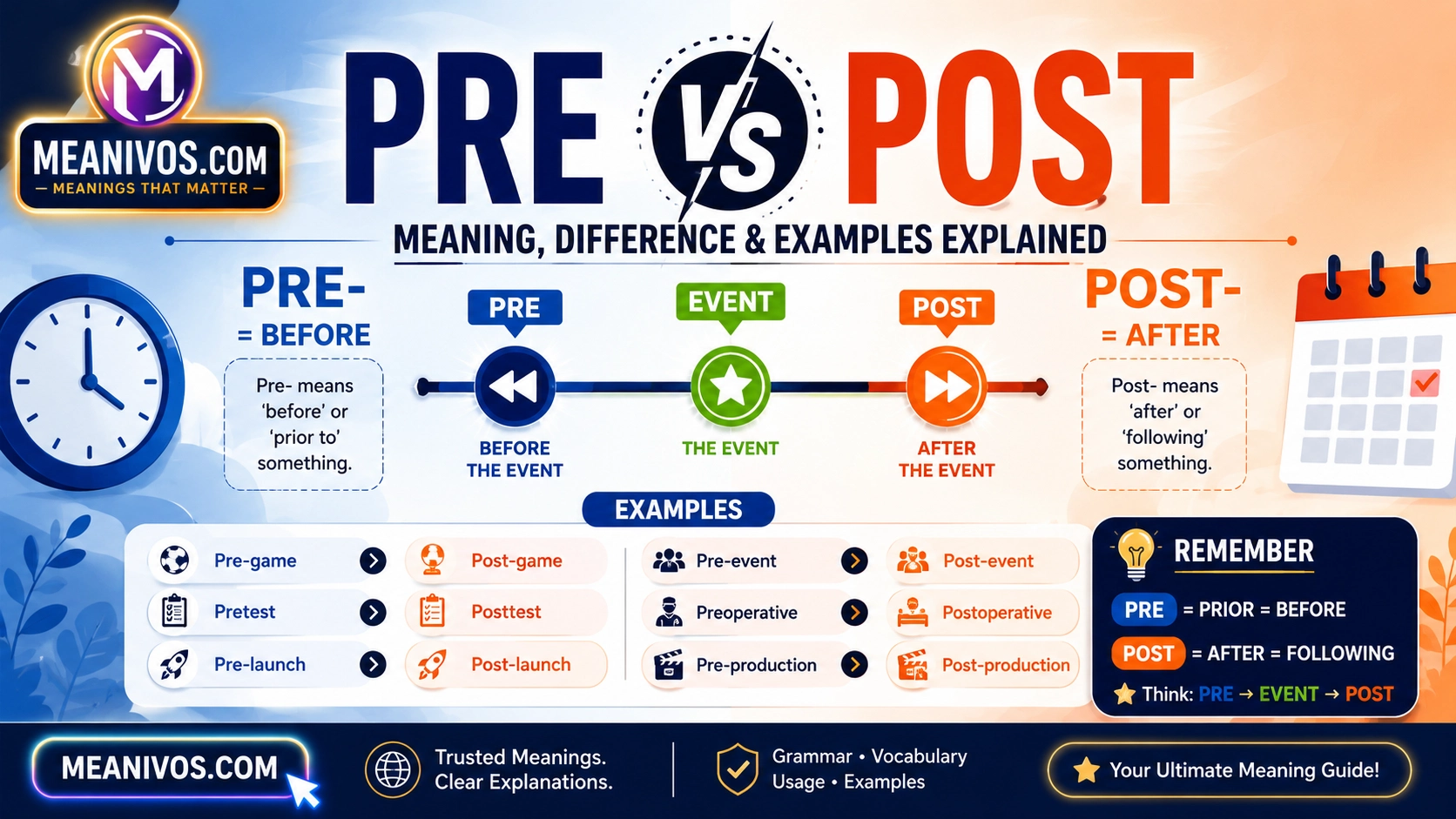
If you are confused about Pre Vs Post, the core rule is simple: pre- means before, while post- means after.
These two prefixes help show where something sits on a timeline. A pre-game meeting happens before the game, while a post-game interview happens after it. Likewise, a pretest can happen before instruction, while a posttest can measure performance afterward.
But there is an important detail: English does not always create a perfect pre-/post- pair for every word. Some words are established without a matching opposite, and spelling and hyphenation can vary depending on the word and context.
This guide explains pre vs post from every practical angle: meaning, grammar, prefixes, examples, business and academic usage, healthcare terminology, spelling, hyphenation, common mistakes, and the difference between prefixes and the ordinary words before and after.
Pre vs Post: Quick Answer
The easiest rule is:
Pre- = before
Post- = after
Cambridge defines pre- as indicating something before a time or event, while post- indicates something after or later than something else. Merriam-Webster similarly defines pre- around ideas such as “before,” “prior to,” and “in advance,” while post- means “after,” “later,” or “following.”
Think of the relationship as:
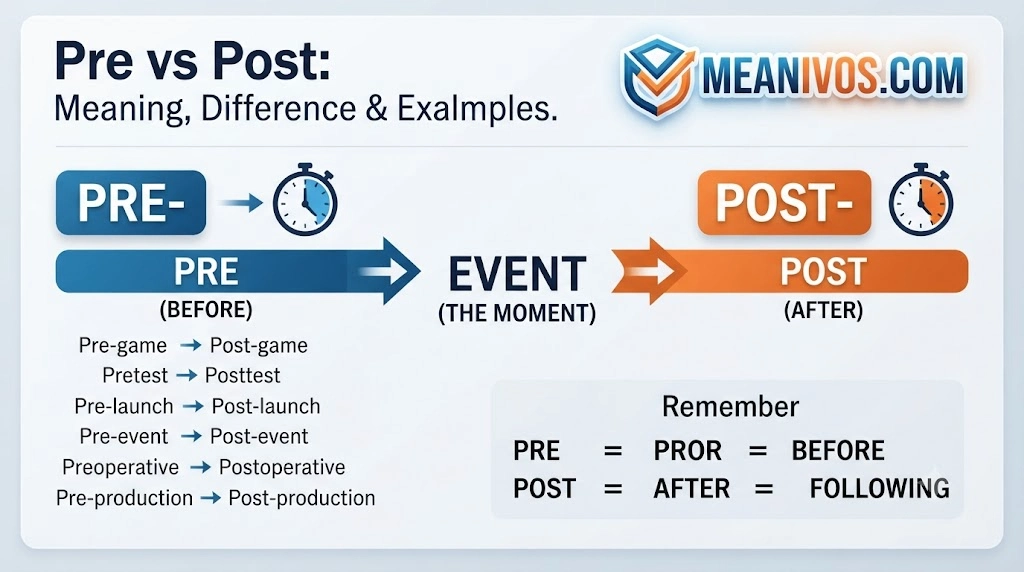
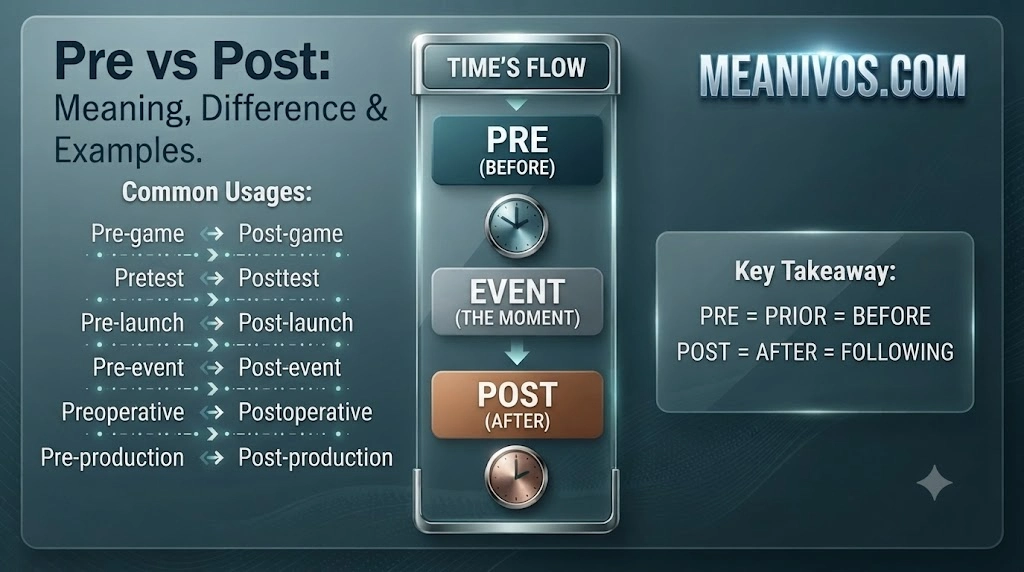
PRE → EVENT → POST
For example:
Pre-game → Game → Post-game
Or:
Pre-exam preparation → Exam → Post-exam review
A useful memory trick is:
PRE = PRIOR = BEFORE
POST = AFTER = FOLLOWING
What Does Pre Mean?
Pre- is a prefix meaning before, earlier than, or in advance of something.
Cambridge gives the temporal meaning “before a time or event,” while Merriam-Webster also includes meanings connected with being earlier, preparatory, or beforehand.
Common examples of pre-
| Word | Meaning |
| pre-order | order before official availability |
| preheat | heat beforehand |
| pre-game | before a game |
| pretest | test before instruction or an intervention |
| pre-event | before an event |
| pre-launch | before a launch |
| prepayment | payment made in advance |
| pre-existing | existing beforehand |
| prewar | before a war |
| prenatal | before birth |
Pre in sentences
- Please preheat the oven before cooking.
- Customers can pre-order the new device.
- The coach held a pre-game meeting.
- Students completed a pretest before the lesson.
- The company created a pre-launch marketing plan.
The key idea is that pre- points to an earlier stage.
What Does Post Mean?
As a prefix, post- means after, later than, or following something.
Cambridge defines post- as “after or later than,” while Merriam-Webster includes “after,” “subsequent,” “later,” and “following” in its definitions.
Common examples of post-
| Word | Meaning |
| post-game | after a game |
| posttest | test after instruction or an intervention |
| post-event | after an event |
| post-launch | after a launch |
| postgraduate | relating to study after graduation |
| postoperative | after an operation |
| postwar | after a war |
| post-election | after an election |
| post-production | work after production |
| postnatal | after birth |
Post in sentences
- The team gave a post-game interview.
- Researchers compared pretest and posttest results.
- We held a post-event review.
- The company analysed its post-launch sales.
- She is completing postgraduate research.
The basic principle is simple: post- places something later on the timeline.
Pre vs Post: Key Difference
The main difference between pre vs post is sequence.
| Feature | Pre- | Post- |
| Basic meaning | Before | After |
| Time | Earlier | Later |
| Sequence | Comes first | Comes afterward |
| Common association | Preparation / anticipation | Follow-up / later stage |
| Example | Pre-event planning | Post-event analysis |
| Another example | Pretest | Posttest |
| Timeline | Before event | After event |
In one sentence
Pre- describes what comes before; post- describes what comes after.
This is the central distinction behind the entire comparison.
How Pre- and Post- Work as Prefixes
A prefix is a letter or group of letters added to the beginning of a word to create or modify its meaning.
When pre- is added to a word, it often introduces a “before” meaning.
For example:
- order → pre-order
- test → pretest
- game → pregame
- launch → pre-launch
When post- is added, it often establishes an “after” relationship:
- game → post-game
- test → posttest
- war → postwar
- launch → post-launch
This makes prefixes useful for understanding unfamiliar vocabulary.
When you encounter a new word beginning with pre-, ask:
Does this refer to something before?
When you see post-, ask:
Does this refer to something after?
That strategy will not solve every word automatically, but it gives you a strong starting point.
Pre vs Post Examples in Everyday English
The prefixes appear in everyday language, professional communication, education, healthcare, technology and many other fields.
Pre-game vs Post-game
Pre-game refers to something happening before a game.
Post-game refers to something happening afterward.
Example:
The players attended a pre-game briefing and a post-game press conference.
Pre-event vs Post-event
Pre-event planning happens before an event.
Post-event analysis happens afterward.
Example:
The team handled pre-event logistics and completed a post-event review.
Pretest vs Posttest
A pretest can measure knowledge or performance before teaching or another intervention.
A posttest can measure it afterward.
Example:
Students took a pretest on Monday and a posttest after completing the course.
This pair is particularly useful when the goal is to measure change.
Pre vs Post in Business and Professional Writing
Business communication often uses pre- and post- to describe project stages.
Common examples
Pre-launch: activities before a product or service launches.
Post-launch: activities after launch.
Pre-meeting: preparation before a meeting.
Post-meeting: actions or discussion following a meeting.
Pre-approval: a stage before final approval.
Post-approval: a stage following approval.
Example
Our Pre-Launch campaign focused on audience research, while the post-launch review focused on customer feedback and sales performance.
The prefixes make the project timeline immediately understandable.
Pre vs Post in Education
Education provides some of the clearest examples of the distinction.
Pretest
A pretest generally occurs before teaching, training or an educational intervention.
Posttest
A posttest generally occurs afterward.
For example:
The students completed a pretest before the course and a posttest after the final lesson.
Other educational terms include:
- preschool
- pre-reading
- prewriting
- pre-course
- postgraduate
- post-school
- post-course assessment
The precise meaning depends on the complete word, but the before/after relationship remains central in many of these terms.
Pre vs Post in Healthcare
Healthcare terminology frequently uses these prefixes to distinguish stages surrounding a medical event.
Examples include:
- preoperative = before an operation
- postoperative = after an operation
- prenatal = before birth
- postnatal = after birth
- pre-treatment = before treatment
- post-treatment = after treatment
- pre-surgery = before surgery
- post-surgery = after surgery
Example:
The doctor explained the preoperative instructions and discussed postoperative care.
Here, pre- identifies the stage before the procedure and post- identifies the stage afterward.
Pre vs Post in Sports and Events
Sports terminology makes the timeline especially easy to see.
Sports examples
- pre-game warm-up
- pre-match training
- pre-season
- post-game interview
- post-match analysis
- post-season
Event examples
- pre-event planning
- pre-event briefing
- post-event feedback
- post-event report
- post-event analysis
Entertainment examples
- pre-show preparation
- pre-show interview
- post-show discussion
- post-show review
Example:
The presenter conducted a pre-show rehearsal and a post-show interview.
Pre vs Post in Technology and Digital Life
Modern technology uses these prefixes to describe stages of development, deployment and processing.
Examples include:
- pre-launch campaign
- pre-release software
- pre-production
- post-production
- pre-installation
- post-installation
- pre-deployment testing
- post-deployment monitoring
- pre-processing
- post-processing
Pre-production vs Post-production
These terms are particularly common in film, television and digital media.
Pre-production happens before the main production stage.
It may involve planning, scheduling, casting, location work and preparation.
Post-production happens after the main production stage and can involve editing, sound, visual effects and other finishing work.
Example:
The director spent several weeks on pre-production before the film entered post-production.
Common Pre vs Post Word Pairs
Here are some useful pairs to remember:
| Pre- | Post- | General relationship |
| Pre-Game | post-game | before/after a game |
| pretest | posttest | before/after testing |
| pre-event | post-event | before/after an event |
| pre-launch | post-launch | before/after a launch |
| pre-treatment | post-treatment | before/after treatment |
| preoperative | postoperative | before/after an operation |
| prewar | postwar | before/after a war |
| pre-election | post-election | before/after an election |
| pre-production | post-production | before/after production |
| pre-season | post-season | before/after a season |
| prenatal | postnatal | before/after birth |
Important: not every pair is equally common, and English does not require every pre- word to have a corresponding post- word.
Pre vs Post: Hyphenation and Spelling Rules
One of the trickiest parts of pre vs post is deciding whether a hyphen is necessary.
The safest rule is:
Do not assume that every pre- or post- construction requires a hyphen.
English spelling is not completely mechanical. Established vocabulary, dictionaries, style guides and context can all affect the preferred form.
For example, established forms include:
- preheat
- prepaid
- pretest
- postgraduate
- postwar
- postoperative
- Explore More: https://meanivos.com/requester-vs-requestor/
Other constructions may commonly appear with a hyphen:
- pre-launch
- post-launch
- pre-event
- post-event
- pre-existing
The supplied competitor research correctly identifies hyphenation as an area where many basic articles are too simplistic.
What should you do if unsure?
- Check a reputable dictionary.
- Check your organisation’s style guide.
- Follow the preferred form consistently.
- Do not add a hyphen automatically just because you see pre- or post-.
For formal writing, an established dictionary or relevant style guide is more reliable than applying one universal hyphen rule.
Pre vs Post vs Before and After
There is an important grammatical distinction between pre-/post- and before/after.
Before and after are ordinary English words that can perform different grammatical functions.
Pre- and post- are prefixes when attached to another word.
Compare:
The meeting happened before lunch.
with:
We had a pre-lunch meeting.
The basic idea is similar, but the grammatical structure differs.
Likewise:
We reviewed the project after the meeting.
can become:
We completed a post-meeting review.
Simple comparison
- before = ordinary word meaning earlier than
- after = ordinary word meaning later than
- pre- = prefix meaning before
- post- = prefix meaning after
Cambridge describes before as a preposition, adverb and conjunction, while after can function as a preposition, conjunction and adverb as well as appearing as a prefix in forms such as after-dinner.
Pre vs Post vs During
There is a third point on the timeline that is easy to overlook.
If:
PRE = before
and
POST = after
Then what happens in between?
Usually, we use words such as:
- during
- while
- ongoing
- in progress
- mid-event
- mid-game
- during the process
The complete timeline is:
PRE → DURING → POST
For example:
Pre-game: preparation before the game
During the game: action while the game is happening
Post-game: analysis after the game
This three-stage model is one of the easiest ways to understand the relationship.
Common Mistakes With Pre and Post
Mistake 1: Reversing the meanings
Wrong:
Post means before.
Correct:
Pre = before; post = after.
Mistake 2: Assuming every pre- word has a post- opposite
English does not work that mechanically.
For example, preheat is a standard word, but postheat is not the normal everyday opposite.
You would usually use cool, let cool, or another expression appropriate to the context.
Mistake 3: Adding hyphens everywhere
Not every word containing pre- or post- needs a hyphen.
Established forms such as preheat, pretest, postwar, and postgraduate are commonly written closed.
Mistake 4: Confusing post- with the standalone word post
This is particularly important.
The prefix post- means “after,” but the standalone word post has many unrelated meanings.
For example, post can refer to:
- a physical pole or upright support
- a job or position
- mail, particularly in British English
- an online message
- the act of publishing something online
- sending something through the mail
Merriam-Webster documents these distinct senses separately from post-, the prefix meaning “after.”
Mistake 5: Using a prefix when a normal phrase is clearer
Sometimes ordinary English sounds more natural.
For example:
We met before the meeting.
may be clearer than trying to create an unnecessarily complicated expression such as:
We had a pre-meeting meeting.
Good writing is not about using as many prefixes as possible. It is about choosing the clearest expression.
How to Remember Pre vs Post
Use this simple trick:
PRE = PRIOR
Pre → Prior → Before
POST = AFTER
Post → Following → After
Or remember the visual sequence:
PRE → EVENT → POST
Examples:
Pre-game → Game → Post-game
Pretest → Test/Lesson → Posttest
Pre-launch → Launch → Post-launch
Once you visualise the timeline, the distinction becomes much easier to remember.
Pre vs Post in Sentences
Here are practical examples:
- The team completed its pre-game warm-up before the match.
- The coach gave a post-game interview afterward.
- Students took a pretest before beginning the course.
- The instructor reviewed the posttest results.
- The company planned a pre-launch advertising campaign.
- The marketing team conducted a post-launch review.
- The patient received preoperative instructions.
- The nurse explained postoperative care.
- The director completed the film’s pre-production planning.
- The editors began post-production after filming ended.
- We prepared a pre-event checklist.
- The organisers collected post-event feedback.
- The company reviewed its pre-election strategy.
- Analysts discussed the post-election results.
- The athlete followed a pre-season training programme.
- The team prepared for the post-season stage.
In every example, identify the reference point first. Then ask whether the word describes something before or after it.
Is “Pre” Before or After?
Pre- means before.
It can indicate:
- an earlier time
- an earlier stage
- something done beforehand
- preparation
- something existing before another event
Examples include:
- pre-order
- preheat
- pretest
- pre-game
- pre-launch
- prewar
- prenatal
Merriam-Webster also notes that pre- can mean “earlier than,” “prior to,” “before,” “in advance,” and “in front of.”
Is “Post” Before or After?
Post- means after.
It indicates a later stage or something that follows a reference point.
Examples include:
- post-game
- posttest
- post-event
- post-launch
- postoperative
- postwar
- post-election
- postgraduate
Merriam-Webster defines post- with meanings including “after,” “subsequent,” “later,” and “following.”
Is Pre the Opposite of Post?
In many contexts, yes.
They can describe opposite points around the same reference event:
pre-event ↔ post-event
pretest ↔ posttest
pre-game ↔ post-game
pre-launch ↔ post-launch
However, they are not perfect opposites for every English word.
A standard pre- word may have no natural post- counterpart. Likewise, a post- word may not have a commonly used pre- equivalent.
So do not mechanically create a word simply by switching pre- to post-.
Use established vocabulary and consider what sounds natural in context.
Does “Pre” Always Mean Preparation?
No.
Preparation is a common association, but the core meaning is broader: before, earlier than, or in advance.
For example:
- prehistoric = relating to a time before recorded history
- prewar = existing or occurring before a war
- pre-existing = existing beforehand
These terms are not necessarily about preparation.
Merriam-Webster’s definition similarly distinguishes the “before” meaning from the related but narrower ideas of preparation and advance action.
Does “Post” Always Mean a Result?
No.
The basic meaning of post- is about later position or sequence.
It can describe a period, condition, action or stage following something.
Examples:
- postwar = after a war
- postgraduate = after graduation
- post-election = after an election
- postoperative = after an operation
The idea of reviewing results or analysing an outcome may be common in terms such as post-event analysis, but “result” is not the fundamental definition of the prefix.
Quick Pre vs Post Reference Guide
| If you mean… | Use |
| before an event | pre- |
| after an event | post- |
| earlier than something | pre- |
| later than something | post- |
| preparation beforehand | often pre- |
| a later stage | often post- |
| something happening in the middle | during / while / ongoing |
The easiest rule
PRE → BEFORE
POST → AFTER
People Also Ask
A:Pre- means before, while post- means after. They are prefixes that commonly indicate where an action, event or condition falls in a sequence.
A:Pre- means before, earlier than, in advance, or preparatory to something.
A:As a prefix, post- means after, later than, or following something.
A:Pre means before.
Think: pre → prior → before.
A:Post means after.
Think: post → following → after.
Related Terms and Similar Meanings
Understanding these related words can make the distinction even clearer:
- prior = existing or happening earlier
- before = at an earlier time
- previous = earlier in time or sequence
- ahead of = before something
- following = coming after
- after = later than something
- subsequent = coming after
- during = happening within the same period or event
- ongoing = continuing to happen
- prefix = an element added to the beginning of a word
For example:
prior → pre- → before
and
following → post- → after
Cambridge describes prior as something existing or happening before something else, while after refers to something following in time, place or order.
Conclusion
Understanding pre vs post is simple once you think about the timeline. Pre- means before, while post- means after. These prefixes help show whether something happens earlier or later than a particular event, action, or period.
For example, pre-game means before a game, while post-game means after it. The same pattern appears in words such as pretest and posttest, pre-launch and post-launch, preoperative and postoperative, and pre-production and post-production.
Remember the easiest rule: PRE → EVENT → POST. However, not every pre- word has a direct post- opposite, and hyphenation depends on the established spelling and context.
Once you understand this simple before-and-after relationship, you can use pre- and post- more confidently in everyday, academic, business, and professional English.