Requester vs Requestor: Which Spelling Is Correct?
Requester Vs Requestor is a common English spelling question. Both words refer to a person, organisation, or system that makes a request, but they are not equally common in everyday writing.
So, which spelling should you use?
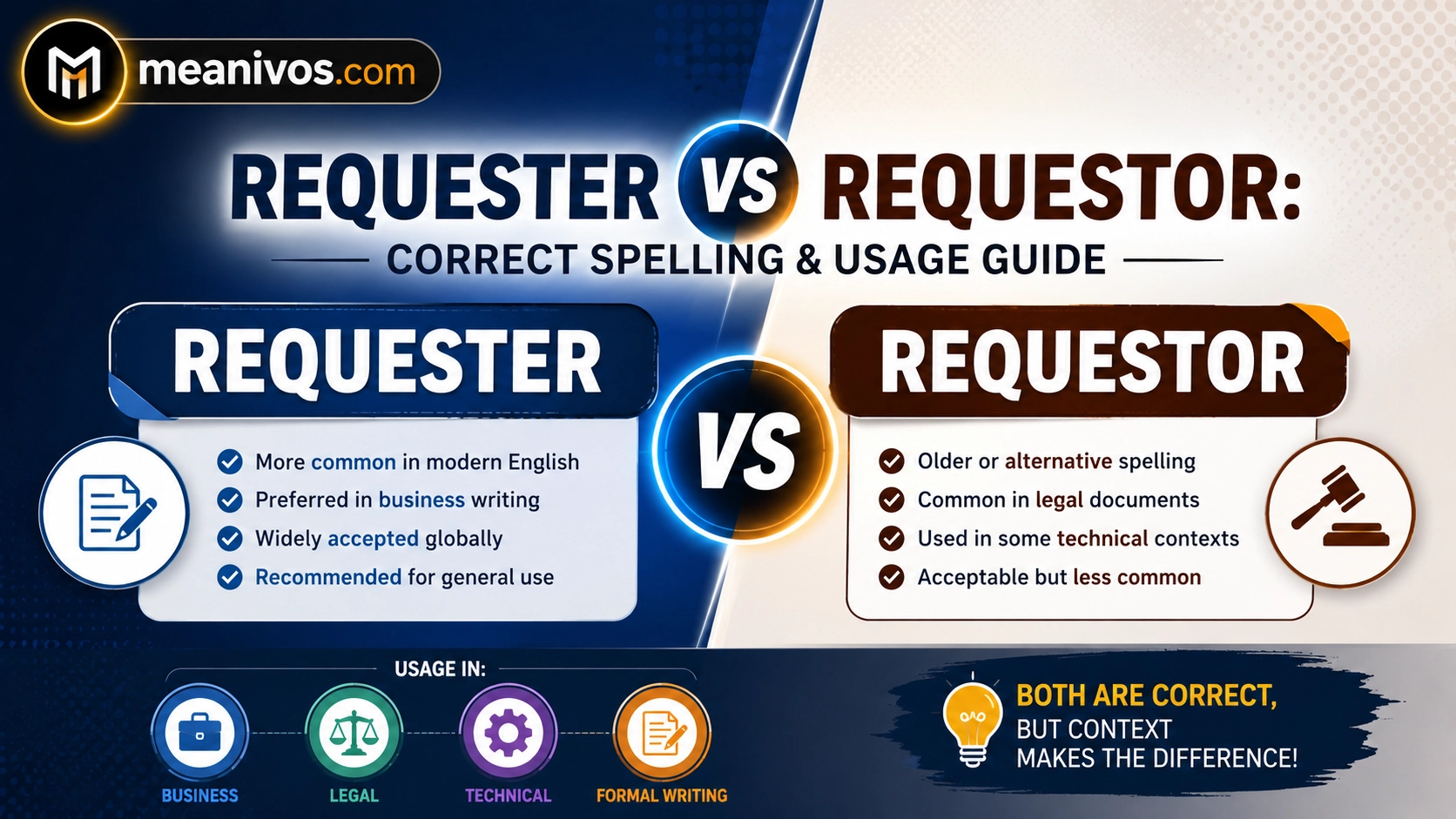
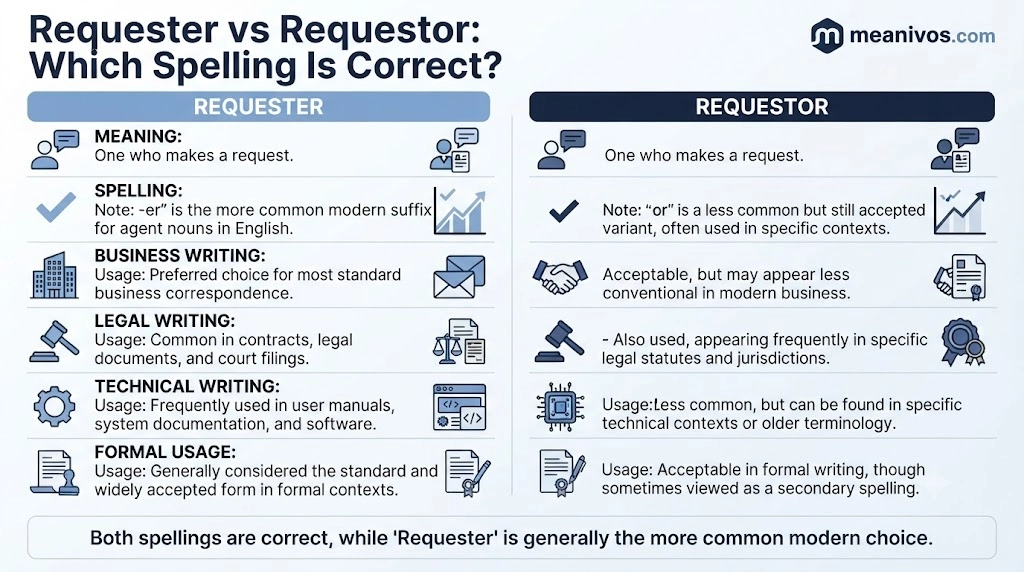
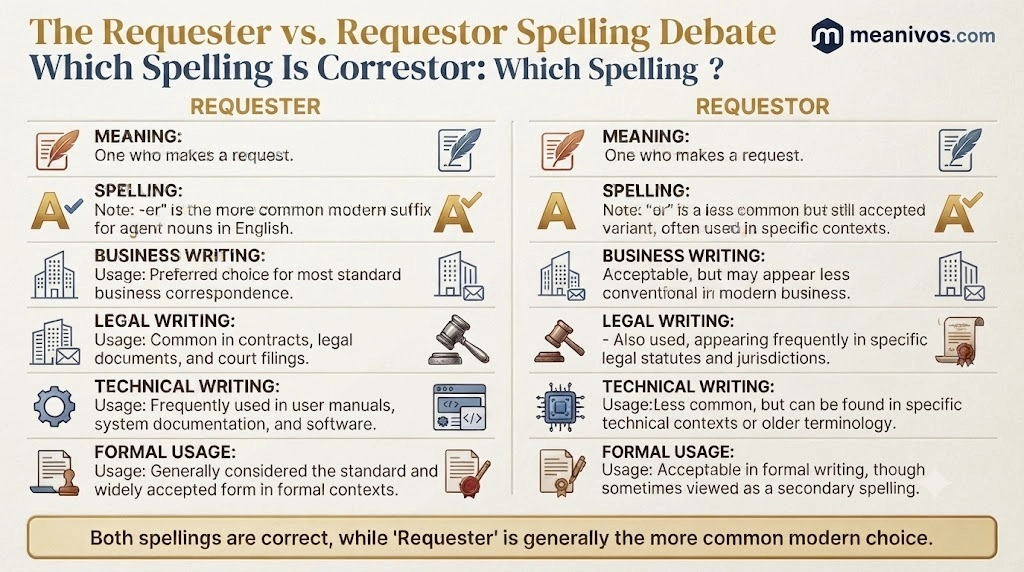
Both “requester” and “requestor” are correct. However, requester is generally the safer and more familiar choice for general English, business communication, and public-facing content. Requestor is a recognised variant that may appear in legal, administrative, government, technical, and software contexts.
The key difference is therefore not meaning but usage and preference. If your organisation or software system already uses requestor, it is usually best to keep that terminology consistent.
In this guide, we’ll explain the requester vs requestor difference, meanings, spelling, pronunciation, American and British English usage, legal and technical contexts, examples, plurals, common mistakes, and exactly which word you should choose.
Requester vs Requestor: Quick Answer
Requester and requestor both mean a person or entity that makes a request.
If you’re writing for a general audience and aren’t following a specific terminology guide, requester is usually the best choice.
| Feature | Requester | Requestor |
| Basic meaning | Someone who makes a request | Someone who makes a request |
| Correct word? | Yes | Yes |
| General English | More common | Less common |
| Business writing | Common | Acceptable |
| Legal writing | Used | Used |
| Government writing | Used | Used |
| Technical writing | Used | Used |
| Software terminology | Possible | Possible |
| Best general default | Yes | Usually no |
| Automatically a misspelling? | No | No |
The easiest rule to remember
General English → requester
Established organisational or technical terminology → follow the terminology being used
So, if you’re simply writing an email or article, requester is usually the safest choice.
What Does “Requester” Mean?
A requester is someone or something that makes a request.
A requester may ask for:
- information
- permission
- access
- assistance
- documents
- a service
- an explanation
- an action
For example:
The requester asked for a copy of the report.
Another example is:
We contacted the requester for additional information.
The word can describe an individual, business, organisation, or even a technical component that initiates a request.
Requester definition
In simple terms:
Requester = a person or entity that requests something.
The word is formed from request + -er, following a familiar English pattern for describing someone who performs an action.
What Does “Requestor” Mean?
A requestor is also someone or something that makes a request.
For example:
The requestor submitted the application yesterday.
Or:
The requestor must provide valid identification.
The important thing to understand is that requestor is not simply a misspelling of requester.
It is a legitimate variant.
Requestor definition
In simple terms:
Requestor = a person or entity that makes a request.
Therefore, the core meanings of requester and requestor are essentially the same.
The main difference is their spelling, frequency, and contextual preference.
Requester vs Requestor: What Is the Difference?
The difference between requester and requestor is mainly one of usage rather than meaning.
Requester is generally more familiar and is a strong choice for everyday and professional English.
Requestor is less common but can be found in specialised terminology, including some legal, administrative, government, technical, and software contexts.
This does not mean that requestor is exclusively legal or technical.
Likewise, it does not mean that requester is informal.
In simple terms:
- Requester = common general-English form
- Requestor = legitimate alternative spelling
- Meaning = essentially the same
- Difference = mainly usage and preference
- Best general choice = requester
This is why the statement “requester is correct, requestor is wrong” is too simplistic.
Is “Requestor” a Correct Word?
Yes, requestor is a correct English word.
It should not automatically be marked as a spelling mistake.
Cambridge Dictionary lists requestor as an alternative form associated with requester, while Dictionary.com also recognises the variant.
Cambridge Dictionary: requester
This distinction is important because less common does not mean incorrect.
For example:
The requestor submitted the necessary documents.
There is no grammatical reason to automatically replace requestor with requester.
However, if you’re writing general content without an established terminology requirement, requester is usually the more natural choice.
Is “Requester” Correct?
Yes.
Requester is a standard English word and is widely understood.
For example:
The requester submitted the form.
It works naturally in:
- everyday English
- business writing
- customer support
- professional emails
- reports
- websites
- technical documentation
- administrative communication
You don’t need to use requestor to make your writing sound professional.
Requester is already clear and professional.
Why Are There Two Spellings?
English has several ways of forming nouns that describe people or things performing an action.
One common ending is -er:
- teach → teacher
- work → worker
- write → writer
- drive → driver
- request → requester
Another common ending is -or:
- act → actor
- operate → operator
- inspect → inspector
- supervise → supervisor
This helps explain why English can have both requester and requestor.
However, English spelling does not follow one perfect rule for every agent noun. Historical development, usage, and convention all influence which form becomes established.
Therefore, the existence of two forms does not automatically mean that one must be an error.
Requester vs Requestor in American English
In American English, requester is generally the safer choice for broad audiences.
For example:
The requester asked for additional information.
This sounds natural in ordinary professional writing.
However, requestor can also be found in American legal, administrative, government, and technical contexts.
So don’t assume that:
and
requestor = British
That is not an accurate rule.
The distinction is better understood as a difference in variant usage rather than a simple American-versus-British spelling difference.
Requester vs Requestor in British English
British English also uses requester, and requestor can occur as an alternative.
This means requester vs requestor is not a straightforward UK/US spelling pair like:
- colour vs color
- centre vs center
- organise vs organize
If you’re writing for an international audience, requester is generally a safe and accessible choice.
When Should You Use “Requester”?
Use requester when you want a natural, widely understood term and no specific terminology requires requestor.
1. Everyday English
The requester asked for directions.
2. Business writing
We contacted the requester for further information.
3. Customer service
The requester will receive an update within two business days.
4. General reports
Each requester must complete the form.
5. Website content
The requester can check the status of the application online.
6. Public-facing communication
When your audience includes people from different backgrounds, requester is often the clearest option.
When Should You Use “Requestor”?
Use requestor when it is the established spelling in a particular environment.
You may encounter it in:
- legal documents
- government procedures
- administrative systems
- technical documentation
- software interfaces
- databases
- access-control systems
- company terminology
- internal policies
For example:
The requestor must provide proof of identity.
If the official system consistently uses requestor, changing every instance to requester can create unnecessary inconsistency.
Best practice
Follow established terminology when one already exists.
The goal isn’t to make every document use the same spelling. The goal is to use the spelling that best fits the document and its audience.
Requester vs Requestor in Legal Writing
Both requester and requestor can appear in legal or administrative writing.
For example:
The requester submitted a request for the records.
Or:
The requestor submitted a request for the records.
Neither spelling is automatically “the legal spelling.”
A legal organisation, government agency, court, or administrative body may have its own preferred terminology.
If you’re writing a legal document
Check:
- the organisation’s style guide
- the relevant official form
- existing terminology in the document
- applicable regulations or policies
- terminology used by the relevant authority
Then use the preferred term consistently.
Important point
Requestor can occur in legal writing, but it is not exclusively a legal word.
Requester vs Requestor in Business Writing
For ordinary business writing, requester is usually the safer default.
Consider:
The requester has asked for an extension.
This sentence is clear and professional.
You could also write:
The requestor has asked for an extension.
This isn’t incorrect. It simply uses a less common variant.
Business recommendation
Use requester unless:
- your company uses requestor
- your software uses requestor
- your client uses requestor
- an industry standard requires it
- you’re maintaining an existing document’s terminology
Requester vs Requestor in IT and Software
The choice can become more important in technology.
In software and computing, a requester may be:
- a user
- an application
- a client
- a process
- a service
- a software component
that initiates a request.
For example:
The requester sends a request to the server.
You may also see terms such as:
- requester ID
- requester name
- requester account
- requester address
- requestor ID
- requestor information
Follow the system’s terminology
Suppose a database field is officially called:
requestor_id
Don’t casually change it to:
requester_id
in technical documentation if the actual software uses the original field name.
In technical writing, consistency and accuracy are often more important than choosing the more common variant.
Requester vs Requestor in Government Forms
Government and administrative documents may use either form.
For example:
The requestor must provide valid identification.
Or:
The requester must provide valid identification.
If you’re writing about an existing government procedure, use the terminology used by that agency.
This can apply to:
- public-record requests
- information-access requests
- official applications
- government forms
- administrative procedures
- public-sector databases
The presence of requestor in an official document doesn’t make requester incorrect.
Requester vs Requestor Examples
Seeing both words in real sentences makes the distinction easier.
Example 1: General English
The requester asked for more information.
The requestor asked for more information.
Both sentences have essentially the same meaning.
Example 2: Business
The requester is waiting for approval.
The requestor is waiting for approval.
Again, the meaning doesn’t materially change.
Example 3: Customer service
We emailed the requester with an update.
Here, requester is a natural general-purpose choice.
Example 4: Administrative writing
The requestor must submit proof of identity.
This may fit an organisation that already uses requestor.
Example 5: Technical writing
The requester initiated the connection.
Here, requester can refer to a technical component.
Example 6: Software
The system stores the requestor’s ID.
If the application officially uses requestor, retain that terminology.
- Explore More: https://meanivos.com/tsts-meaning-in-text/
Requester vs Requestor Comparison
| Category | Requester | Requestor |
| Meaning | Person/entity making a request | Person/entity making a request |
| Spelling | Common form | Variant form |
| General English | Preferred | Less common |
| Professional writing | Excellent | Acceptable |
| Legal writing | Used | Used |
| Government | Used | Used |
| Technical writing | Used | Used |
| Software | Used | Used |
| Public-facing content | Usually best | Less common |
| Correct word | Yes | Yes |
| Misspelling? | No | No |
Is Requester More Correct Than Requestor?
If by “more correct” you mean better for general English, then requester is usually the better choice.
But if you’re asking whether requestor is grammatically wrong, the answer is no.
This is an important difference between correctness and preference.
Think of it this way:
Requester: the safer general-purpose choice.
Requestor: a legitimate alternative that may fit specialised terminology.
Therefore, don’t automatically replace requestor simply because requester is more common.
Is Requestor More Formal?
Sometimes it may sound more formal or specialised, but the spelling itself does not automatically make it formal.
You may see requestor in legal, administrative, government, or technical documents, which can give it a specialised feel.
But there is no universal rule that:
-er = informal
and
-or = formal
That would be too simplistic.
The surrounding context determines formality.
Which One Should You Use in an Email?
For most ordinary professional emails, use requester.
For example:
The requester has provided the required documents.
It’s simple, clear, and professional.
If your organisation’s official terminology uses requestor, however, follow that terminology.
Which One Should You Use in a Legal Document?
First check whether the document or organisation already has a preferred term.
If it consistently uses requestor, retain it.
If you’re writing from scratch and there is no prescribed terminology, requester is generally a safe general-English option.
The important thing is consistency.
Which One Should You Use in Technical Writing?
Check the terminology used by:
- the software
- API documentation
- database
- technical specification
- platform
- Organisation
- development team
If there is no established terminology, requester is a strong choice for a general technical audience.
If the software officially uses requestor, keep that spelling.
What Is the Plural of Requester?
The plural of requester is:
requesters
Example:
All requesters must complete the form.
Possessive forms
Singular possessive:
The requester’s identity was verified.
Plural possessive:
The requesters’ applications were reviewed.
What Is the Plural of Requestor?
The plural of requestor is:
requestors
Example:
All requestors must provide identification.
Possessive forms
Singular possessive:
The requestor’s application was reviewed.
Plural possessive:
The requestors’ records were checked.
Requester vs Requestor Pronunciation
The two words are pronounced very similarly.
Requester
Approximately:
ri-KWES-ter
Requestor
Approximately:
ri-KWES-tor
The exact sound can vary by accent, but the difference is usually small.
This is why people are much more likely to become confused about the written spelling than the pronunciation.
Common Mistakes With Requester and Requestor
Mistake 1: Calling requestor a spelling error
Wrong assumption: “Requestor isn’t a real word.”
Better understanding: Requestor is a recognised variant.
Mistake 2: Saying requestor is only legal
This is too restrictive.
It can appear in technical, administrative, government, and organisational contexts.
Mistake 3: Assuming requester is informal
Requester is perfectly acceptable in professional writing.
Mistake 4: Assuming requestor is automatically more formal
The -or ending doesn’t automatically make a word more formal.
Mistake 5: Changing official terminology
If an application, database, or policy officially uses requestor, changing it to requester may create confusion.
Mistake 6: Mixing both spellings
If both forms refer to exactly the same role, don’t switch randomly between them.
For example:
The requester submits the form. The requestor then receives confirmation.
If both refer to the same person, choose one spelling and remain consistent.
Requester vs Requestor: How to Choose
Not sure which one to use? Follow these steps.
Step 1: Check for official terminology
Does the company, software, government agency, or document already use one form?
Follow it.
Step 2: Consider your audience
Are you writing general English for a broad audience?
Choose requester.
Step 3: Check technical identifiers
If the word appears in a database field, API, code, or system label, don’t change the spelling casually.
Step 4: Check existing documents
If you’re editing a document, maintain its terminology unless a style guide says otherwise.
Step 5: Still unsure?
Choose requester.
It’s the safest general-purpose option.
Requester vs Requestor: Easy Memory Trick
Remember this simple rule:
General request → requester.
Established terminology → follow the system’s spelling.
You don’t need to memorise:
“Legal = requestor.”
That’s not a reliable rule.
Instead, remember:
Requester is the general default. Requestor is a valid alternative.
Better Alternatives to Requester or Requestor
Sometimes a different word may be more precise.
Depending on your context, you could use:
- applicant
- customer
- client
- user
- petitioner
- requesting party
- requesting user
- submitter
- person making the request
But these aren’t always exact synonyms.
For example:
Applicant usually describes someone applying for something.
Petitioner often refers to someone making a formal petition.
Recipient is the person receiving something, not necessarily the person who requested it.
So choose the alternative based on the exact role you’re describing.
Requester vs Requestor in a Sentence
Here are additional examples you can use as a quick reference.
Requester
- The requester submitted the form.
- We contacted the requester yesterday.
- The requester needs additional information.
- Each requester receives a confirmation email.
- The requester can track the application online.
- The system identifies the requester automatically.
Requestor
- The requestor submitted the application.
- The requestor must verify their identity.
- The requestor received an approval notice.
- The system records the requestor’s details.
- The requestor is responsible for the information provided.
- The requestor can check the status online.
In most examples, changing requester to requestor does not substantially change the meaning.
Requester vs Requestor: Quick Decision Chart
Writing a normal email?
→ Requester
Writing general website content?
→ Requester
Writing a general business report?
→ Requester
Writing public-facing information?
→ Requester
Working with an official system that says “requestor”?
→ Requestor
Editing a document that consistently uses “requestor”?
→ Requestor
Documenting a database field called requestor_id?
→ Requestor
No terminology preference and you’re unsure?
→ Requester
People Also Ask
A:Both requester and requestor are correct. Requester is generally the more common general-English choice, while requestor is a legitimate alternative that may be preferred in particular contexts.
A:Yes. Requestor is a real and recognised English word meaning someone or something that makes a request.
A:No. Requestor should not automatically be treated as a misspelling of requester.
A:Generally, yes. Requester is more familiar in broad general English, while requestor is less common overall.
A:It can sound more specialised in some contexts, but requestor is not automatically more formal simply because it ends in -or.
Related Words You Should Know
The word requester can sometimes be confused with other terms.
| Word | Meaning |
| Requester | Someone who makes a request |
| Requestor | Variant of requester |
| Applicant | Someone applying for something |
| Petitioner | Someone submitting a formal petition |
| Submitter | Someone who submits something |
| Recipient | Someone who receives something |
| Requesting party | The party making a request |
These terms can overlap in certain situations, but they are not interchangeable in every sentence.
Final Verdict
So, requester vs requestor—which spelling should you choose?
The answer is straightforward:
Both are correct.
Requester is generally the better default for general English, everyday communication, business writing, websites, and broad audiences.
Requestor is also valid and can be appropriate when it is established terminology in a legal, government, administrative, technical, software, or organisational setting.
The most useful rule is:
Use “requester” for general English, and use “requestor” when a specific context or established terminology calls for it.
Most importantly, don’t assume that requestor is a misspelling simply because requester is more common.
When in doubt, choose requester—and when an official system has already chosen requestor, respect the system’s terminology.