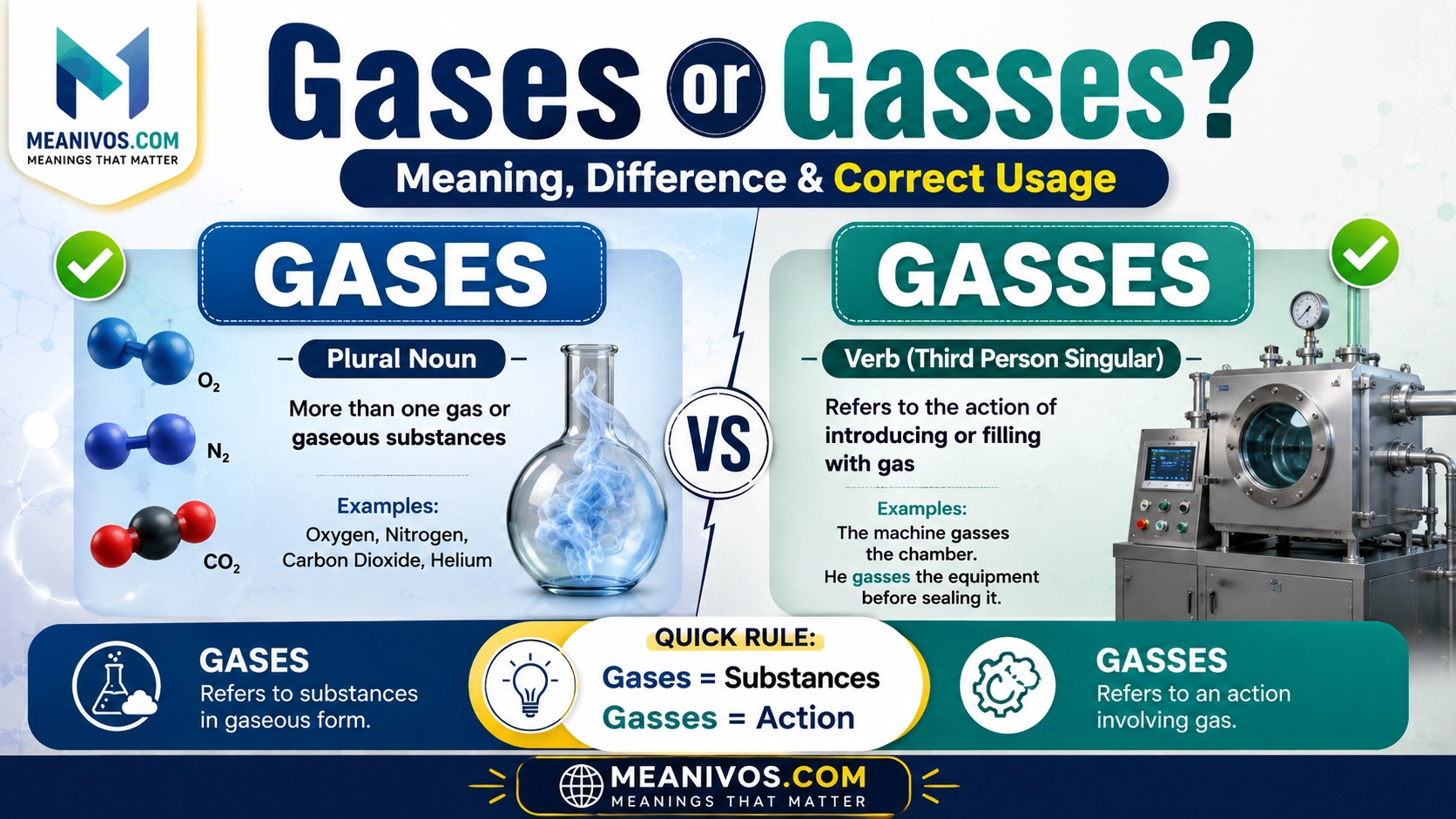
Gases or Gasses: Which Spelling Is Correct?
Gases or gasses—which spelling is correct?
If you are writing about oxygen, nitrogen, carbon dioxide, or other substances, the answer is usually gases. But gasses is not simply a misspelling. It is a legitimate English word and is commonly used as the third-person singular present form of the verb to gas. Some major dictionaries also record gasses as an alternative plural of gas, although gases is much more common in contemporary writing.
So the easiest rule is:
Use “gases” when you mean more than one gas. Use “gasses” when it functions as the verb “to gas.”
For example:
- Oxygen and nitrogen are gases.
- The machine gasses the chamber.
The confusion exists because the two spellings look almost identical and are generally pronounced the same. The difference becomes important when you are writing, especially in schoolwork, professional documents, scientific papers, and SEO content.
This guide explains gases vs. gasses, their meanings, grammar, history, pronunciation, British and American usage, common mistakes, and dozens of examples so you can choose the right spelling with confidence.
Gases or Gasses: Quick Answer
If you need the plural of the noun gas, choose gases in normal modern writing.
If you need the third-person singular form of the verb to gas, use gasses.
| Word | Main grammatical role | Meaning | Example |
| gases | Plural noun | More than one gas | Oxygen and nitrogen are gases. |
| gasses | Verb | He/she/it supplies, treats, exposes, or gives off gas | The machine gasses the chamber. |
| gasses | Alternative plural | More than one gas | This spelling is recognised in some dictionaries but is much less common. |
The important nuance is that gasses can be a plural noun in some dictionary traditions. Dictionary.com explicitly says both gases and gasses are acceptable plural forms, while noting that gases is much more commonly used. Merriam-Webster likewise records gases and gasses as plural forms.
The safest rule
For most readers and most types of writing:
gas → gases
That is especially true for scientific, academic, educational, business, and professional writing.
What Does “Gases” Mean?
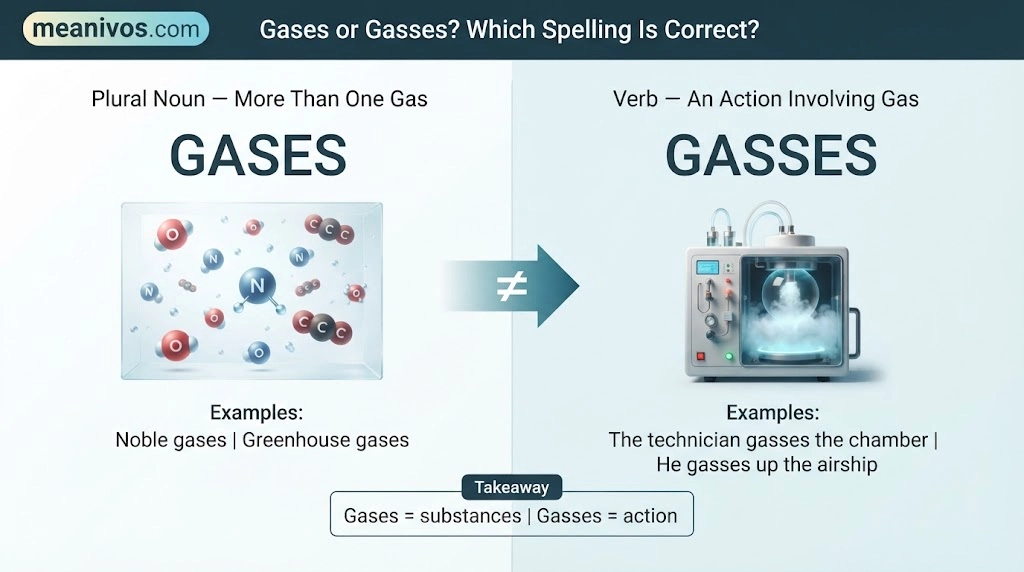
Gases is the most common plural form of the noun gas.
A gas is a substance in a gaseous state. Unlike a solid, it does not have a fixed shape, and a gas can expand to occupy the space available to it.
Examples of gases include:
- oxygen
- nitrogen
- hydrogen
- helium
- carbon dioxide
- methane
- neon
- argon
- water vapour
When you are referring to two or more gases, gases is the conventional spelling.
Examples of “gases”
- Oxygen and nitrogen are gases.
- The atmosphere contains several different gases.
- Scientists analysed the gases released by the volcano.
- Some gases can be dangerous when inhaled.
- Greenhouse gases affect Earth’s climate.
- Noble gases include helium, neon, and argon.
- The experiment produced several gases.
- The factory monitors harmful gases in the air.
- The detector measures different gases.
- Several gases were detected in the sample.
Dictionary.com currently lists gases as the plural form of gas and provides contemporary examples of the word in scientific and environmental contexts.
What Does “Gasses” Mean?
Gasses has an important grammatical use as a verb.
It is the third-person singular present-tense form of “to gas.”
Depending on the context, to gas can mean to supply something with gas, expose or treat something with gas, cause something to give off gas, or use gas in another process. Dictionary.com lists gasses as the present form of the verb.
Examples of “gasses”
- The machine gasses the chamber.
- The technician gasses the material before processing.
- The system gasses the container.
- The battery gasses while charging.
- The facility gasses the samples before testing.
- The equipment gasses the chamber automatically.
Here, gasses are describing an action rather than naming substances.
Compare these two sentences
The laboratory contains several gases.
Here, gases names substances.
The machine gasses the laboratory chamber.
Here, gasses describe what the machine does.
That noun-versus-verb distinction is the most useful way to understand the two spellings.
Gases vs Gasses: The Key Difference
The simplest practical distinction is:
Gases = things or substances
Gasses = an action
Consider this example:
The atmosphere contains several gases.
What does the atmosphere contain?
Gases.
Now consider:
The machine gasses the chamber.
What does the machine do?
It gasses the chamber.
A useful sentence test
Ask yourself:
Am I naming multiple gases?
If yes, use gases.
Am I describing what someone or something does with gas?
If yes, gasses may be the correct verb.
This simple test works for most everyday situations.
What Is the Plural of “Gas”?
The standard and overwhelmingly common plural form is:
gas → gases
Examples:
- one gas
- two gases
- several gases
- different gases
- harmful gases
- greenhouse gases
- noble gases
- industrial gases
If your sentence says:
Oxygen, nitrogen, and carbon dioxide are ___.
The natural answer is:
gases
This is the form readers expect in modern scientific and general writing.
However, it is important not to claim that gasses is never a plural noun. Major dictionary sources recognise the alternative. Dictionary.com says both plural forms are acceptable, while gases is much more common. Merriam-Webster also records gasses as an alternative plural.
Best practical advice
If you are unsure, choose:
gases
It is the clearest choice for contemporary standard writing.
Why Is It “Gases” Instead of “Gasses”?
This is one of the reasons the word creates so much confusion.
English has many nouns where an ending such as -es produces a double-looking consonant:
- class → classes
- glass → glasses
- kiss → kisses
- bus → buses
So it is natural to think:
gas → gasses
But English spelling does not always work through simple visual patterns.
Dictionary.com explains that consonant doubling has historically been connected with pronunciation and vowel-length conventions. In the case of the plural of gas, gases became the established and much more common spelling.
The important lesson for learners is not to create a complicated spelling rule.
Simply remember:
gas → gases
And remember that the doubled ss has a particularly important grammatical role when gas is used as a verb:
gas → gasses
When Should You Use “Gases”?
Use gases when the word is functioning as a plural noun.
1. In science
- The experiment produced three different gases.
- Scientists analysed the gases inside the container.
- Different gases behave differently under pressure.
2. In chemistry
- The reaction released several gases.
- The students identified the unknown gases.
- Chemical reactions can produce toxic gases.
3. In environmental writing
- Greenhouse gases affect the Earth’s atmosphere.
- Industrial facilities can release harmful gases.
- Researchers monitor atmospheric gases.
4. In medicine
- Hospitals use several medical gases.
- Some gases are used during medical procedures.
- The equipment supplies specific gases to patients.
5. In everyday English
- The balloon contains different gases.
- Some gases are invisible.
- The tank stores compressed gases.
6. In industry
- The factory stores several industrial gases.
- Workers must handle pressurised gases carefully.
- The equipment detects dangerous gases.
In all these examples, gases names substances or types of gas.
When Should You Use “Gases”?
Use Gasses when it is functioning as a verb.
For example:
The machine gasses the chamber.
Here, gasses tells us what the machine does.
More examples
The technician gasses the material before processing.
The system gasses the chamber automatically.
The battery gasses during charging.
The facility gasses the samples before testing.
The equipment gasses the enclosed space.
The precise meaning of the verb depends on context. Dictionary sources include meanings such as supplying something with gas, treating or impregnating something with gas, exposing something to gas, and giving off gas.
“Gasses” as a Verb in Everyday American English
You may also see gasses up in informal American English.
To gas up can mean to fill a vehicle with fuel.
For example:
We need to gas up before the road trip.
She gasses up her car every Friday.
He stopped to gas up before driving home.
Dictionary.com lists gas up as a verb phrase meaning to fill an automobile’s gasoline tank.
This is another reason it is useful to understand gasses as a verb rather than assuming the double-s spelling is simply a spelling error.
Is “Gasses” a Real Word?
Yes.
Gasses is a real English word.
It is commonly used as the third-person singular present form of to gas:
The machine gasses the chamber.
It is also recorded as an alternative plural form by some dictionaries. Merriam-Webster lists gases and gasses as plural forms, while Dictionary.com states that both are acceptable but that gases is much more common.
Therefore, saying:
“Gasses is not a word.”
is too broad.
A more accurate explanation is:
Gasses is a valid English word, but gases is the normal plural spelling in modern writing, while gasses is especially common as a verb.
Is “Gases” a Correct Word?
Absolutely.
Gases is the standard and most widely used plural form of gas.
You will commonly see it in phrases such as:
- greenhouse gases
- noble gases
- toxic gases
- industrial gases
- atmospheric gases
- medical gases
- exhaust gases
- compressed gases
For example:
Carbon dioxide and methane are gases.
The researchers measured several gases in the atmosphere.
Noble gases have distinctive chemical properties.
Gases vs Gasses in Scientific Writing
If you are writing a:
- science assignment
- chemistry report
- laboratory report
- research paper
- environmental article
- educational guide
- technical document
then gases is the safest conventional choice when you mean the plural noun.
For example:
The reaction produced three different gases.
This is much more familiar to scientific readers than:
The reaction produced three different gasses.
The alternative plural gasses is recognised by dictionary sources, but gases remains the conventional choice in modern scientific terminology.
Common scientific expressions include:
- greenhouse gases
- noble gases
- atmospheric gases
- industrial gases
- medical gases
- exhaust gases
- inert gases
- toxic gases
- compressed gases
Writing gases in these contexts keeps your terminology conventional and immediately recognisable.
Gases or Gasses in British English
British English does not require you to change the spelling to gasses.
For the plural noun, gases remains the safest modern choice:
The atmosphere contains several gases.
Scientists measured the gases released by the volcano.
Collins records both gases and gasses in its dictionary treatment, while also distinguishing gases as the noun plural and gasses as the third-person singular verb in its learner-oriented material.
So if you are writing for a British audience, use gases when you mean multiple gases.
Gases or Gasses in American English
American English also commonly uses gases as the plural noun.
For example:
Greenhouse gases contribute to atmospheric warming.
The laboratory analysed several gases.
The atmosphere contains many different gases.
American dictionaries can recognise gasses as an alternative plural as well. Dictionary.com explicitly lists gases and gasses as plural forms while noting that gases is much more common.
The verb form remains:
The machine gasses the chamber.
So the practical rule is essentially the same in both major varieties of English.
Do “Gases” and “Gasses” Sound the Same?
Generally, yes.
In ordinary pronunciation, gases and gasses are normally pronounced alike or very similarly.
That means your ears cannot always tell you which spelling the speaker intends.
The difference becomes visible when the word is written:
- gases
- gasses
This is one reason spelling questions about these words are so common.
When speaking, context usually provides the meaning. When writing, choosing the conventional form helps readers immediately understand the grammatical role.
Why Do People Confuse Gases and Gasses?
There are several reasons.
1. They look almost identical
The only obvious difference is the additional s:
gases
versus
gasses
2. They sound alike
Because pronunciation generally does not distinguish the spellings, people often have to remember the written forms.
3. English spelling can be unpredictable
Learners see:
- class → classes
- glass → glasses
- bus → buses
- kiss → kisses
So gasses may look like a logical plural.
4. “Gasses” is a real word
Spell-checkers may not flag gasses because it is a legitimate English form.
That can make the mistake harder to notice.
5. Grammar matters
The two spellings can perform different grammatical jobs:
The atmosphere contains gases.
versus:
The machine gasses the chamber.
Understanding the part of speech makes the choice much easier.
Gases vs Gasses: Noun or Verb?
Here is the easiest grammar breakdown:
| Sentence | Word | Part of speech | Why? |
| Oxygen and nitrogen are gases. | gases | Plural noun | Names substances |
| The atmosphere contains several gases. | gases | Plural noun | Refers to multiple gases |
| The machine gasses the chamber. | gasses | Verb | Describes an action |
| The battery gasses during charging. | gasses | Verb | Describes what it does |
| Greenhouse gases affect the atmosphere. | gases | Plural noun | Names multiple gases |
| The facility gasses the samples. | gasses | Verb | Describes an action |
If the word is answering “What things?”, you probably want gases.
If it is answering “What does it do?”, you may need glasses.
- Explore More: https://meanivos.com/emasculate-vs-demasculate/
A Simple Sentence Test
When you are unsure, use this three-step method.
Step 1: Look at the word’s job
Ask:
Is it naming something?
If yes, consider gases.
Step 2: Ask what the sentence means
If the sentence refers to oxygen, nitrogen, carbon dioxide, methane, or other gaseous substances, use:
gases
Step 3: Check whether it describes an action
If a person, machine, battery, facility, or system is doing something involving gas, gasses may be the correct verb.
Example
The factory releases harmful ___.
The blank names substances.
Therefore:
The factory releases harmful gases.
Now:
The machine ___ the chamber.
The blank describes an action.
Therefore:
The machine gasses the chamber.
A Fast Memory Trick
Remember:
Gases = substances.
Gasses = action.
Think of:
oxygen + nitrogen + carbon dioxide → gases
But:
machine + chamber → gasses
Another useful test is:
If you can replace the word with “substances,” choose “gases.”
For example:
Several gases were detected.
You could say:
Several substances were detected.
But:
The machine gasses the chamber.
You cannot replace gasses with substances because it is describing an action.
The shortest memory rule
One S in the middle: gases = things.
Double S: gasses = action.
This is a practical learner’s rule, not a complete dictionary rule, because gasses is also recorded as an alternative plural by some dictionaries.
Common Mistakes With Gases and Gasses
Mistake 1: Using “gasses” for every plural
A common error is:
Oxygen and nitrogen are gasses.
For standard modern writing, prefer:
Oxygen and nitrogen are gases.
Mistake 2: Saying “gasses” is always wrong
That is also incorrect.
Consider:
The machine gasses the chamber.
Here, gasses is the correct verb form.
Mistake 3: Assuming “gasses” is not a word
It is a real English word.
The problem is not that the word is fake. The issue is whether it fits the grammatical context.
Mistake 4: Using “gasses” in scientific terms
Prefer:
- greenhouse gases
- noble gases
- toxic gases
- industrial gases
- atmospheric gases
These established scientific expressions normally use gases.
Mistake 5: Treating the dictionary nuance as a contradiction
The fact that dictionaries recognise gasses as an alternative plural does not mean both forms are equally common.
The practical difference is frequency and convention.
Gases is the overwhelmingly safer choice for ordinary plural usage.
20 Examples of “Gases”
Here are practical examples of gases used as a plural noun:
- Oxygen and nitrogen are gases.
- The atmosphere contains many different gases.
- The experiment produced several gases.
- Scientists analysed the gases released by the volcano.
- Greenhouse gases affect the atmosphere.
- Some industrial gases can be hazardous.
- The laboratory stores compressed gases.
- Noble gases are chemically distinctive.
- The reaction released toxic gases.
- Different gases behave differently under pressure.
- The detector measures several gases.
- The container was filled with inert gases.
- Some gases are invisible.
- Researchers compared different gases.
- The factory monitors airborne gases.
- Several gases were detected in the sample.
- Volcanic eruptions can release dangerous gases.
- The atmosphere contains trace gases.
- The instrument identifies unknown gases.
- Certain gases expand when heated.
20 Examples of “Gasses”
Here are examples where gasses works as a verb:
- The machine gasses the chamber.
- The facility gasses the samples.
- The process gasses the material.
- The battery gasses during charging.
- The device gasses the container.
- The technician gasses the equipment.
- The system gasses the chamber before testing.
- The plant gasses certain materials during processing.
- She gasses up the car before the trip.
- The driver gasses up the vehicle.
- The battery sometimes gasses when overheated.
- The equipment gasses the chamber with a controlled substance.
- The system automatically gasses the enclosed space.
- The machine gasses each container.
- The process gasses the samples before analysis.
- The technician checks whether the battery gasses excessively.
- The factory gasses certain materials during production.
- He gasses up before the long journey.
- The system gasses the chamber before sealing it.
- The device gasses the samples according to the procedure.
The exact meaning of gasses changes according to the context and the meaning of the underlying verb to gas. Dictionary.com records several senses of the verb, including supplying, treating, exposing, and giving off gas.
Gases vs Gasses: Side-by-Side Comparison
| Feature | Gases | Gasses |
| Base word | gas | gas |
| Most common role | Plural noun | Verb |
| Main meaning | More than one gas | Performs an action involving gas |
| Example | The gases escaped. | The machine gasses the chamber. |
| Common in science | Very common | Much less common |
| Common in academic writing | Yes | Mainly when grammatically required |
| Alternative plural | Yes | Yes, in some dictionaries |
| Best choice for plural noun | Yes | Less common |
| Typical learner rule | Things | Action |
The table captures the practical distinction while acknowledging the dictionary nuance that some competitors leave out. Your original research identified this nuance as one of the most important opportunities for making the article more accurate than overly absolute competitor explanations.
Are “Gases” and “Gasses” Interchangeable?
Not completely.
In casual writing, readers will often understand what you mean from context, but the forms are not equally suitable in every sentence.
For example:
The atmosphere contains several gases.
Here, gases is the natural choice.
Replacing it with:
The atmosphere contains several gasses.
may still be understood, and dictionary sources recognise gasses as an alternative plural, but gases is the much more conventional choice.
Now consider:
The machine gasses the chamber.
Here, gasses has a verb function. Replacing it with gases would change the grammar and would not work in the same way.
So it is better to think of the two forms as related but context-dependent, rather than simply interchangeable spellings.
Why “Gases” Is Better for Professional Writing
When clarity matters, gases is usually the better choice for the plural noun.
This includes:
- academic papers
- school assignments
- scientific reports
- laboratory notes
- journalism
- business writing
- educational websites
- technical documentation
For example:
The study analysed greenhouse gases.
This looks immediately familiar to readers.
The conventional phrase is also:
greenhouse gases
not:
greenhouse gasses
Similarly, use:
noble gases
toxic gases
industrial gases
medical gases
atmospheric gases
Using the established spelling reduces unnecessary distraction and makes technical writing easier to read.
Why Some Websites Say “Gasses” Is Wrong
Many grammar articles simplify the rule to:
gases = noun
gasses = verb
That is useful for learners because it gives them an easy decision rule.
However, it can become misleading when presented as an absolute dictionary rule.
Current dictionary evidence is more nuanced. Dictionary.com says both spellings can be used as plural forms, while gases is much more common. Merriam-Webster also records gasses as an alternative plural.
Several current competing articles make the noun-versus-verb distinction the centre of their explanation. That is useful, but it also creates a content opportunity: an authoritative article should explain the practical rule without pretending the dictionary evidence is simpler than it actually is.
That balanced explanation is more helpful to readers who encounter gasses in a dictionary, book, scientific source, or older text.
The History of the Word “Gas”
The spelling question becomes even more interesting when you look at the history of gas.
Dictionary.com traces the word to the seventeenth century. It was coined by Flemish chemist Jan Baptist van Helmont, who associated the word with the Greek chaos, referring to an idea of formless or empty space.
The word subsequently became established in scientific English.
As English developed its spelling conventions, the plural gases became the dominant form, while gasses developed and remained useful in other grammatical contexts, particularly as the inflected form of the verb to gas.
The history also helps explain why modern English cannot always be understood through a single simple spelling formula.
Do British and American English Use Different Spellings?
Not in the way many people assume.
Both British and American English commonly use gases as the plural noun.
For example:
The atmosphere contains several gases.
The verb remains:
The machine gasses the chamber.
There can be differences in how dictionaries describe or label the alternative plural, but there is no need to switch to gasses simply because you are writing British English.
For broad international or European-facing content, gases is therefore the safest plural spelling.
What About “Greenhouse Gases” or “Greenhouse Gases”?
Use:
greenhouse gases ✅
This is the conventional scientific expression.
Examples:
- Carbon dioxide is a greenhouse gas.
- Carbon dioxide and methane are greenhouse gases.
- Greenhouse gases contribute to atmospheric warming.
Likewise, use:
noble gases
toxic gases
industrial gases
exhaust gases
medical gases
When the phrase refers to multiple gaseous substances, gases is the conventional choice.
What About “Noble Gasses”?
The standard scientific phrase is:
noble gases
For example:
Helium, neon, and argon are noble gases.
Using noble gasses may be understood, but it is not the conventional spelling readers expect in scientific writing.
When dealing with established scientific terminology, it is best to follow the standard form rather than choosing an alternative spelling simply because it appears possible.
What About “Toxic Gases”?
The conventional phrase is:
For example:
The factory monitors toxic gases in the air.
Here, gases is a plural noun referring to multiple substances.
Gases or Gasses: Which One Is More Common?
Gases is much more common as the plural noun.
Dictionary.com specifically states that both plural forms are acceptable but that gases is much more commonly used and is often regarded as the standard form.
This explains why you are likely to see:
greenhouse gases
far more often than:
greenhouse gasses
The double-s spelling is especially familiar because of the verb:
The battery gasses during charging.
So frequency and grammatical function both matter.
Can “Gasses” Be a Plural Noun?
Yes, according to some major dictionaries.
This is an important point that is often missing from simplified grammar guides.
Dictionary.com lists gasses as a plural form of gas and explains that it is less common than gases. Merriam-Webster also records gasses as an alternative plural.
However, if you are writing modern standard English and want the form most readers expect, use:
gases
So these two statements can both be true:
Gases is the standard and much more common plural.
and:
Gasses is recognised as an alternative plural in some dictionaries.
There is no contradiction.
Which Spelling Should Students Use?
For school and university writing, gases is the safest choice when you mean more than one gas.
For example:
The experiment produced several gases.
The atmosphere contains different gases.
Greenhouse gases influence the climate.
If your teacher, textbook, university style guide, or scientific publication has a specific preference, follow that guidance.
But as a general modern-writing rule:
gas → gases
Which Spelling Should Writers Use?
For articles, reports, websites, professional documents, and general communication:
Use gases for the plural noun.
Use gasses when the sentence genuinely needs the verb form.
This gives you clarity without requiring you to treat the alternative plural as nonexistent.
Gases or Gasses: 10 Quick Examples
| Meaning | Correct form | Example |
| More than one gas | gases | Oxygen and nitrogen are gases. |
| More than one gas | gases | The atmosphere contains gases. |
| Scientific term | gases | Greenhouse gases trap heat. |
| Scientific term | gases | Noble gases are stable elements. |
| Harmful substances | gases | Toxic gases were detected. |
| Machine performs an action | gasses | The machine gasses the chamber. |
| Battery releases gas | gasses | The battery gasses while charging. |
| Treatment with gas | gasses | The system gasses the material. |
| Filling a vehicle | gasses up | He gasses up before the trip. |
| Alternative plural | gasses | Some dictionaries recognise gasses as a plural. |
A One-Second Rule for Choosing the Right Word
When you see the blank:
The laboratory detected several ___.
Choose:
gases
When you see:
The machine ___ the chamber.
Choose:
gasses
Why?
Because:
gases = noun
gasses = verb
This is the quickest practical rule for most writers.
People Also Ask
A:Both spellings exist, but gases is the normal and much more common plural of gas. Gasses is commonly used as the third-person singular form of the verb to gas, and some dictionaries also recognise it as an alternative plural.
A:The most common plural is gases.
For example:
One gas → two gases.
Some dictionaries also record gasses as an alternative plural, but gases is the safest choice for modern standard writing.
A:Yes. Gasses is a real English word. It is especially common as the third-person singular present form of the verb to gas.
Example:
The machine gasses the chamber.
Some dictionaries also recognise gasses as an alternative plural.
A:Yes. Gases is the standard and overwhelmingly common plural form of gas.
Example:
Carbon dioxide and methane are gases.
A:It can be tempting to follow patterns such as class → classes or glass → glasses. However, the established and much more common plural of gas is gases. Some dictionaries do record gasses as an alternative plural, but gases is the normal modern choice.
Conclusion
When it comes to gases or gasses, the best choice depends on how the word is being used. Gases is the standard and much more common plural of gas, so it is the preferred spelling when you mean two or more gaseous substances, such as oxygen, nitrogen, methane, or carbon dioxide. Gasses, meanwhile, is commonly used as the third-person singular form of the verb to gas, as in “The machine gasses the chamber.”
Although some dictionaries recognise gasses as an alternative plural, gases remains the safest and most natural choice for modern, academic, scientific, and professional writing.
The easiest rule to remember is: “Gases” means substances, while “gasses” usually describes an action. When in doubt about the plural of gas, choose gases.