Emasculate vs Demasculate: Which Word Is Correct?
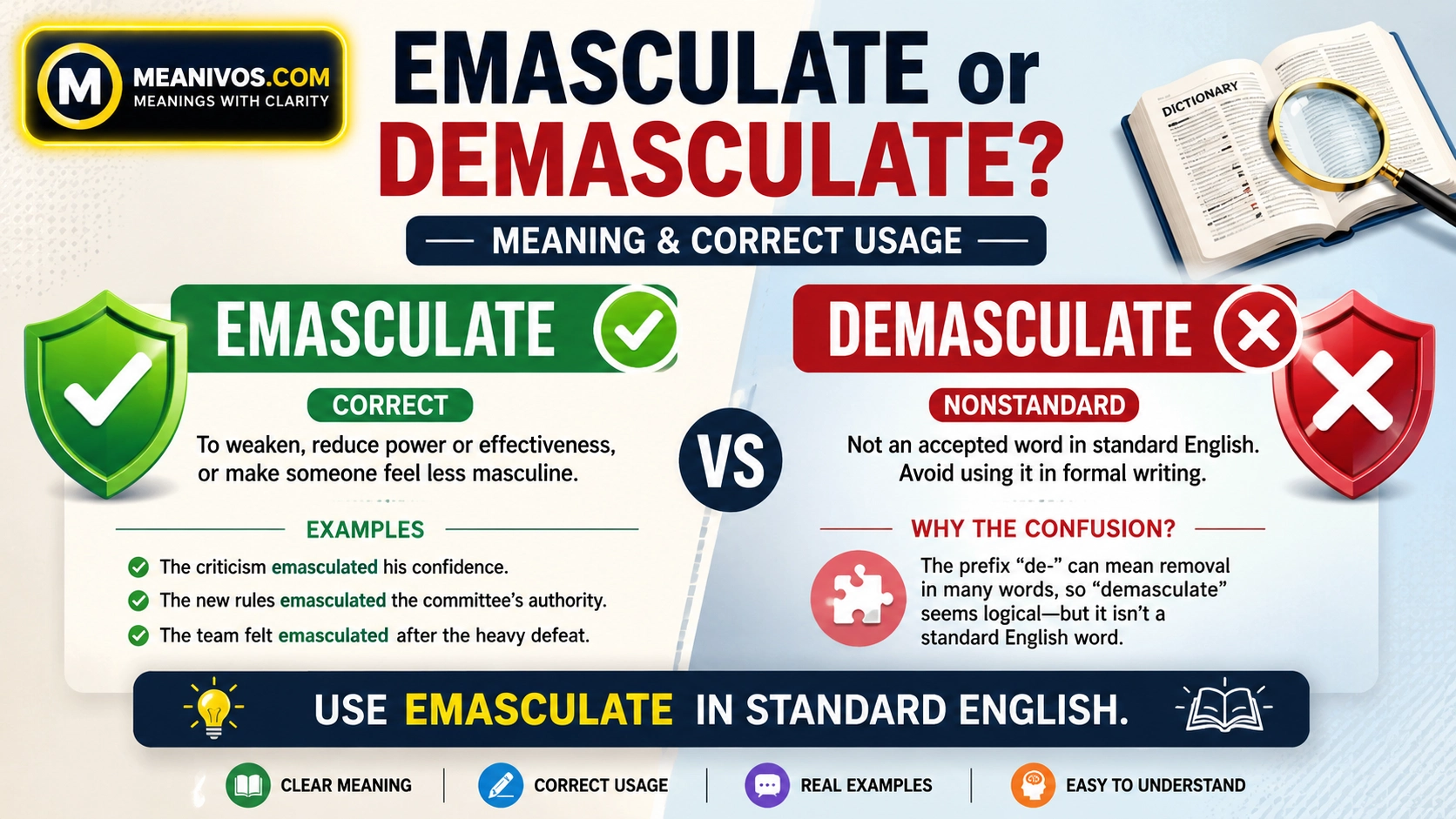
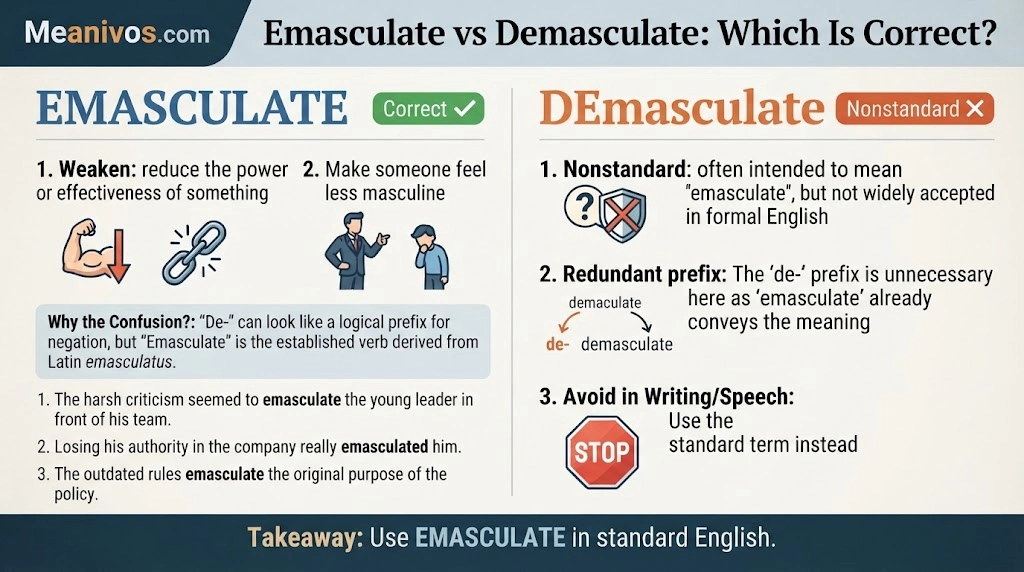
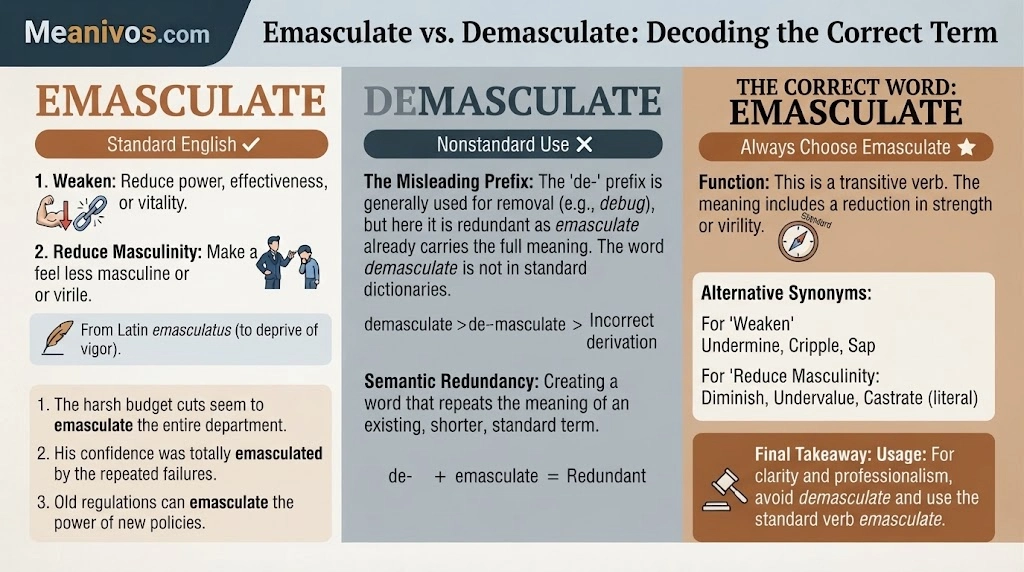
If you are unsure whether to write Emasculate Or Demasculate, the correct choice in standard English is emasculate. Demasculate sometimes appears online, usually as a mistaken or nonstandard formation, but it is not the established word used by major English dictionaries.
The confusion is understandable. English often uses the prefix de- to express removal, reversal, or reduction, so emasculate may look as though it should mean “remove masculinity” or “make less masculine.” However, English vocabulary does not always work by simply combining familiar-looking parts.
Emasculate is an established verb with several meanings. It can mean to weaken someone or something, reduce effectiveness or authority, undermine a person’s confidence or sense of masculinity, or, in a literal biological context, deprive a male of reproductive capacity. It also has a specialised meaning in botany: removing the male reproductive parts of a flower.
This guide explains emasculate vs demasculate in simple English, shows how each form is used, explains the history behind emasculate, and gives practical examples so you can choose the right word confidently.
Emasculate vs Demasculate: Quick Answer
| Word | Standard English? | Main meaning | Best choice |
| Emasculate | Yes | Weaken, reduce effectiveness, undermine power, or make someone feel less masculine | Use it |
| Demasculate | Generally no | Usually intended to mean something similar to emasculate | Avoid in formal English |
The simple rule
Emasculate is the established standard-English word.
For example:
The criticism emasculated his confidence.
Not:
The criticism emasculated his confidence.
If you want a more neutral and straightforward alternative, you can often use weaken, undermine, diminish, or reduce, depending on the context.
What Does “Emasculate” Mean?
Emasculate is a formal English verb with several related meanings.
In simple English, it can mean:
To make someone or something weaker, less powerful, or less effective.
It can also have a gender-related meaning: making a man feel that he has lost masculine power, confidence, authority, or identity.
In a literal biological context, emasculate can mean to castrate or deprive a male of reproductive power. In botany, it can mean removing the male reproductive parts of a flower.
Major dictionaries recognise these different senses. Merriam-Webster defines the verb in terms of depriving someone or something of strength, vigour, or spirit and also records biological and botanical meanings. Oxford and Cambridge likewise recognise broader figurative and gender-related uses.
Examples
The defeat emasculated the team’s confidence.
Here, emasculated means weakened or damaged the team’s sense of power.
The amendments emasculated the proposed legislation.
Here, the word means the amendments reduced the legislation’s effectiveness.
He felt emasculated after being publicly humiliated.
Here, the meaning relates to a person’s sense of masculinity, power, or confidence.
Emasculate Meaning in Simple English
The easiest way to remember the word is:
Emasculate = weaken, take away power, or make someone feel less powerful or masculine.
Depending on the context, it may refer to:
- weakened confidence
- reduced authority
- loss of power
- reduced effectiveness
- damaged masculine identity
- loss of male reproductive capacity
- removal of male reproductive parts from a flower
The surrounding words tell you which meaning is intended.
Easy examples
- The criticism emasculated his confidence.
- The new policy emasculated the committee’s authority.
- He felt emasculated after the public criticism.
- The organisation was emasculated by severe funding cuts.
- The researchers emasculated the flowers before controlling pollination.
Is “Demasculate” a Word?
Demasculate is not the established standard-English word you should normally use.
You may encounter it on websites, forums, social media, or informal writing. Some writers use it because it appears to be a logical construction from de- and a word associated with masculinity.
However, the existence of an expression in informal online usage does not automatically make it the preferred standard-English form.
For formal writing, including:
- academic essays
- professional communication
- journalism
- business writing
- educational content
- formal correspondence
The safer choice is emasculation.
Example
Instead of:
He was emasculated by the criticism.
Use:
He was emasculated by the criticism.
Or, when masculinity is not part of the intended meaning:
He felt undermined by the criticism.
Why Do People Say “Demasculate”?
The confusion mainly comes from the appearance of the word.
English has many words beginning with de-, such as:
- deactivate
- deconstruct
- defrost
- devalue
- decrease
- deregulate
- decentralise
Because de- can indicate removal, reversal, or reduction, demasculate may look logical.
Someone might reason:
de- + masculine → emasculate
That reasoning is understandable, but English words are not always created through simple mathematical formulas.
Established vocabulary develops through historical usage, borrowing, linguistic change, and convention.
In this case, English already has the established word emasculate.
So even though demasculate may look intuitive, that does not make it the standard form.
Etymology of “Emasculate”
The history of emasculation is one reason the de- versus e- confusion can be misleading.
Merriam-Webster traces emasculate to Latin emasculatus, the past participle of emasculare, from e- plus masculus, meaning “male.” Its first known English use is recorded as 1607. Oxford also traces the word to Latin origins and early seventeenth-century English usage.
This means emasculate is not simply a modern English word formed by attaching a prefix to “masculate.”
That historical background helps explain why replacing the beginning with de- does not automatically produce an accepted synonym.
Important takeaway
You should not assume that:
de- + masculine = emasculate
is how the established English vocabulary developed.
The standard word is emasculate.
Emasculate as “To Weaken”
One of the most important modern uses of emasculate is the figurative meaning to make something less Powerful or effective.
This meaning does not necessarily involve gender.
For example:
The amendments could emasculate the proposed legislation.
The sentence means that the amendments could reduce the force or effectiveness of the legislation.
Other examples include:
Budget cuts emasculated the programme.
Excessive restrictions emasculated the agency.
The compromise emasculated the original proposal.
Censorship can emasculate public debate.
In each case, emasculate means weaken, diminish, or strip away effectiveness.
This broader meaning is important because many people incorrectly assume that emasculate can only describe men or male biology.
Emasculate and Masculinity
A second major meaning concerns masculinity.
To emasculate a man can mean to make him feel that he has lost masculine power, status, confidence, authority, independence, or identity.
For example:
He felt emasculated when he could no longer make important decisions.
Public humiliation left him feeling emasculated.
Losing his position made him feel emasculated.
In these examples, nothing necessarily happens physically. The word describes an emotional or social experience.
A useful nuance
The gender-related meaning can reflect traditional ideas about masculinity, such as:
- independence
- authority
- physical strength
- social status
- leadership
- confidence
- provider roles
Because of these associations, emasculate can carry cultural or social implications depending on how it is used.
If gender is irrelevant, undermine, weaken, or discourage may be clearer choices.
Does “Emasculate” Only Apply to Men?
No.
The gender-specific sense traditionally relates to making a man feel less masculine. However, the broader figurative meaning of weakening or reducing effectiveness can apply to people, organisations, institutions, laws, plans, and other things.
For example:
The new regulations emasculated the organisation.
The organisation is not a man. Here, emasculated means its power or effectiveness was reduced.
Another example:
The amendments emasculated the bill.
Again, the word describes reduced effectiveness rather than masculinity.
So context is essential.
Compare these two sentences
The experience emasculated him.
This may suggest a loss of masculine confidence or power.
The regulations emasculated the agency.
This means the agency became weaker or less effective.
The Literal Meaning of Emasculate
Emasculate also has a literal biological meaning.
It can mean to castrate or deprive a male of reproductive power.
This is very different from the common figurative use.
Compare:
The animal was castrated.
with:
The humiliating experience emasculated him.
The first sentence refers to a biological procedure.
The second is figurative and concerns confidence, power, or masculinity.
Because the literal meaning can sound clinical or severe, context matters when using the word.
Emasculate in Botany
A specialised meaning that many basic word-comparison articles overlook is found in botany.
In plant breeding, to emasculate a flower means to remove its male reproductive parts, usually to prevent self-pollination and allow controlled cross-pollination.
For example:
Researchers emasculated the flowers before controlled pollination.
This is a technical scientific use. It has nothing to do with insulting someone’s masculinity.
This botanical sense is one reason a complete dictionary-style article should not reduce emasculation to simply “make a man feel less masculine.”
Emasculated Meaning
Emasculated is the past tense and past participle of emasculate.
Depending on context, it can mean:
- made weaker
- made less effective
- deprived of power or authority
- made to feel less masculine
- deprived of male reproductive capacity
Examples
He felt emasculated after losing control of the situation.
The revised law was emasculated by several amendments.
The organisation was effectively emasculated by funding cuts.
The context determines the intended sense.
Emasculating Meaning
Emasculating is the present participle of emasculate.
It can describe something that is:
- weakening
- undermining
- reducing effectiveness
- reducing authority
- making someone feel less powerful
- making someone feel less masculine
Examples
The constant criticism was emasculating.
He found the situation deeply emasculating.
The restrictions had an emasculating effect on the organisation.
Emasculation Meaning
Emasculation is the noun form associated with emasculate.
It refers to the act or process of emasculating.
Depending on context, it can describe:
- weakening
- loss of authority
- loss of power
- undermining masculinity
- literal castration
- removal of male reproductive parts in specialised contexts
Examples
The emasculation of the committee reduced its influence.
He described the experience as a form of emasculation.
The study examined emasculation in controlled plant breeding.
Emasculate vs Demasculate: Key Difference
The distinction can be remembered very simply:
Emasculate
Established English word.
It can mean:
- weaken
- reduce effectiveness
- undermine authority
- reduce power
- make someone feel less masculine
- castrate
- remove male reproductive parts from a flower
Demasculate
Not the standard modern English form.
It is generally used as a nonstandard or mistaken formation of emasculate.
Final choice
Use “emasculate.”
If you want neutral wording, choose weaken, undermine, diminish, or reduce, depending on your meaning.
Emasculate vs Castrate
These words overlap, but they are not interchangeable in every situation.
Castrate
Castrate is specifically associated with removing or disabling male reproductive organs.
Emasculate
Emasculate can have that literal biological meaning, but it also has broader figurative meanings involving power, effectiveness, confidence, and masculinity.
| Word | Main idea | Figurative use? |
| Castrate | Remove or disable male reproductive organs | Limited |
| Emasculate | Weaken, deprive of power, or remove male reproductive capacity | Yes |
Simple rule
Castrate = primarily biological.
Emasculate = biological or figurative, depending on context.
Emasculate vs Undermine
The Emasculate and undermine can overlap when they mean “weaken,” but their connotations are different.
Undermine usually means to weaken someone’s confidence, authority, position, or effectiveness, often gradually or indirectly.
Emasculate can also mean to weaken, but it may carry an additional association with masculinity or masculine power.
Compare:
The criticism Undermined her confidence.
This is neutral and broadly applicable.
The criticism emasculated him.
This can suggest that the criticism damaged his sense of masculine confidence or power.
Which word should you choose?
Use undermine when you want a neutral expression.
Use emasculate when the stronger connotation of lost power, effectiveness, or masculinity is relevant.
Emasculate Synonyms
The best synonym depends on the intended meaning.
When you mean “weaken”
- weaken
- diminish
- reduce
- impair
- sap
- enervate
- Explore More: https://meanivos.com/since-vs-sense/
When you mean “reduce authority”
- undermine
- weaken
- disempower
- marginalise
- neutralise
- strip of authority
Whet you mean “damage confidence”
- discourage
- undermine
- unsettle
- intimidate
- humiliate
- demoralise
When you mean the biological sense
- castrate
- remove male reproductive organs
- sterilise, where technically appropriate
Do not automatically substitute a synonym without checking the context. A word that means “weaken” may not carry the same gender-related or biological meaning.
Emasculate Examples in Sentences
Here are examples covering the major meanings:
1. Confidence
The public criticism emasculated his confidence.
2. Authority
The new rules emasculated the manager’s authority.
3. Effectiveness
The amendments emasculated the original proposal.
4. Masculinity
He felt emasculated after being publicly humiliated.
5. Organisation
Excessive bureaucracy emasculated the department.
6. Political power
The reforms emasculated the institution.
7. Literature
The character’s defeat left him feeling emasculated.
8. Biology
The male animal was emasculated during the procedure.
9. Botany
The researchers emasculated the flowers before pollination.
10. Neutral alternative
The criticism undermined her confidence.
The last example may be preferable when gender or masculinity is not relevant.
Common Mistakes With “Emasculate”
Mistake 1: Using “demasculate”
Incorrect in standard English:
He was emasculated by the criticism.
Better:
He was emasculated by the criticism.
Mistake 2: Assuming “de-” must be correct
English prefixes are not interchangeable mathematical symbols.
The fact that de- expresses removal or reversal in some words does not mean it can automatically replace the historical beginning of another word.
Mistake 3: Thinking emasculate only means castrate
This is incomplete.
Modern dictionary definitions also recognise figurative meanings involving strength, effectiveness, power, confidence, and masculinity.
Mistake 4: Using emasculate when “weaken” is clearer
Sometimes the simpler word communicates the idea better.
Instead of:
The decision emasculated the department.
you could write:
The decision weakened the department.
If you are not intentionally using the stronger connotations of emasculate, weaken may be clearer.
Mistake 5: Assuming emasculate only describes people
It can also describe:
- organisations
- laws
- institutions
- proposals
- agencies
- programmes
- policies
- departments
when their effectiveness or authority has been reduced.
How to Remember Emasculate vs Demasculate
Try this simple memory trick:
E = Established
E = Emasculate = Established English
And:
D = Don’t use demasculate
This is only a memory aid, not an etymological rule.
Another simple reminder is:
When you mean “weaken” and are choosing between E and D, choose E: emasculate.
Is “Demasculate” Ever Acceptable?
You may encounter emasculate in informal internet writing or other nonstandard contexts.
Some online sources may describe it as a rare or informal variation. However, that does not make it the preferred standard-English form.
For:
- academic writing
- business writing
- professional communication
- essays
- journalism
- formal correspondence
- educational content
emasculate is the safest established choice.
If you encounter emasculate online, the intended meaning may be obvious from context. But recognition does not necessarily mean that the form is standard or recommended.
How Do You Pronounce “Emasculate”?
Emasculate is commonly pronounced approximately:
ih-MASS-kyuh-layt
Pronunciation can vary slightly between British and American English.
The important point is that the word begins with the “ih-MASS” sound rather than being pronounced as though it were emasculate.
What Is the Opposite of Emasculate?
There is no single perfect opposite in every context because emasculate has several meanings.
Depending on the sentence, possible opposites include:
- strengthen
- empower
- reinforce
- encourage
- embolden
For example:
The reforms strengthened the institution.
This is a natural opposite when emasculate means weaken.
The experience empowered him.
This works when the original idea involves loss of personal power or confidence.
Emasculate vs Demasculate: Comparison at a Glance
| Feature | Emasculate | Demasculate |
| Standard English | Yes | Generally no |
| Dictionary-established | Yes | Not the standard form |
| Can mean “weaken” | Yes | Usually intended, but nonstandard |
| Can relate to masculinity | Yes | Usually intended |
| Biological meaning | Yes | Not established as the standard form |
| Botanical meaning | Yes | No established standard use |
| Recommended in formal writing | Yes | No |
| Better alternative | — | Use emasculate |
People Also Ask
A:It can appear in informal or nonstandard usage, but it is not the established standard-English word. In formal writing, use emasculate.
A:Emasculate is correct in standard English.
A:It can mean to weaken someone or something, reduce effectiveness, undermine power, or make a man feel less masculine. It can also have literal biological and specialised botanical meanings.
A:People who use demasculate generally appear to intend a meaning similar to emasculate. However, emasculate is the established standard form.
A:Yes. Emasculate is a verb.
Final Verdict
When choosing between emasculate vs demasculate, choose emasculate.
Emasculate is an established English verb. It can mean to weaken something, reduce effectiveness, undermine authority, damage someone’s sense of power or masculinity, or, in literal and specialised contexts, remove male reproductive capacity or reproductive parts.
Demasculate may appear online, but it is not the standard form you should use in formal English.
So the easiest rule is:
Correct: emasculate
Avoid in standard English: demasculate
If you want a simpler and more neutral word, choose weaken, undermine, diminish, or reduce, depending on your intended meaning.
The bigger lesson is useful for English learners: a word that looks logically constructed is not necessarily an established English word. Standard usage develops through history and convention, not simply by combining prefixes and roots.
Quick takeaway
Emasculate = established standard English.
Demasculate = nonstandard/mistaken form that should generally be avoided.
When in doubt, use “emasculate.”