Since vs Sense: What’s the Difference?
Since and sense are two different English words that are easy to confuse because their spelling and pronunciation are similar. But they have different meanings and grammatical jobs.
The simplest rule is:
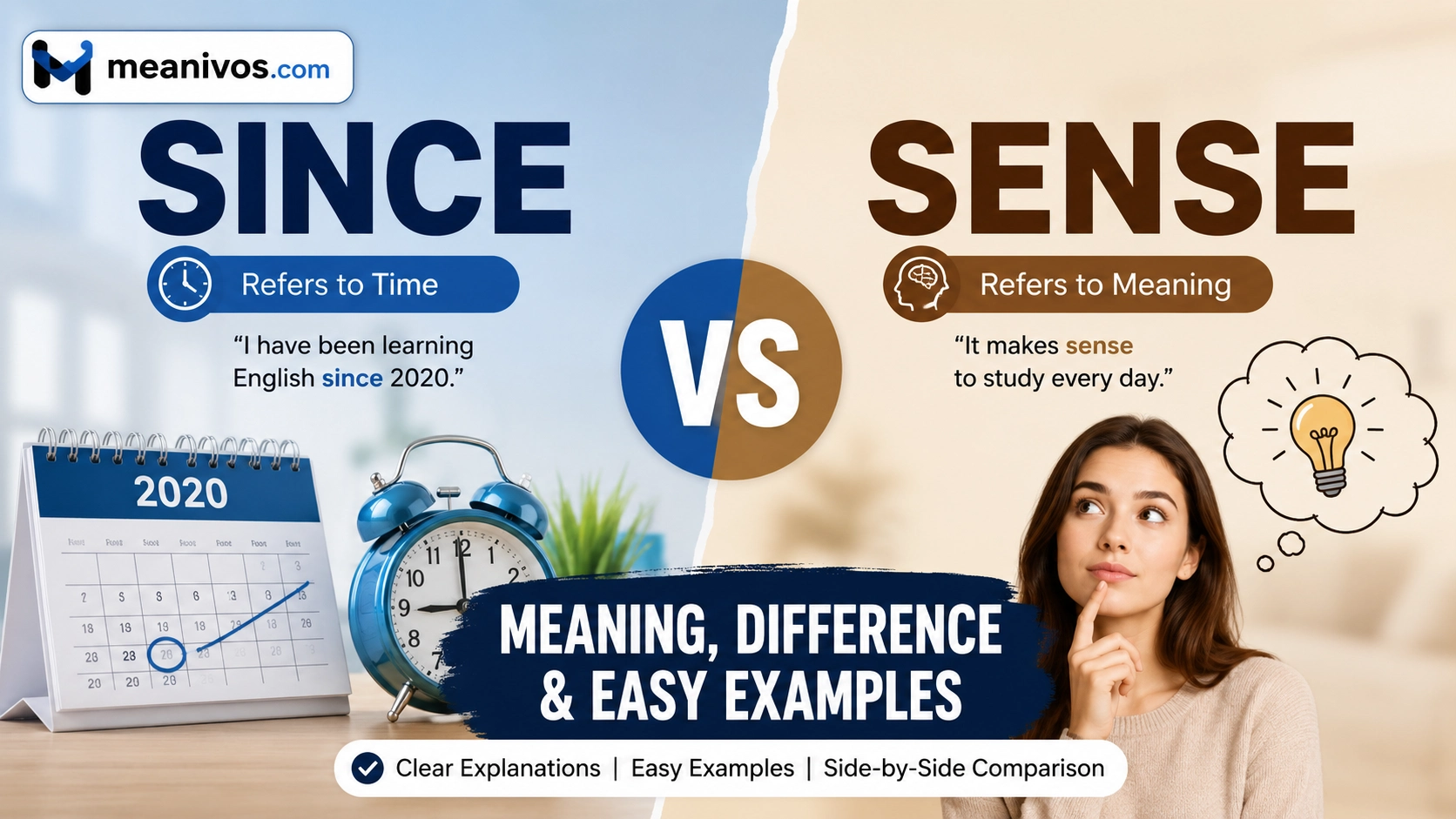
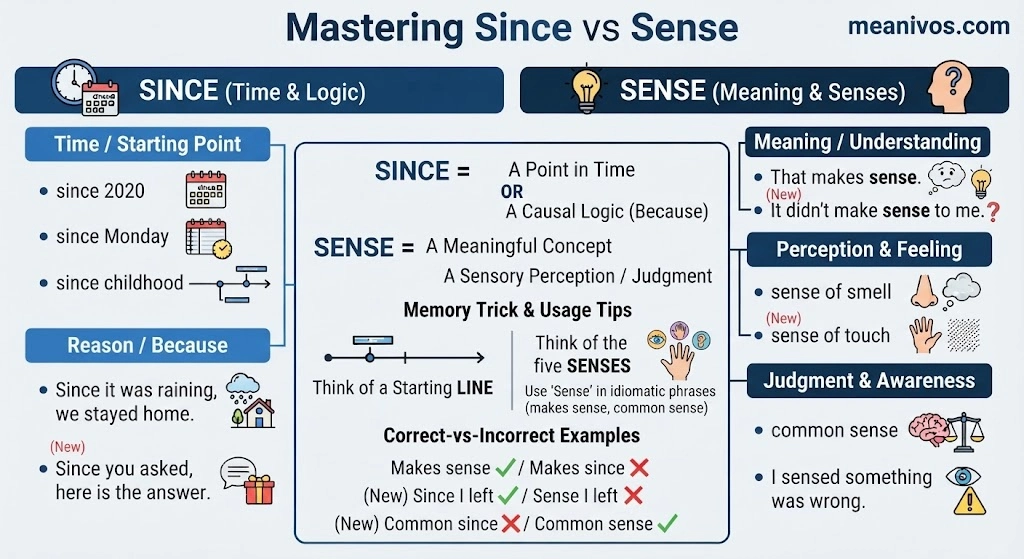
Since = a starting point in time or a reason.
Sense = meaning, understanding, perception, or judgment.
For example:
- I have lived here since 2020. → Since identifies when something started.
- That explanation makes sense. → Sense refers to meaning or understanding.
- Since you’re already here, let’s begin. → Since means approximately because.
- I could sense that something was wrong. → Sense is a verb meaning to perceive or become aware of something.
So if you’re wondering “Is it since or sense?”, don’t choose based on spelling alone. Identify the meaning first.
Since vs Sense at a Glance
| Word | Main meanings | Common grammatical roles | Example |
| since | From a particular time; because | Preposition, conjunction, adverb | I have worked here since 2020. |
| sense | Meaning, perception, awareness, judgment | Noun, verb | That explanation makes sense. |
Cambridge Dictionary describes since as a preposition, conjunction, and adverb in its time-related uses, and as a conjunction when it introduces a reason. Sense has several noun meanings, including physical perception, awareness, judgment, and meaning, and it can also be Since vs Sense used as a verb.
The fastest way to choose
Ask yourself:
Does the word refer to when something started?
→ Use since.
Does it give a reason equivalent to “because”?
→ Use since.
Does it refer to meaning, understanding, perception, or judgment?
→ Use sense.
What Does “Since” Mean?
Since has two major meanings: it can refer to time or introduce a reason.
It can also perform several grammatical roles depending on how it is used.
Since for Time
We use since to identify a particular point in the past from which something continues or is measured.
Examples:
- I have lived here since 2020.
- She has worked there since Monday.
- We haven’t spoken since last year.
- He has known her since childhood.
- They have been married since June.
The important idea is a starting point.
Cambridge explains that since refers back to a previous point in time and can be followed by a date, time, noun phrase, or clause.
Common patterns with since
You can use since with:
- since 2020
- since Monday
- since yesterday
- since last summer
- since childhood
- since breakfast
- since I moved here
- since she graduated
For example:
I’ve worked remotely since 2021.
Here, 2021 is the starting point.
Since a Specific Starting Point
One of the most useful grammar distinctions is:
Since = starting point
For = duration
Compare:
- I have lived here since 2020.
- I have lived here for six years.
The first sentence answers when it started.
The second answers how long.
Cambridge specifically distinguishes since, which refers to a point in time, from for, which refers to a period or duration.
Since for Reason
Since I can also introduce a reason. In this use, it means approximately because or as.
Examples:
- Since you’re tired, you should rest.
- Since it was raining, we stayed home.
- We left early since traffic was getting heavier.
- I didn’t call her since I knew she was working.
Consider:
Since it was raining, we stayed inside.
You can replace since with because:
Because it was raining, we stayed inside.
The basic meaning remains the same.
Cambridge identifies this as a conjunction use of since for introducing a reason.
A useful substitution test
If because fits naturally in the sentence, since may be the correct choice.
Since the store was closed, we went home.
→
Because the store was closed, we went home.
But remember that since can also mean time, so context matters.
Since as a Preposition
Since is a preposition when it comes before a noun phrase or similar expression referring to a starting point.
Examples:
- since Monday
- since 2020
- since last summer
- since childhood
- since breakfast
Example:
I haven’t eaten anything since breakfast.
Here, since identifies the point from which the situation is measured.
Since as a Conjunction
Since I can introduce a clause.
It may express time:
I’ve felt better since I started exercising.
Or it may express reason:
Since you’re already here, let’s start.
The surrounding meaning tells you which use is intended.
Cambridge notes that since can introduce subordinate clauses for both time and reason.
Since as an Adverb
Sometimes the starting point has already been mentioned, so it can stand alone.
Examples:
She left yesterday and hasn’t returned since.
He moved abroad years ago and has lived there ever since.
They had an argument and haven’t spoken since.
In these sentences, the reader or listener understands the time reference from the earlier context.
Cambridge also identifies since, since then, and ever since as adverbial time expressions.
Since and the Present Perfect
Since frequently appears with the present perfect when something began in the past and continues into the present.
Examples:
- I have lived here since 2019.
- She has worked there since June.
- We have known each other since childhood.
- They have been married since 2020.
A common structure is:
have/has + past participle + since + starting point
For example:
I have worked here since 2022.
When introducing an event or action in a clause, English can use different tense combinations depending on the construction and meaning. Cambridge provides examples involving the past simple, present perfect, and other Since vs Sense perfect forms.
What Does “Sense” Mean?
Sense has several meanings, but most are connected to perception, understanding, meaning, awareness, or judgment.
It can function as both a noun and a verb.
Sense as Physical Perception
One familiar meaning of sense relates to the body’s physical senses:
- sight
- hearing
- smell
- taste
- touch
Examples:
- Dogs have an excellent sense of smell.
- She temporarily lost her sense of taste.
- His sense of hearing is very sensitive.
- The five senses help us perceive the world around us.
This is an easy memory association:
Five senses → sense
Cambridge lists the physical abilities to see, hear, smell, taste, and feel among the meanings of sense.
Sense as Understanding or Meaning
Sense can mean that something has understandable meaning or logic.
This is the meaning behind the extremely common phrase:
That makes sense.
Examples:
- Your explanation makes sense.
- That doesn’t make sense.
- Now the instructions make sense.
- Her argument makes perfect sense.
- I can’t make sense of these directions.
Cambridge includes sense as a noun meaning a possible meaning of a word or phrase and makes sense in the context of something being understandable.
Sense as Good Judgment
Sense can also mean practical or reasonable judgment.
Examples:
- Use your common sense.
- She had the good sense to leave early.
- It makes sense to save money.
- He showed excellent business sense.
Here, sense means the ability to make reasonable decisions rather than one of the five physical senses.
Sense as Awareness or Feeling
The word sense can describe an awareness or feeling.
Examples:
- I had a sense that something was wrong.
- There was a sense of excitement in the room.
- She felt a sense of relief.
- He has a strong sense of responsibility.
This meaning is related to becoming aware of or experiencing something.
Sense as a Verb
Sense can also be a verb meaning to perceive, detect, or become aware of something.
Examples:
- I could sense that she was nervous.
- He sensed danger.
- The dog sensed something unusual.
- She could sense tension in the room.
Cambridge defines the verb sense in terms of feeling or experiencing something without necessarily being able to explain exactly how.
Since vs Sense Examples in Sentences
| Since | Sense |
| I have worked here since 2021. | That explanation makes sense. |
| She hasn’t called Since Monday. | I have a strong sense of smell. |
| Since it is late, let’s go home. | He has good common sense. |
| We haven’t met since last year. | I could sense that he was worried. |
| He has lived there since childhood. | She has a good sense of direction. |
| Since you asked, I’ll explain. | I couldn’t make sense of the instructions. |
The words can even appear together:
Since childhood, she has had a strong sense of direction.
In that sentence:
- since = starting point in time
- sense = an ability or awareness
“Makes Sense” or “Makes Since”?
The correct expression is:
It makes sense.
Not:
It makes since.
Why?
Because sense here means meaning, logic, or understandability.
Examples:
- Your explanation makes sense.
- This plan makes sense.
- That doesn’t make sense.
- Does this make sense?
- It makes perfect sense.
- Explore More: https://meanivos.com/cfs-meaning-in-text/
Remember this phrase
Make sense = be understandable or logical
So whenever you are writing “makes sense,” the correct spelling is sense.
“Does That Make Sense?” or “Does That Make Since?”
The correct question is:
Does that make sense?
This is one of the most common situations in which writers accidentally use since.
Correct
Does that make sense?
Incorrect
Does that make since?
The question asks whether an explanation or idea is understandable. Therefore, sense is the appropriate word.
Other correct examples include:
- Does this make sense?
- Does what I said make sense?
- I hope that makes sense.
- Let me know if that makes sense.
- It doesn’t make sense to wait.
“Sense” or “Since” for “Because”?
If you mean because, use since, not sense.
Correct
Since it was raining, we canceled the game.
Incorrect
Sense it was raining, we canceled the game.
Try replacing the word with because:
Since it was raining, we canceled the game.
→
Because it was raining, we canceled the game.
The substitution works because since is being used to introduce a reason.
Since vs For: What’s the Difference?
Since and for are often confused, especially with perfect tenses.
The basic distinction is:
Since = a starting point
For a duration
Since
Use since with a point in time:
- since 2020
- since Monday
- since breakfast
- since childhood
- since last summer
For
Use for with a period of time:
- for two years
- for three hours
- for several days
- for a long time
- for six months
Compare:
I have lived here since 2020.
I have lived here for six years.
And:
She has been waiting since 9 a.m.
She has been waiting for three hours.
Cambridge explicitly states that for is used with periods of time while since refers to a point in past time.
Easy question test
Ask:
“When did it start?”
→ since
“How long?”
→ for
Since vs Sense vs Sence
A third spelling you may encounter is:
sence
For standard English, sence is not the correct spelling of either word.
The correct spellings are:
- since → time or reason
- sense → meaning, perception, awareness, or judgment
Examples:
I have lived here since 2019.
That explanation makes sense.
Not:
I have lived here since 2019.
or:
That explanation makes sense.
If you’re unsure which spelling to use, identify the meaning first.
Are “Since” and “Sense” Homophones?
Not exactly.
They are commonly confused because they look and sound similar, but their standard dictionary pronunciations are different:
- since — /sɪns/
- sense — /sens/
Cambridge gives these pronunciations for the two words.
So it is more precise to call them similar-sounding, commonly confused words rather than exact homophones.
Pronunciation can also vary by accent, which Since vs Sense may make the distinction more or less noticeable to individual speakers.
Common Mistakes With Since and Sense
1. “Makes since”
❌ That doesn’t make since.
✅ That doesn’t make sense.
2. “Sense it was raining”
❌ Sense it was raining, we stayed home.
✅ Since it was raining, we stayed home.
3. “It makes since”
❌ It makes since to wait.
✅ It makes sense to wait.
4. Using since with a duration
❌ I have lived here since five years.
✅ I have lived here for five years.
But:
✅ I have lived here since 2021.
The first correct sentence gives a duration. The second gives a starting point.
5. Assuming sense is only a noun
Sense can be both a noun and a verb.
Noun:
She has a good sense of humor.
Verb:
I could sense that something was wrong.
6. Confusing “since” with “for”
Remember:
since Monday
but:
for three days
The first identifies a starting point; the second identifies elapsed time.
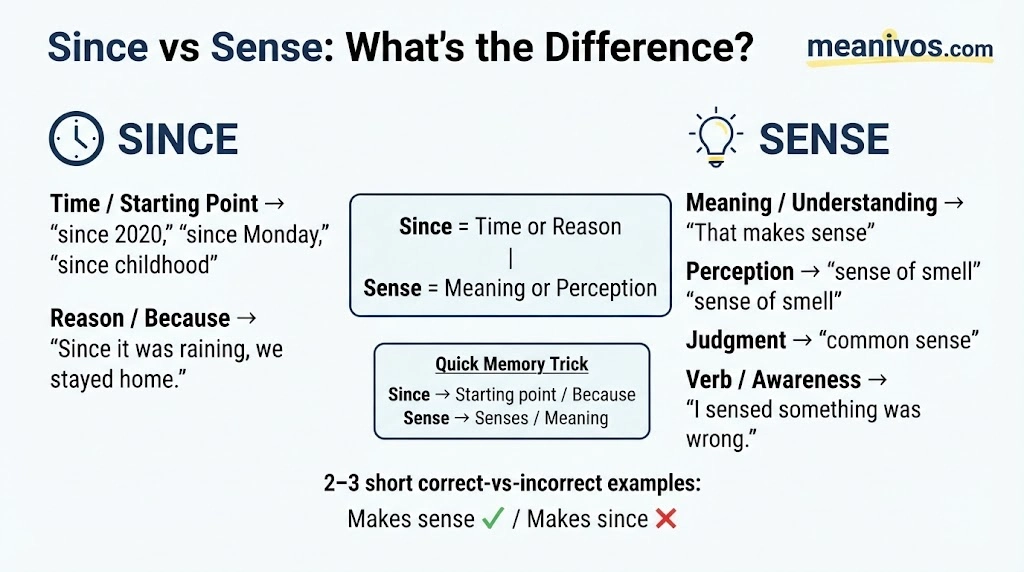
How to Remember Since vs Sense
You don’t need a complicated mnemonic. Three simple associations are enough.
Trick 1: Since = Starting Point
Think:
Since → Starting point
Examples:
- since Monday
- since 2020
- since childhood
- since last week
Trick 2: Since = Because
When introducing a reason, try replacing it with because.
Since you’re tired, go to bed.
→
Because you’re tired, go to bed.
If the substitution makes sense, it is likely correct.
Trick 3: Sense = Senses
Connect sense with the five senses:
- sight
- hearing
- smell
- taste
- touch
Then expand the association:
sense → perception → awareness → understanding → meaning → judgment
That’s why we have expressions such as:
- sense of smell
- sense of direction
- sense of humor
- common sense
- sense of responsibility
- make sense
A Simple Decision Tree
When you’re choosing between since and sense, ask these questions.
Are you talking about when something began?
Yes → since
I’ve lived here since 2020.
Are you giving a reason?
Yes → since
Since you’re already here, let’s begin.
Are you talking about meaning or logic?
Yes → sense
That explanation makes sense.
Are you talking about perception or awareness?
Yes → sense
I sense that something is wrong.
Are you talking about one of the five senses?
Yes → sense
She has a strong sense of smell.
Since vs Sense Mini Quiz
Choose since or sense.
1. I have lived here _____ 2020.
2. That explanation doesn’t make _____.
3. _____ you’re already here, let’s start.
4. She has a great _____ of direction.
5. We haven’t spoken _____ Monday.
6. I could _____ that something was wrong.
7. He has worked there _____ graduating.
8. Does that make _____?
Answers
- since
- sense
- Since
- sense
- since
- sense
- since
- sense
The two rules that solve nearly every question are:
Since = time or reason.
Sense = meaning, perception, awareness, or judgment.
People Also Ask
A:No. Since and sense are separate words with different meanings and grammatical functions.
Since commonly refers to a starting point in time or introduces a reason. Sense relates to perception, meaning, awareness, or judgment.
A:The correct phrase makes sense.
Your explanation makes sense.
Here, sense means that something is understandable or logical.
A:The correct expression is:
Does that make sense?
Use sense because the question asks whether an idea or explanation is understandable.
A:Yes. Since can introduce a reason and can often be replaced by because.
Since it was late, we went home.
Because it was late, we went home.
The exact nuance can depend on context, but both connect a result with its reason.
A:Yes. Since it can function as a conjunction.
It can introduce a time clause:
I’ve felt better since I started exercising.
It can also introduce a reason:
Since you’re busy, I’ll come back later.
It can additionally function as a preposition and adverb in its time-related uses.
Related Expressions With “Sense”
Learning common expressions can make the difference easier to remember.
Make sense
Meaning: be understandable or logical.
The explanation makes sense.
Make sense of
Meaning: understand something.
I can’t make sense of these instructions.
Common sense
Meaning: practical judgment.
Use your common sense.
Sense of smell
Meaning: the ability to detect smells.
Dogs have an excellent sense of smell.
Sense of direction
Meaning: the ability to know where you are or where to go.
I have a terrible sense of direction.
Sense of humor
Meaning: the ability to appreciate or create humor.
She has a great sense of humor.
Sense of responsibility
Meaning: awareness of one’s duties or obligations.
He has a strong sense of responsibility.
Sense that
Meaning: an awareness or feeling that something is true.
I had a sense that something was wrong.
Related Expressions With “Since”
Since then
Refers to the period after a previously mentioned event or time.
We met in 2020 and have stayed friends since then.
Ever since
Emphasizes continuity from a past event or time.
She moved there in 2018 and has lived there ever since.
Since childhood
Means from the period when someone was a child.
He has loved music since childhood.
Since last year
Means from some point last year until the relevant later time.
Sales have increased since last year.
Since you asked
Introduces a reason or circumstance.
Since you asked, I’ll give you my honest opinion.
Quick Comparison: Since, Sense, and For
| Word | Meaning | Example |
| since | Starting point in time | I’ve lived here since 2020. |
| since | Reason / because | Since you’re here, let’s begin. |
| sense | Meaning or logic | That makes sense. |
| sense | Perception | I could sense danger. |
| sense | Judgment | Use your common sense. |
| for | Duration | I’ve lived here for six years. |
Why These Words Are Commonly Confused
There are several reasons writers mix up since and sense.
First, both words are short and visually similar.
Second, their pronunciation is close enough that the distinction may be Since vs Sense difficult to hear for some learners or in some accents. Cambridge lists different standard pronunciations, /sɪns/ and /sens/, but the difference is subtle.
Third, phrases such as “makes sense” and “since you asked” are extremely common, so a spelling mistake can happen quickly when writing from memory.
The best solution isn’t to memorize Since vs Sense every phrase separately. Learn the underlying meanings:
Since → time or reason
Sense → perception, meaning, or judgment
Final Rule
The difference between Since and sense becomes much easier when you focus on meaning instead of spelling.
Use since when you mean:
- a starting point in time
- a situation continuing from a past point
- a reason similar to because
- expressions such as since Monday, since 2020, and since you asked
Use sense when you mean:
- physical perception
- meaning
- understanding
- awareness
- judgment
- expressions such as make sense, common sense, and sense of smell
- the verb meaning to detect or become aware of something
The easiest rule to remember is:
It tells you when or why. Sense tells you what something means, how you perceive it, or whether it is logical.
So:
I have lived here since 2020.
That explanation makes sense.
Since you’re here, let’s begin.
I could sense that something was wrong.
Once that distinction is clear, most since vs sense questions become straightforward.