Soo vs So: Meaning, Difference & Correct Usage
Have you ever wondered whether you should write so or soo?
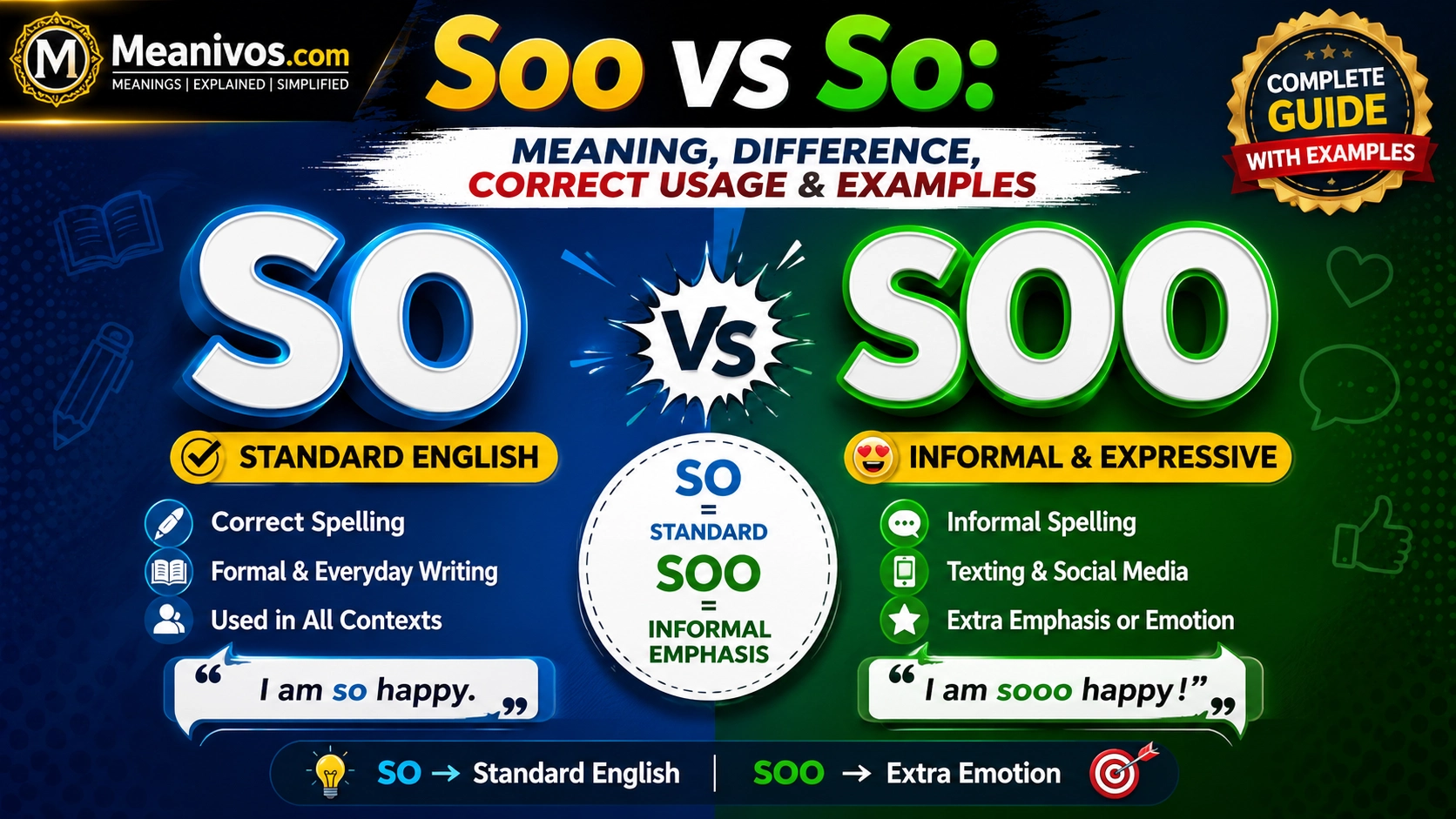
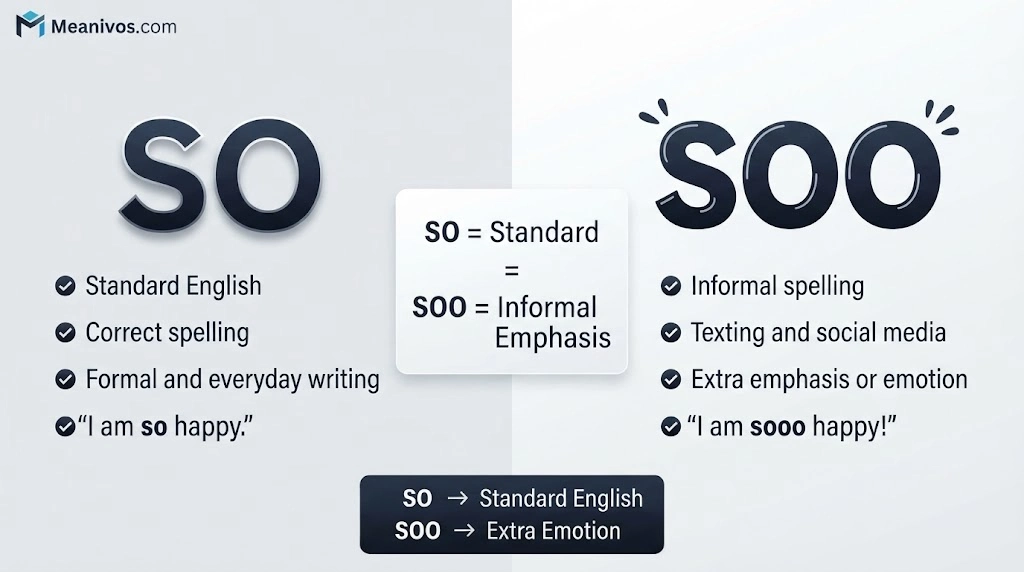
The short answer is simple: so is the standard English spelling when you mean the ordinary grammatical word. Soo is commonly used online as an informal, expressive spelling of so, especially when someone wants to stretch the sound or add emotional emphasis.
For example:
- Standard: I am so tired.
- Informal text: I am soo tired!
- Extra emphasis: I am sooo tired!
The extra letters in soo or sooo usually do not create a new grammatical meaning. Instead, they visually suggest that the writer is drawing out the sound for emphasis, excitement, affection, frustration, humour, or dramatic effect.
However, there is an important detail that many quick grammar articles miss: Soo can also occur as a genuine dictionary term in a different context. Collins records Soo as an American English alteration of Sault, referring to the region around Sault Ste. Marie and the St. Marys Falls Canals.
So, when comparing soo vs so in ordinary English sentences, the practical rule is:
Use “so” in standard writing. Use “soo” as an intentional informal spelling when you want to express extra emotion or a stretched pronunciation.
Soo vs So: Quick Answer
| Form | What it means | Standard English? | Typical use |
| so | A standard English word with several grammatical meanings | Yes | Everyday and formal writing |
| soo | Usually an expressive spelling of “so” | No, when used this way | Texting, chats, social media |
| sooo | A stronger expressive spelling of “so” | No, when used this way | Very casual digital communication |
| Soo | A separate geographical term in specific contexts | Yes, in that specific sense | Regional/name-related contexts |
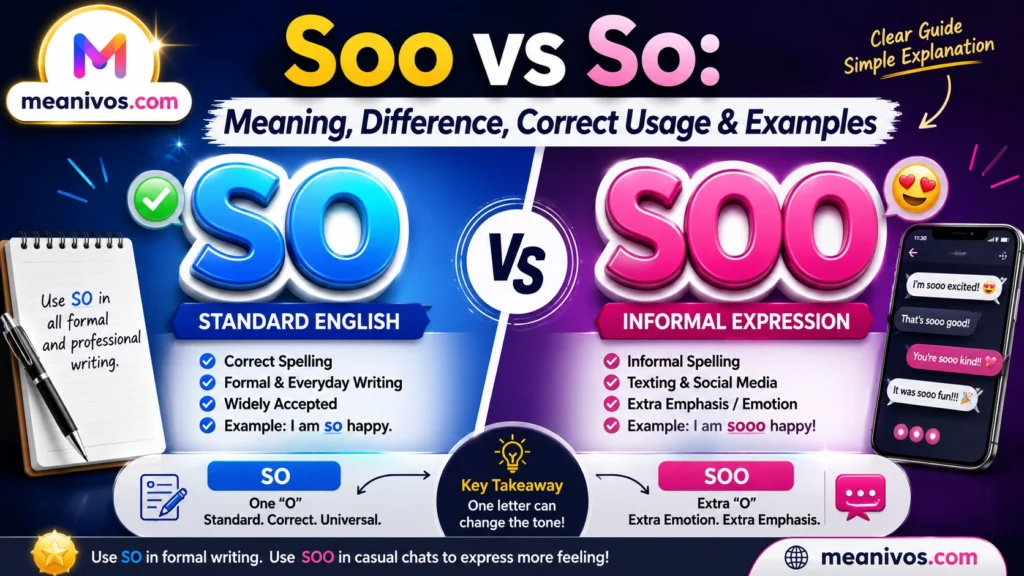
The key distinction is grammar versus expression.
Cambridge lists so as a standard English word used in several ways, including as a degree adverb, conjunction, substitute form, and discourse marker.
What Does “So” Mean?
So is a common English word with many grammatical functions.
It can mean very, to such a degree, therefore, in the same way, or in this manner, depending on the sentence.
Cambridge gives several standard uses of so, including its use as a degree adverb, conjunction, substitute form, and discourse marker.
1. “So” means “very” or “to a great degree”
This is one of its most familiar uses.
Examples:
- She is so happy.
- That film was so good.
- The water is so cold.
- He speaks so quickly.
- I am so tired.
Here, it strengthens an adjective or adverb.
For example:
She is so happy.
The word so increases the degree of happiness.
2. “So” can show a result
So can connect one event with its result.
Examples:
It was raining, so we stayed inside.
I was hungry, so I made a sandwich.
The shop was closed, so we went home.
In these examples, so is functioning as a conjunction meaning roughly therefore or as a result. Cambridge identifies this result/decision use as a standard function of so.
3. “So” can mean “in the same way”
Consider:
I love reading, and so does my sister.
Or:
“I am tired.”
“So am I.”
Here, so refers back to something already stated.
This is another established grammatical use of the word.
4. “So” can replace something already mentioned
For example:
“Do you think it will rain?”
“I think so.”
Here, so avoids repeating the entire idea.
Instead of saying:
I think it will rain.
the speaker says:
I think so.
5. “So” can introduce or manage a conversation
You may see:
So, what happened?
So, where were we?
Soo, let’s begin.
In spoken English, it frequently works as a discourse marker. Cambridge explains that it can appear at the beginning of clauses when speakers summarise what has been said or change the topic.
This is especially important because so is much more than a synonym for “very.”
What Does “Soo” Mean?
In texting and informal online communication, soo is usually an expressive spelling of so.
The writer adds another o to make the word look and feel longer.
For example:
I am soo excited!
The writer generally means:
I am so excited!
but I want the sentence to sound more emotional.
You may see the same technique with other words:
- no → nooo
- yes → yesss
- please → pleaseee
- why → whyyy
- so → sooo
This type of spelling is common in casual digital communication because written text does not automatically show voice, facial expression, or emotional tone.
Extra letters can therefore imitate the way someone might stretch a sound while speaking.
Is “Soo” a Real Word?
The answer depends on what you mean by soo.
In ordinary English sentences
When someone writes:
I am soo happy.
The word soo is generally an informal, nonstandard spelling of so.
It is not the standard spelling you would normally use in edited English.
In other contexts
Soo can exist as a separate dictionary entry with a different meaning.
Collins records Soo in American English as an alteration of Sault, referring to the region around Sault Ste. Marie and the St. Marys Falls Canals in northern Michigan and southern Ontario.
Therefore, it would be inaccurate to claim:
“Soo is never a word.”
A better explanation is:
When “soo” is being used as an expressive version of the ordinary word “so,” it is informal and nonstandard. But “Soo” can also have independent uses in specific geographical contexts.
That distinction makes the answer much more precise.
Soo vs So: What’s the Difference?
The simplest distinction is this:
| Feature | So | Soo |
| Standard spelling | Yes | No, when used as an expressive spelling |
| Formal writing | Appropriate | Generally inappropriate |
| Texting | Appropriate | Common as an expressive form |
| Social media | Common | Common for emphasis |
| Grammar | Standard grammatical word | Usually not a separate grammatical form |
| Emotion | Neutral to emphatic | Usually more expressive |
| Extra letters | No | Yes |
| Can indicate stretched pronunciation | Sometimes through context | Often |
| Used in academic writing | Yes | No |
| Used in professional emails | Yes | Usually no |
| Can be a separate term in another context | Yes | Yes, in specific contexts |
The important point is that soo does not normally replace so in standard grammar.
Instead, it changes the tone of an informal message.
Compare:
That is so cute.
with:
That is soo cute!
The first is standard.
The second feels more enthusiastic, playful, affectionate, or emotionally expressive.
So vs Soo vs Sooo
One of the biggest opportunities in this topic is explaining the difference between so, soo, and sooo.
There is no formal grammar rule saying that two extra letters create one exact amount of emotion.
The interpretation depends on context.
“So”
I am so happy.
This is completely standard.
“Soo”
I am soo happy!
This looks more expressive.
“Sooo”
I am sooo happy!!!
This usually suggests even stronger or more dramatic emphasis.
“Soooo”
I am soooo happy right now!
The writer is stretching the word even further.
The important rule is:
Repeated letters are a stylistic device, not a formal grammatical degree.
There is no official scale such as:
- soo = 20% more emotion
- sooo = 40% more emotion
- soooo = 60% more emotion
The meaning is flexible.
Why Do People Write “Soo” Instead of “So”?
There are several reasons.
1. To show emphasis
Compare:
I am so excited.
with:
I am soo excited!
The second feels more energetic.
2. To express excitement
For example:
This is soo amazing!
The extra letter helps communicate enthusiasm.
3. To show affection
Someone might write:
You are soo sweet!
The spelling can make the sentence feel warmer or more playful.
4. To imitate speech
Imagine someone saying:
“I am sooooo tired.”
They might hold the vowel sound longer.
Written language cannot literally reproduce that sound, so repeated letters can represent it visually.
5. To make a message sound playful
For example:
Soo… what are you doing tonight? 😂
Here, the extended spelling can make the opening feel casual or teasing.
6. To exaggerate
For example:
That exam was sooo difficult.
The extra letters visually reinforce the speaker’s emotional reaction.
What Is Expressive Spelling?
Expressive spelling is the informal practice of changing normal spelling to communicate emotion, tone, pronunciation, or emphasis.
Examples include:
- sooo
- nooo
- yesss
- pleeease
- why
- hiiii
- okayyy
These forms are particularly common in informal digital communication.
The spelling itself becomes part of the message’s emotional tone.
For example:
Okay.
can sound neutral.
Okaaayyy!
can sound playful, surprised, doubtful, or teasing depending on context.
Likewise:
I am so tired.
is straightforward.
I am sooo tired 😭
feels more dramatic.
This is why simply calling soo a “mistake” can miss what the writer is actually trying to communicate.
Is “Soo” a Typo?
Sometimes, but not always.
Suppose someone writes:
The movie was soo good.
They may have accidentally typed an extra o.
But consider:
That puppy is sooo cute 😭❤️
The repeated letters are much more likely to be intentional.
Context is therefore important.
Likely typo
I am soo tired.
No other informal markers appear, and the extra letter may simply be accidental.
Likely expressive spelling
I am SOOOO tired 😭😭😭
The capital letters, repeated vowels, and emojis strongly suggest intentional emphasis.
So soo can be either a typo or deliberate expressive spelling.
Is “Soo” Grammatically Correct?
If you are using soo as an informal spelling of so, it is not standard English grammar or spelling.
That does not mean people cannot use it.
It means that the form belongs mainly to casual communication.
For example:
Standard
She is so beautiful.
Informal
She is soo beautiful!
Both are understandable, but they serve different writing contexts.
The first follows standard spelling.
The second uses expressive digital spelling.
Can You Use “Soo” in Formal Writing?
Generally, no.
Use so in:
- academic essays
- school assignments
- university papers
- business reports
- professional emails
- applications
- CVs and résumés
- formal letters
- official documents
- research papers
For example:
❌ The results were soo surprising.
Better:
✅ The results were so surprising.
Or, depending on the intended meaning:
✅ The results were extremely surprising.
Informal spelling is not automatically bad writing. It is simply inappropriate when the context requires standard written English.
Soo vs So in Texting
Texting is where the difference becomes most noticeable.
Example 1: Excitement
Friend A: Are you ready for the concert?
Friend B: I am soo ready!
The extra o makes the response feel more excited.
Example 2: Affection
Friend A: Look at this puppy!
Friend B: Aww, it is soo cute!
Example 3: Exhaustion
Friend A: How was work?
Friend B: I am sooo tired 😭
Example 4: Casual transition
Friend A: Soo… what happened after that?
Friend B: You won’t believe it 😂
Here, Soo does not simply mean “very.”
It functions as a casual conversational opening.
Soo vs So on Social Media
You can encounter expressive spellings such as soo and sooo across many social platforms.
TikTok
Creators and commenters may use repeated letters to exaggerate reactions.
That outfit is sooo good!
Captions and comments may use expressive spelling to make messages feel more emotional.
You look soo beautiful!
Snapchat
Informal conversations frequently use stretched spellings.
I am sooo bored 😂
Users may use soo for emphasis in comments and casual posts.
That was soo funny!
The meaning depends heavily on the subreddit and conversational context.
That ending was sooo unexpected.
Discord
Gaming and community chats often use exaggerated spellings to convey immediate reactions.
That was sooo close!
X
Informal posts may use repeated letters for humour, excitement, frustration, or sarcasm.
The key principle is that none of these platforms changes the formal spelling of the English word “so.”
The platforms simply provide environments where informal expressive spelling is common.
- Explore More: https://meanivos.com/impatient-vs-inpatient/
Does “Soo” Change the Pronunciation of “So”?
Usually, not in a fixed or formal way.
When someone writes:
soo
they often intend the reader to imagine a slightly stretched version of:
sooooo
But the exact pronunciation depends on the writer and context.
The extra letters are better understood as a visual representation of length or emphasis than as a new pronunciation rule.
Cambridge gives the standard pronunciation of so as /səʊ/ in British English and /soʊ/ in American English.
For example:
I am so happy.
might be spoken normally.
But:
I am sooo happy!
could be spoken with a deliberately prolonged vowel.
Does “Soo” Mean “Very”?
In informal messages, soo often functions like an emphatic version of so.
For example:
She is soo nice.
roughly communicates:
She is so nice.
with extra emotional emphasis.
But soo does not have a fixed dictionary definition meaning “very.”
The standard English word can mean “very,” “extremely,” or “to such a degree.” Cambridge explicitly documents this use.
So it is better to think of:
soo = expressive “so”
rather than:
soo = a separate word meaning “very.”
Examples of “So” in Standard English
Here are some common examples.
- She is so kind.
- The food was so delicious.
- I was so tired.
- It was raining, so we stayed home.
- I think so.
- So, what happened?
- I love music, and so do they.
- He was so nervous that he could barely speak.
- Please don’t be so loud.
- I didn’t expect it to be so difficult.
Each sentence uses so in a recognised standard-English construction.
Examples of “Soo” in Informal Communication
These examples show how people may use soo online.
- I am soo happy!
- That is soo cute!
- You are soo funny.
- I missed you soo much!
- This cake is soo good!
- I am soo excited!
- Why are you so quiet?
- That was soo unexpected!
- She is soo talented.
- I am soo ready for tomorrow!
These are examples of informal expressive spelling, not formal grammar.
Examples of “Sooo” for Stronger Emphasis
- I am sooo tired.
- That was sooo funny!
- I am sooo excited!
- You look sooo good!
- This is sooo unfair!
- I was sooo nervous.
- That movie was sooo long.
- I missed you sooo much.
- The food was sooo delicious.
- This is sooo cute!
Again, there is no official grammar rule controlling how many of letters a person can use.
“So” vs “Soo”: Formal and Informal Examples
| Situation | Recommended form | Example |
| Academic essay | so | The results were so significant. |
| Professional Email | so | I am so pleased to hear that. |
| Business report | so | Demand was so high that supplies ran out. |
| Text message | so or soo | I am soo excited! |
| Social media comment | so or soo | That is sooo cute! |
| Formal letter | so | Thank you so much for your response. |
| Casual chat | soo can be expressive | I am soo tired 😂 |
| Official document | so | The process was so effective. |
The rule is simple:
The more formal the context, the stronger the reason to use standard “so.”
Common Misunderstandings About Soo vs So
Misunderstanding 1: “Soo is always wrong.”
Not necessarily.
As an expressive spelling, soo is informal and nonstandard, but people intentionally use it in digital communication.
Also, Soo can appear as a separate geographical term. Collins records that use in relation to Sault Ste. Marie.
Misunderstanding 2: “Soo is exactly the same as so.”
Not quite.
The basic semantic content may be the same when soo is simply an expressive spelling, but the tone can be different.
I am so happy.
is neutral.
I am soo happy!
is more expressive.
Misunderstanding 3: “Sooo is a grammatical form.”
No.
The extra letters are a stylistic choice.
Misunderstanding 4: “You should use soo when you mean very.”
No.
In standard English, use so.
Misunderstanding 5: “Every extra letter has a fixed meaning.”
No.
One person might write:
sooooo
while another writes:
sooo
The number of letters does not represent a standard measurable degree of emotion.
How to Remember Soo vs So
Use this simple rule:
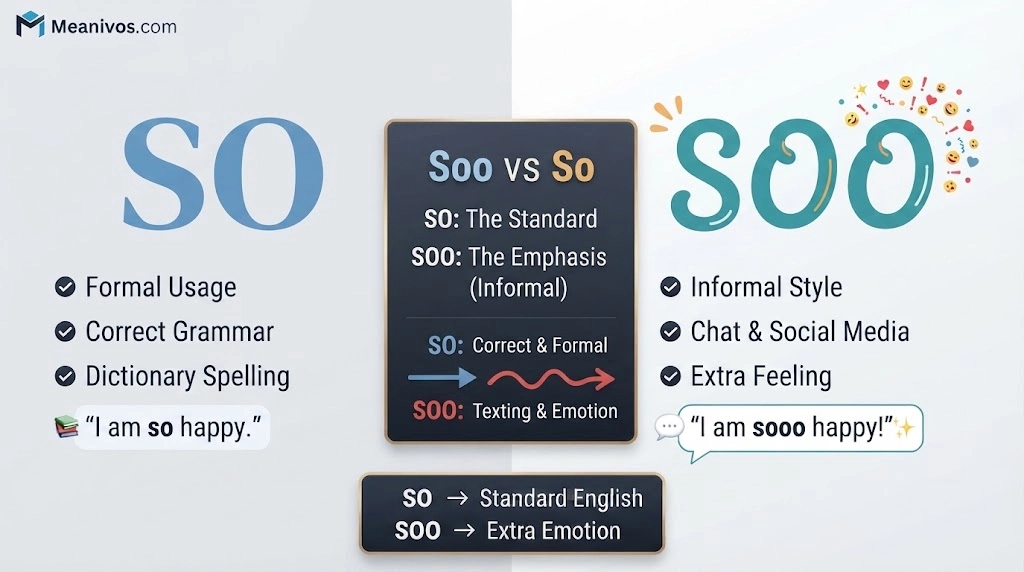
One “o” = ordinary English.
Extra “o” = extra emotion.
So:
so → standard
soo → informal emphasis
sooo → stronger informal emphasis
This is not a formal grammar rule, but it is an Soo vs So easy way to remember the difference.
Which Is Correct: Soo or So?
If you are writing standard English, so is correct.
For example:
She is so beautiful.
I was so tired.
It was so expensive.
I think so.
If you are writing a casual text or social media message, so can be used intentionally for emphasis:
She is soo beautiful!
I am sooo tired 😭
So the best choice depends on the context and purpose.
When Should You Use “So”?
Use so when:
- You are writing formally.
- You are completing schoolwork.
- You are writing an essay.
- You are writing a professional email.
- You are writing a report.
- You want standard spelling.
- You are using one of the normal grammatical functions of so.
Examples:
The problem was so complicated.
I was tired, so I went home.
So, what should we do next?
When Can You Use “Soo”?
Use soo only when informal expression is appropriate and you deliberately want to add emphasis or emotional tone.
Examples:
I am soo excited!
That puppy is soo cute!
You are soo funny 😂
I missed you sooo much!
It works best when the reader understands that the spelling is intentional.
A Note About “Soo” as a Separate Term
The word Soo should not be confused with the informal spelling discussed throughout this article.
Collins records Soo as an American English alteration of Sault, particularly in the geographical name associated with the Sault Ste. Marie area and the St. Marys Falls Canals.
That is a completely different use from:
I am soo happy!
This distinction matters because dictionary status Soo vs So depends on meaning and context, not just spelling.
Soo vs So: Quick Decision Guide
Ask yourself one question:
Am I writing standard English?
If yes, use:
so
Am I texting or posting casually and intentionally stretching the word for emotion?
You can use:
soo or sooo
Am I referring to the geographical term “Soo”?
Use:
Soo
with the appropriate context and capitalisation.
30 Quick Examples: So or Soo?
| No. | Standard form | Informal expressive form |
| 1 | I am so happy. | I am soo happy! |
| 2 | That is so cute. | That is sooo cute! |
| 3 | She is so kind. | She is soo kind! |
| 4 | I am so tired. | I am sooo tired. |
| 5 | This is so good. | This is soo good! |
| 6 | He is so funny. | He is sooo funny! |
| 7 | It was so unexpected. | It was sooo unexpected! |
| 8 | I missed you so much. | I missed you sooo much! |
| 9 | You look so nice. | You look soo nice! |
| 10 | That was so difficult. | That was sooo difficult. |
| 11 | She was so excited. | She was soo excited! |
| 12 | The food was so good. | The food was sooo good! |
| 13 | Why are you so quiet? | Why are you so quiet? |
| 14 | That movie was so funny. | That movie was sooo funny! |
| 15 | I am so ready. | I am soo ready! |
| 16 | It is so beautiful. | It is sooo beautiful! |
| 17 | He was so nervous. | He was so nervous. |
| 18 | That sounds so interesting. | That sounds sooo interesting! |
| 19 | I am so hungry. | I am sooo hungry! |
| 20 | This feels so strange. | This feels so strange. |
| 21 | You are so sweet. | You are soo sweet! |
| 22 | The exam was so hard. | The exam was sooo hard. |
| 23 | I am so proud of you. | I am soo proud of you! |
| 24 | That is so unfair. | That is sooo unfair! |
| 25 | It was so close. | It was sooo close! |
| 26 | She sings so beautifully. | She sings sooo beautifully! |
| 27 | I was so surprised. | I was soo surprised! |
| 28 | This place is so nice. | This place is soo nice! |
| 29 | I am so confused. | I am sooo confused! |
| 30 | That was so amazing. | That was sooo amazing! |
The left column follows standard spelling. The right column illustrates informal expressive writing.
People Also Ask
A:Soo is not the standard spelling of the ordinary English word. In texting and social media, however, people commonly use soo as an expressive spelling to add emphasis. For formal writing, use so.
A:It depends on the context. As an informal spelling of so, it is nonstandard. However, Soo is also recorded as a geographical term associated with Sault Ste. Marie, so saying it is “never a word” would be too absolute.
A:In texting, soo usually means so, but with extra emphasis or emotional expression. For example, “I am so happy!” feels more enthusiastic than “I am so happy!”
A:Sooo is an even more exaggerated informal spelling of so. The repeated letters usually indicate a stretched pronunciation or stronger emotion.
A:It can be. Sometimes an extra o is accidental, but in messages such as “That is sooo cute!” The repeated letters are usually intentional.
Related Terms
If you are interested in soo vs so, you may also encounter other expressive spellings online.
Sooo
A longer version of soo, usually signalling stronger emphasis.
Nooo
An expressive version of no, often showing disappointment, shock, or disagreement.
Yesss
An expressive version of yes, often showing excitement.
Pleaseee
An elongated version of please, often used to sound pleading, playful, or dramatic.
Whyyy
An expressive version of why, often indicating frustration, disbelief, or dramatic reaction.
These spellings share the same general principle: repeated letters can communicate a tone that ordinary spelling does not fully capture.
Final Verdict
So, which one should you use?
Use “so” when you want standard English.
Use “soo” or “sooo” when you are deliberately using informal expressive spelling in a casual message, comment, or social-media post.
The extra o usually does not create a new grammatical word. Instead, it visually stretches the sound and can communicate excitement, affection, emphasis, frustration, humour, or exaggeration.
Remember:
So = standard.
Soo = informal emphasis.
Sooo = stronger informal emphasis.
And there is one important exception to the simple rule: Soo can also occur as a separate geographical term related to Sault Ste. Marie.
The safest choice for school, work, academic writing, and professional communication is therefore So.