Imbed vs Embed: Meaning, Difference, Correct Usage & Examples
Imbed and embed are two spellings of the same English verb, so it is understandable to wonder whether there is an actual difference between them.
The short answer is:
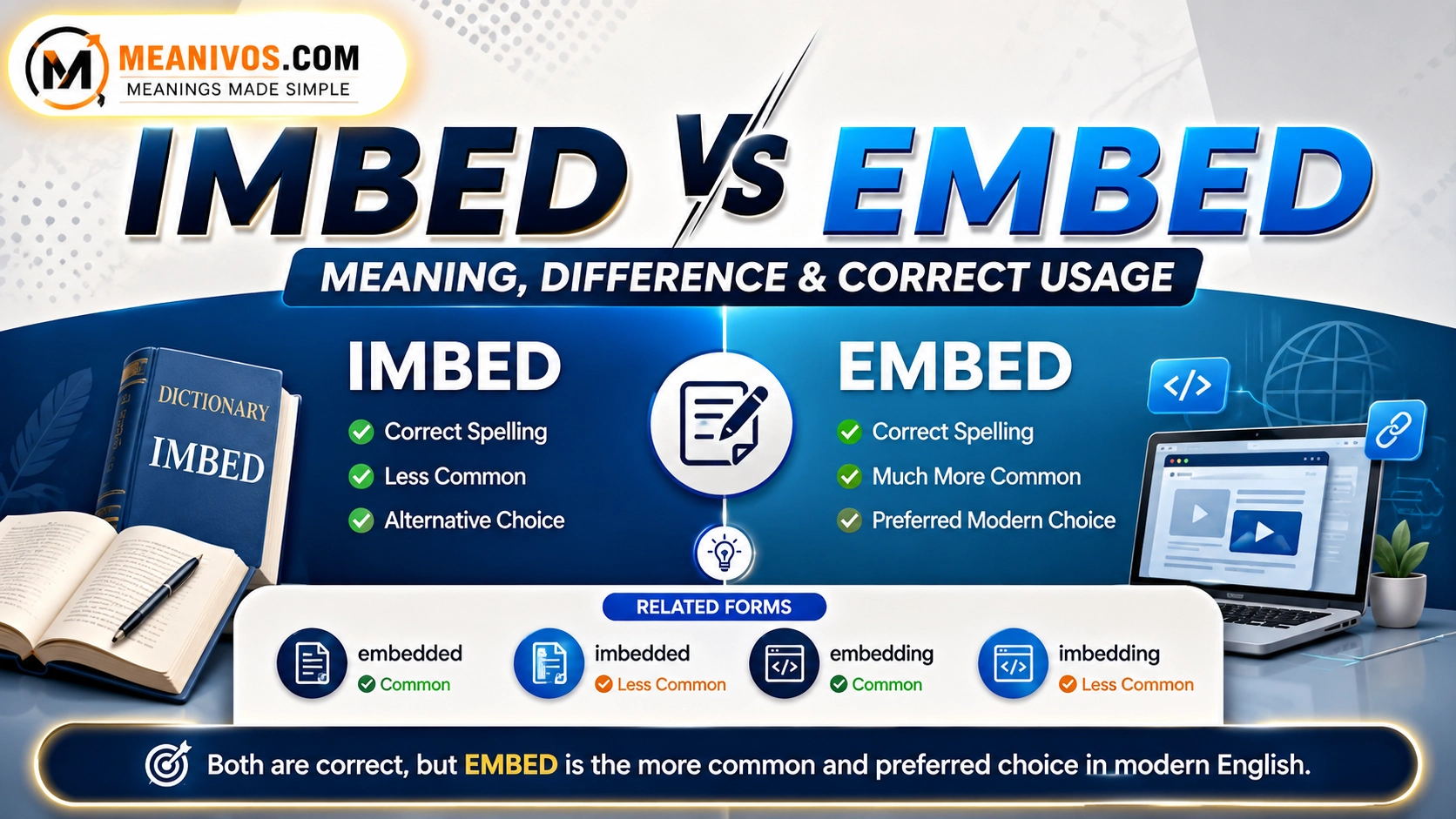
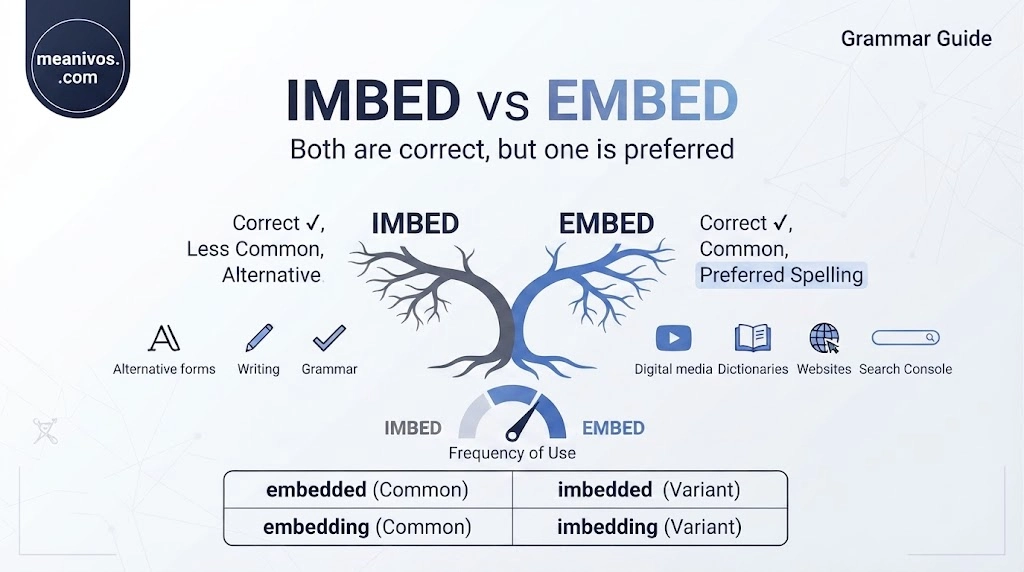
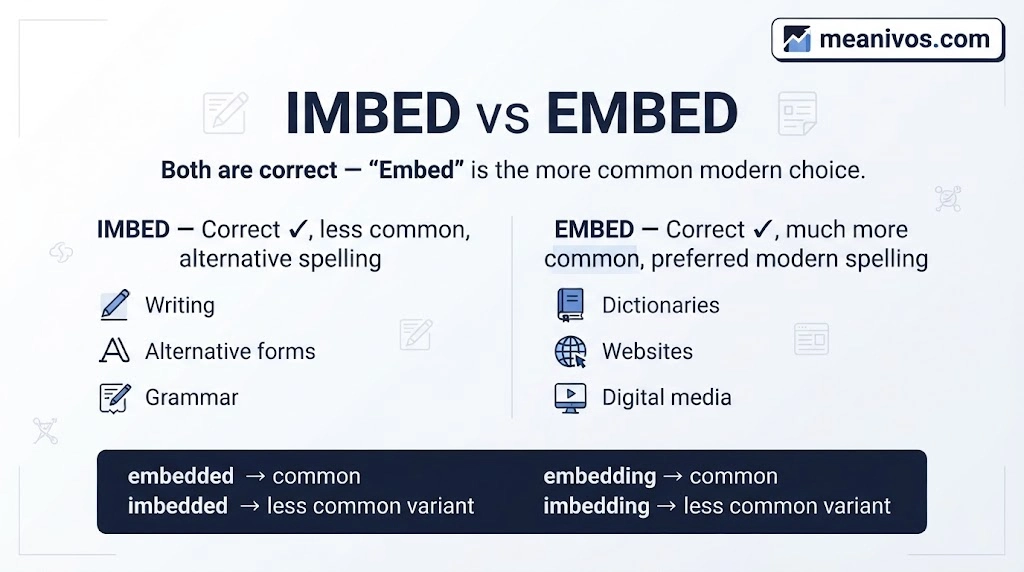
Both “imbed” and “embed” are correct, but “embed” is much more common and is the preferred spelling in most modern English writing.
Both words can describe putting something firmly inside another thing, making something an integral part of a larger system, or incorporating digital content into a document or website.
The important distinction is therefore not meaning but usage frequency and modern preference.
Merriam-Webster describes imbed as the “less common spelling” of embed, while Cambridge sends readers from imbed to embed. Dictionary.com likewise explains that imbed is an alternative spelling with the same meanings as embed.
So, if you are writing an essay, business email, academic paper, website, article, or technical document, embed is normally the safest choice.
But imbed is not simply a spelling mistake.
This guide explains exactly how the two forms work, which one you should choose, how their related forms are spelled, and how embed is used in physical, abstract, digital, and journalistic contexts.
Imbed vs Embed: Quick Answer
Imbed and embed have essentially the same meaning.
Both can mean:
- to place something firmly inside another substance;
- to make something an integral part of something larger;
- to incorporate digital content into a document, email, or website;
- to establish an idea, value, habit, or characteristic deeply within a system or culture;
- in some contexts, to attach a person to a group or organisation.
The main difference is how commonly each spelling is used.
| Form | Correct? | Meaning | Modern usage |
| embed | Yes | To place or incorporate something within something else | Very common |
| imbed | Yes | Same basic meaning as embed | Less common |
| embedded | Yes | Past tense/past participle of embed | Very common |
| imbedded | Yes | Variant of embedded | Less common |
| embedding | Yes | -ing form of embed | Very common |
| imbedding | Yes | Variant of embedding | Less common |
Merriam-Webster currently lists embed as the main form and identifies imbed as a variant or less common form. It also lists embedded/imbedded and embedding/embedded as variants.
The easiest rule
If you are unsure which one to use:
Choose “embed.”
It is the familiar modern spelling and is particularly dominant in technology, digital publishing, professional Imbed vs Embed writing, and web content.
What Does “Embed” Mean?
Embed is a verb meaning to place something firmly within something else or to make something an integral part of a larger thing.
For example:
The jeweller embedded the stone in the ring.
Here, the stone is physically fixed within the ring.
But embed is not limited to physical objects.
It can also describe ideas, habits, values, procedures, or characteristics that become deeply established.
The company embedded safety procedures into its daily operations.
The safety procedures are not physically inserted into the company. Instead, they have become an established part of the organisation.
Embed can also describe digital content
The developer embedded a video in the webpage.
Here, the video has been incorporated into the webpage.
Merriam-Webster includes physical, conceptual, scientific, digital, and journalistic uses of embed. Its definition specifically includes Imbed vs Embed inserting media such as graphics, videos, or audio into a computer document.
What Does “Imbed” Mean?
Imbed is an alternative spelling of embed.
It has essentially the same meanings and can be used in the same grammatical situations.
For example:
The stone was imbedded in the wall.
This communicates the same basic idea as:
The stone was embedded in the wall.
Similarly:
The website allows users to imbed videos.
means essentially the same as:
The website allows users to embed videos.
Cambridge lists imbed as a verb that directs users to embed, while Merriam-Webster identifies it as the less common spelling.
Therefore, it is more accurate to call imbed a less common variant spelling than to call it simply “wrong.”
Is “Imbed” a Correct Word?
Yes, “imbed” is a correct word.
This is the most important point for anyone searching imbed vs embed.
Because embed is so much more common, writers sometimes assume that imbed must be a misspelling.
That conclusion is too strong.
Major dictionary sources recognise the form.
Merriam-Webster lists imbed as a less common spelling of embed, while Cambridge lists imbed and directs readers to the main embed entry.
Therefore, both of these are possible:
The object was imbedded in the material.
The object was embedded in the material.
The second version is normally preferable for contemporary readers because embedded is much more familiar.
Correct does not always mean preferred
This is an important language principle.
A spelling can be:
- grammatically valid;
- recognised by dictionaries;
- understandable;
- but still less common than another accepted form.
That is exactly the relationship between imbed and embed.
Imbed vs Embed: What Is the Difference?
There is no important difference in their core meaning.
The main distinction is spelling and frequency.
Compare:
The photograph was embedded in the article.
and:
The photograph was imbedded in the article.
Both communicate the idea that the photograph was incorporated into the article.
The first sentence is preferable in most modern writing because readers are much more accustomed to embedded.
In simple terms
Embed = common, modern, preferred
Imbed = correct variant, less common
Dictionary.com similarly explains that imbed is an alternative spelling of embed and does not have a separate meaning.
Which Is More Common: Imbed or Embed?
Embed is much more common.
This is the practical reason most writers should choose it.
Modern English contains many familiar expressions built around embed, including:
- embedded video
- embedded image
- embedded content
- embedded software
- embedded system
- embedded link
- embedded media
- embedded journalist
- deeply embedded
- embed code
- embedding technology
The spelling embed is especially dominant in technology and digital publishing.
Dictionary.com notes that imbed is much less commonly used, while Merriam-Webster explicitly labels it a less common spelling.
Why does frequency matter?
Imagine you write:
Please imbed the YouTube video in the article.
Most readers will understand the sentence.
But:
Please embed the YouTube video in the article.
looks completely natural to modern readers.
When two accepted forms have Imbed vs Embed the same meaning, the more familiar one usually creates less friction.
That is why embed is the better default.
Is “Imbed” Old or Outdated?
It is better not to describe imbed simply as obsolete.
That would be misleading because major dictionaries still recognise it.
A more accurate description is:
- less common;
- alternative spelling;
- variant spelling;
- less preferred in contemporary general writing.
Cambridge and Merriam-Webster both continue to recognise imbed.
So avoid writing:
“Imbed is an incorrect or obsolete word.”
A more accurate statement is:
“Imbed is a recognised but less common variant of embed.”
That distinction improves both linguistic accuracy and reader trust.
Embedded vs Imbedded: Which Is Correct?
Both embedded and imbedded are recognised forms.
However:
embedded
is overwhelmingly the better default for modern writing.
Merriam-Webster lists embedded as the common form and imbedded as a variant.
Compare:
The image is embedded in the document.
The image is imbedded in the document.
Both can express the same meaning, but the first will look more natural to most contemporary readers.
Preferred form
embedded
Less common variant
imbedded
If you are writing for a general audience, use embedded unless you have a specific reason to preserve the alternative spelling.
Embedding vs Imbedding
The same pattern applies to the -ing forms.
Common form
embedding
Less common variant
imbedding
Examples:
We are embedding the video on the homepage.
The process involves embedding security features into the software.
The less common variants are:
We are imbedding the video on the homepage.
The process involves imbedding security features into the software.
The meaning remains the same.
For contemporary professional writing, however, embedding is the better choice.
Merriam-Webster explicitly lists embedding and imbedding as variants.
How Do You Pronounce Embed and Imbed?
The two forms are pronounced essentially the same way.
Embed
em-BED
Imbed
im-BED
The main stress falls on the second syllable.
Cambridge gives imbed as /ɪmˈbed/, and Merriam-Webster gives embed as /ɪmˈbed/.
Because the pronunciation is so similar, hearing the word does not reliably tell you which spelling the writer intends.
That is one reason this spelling question Imbed vs Embed occurs so often.
Is “Embed” British or American English?
Embed is used in both British and American English.
It is not an American-only spelling.
Likewise, imbed is not simply a British alternative.
Cambridge’s entries show imbed in both US and UK contexts, while its Business English entry points users to embed.
So do not use this rule:
American English = imbed
British English = embed
That is inaccurate.
A better rule is:
Both forms exist in English, but embed is much more common and is the safest modern choice in both major varieties.
What Does “Embed” Mean in Technology?
The technology meaning of embed is particularly important because modern digital language uses this word constantly.
To embed digital content means to incorporate that content into another digital environment.
For example, you can:
- embed a YouTube video in a webpage;
- embed an image in a document;
- embed a map on a website;
- embed a social media post;
- embed audio in an article;
- embed a document viewer;
- embed code into a webpage.
- Explore More: https://meanivos.com/soo-vs-so/
Example
The developer embedded the video into the landing page.
The video is incorporated into the webpage rather than merely mentioned as a separate resource.
Another example:
The article contains an embedded image.
The image forms part of the article’s presentation.
Merriam-Webster specifically includes the Imbed vs Embed insertion of media files such as graphics, video, and audio into computer documents among the meanings of embed.
Why “embed” dominates technology
Technology has developed a large vocabulary around embed:
- embedded system
- embedded software
- embedded device
- embedded code
- embedded media
- embedded content
- embedded database
- embedded controller
This makes embedding especially important in technical writing.
Embed in Physical Contexts
The original literal idea behind embed involves placing something within surrounding material.
Examples include:
The nail was embedded in the wood.
The stone was embedded in the concrete.
The fossil was embedded in rock.
The jewel was embedded in the necklace.
The roots were deeply embedded in the soil.
In each case, something is positioned firmly within something else.
You could technically use the less common spelling:
The fossil was imbedded in rock.
But embedded is much more familiar.
Embed in an Abstract Sense
Something does not have to be physically inside another object to be embedded.
English also uses the word for:
- beliefs;
- values;
- habits;
- traditions;
- principles;
- procedures;
- characteristics;
- ideas.
For example:
Trust is embedded in the company’s culture.
This means trust has become a deeply established part of the culture.
More examples:
The tradition is deeply embedded in local society.
These values are embedded in the organisation’s policies.
The idea became embedded in public consciousness.
The habit was deeply embedded in her routine.
Here, embed means something like establishing deeply within a larger system or context.
Embed in Journalism
Embed also has a specialised journalistic meaning.
An embedded journalist is a journalist attached to a particular group, traditionally a military unit, to report from within that environment.
For example:
The journalist was embedded with the military unit.
The meaning is related to the general idea of being placed within a larger group or environment.
Merriam-Webster includes the journalistic sense of attaching a journalist to a military unit or another group.
This is another reason the word embed has a broader meaning than simply “put inside.”
Embed in a Sentence: Examples
Physical placement
- The stone was embedded in the wall.
- The nail became embedded in the wooden floor.
- The fossil was embedded in ancient rock.
- The jewel was embedded in the ring.
- Small pieces of glass were embedded in the surface.
Ideas and concepts
- The tradition is deeply embedded in the culture.
- These principles are embedded in the company’s policies.
- The belief became embedded in the community.
- Safety is embedded in the organisation’s procedures.
- The habit was deeply embedded in her daily routine.
Technology
- The developer embedded a video in the webpage.
- The article contains an embedded image.
- You can embed the map on your website.
- The application supports embedded media.
- The designer embedded the form directly into the landing page.
Journalism
- The reporter was embedded with the military unit.
- An embedded journalist travelled with the group.
Imbed in a Sentence: Examples
Because imbed is a recognised variant, it can be used in equivalent contexts.
- The stone was imbedded in the wall.
- The fossil was imbedded in the rock.
- The jewel was imbedded in the ring.
- The tradition was deeply imbedded in the culture.
- The software contains imbedded security features.
- The developer imbedded the image in the document.
- The video was imbedded in the webpage.
- The idea became deeply imbedded in society.
These sentences are grammatically possible, but many modern readers Imbed vs Embed will find embedded more familiar.
Therefore, for new writing, embed is usually the better choice.
Embed vs Insert: Are They the Same?
Not exactly.
Embed and insert overlap in meaning, but they can describe slightly different relationships.
Insert
To insert something generally means to put it into a particular place.
Insert the card into the machine.
Embed
To embed something usually suggests that it becomes integrated into or firmly positioned within something else.
The artist embedded the stones in the sculpture.
The distinction becomes especially useful in digital contexts.
You might:
insert an image into a document
while you might:
embed an image in a webpage.
The exact distinction depends on the technology and context, but embed often carries the stronger idea of integration into the surrounding environment.
Embed vs Link: What’s the Difference?
These terms are frequently confused in digital publishing.
A link generally directs the user to another resource.
An embedded item can appear directly within the current content.
For example:
Read the video here: [link]
versus:
The video is embedded directly in the article.
This difference matters when writing about websites, content management systems, social media, and digital publishing.
A link can take the reader elsewhere, while embedded content can become part of the current page experience.
Embed vs Attach: Are They Interchangeable?
No.
An attachment is usually treated as a separate file associated with an email or message.
Embedded content is incorporated into the surrounding document, page, or interface.
Compare:
I attached the PDF to the email.
with:
I embedded the PDF viewer into the webpage.
The first describes a separate file.
The second describes integrated digital content.
Embed “In” vs “Into”
Another common grammar question is whether to use in or into after embed.
Both constructions occur.
Embed in
Use in when describing the resulting position or state.
The stone is embedded in the wall.
The image is embedded in the document.
The values are embedded in the culture.
The focus is on where something exists.
Embed into
Use into when emphasising the action or movement of placing something within another thing.
The designer embedded the image into the page.
The stones were embedded into the concrete.
Actual usage varies by context, and the distinction is not absolute.
For many descriptions of an existing state, embedded in is particularly natural.
Is “Embed Into” Grammatically Correct?
Yes.
For example:
The developer embedded the video into the webpage.
This is understandable and widely used.
You can also say:
The developer embedded the video in the webpage.
The choice can depend on what you want to emphasise.
Compare
The video is embedded in the webpage.
Focus: location or resulting state.
The developer embedded the video into the webpage.
Focus: action or placement.
The surrounding sentence often determines which preposition sounds most natural.
Common Mistakes With Imbed and Embed
Mistake 1: Assuming “imbed” is always wrong
This is too absolute.
Imbed is a recognised variant.
The better explanation is:
Imbed is correct but less common.
Mistake 2: Assuming the two forms have different meanings
They do not have different core meanings.
They are spelling variants of the same verb.
Mistake 3: Assuming “imbed” is British English
It is not simply a British spelling.
Both forms occur in English, although embed is the much more common modern form.
Mistake 4: Writing “embedded”
The correct spelling is:
embedded
not:
embedded
Mistake 5: Writing “embedding”
The correct form is:
embedding
not:
embedding
Mistake 6: Assuming “imbedded” is impossible
Imbedded is a recognised variant, although it is much less common than embedded. Merriam-Webster lists both forms.
Mistake 7: Using “imbed” in technical writing without considering your audience
Although imbed is valid, readers in software, web development, engineering, publishing, and digital media are much more accustomed to embed.
Therefore:
Embed the video in the webpage.
is normally better than:
I Imbedded the video in the webpage.
Why “Embed” Is Usually the Better Choice
If both spellings are correct, why favour embed?
1. It is more familiar
Readers encounter embedment much more frequently.
2. It dominates digital language
Common expressions include:
- embedded video;
- embedded software;
- embedded system;
- embedded content;
- embedded image;
- embedding code.
3. It looks more natural in professional writing
A familiar spelling reduces the chance that readers will pause and question it.
4. It reduces unnecessary confusion
A less common spelling can create hesitation even when it is technically correct.
5. It is the main dictionary form
Major dictionaries commonly centre their definitions around embed, with imbed treated as a variant.
When Can You Use “Imbed”?
You can use imbed when you intentionally choose the recognised variant.
It may appear in:
- quotations;
- older publications;
- historical texts;
- sources that consistently use imbed;
- specialised writing;
- personal writing;
- discussions about the spelling itself.
If you are reproducing a quotation, preserve the original spelling unless you clearly indicate that you have changed it.
Consistency also matters.
If an entire document consistently uses imbed, imbedded, and imbedding, randomly switching between variants may create unnecessary inconsistency.
Should Students Use “Imbed” in Essays?
They can, but embed is the better default.
Academic writing generally benefits from familiar, widely recognised terminology.
Instead of:
The theory is deeply embedded in modern psychology.
prefer:
The theory is deeply embedded in modern psychology.
The second version is more familiar to contemporary readers.
Should You Use “Imbed” in Business Writing?
Again, embed is normally preferable.
For example:
We can embed the payment form directly into the website.
is generally more natural than:
We can embed the payment form directly into the website.
Business writing usually prioritises clarity, familiarity, and efficient communication.
Should You Use “Imbed” in Technical Writing?
Technically, yes.
Practically, embedding is strongly preferred.
Technical English contains many established terms based on embed, such as:
- embedded system;
- embedded device;
- embedded software;
- embedded content;
- embedded code;
- embedded database;
- embedded media;
- embedded controller.
Replacing these with imbed may make otherwise standard terminology look unusual.
Therefore, if you work in software, web development, engineering, or digital publishing:
Use “embed.”
Is “Embed” a Verb?
Yes.
Embed is primarily a verb.
Examples:
We need to embed the video.
The artist embedded the stones in the wall.
The company embedded security into the system.
It can also appear in participial and adjective-like forms:
embedded content
embedded software
an embedded image
Is “Embedded” an Adjective?
Yes.
Embedded can function as an adjective when it describes something incorporated or fixed within something else.
Examples:
- embedded software
- embedded content
- embedded image
- embedded journalist
- embedded values
- embedded feature
For example:
The webpage contains an embedded video.
Here, embedded, describes the video.
Is “Embed” Transitive or Intransitive?
Embed is commonly transitive.
A transitive verb acts on an object.
For example:
The developer embedded the video.
The object is the video.
Another example:
The artist embedded the stones in the wall.
However, embed can also occur in intransitive constructions describing something becoming embedded.
For example:
The object embedded itself in the soft material.
Merriam-Webster recognises both transitive and intransitive uses.
What Is the Past Tense of “Embed”?
The past tense is:
embedded
Example:
The developer embedded the video yesterday.
Notice the double d.
Correct
embed → embedded
Incorrect
embed → embeded
The same spelling applies when embedded is used as a past participle:
The image is embedded in the article.
What Is the Present Participle of “Embed”?
The -ing form is:
embedding
Example:
She is embedding the video into the webpage.
Correct
embed → embedding
Incorrect
embed → embedding
The less common variant follows the same pattern:
imbed → imbedding
Imbed vs Embed: Grammar Table
| Grammatical form | Common form | Less common variant |
| Base verb | embed | imbed |
| Third-person singular | embeds | imbeds |
| Past tense | embedded | imbedded |
| Past participle | embedded | imbedded |
| Present participle | embedding | imbedding |
Merriam-Webster confirms these variant forms.
Imbed vs Embed in Digital Media
Digital media is one of the clearest situations in which embed should be preferred.
Embed a YouTube video
The article embeds a YouTube video.
Embed an image
The designer embedded the image into the page.
Embed a map
The company embedded an interactive map on its contact page.
Embed audio
The website allows users to embed audio files.
Embed social media content
The publisher embedded the social media post in the article.
In all these contexts, embed is the natural modern choice.
Quick Comparison: Imbed vs Embed
| Feature | Imbed | Embed |
| Correct spelling | Yes | Yes |
| Basic meaning | Same | Same |
| Pronunciation | /ɪmˈbed/ | /ɪmˈbed/ |
| Frequency | Less common | Much more common |
| Technical writing | Possible | Preferred |
| Academic writing | Possible | Preferred |
| Digital media | Possible | Strongly preferred |
| British English | Used | Common/preferred |
| American English | Used | Common/preferred |
| Past form | imbedded | embedded |
| -ing form | imbedding | embedding |
| Best default | No | Yes |
Imbed or Embed: Which One Should You Use?
Use embed when:
- writing for a general audience;
- writing an essay;
- creating a website;
- writing technical documentation;
- writing business content;
- describing digital media;
- writing an academic paper;
- publishing an article;
- writing SEO content;
- you simply want the most familiar spelling.
Use imbed when:
- you intentionally prefer the variant;
- reproducing a source that uses it;
- following a style that accepts it;
- discussing the spelling itself;
- preserving the wording of an original quotation.
For almost everyone, embed is the safest default.
Imbed or Embed: Which Is Correct?
Both are correct.
But if the question is:
Which spelling should I normally use?
the answer is:
Use “embed.”
Cambridge treats imbed as a variant pointing readers to embed, while Merriam-Webster calls imbed the less common spelling.
Therefore, the most accurate answer is not:
“Imbed is wrong.”
It is:
“Imbed is a correct but less common variant of embed; embed is the preferred modern spelling.”
That distinction gives writers both accuracy and practical guidance.
People Also Ask
A:Yes. Imbed is a real and recognised English word. It is an alternative spelling of embed, although it is much less common. Cambridge lists imbed and directs users to embed, while Merriam-Webster calls it the less common spelling.
A:Both are correct. However, embed is much more common and is generally the better choice for modern writing.
A:Yes. The two forms have essentially the same meanings and grammatical functions.
A:Not necessarily. Imbed is a recognised variant spelling, although most readers are more familiar with embed.
A:Embed is much more common and is the standard choice in most contemporary writing.
Final Verdict
Imbed Vs Embed is not really a comparison between two words with different meanings.
They are two accepted spellings of essentially the same verb.
Imbed is correct.
Embed is correct.
But they are not equally common.
Embed is the modern, familiar, and preferred choice for most writers.
It is especially appropriate for:
- academic writing;
- business communication;
- technical documentation;
- websites;
- digital media;
- professional writing;
- SEO content.
Imbed remains a legitimate variant, but its lower frequency means it can look unusual to contemporary readers.
The easiest rule is:
Use “embed” by default. Use “imbed” when you have a specific reason to use the less common variant.
Remember the related forms:
- embed → embedded
- embed → embedding
- imbed → imbedded
- imbed → imbedding
The key takeaway is simple: there is no meaningful difference in their core meaning; the real difference is usage frequency and modern preference.
If your goal is clarity, professionalism, and alignment with contemporary English usage, embed is the winning choice.