Input or Imput: Which One Is Correct?
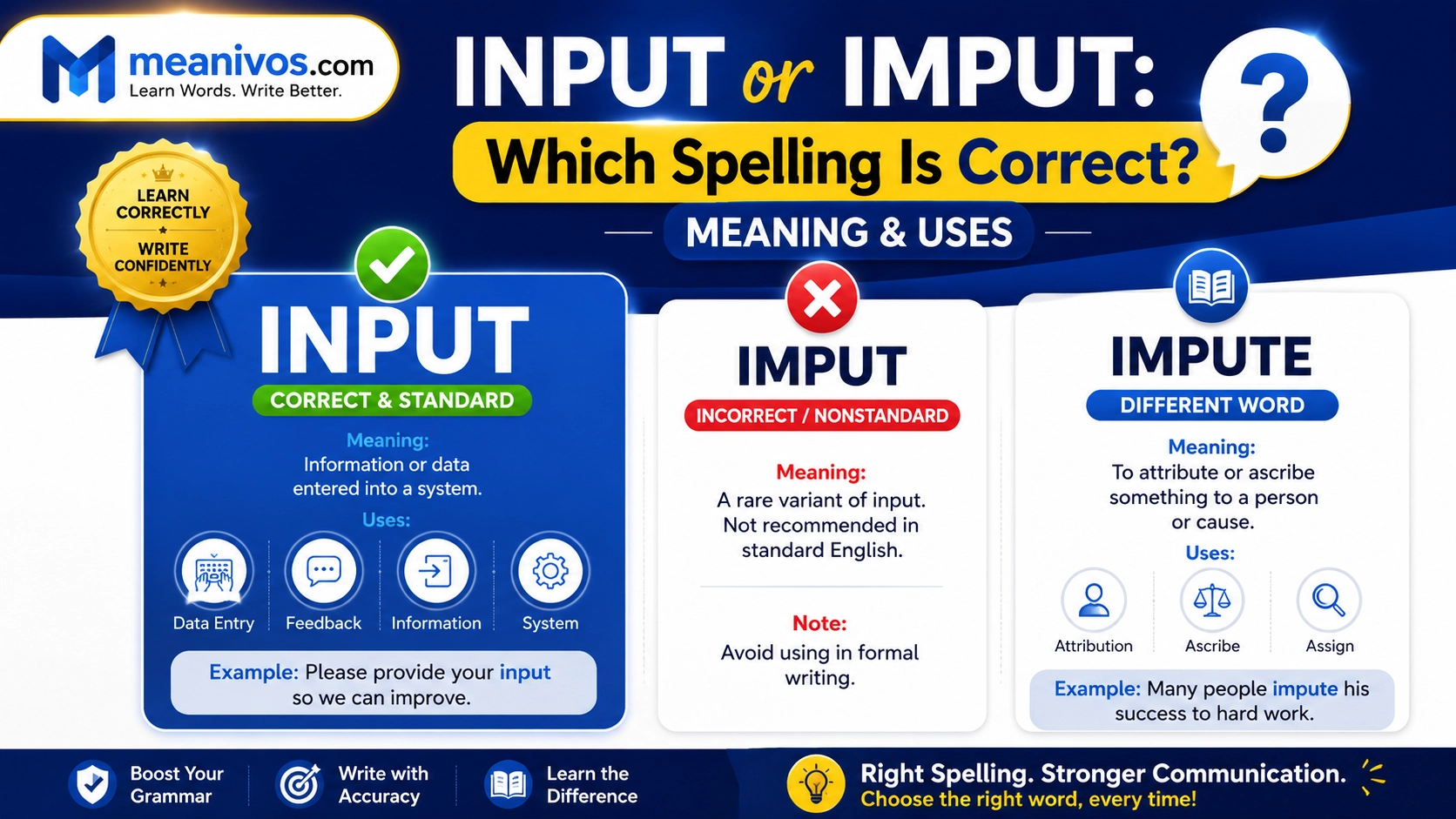
If you are wondering whether the correct spelling is Input Or Imput, use input in standard modern English.
Input is an established English word that works as both a noun and a verb. It can refer to information, data, advice, feedback, effort, money, energy, or something supplied to a system or process. Cambridge lists both noun and verb uses and gives input and inputted as past forms of the verb.
Imput is not the normal spelling you should choose when you mean input. However, there is an important dictionary nuance: Merriam-Webster records imput as a variant of input. Therefore, saying that imput “does not exist in any dictionary” is too absolute.
There is also another legitimate word that looks similar:
Impute means to attribute or ascribe something to a person, thing, or cause.
So the simplest rule is:
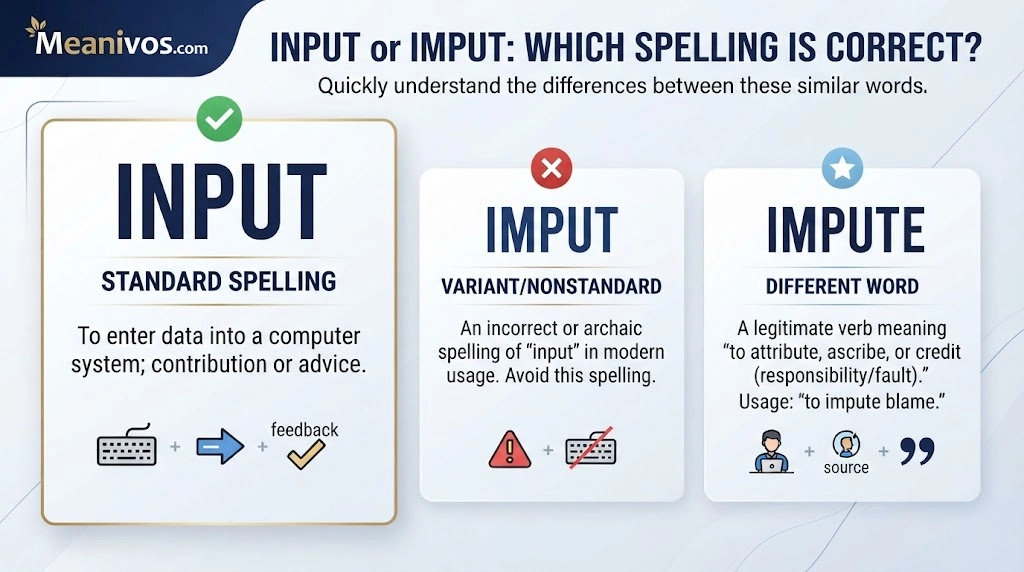
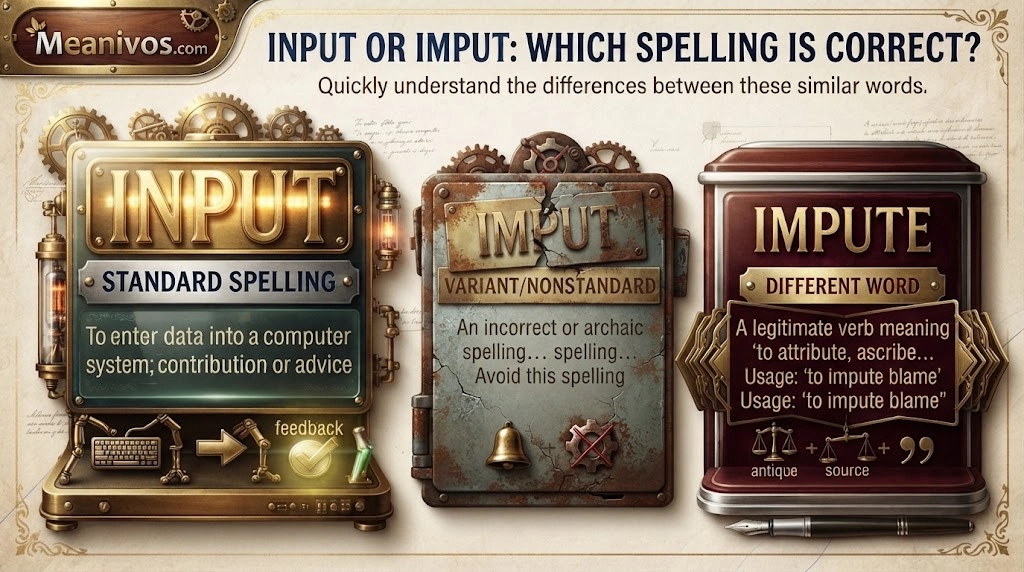
- Input = the standard spelling for information, data, feedback, or something put into a system.
- Imput = a variant recorded by Merriam-Webster, but not the normal spelling to use in standard contemporary writing.
- Impute = a different word meaning to attribute or ascribe.
If you are writing an email, article, essay, report, application, or professional document, input is the safest choice.
Quick Meaning Summary
| Word | Meaning | Recommended Use |
| Input | Information, data, advice, feedback, resources, or something put into a system | ✅ Standard |
| Imput | Variant of input recorded by Merriam-Webster | ⚠️ Avoid in ordinary modern writing |
| Impute | To attribute or ascribe something to someone or something | ✅ Correct, but different meaning |
| Output | Something produced or sent out by a system | ✅ Common counterpart to input |
The easiest memory trick
Think:
IN + PUT = INPUT
Something is put in.
That connection makes the standard spelling much easier to remember.
What Does Input Mean?
Input broadly means something that is put into a system, process, organisation, machine, or discussion.
The exact meaning changes slightly according to context.
For example:
We need your input on the new design.
Here, input means your opinion, advice, ideas, or feedback.
In another sentence:
Please input your details into the form.
Here, input means enter information into a system.
Cambridge defines input as something such as information, money, or energy supplied to a system, organisation, or machine. Its Business English definition also includes help, ideas, knowledge, resources, and information entered into a computer.
Input as a Noun
As a noun, input can describe something supplied to a process.
1. Input as Advice or Opinion
This is very common in everyday and professional English.
We would appreciate your input on the proposal.
Here, input means ideas, advice, knowledge, or an opinion.
More examples:
- I value your input.
- Can I get your input on this?
- We need input from the marketing team.
- Her input improved the final design.
- The manager asked for everyone’s input.
Cambridge specifically recognises this business use for help, ideas, and knowledge contributed to a project or organisation.
2. Input as Information or Data
In technology, input often means information supplied to a computer or system.
For example:
The application requires user input.
User input might include:
- a name
- an email address
- a password
- a search query
- a number
- a command
- an uploaded file
- a selection from a menu
3. Input as a Resource
Input can also describe resources used by a process.
For example:
Labour and raw materials are important inputs in manufacturing.
The word can therefore be used far beyond computers.
4. Input in Electronics
In electronics, an input can refer to a connection or part through which information or a signal enters a device.
For example:
Connect the microphone to the audio input.
Cambridge lists specialised electronics uses involving the part that carries information to a machine or the place where it is connected.
Input as a Verb
Input is also a verb.
As a verb, it generally means to enter information into a computer, electronic device, database, form, or other system.
Examples:
- Please input your email address.
- She input the customer data into the database.
- I need to input these figures into the spreadsheet.
- Users can input their details online.
- The employee input the information manually.
Cambridge lists input as a transitive verb and gives inputting as the present participle and inputted or input as past forms.
Input vs Imput: The Difference
The most useful distinction is simple:
| Feature | Input | Imput |
| Standard spelling for the word | ✅ Yes | ⚠️ No |
| Common in modern writing | ✅ Yes | Rare |
| Noun | ✅ Yes | Not normally used independently |
| Verb | ✅ Yes | Not normally used |
| Computing | ✅ Yes | Usually a spelling error/variant |
| Professional writing | ✅ Recommended | Usually avoid |
| Dictionary status | Established English word | Merriam-Webster records it as a variant |
| Meaning | Information, contribution, data, etc. | Generally the same intended meaning as input |
Which should you use?
Use input.
For example:
Please input your account number.
Not:
Please imput your account number.
The second spelling may be understood, but input is the normal choice for standard contemporary writing.
Is “Imput” a Real Word?
This question needs a more careful answer than many competing articles provide.
If by “real word” you mean the standard spelling you should use in ordinary English writing, then input is the correct choice.
However, it is inaccurate to claim that imput has never appeared in a dictionary. Merriam-Webster has an entry for imput as a variant of input.
That means there are two separate questions:
Is “imput” the standard spelling?
No. Use input.
Has “imput” ever been recorded lexicographically?
Yes. Merriam-Webster records it as a variant.
This distinction makes the answer more accurate than the common claim that imput is “not in any dictionary.”
Why Do People Spell Input as Imput?
The confusion is understandable because Input is pronounced quickly enough that some speakers may perceive the middle consonant differently.
The standard pronunciation is approximately:
/ˈɪn.pʊt/
Cambridge gives this pronunciation for both British and American English.
There are several reasons someone might write imput.
1. Sound-Based Confusion
When input is spoken quickly, the transition between n and p can be easy to hear incorrectly.
Someone may mentally represent the sound as:
im-put
and then write:
imput
instead of:
input
2. Typing Errors
Fast typing can also create spelling mistakes.
The letters n and m are adjacent on a standard QWERTY keyboard, so a quick keystroke can produce imput.
3. Pattern Confusion
English contains many words beginning with im-, including:
- improve
- impact
- import
- impress
- impose
- imitate
That familiar pattern can make imput look more natural than it actually is in ordinary writing.
4. Confusion With “Impute”
The word impute is a genuine English word, which can further complicate matters.
For example:
The report imputed the failure to poor planning.
Here, impute has nothing to do with entering information into a system.
Input vs Impute: Don’t Confuse These Words
This is one of the most important distinctions in the entire topic.
Input
Input means to put information, data, feedback, resources, or another contribution into a system or process.
Please input the customer details.
Impute
Impute means to attribute or ascribe something to someone or something.
The investigation imputed the failure to poor planning.
In the second sentence, imputed means something like attributed or ascribed.
Collins defines impute in this sense of attributing or ascribing something, particularly a fault or action, to another person or cause.
Easy way to remember
Input = put in.
Impute = attribute.
Input vs Imput vs Impute
| Word | Basic Meaning | Example |
| Input | Put information in; contribution or data supplied | Please input your details. |
| Imput | Variant spelling recorded by Merriam-Webster; not the normal modern choice | Use input in ordinary writing. |
| Impute | Attribute or ascribe something | They attributed the error to poor planning. |
This three-word comparison is especially useful because a reader searching “input or imput” may actually be trying to understand impute.
How to Use Input Correctly
Input for Information
Please input your contact information.
Here, input means enter.
Input for Data
The analyst input the figures into the spreadsheet.
Here, input refers to entering numerical data.
Input for Feedback
We would appreciate your input on the new policy.
Here, input means feedback or opinion.
Input for Advice
The committee requested input from several experts.
Here, input means advice or knowledge.
Input in Business
Customer input helped shape the final product.
Here, input means contributions or feedback.
Input in Education
Student input helped the school improve the course.
Again, input refers to ideas, opinions, or feedback.
Input in Technology and Computing
The computing meaning of input is extremely common.
A simple computer model is:
Input → Processing → Output
For example:
- You type your password.
- The computer receives that information as input.
- The system processes the information.
- The system produces an output, such as granting or denying access.
Common computing expressions include:
- user input
- input data
- input device
- input field
- input value
- input signal
- data input
- keyboard input
- text input
- input method
Cambridge’s Business English entry specifically includes information entered into a computer, the act of putting information into a computer, and hardware connections that carry information to a machine.
Common Input Devices
An input device allows information or signals to enter a computer or electronic system.
Examples include:
- Keyboard
- Mouse
- Microphone
- Touchscreen
- Scanner
- Camera
- Game controller
- Barcode reader
For example:
A keyboard is an input device because it sends information to the computer.
Input in Business and Professional Writing
In professional communication, input often means advice, feedback, or contribution.
Common expressions include:
Provide input
Please provide your input before Friday.
Get input
We need to get input from the sales team.
Seek input
The manager sought input from employees.
Ask for input
She asked for input on the proposal.
Valuable input
Your valuable input helped us improve the plan.
Customer input
Customer input influenced the product update.
These phrases are natural in meetings, emails, reports, presentations, and business documents.
Input in Education
Teachers, students, researchers, and educational organisations also use input to describe contributions or information.
Examples:
The teacher welcomed student input.
We collected input from parents.
Student input helped improve the curriculum.
The research team considered input from participants.
In these examples, input does not mean typing data. It means ideas, feedback, knowledge, or contributions.
Input in Everyday English
You do not need to be talking about computers to use input correctly.
For example:
Thanks for your input.
I would like your input on this idea.
Her input was extremely helpful.
We need more input before making a decision.
Everyone had a chance to give their input.
These are ordinary, natural uses of the word.
Is “Inputted” Correct?
Yes.
Inputted is an accepted past-tense and past-participle form of input.
For example:
She inputted the data yesterday.
However, input can also function as the past form:
She input the data yesterday.
Cambridge lists both inputted and input as past-tense and past-participle forms.
Which one should you choose?
Both are recognised.
If you want to avoid awkwardness in a sentence, you can sometimes rewrite it:
She entered the data yesterday.
But there is nothing inherently wrong with:
She inputted the data yesterday.
Is “Inputting” Correct?
Yes.
The correct present participle is:
inputting
Notice the spelling:
input + ting = inputting
Examples:
- She is inputting the data.
- They are inputting customer records.
- I spent the morning inputting information.
- The workers are inputting figures manually.
Do not write:
imputting
when you mean inputting.
- Explore More: https://meanivos.com/imbed-vs-embed/
Input vs Inputs
Both input and inputs can be correct.
Input as a singular or uncountable noun
We need your input.
Here, input means general feedback, advice, or contribution.
Inputs as a plural noun
The system receives inputs from several sensors.
Here, inputs refers to separate sources or instances of information.
Another example:
We gathered inputs from five different departments.
So the plural form is:
inputs
not:
imputs
Common Mistakes With Input
Mistake 1: Imput
❌ Please imput your name.
✅ Please input your name.
Mistake 2: Imputted
❌ She imputted the data.
✅ She inputted the data.
Mistake 3: Imputting
❌ He is imputting information.
✅ He is inputting information.
Mistake 4: Confusing Input With Impute
❌ They input the failure to poor management.
If you mean “attribute the failure,” use:
✅ They imputed the failure to poor management.
Mistake 5: Assuming Input Only Means Computer Data
Input can also mean:
- advice
- feedback
- opinion
- knowledge
- effort
- resources
- energy
- contribution
Input vs Output
The Input and output are often used as opposites in technology and systems.
| Term | Meaning | Example |
| Input | Something entering a system | Keyboard data |
| Processing | Work performed on the input | Calculating data |
| Output | Result produced by the system | A displayed answer |
For example:
Input: You enter 25 + 25.
Processing: The calculator performs the calculation.
Output: 50.
This is why the phrase input and output is so common in computing.
Input Pronunciation
The standard pronunciation of input is approximately:
IN-put
IPA:
/ˈɪn.pʊt/
Cambridge lists this pronunciation for both British and American English.
Pronunciation is one reason the spelling can cause confusion. When people speak quickly, the boundary between sounds may not be as clear as it appears in writing.
The spelling, however, remains:
input
How to Remember Input Spelling
The best memory trick is:
IN + PUT = INPUT
Think about the meaning:
You put something in.
Therefore:
in + put → input
Examples:
- put information in → input information
- put data in → input data
- put your details in → input your details
This is more useful than simply memorising a spelling rule because it connects the spelling to the meaning.
Input in a Sentence: 20 Examples
Here are examples covering different contexts.
Everyday English
- I appreciate your input.
- Can I get your input on this idea?
- Her input was very helpful.
- We need everyone’s input.
- Thanks for your input.
Business
- The manager requested input from the team.
- Customer input influenced the final design.
- We need more input from our clients.
- The project benefited from expert input.
- Employee input helped improve the policy.
Technology
- Please input your password.
- The system accepts user input.
- Enter your input in the field below.
- The application processes the input automatically.
- The keyboard provides input to the computer.
Education
- The teacher encouraged student input.
- We collected input from parents.
- Student input improved the course.
- The committee considered input from teachers.
- The researchers requested input from participants.
Input or Imput: Correct and Incorrect Examples
| ❌ Incorrect | ✅ Correct |
| Please imput your name. | Please input your name. |
| I need your imput. | I need your input. |
| She imputted the data. | She inputted the data. |
| He is imputting the figures. | He is inputting the figures. |
| The system needs user imput. | The system needs user input. |
| Thank you for your imput. | Thank you for your input. |
Common Collocations With Input
Learning common word combinations can make your English sound more natural.
Noun collocations
- user input
- customer input
- employee input
- expert input
- technical input
- valuable input
- useful input
- additional input
- data input
- keyboard input
- audio input
- digital input
Verb collocations
- provide input
- give input
- receive input
- collect input
- request input
- seek input
- ask for input
- consider input
- gather input
- enter input
Technology phrases
- input field
- input device
- input data
- input value
- input signal
- input method
- input source
- input command
Is Input a Noun or a Verb?
Both.
As a noun
Your input is valuable.
Here, input is a noun meaning feedback, advice, or contribution.
As a verb
Please input your details.
Here, input is a verb meaning enter information.
This dual grammatical role is one reason the word appears so frequently in both everyday and technical English. Cambridge identifies both noun and verb uses.
Is “Imput” Ever Appropriate?
For most readers and writers, the practical answer is:
Use input.
The dictionary nuance matters, though. Merriam-Webster records imput as a variant, so it is better to describe it accurately rather than claim that it is completely absent from English.
If your goal is clear, conventional, professional writing, input is the form readers will expect.
That is especially true for:
- business emails
- academic papers
- websites
- reports
- job applications
- technical documentation
- school assignments
- professional communication
What Is the Difference Between Input and Enter?
These words can overlap in computing, but they are not identical.
Enter means to put information into a system.
Input can mean the information itself, the act of entering it, or the broader contribution supplied to a system.
Compare:
Enter your name in the form.
and:
The form requires your name as input.
Both are natural, but they perform different grammatical roles.
What Is the Opposite of Input?
The most common opposite in computing is output.
Input is information or something supplied to a system.
Output is what the system produces or sends out.
For example:
Keyboard → Input → Processing → Output → Screen
This input/output relationship is fundamental to computing and many other systems.
People Also Ask
A:Input is the standard spelling. Use it when referring to information, data, feedback, advice, or something supplied to a system.
A:In ordinary modern writing, imput is best treated as a nonstandard or variant form of input. Merriam-Webster records it as a variant, so the stronger explanation is more nuanced than simply calling it nonexistent.
A:Yes. You can input data, information, details, numbers, or commands into a computer or system.
A:Both input and inputted are accepted past forms. For example: “She input the data” and “She inputted the data.”
A:In computing, input is information or a signal supplied to a computer or system for processing. A keyboard, mouse, microphone, or touchscreen can provide input.
Topical Cluster Ideas
To build a stronger spelling-and-meaning cluster around this page, Meanivos could publish related articles covering:
1. Commonly Misspelled Words
A hub explaining frequent spelling mistakes and why they happen.
2. Word vs Word Comparisons
Examples:
- affect vs effect
- advice vs advise
- accept vs except
- principal vs principle
- insure vs ensure
3. Word Forms and Grammar
Cover:
- noun vs verb
- singular vs plural
- past tense
- participles
- irregular verb forms
4. Commonly Confused Words
Explain words that look or sound similar but have different meanings.
5. English Spelling Questions
Build supporting content around searches such as:
- Is this word correct?
- Is this a word?
- How do you spell this word?
- What does this word mean?
- Which spelling is correct?
This can help Meanivos develop topical relevance beyond a single keyword.
Final Verdict
If you are choosing between input and imput, choose input for normal modern English writing.
Input is an established noun and verb. It can refer to information, data, advice, feedback, resources, energy, or something supplied to a system. In computing, it commonly describes information entered into a computer or electronic system. Cambridge confirms these noun and verb uses and lists inputting, input, and inputted among its verb forms.
The important nuance is that imput should not simply be described as a word that “does not exist in any dictionary.” Merriam-Webster records imput as a variant of input.
For everyday, academic, business, and professional writing, however, input is the conventional choice.
And remember not to confuse it with impute.
Input = put information in.
Impute = attribute or ascribe something.
Final memory trick
IN + PUT = INPUT
If you mean put something in, write:
Please input your information.
If you mean feedback or an opinion, write:
We appreciate your input.
If you mean attribute something to a cause, use:
They imputed the error to poor planning.
That distinction gives you the correct spelling, the correct meaning, and the correct word for each context.