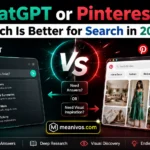
ChatGPT vs Pinterest: Search vs Visual Discovery
ChatGPT vs Pinterest is an unusual comparison because the two platforms were built around very different ways of discovering information.
The ChatGPT is designed around conversation. You can ask a question, request an explanation, brainstorm ideas, research a topic or compare options. Its Search feature can retrieve current web information and provide source links, while Deep Research can investigate complex questions and produce a documented report.
Pinterest works differently. It is strongly visual and is built around discovering ideas, browsing images, finding related Pins, saving inspiration and discovering products. Pinterest’s visual-search tools can also identify objects within images and surface visually similar or shoppable items where available.
So which one is better?
Neither is better for everything.
If you need an answer, explanation, research plan or personalised comparison, ChatGPT is usually the better choice.
If you want to browse visual inspiration, discover styles, save ideas or explore products through images, Pinterest is usually the better choice.
The easiest way to remember the difference is:
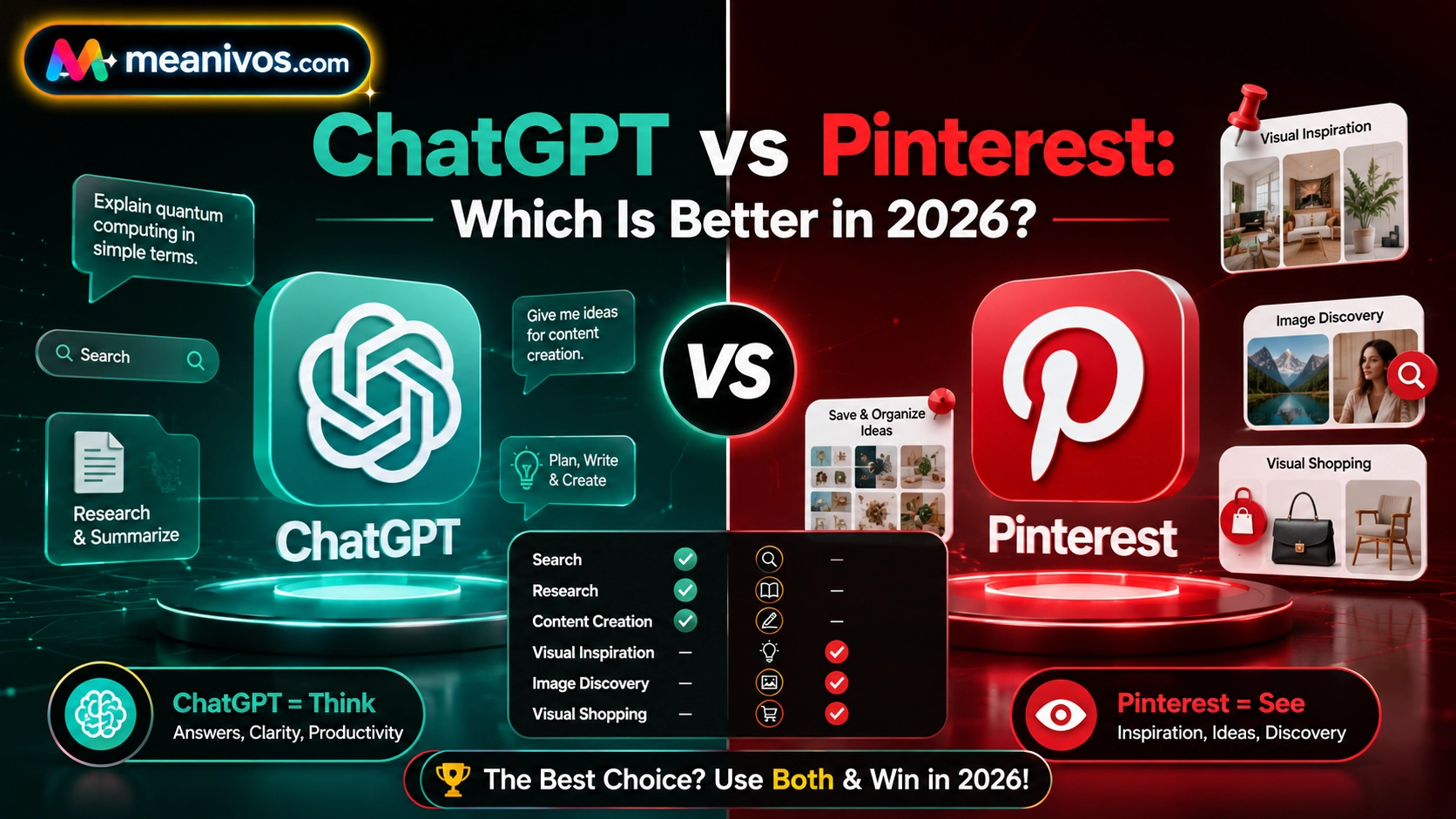
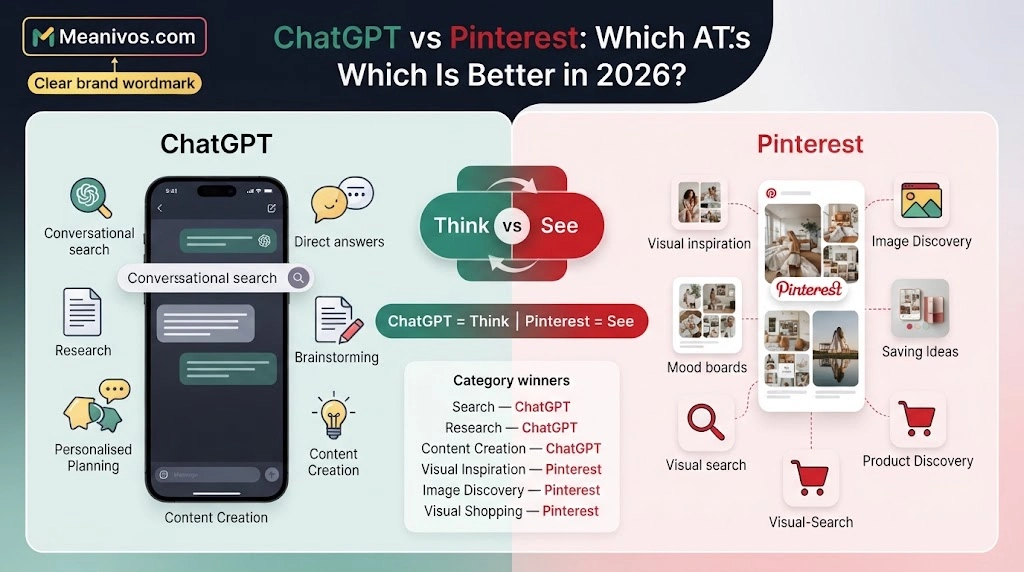
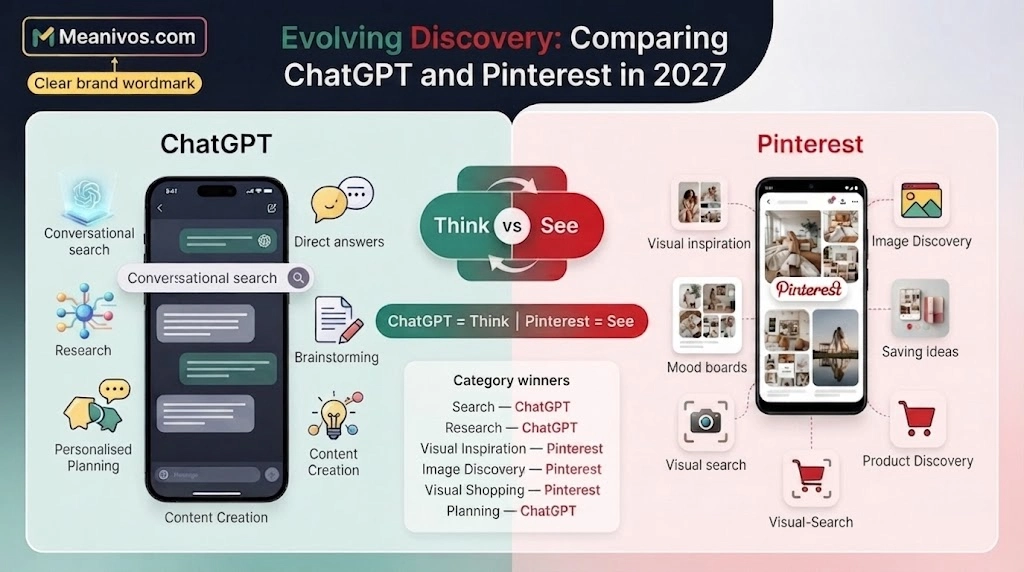
ChatGPT helps you think. Pinterest helps you see.
And in many cases, the smartest workflow is to use both.
ChatGPT vs Pinterest at a Glance
| Feature | ChatGPT | Winner | |
| Direct answers | Excellent | Limited | ChatGPT |
| Conversational search | Excellent | Limited | ChatGPT |
| Detailed explanations | Excellent | Limited | ChatGPT |
| Complex research | Excellent | Limited | ChatGPT |
| Brainstorming | Excellent | Very good | ChatGPT |
| Personalised planning | Excellent | Good | ChatGPT |
| Visual inspiration | Good | Excellent | |
| Image discovery | Good | Excellent | |
| Similar visual ideas | Good | Excellent | |
| Saving inspiration | Limited | Excellent | |
| Mood boards | Limited | Excellent | |
| Visual search | Good | Excellent | |
| Product discovery | Excellent | Excellent | Tie |
| Product comparison | Excellent | Good | ChatGPT |
| Shopping inspiration | Very good | Excellent | |
| Content planning | Excellent | Good | ChatGPT |
| Visual trend research | Good | Excellent | |
| SEO brainstorming | Excellent | Useful | ChatGPT |
| Visual content research | Good | Excellent |
This task-based approach is more useful than declaring one platform the universal winner. The original research similarly recommends category winners rather than a single overall winner.
What Is ChatGPT?
ChatGPT is a conversational AI platform that can help users generate and understand information through natural-language interaction.
Instead of searching for a list of webpages and opening them one by one, you can describe what you want and ask follow-up questions.
For example:
“Give me five Scandinavian living-room wall-art ideas for a small apartment and explain why each one works.”
ChatGPT can turn that request into a structured answer.
With ChatGPT Search, it can also retrieve current web information and provide links to relevant sources.
For more complex research, OpenAI’s Deep Research can plan an investigation, use selected sources, synthesise information and produce a documented report with citations.
ChatGPT is particularly useful for:
- answering questions
- explaining difficult concepts
- brainstorming
- research
- summarising information
- writing and editing
- planning projects
- comparing products
- generating content ideas
- developing SEO strategies
- personalised recommendations
- analysing information
What Is Pinterest?
Pinterest is a visual discovery platform where people explore, save and organise ideas.
Instead of beginning with a perfectly defined question, users can start with an image, style, product or vague idea and continue exploring.
Pinterest says users discover content through the home feed, keyword and visual search, related Pins and shopping experiences.
The Pinterest also lets users save Pins to boards, making it useful for organising inspiration for future projects.
Pinterest is particularly useful for:
- home décor inspiration
- fashion ideas
- recipes
- wedding planning
- travel inspiration
- DIY projects
- graphic design
- photography
- hairstyles
- beauty inspiration
- product discovery
- mood boards
- visual trend research
ChatGPT vs Pinterest: The Key Difference
The biggest difference is how each platform helps people discover information.
ChatGPT is answer-first.
You normally begin with a question or goal.
For example:
“What colours work best in a small Scandinavian bedroom?”
ChatGPT can explain the choices and provide recommendations.
Pinterest is discovery-first.
You may begin without knowing exactly what you want.
For example:
Search for “Scandinavian bedroom”.
You can browse hundreds of visual possibilities and gradually discover your preferred style.
This difference matters because people do not always know the words for what they want.
Pinterest’s own visual-search documentation specifically highlights the ability to discover styles, objects and inspiration even when users do not have the words to describe what they are looking for.
ChatGPT vs Pinterest for Search
Winner: ChatGPT for answers; Pinterest for visual discovery
If your search looks like a traditional question, ChatGPT has a major advantage.
Examples include:
- “What is the best wall art for a narrow hallway?”
- “How much wall art should I use above a sofa?”
- “Explain the difference between MDF and solid wood.”
- “Compare three types of bedroom lighting.”
ChatGPT Search can retrieve current information from the web and provide relevant sources.
Pinterest is better when your search is more visual:
- “Modern hallway ideas”
- “Neutral bedroom décor”
- “Small kitchen inspiration”
- “Black and white wall art”
Pinterest’s search system supports keyword and visual discovery, while related Pins help users continue exploring similar ideas.
Best choice
Need an explanation? → ChatGPT
Need visual inspiration? → Pinterest
ChatGPT vs Pinterest for Finding Ideas
Winner: Depends on the type of idea
ChatGPT is excellent for generating ideas from a specific brief.
For example:
“Give me 20 unique blog topics about minimalist wall décor for European homeowners.”
It can generate ideas and organise them by audience, search intent or difficulty.
Pinterest is excellent when you want to see possibilities before deciding what you like.
You can search a broad concept and allow related Pins to lead you in new directions.
Example
Imagine you want to redesign a bedroom.
With ChatGPT, you might ask:
“Create three bedroom design concepts for a small room with beige walls.”
With Pinterest, you might search:
“Small beige bedroom.”
The first approach gives you structured concepts.
The second gives you visual possibilities.
ChatGPT vs Pinterest for Image Search
Winner: Pinterest for visual similarity and discovery
Pinterest has a significant advantage for visual exploration.
Its visual-search tools allow users to select objects inside a Pin, find similar visual content and, where available, discover shoppable products.
This makes Pinterest particularly useful when you see something you like but don’t know what to call it.
For example, you might see a chair in a photograph and want to find similar chairs.
Pinterest’s visual search can let you select the object and explore related results.
ChatGPT is more useful when the goal is to discuss, analyse or transform information about an image rather than simply browse visually similar content.
Simple rule
Find similar visuals → Pinterest
Understand or discuss the visual → ChatGPT
ChatGPT vs Pinterest for Inspiration
Winner: Pinterest
This is one of Pinterest’s strongest categories.
Pinterest is designed around visual discovery, and its home feed, search, related Pins and boards encourage users to continue exploring ideas.
For inspiration such as:
- interior design
- fashion
- weddings
- hairstyles
- tattoos
- recipes
- gardens
- travel
- crafts
- photography
Pinterest is often the more natural starting point.
ChatGPT can certainly generate inspiration, but it normally describes or structures ideas rather than giving you the same open-ended visual browsing experience.
ChatGPT vs Pinterest for Shopping
Winner: Tie, depending on the shopping stage
Pinterest has long been strong in visual product discovery.
Its platform connects search, related Pins and shopping experiences, allowing users to discover products through visual content.
Pinterest’s current business tools also support product feeds and shopping campaigns, reinforcing its role in product discovery.
ChatGPT has also developed substantially as a shopping tool.
ChatGPT Search can display product options with images, product information and merchant links. Its shopping research experience is designed to help users compare products based on requirements such as budget, features and preferences.
Pinterest is better when:
You want to discover products visually.
ChatGPT is better when:
You already have requirements and want help comparing options.
Example
Pinterest:
“Show me modern beige sofas.”
ChatGPT:
“Compare three beige sofas under £1,000 for a small living room and explain which offers the best value.”
The difference is discovery versus decision-making.
ChatGPT vs Pinterest for Research
Winner: ChatGPT
ChatGPT has a clear advantage when research requires multiple steps.
ChatGPT Search is designed for fast web-based information retrieval, while Deep Research is designed for complex questions involving research, reasoning and synthesis.
Pinterest can be useful for researching visual trends, but it is not designed to replace a research assistant.
For example:
“Compare the major interior-design trends for 2026 and explain which ones are practical for small European apartments.”
This is much more suitable for ChatGPT.
Pinterest could then complement the research by helping you find visual examples of the styles.
ChatGPT vs Pinterest for Content Creators
Winner: ChatGPT for strategy; Pinterest for visual research
Content creators can benefit from both platforms.
Use ChatGPT for:
- content ideas
- article outlines
- keyword brainstorming
- audience research
- content briefs
- FAQ ideas
- social media concepts
- headline variations
- content planning
- rewriting
- competitive analysis
Use Pinterest for:
- visual inspiration
- colour palettes
- photography ideas
- thumbnail concepts
- design trends
- lifestyle imagery
- product inspiration
- visual content research
The uploaded research identifies this combined workflow as a particularly strong opportunity for creators and bloggers.
Best workflow
ChatGPT → strategy → Pinterest → visual research → ChatGPT → content creation
This can be considerably more effective than using either platform alone.
ChatGPT vs Pinterest for Bloggers and SEO
Winner: ChatGPT for SEO strategy; Pinterest for visual traffic opportunities
For bloggers, ChatGPT can help with:
- search-intent analysis
- topic clustering
- keyword variations
- article structures
- FAQs
- content briefs
- title ideas
- semantic entities
- content optimisation
Pinterest can support the visual side of content marketing.
A blog about home décor, fashion, recipes, travel or DIY can use Pinterest to showcase visual content and direct users to a website.
Pinterest says Pins can link directly to a website and can be used to share ideas, showcase brands and sell products.
For a visual website, the strongest strategy may therefore be:
ChatGPT for information architecture + Pinterest for visual discovery and distribution.
ChatGPT vs Pinterest for Businesses
Winner: Both, for different purposes
Businesses should not automatically choose one platform.
ChatGPT can help with:
- market research
- customer personas
- content strategy
- competitor analysis
- product comparisons
- customer-question analysis
- campaign ideas
- copywriting
- planning
Pinterest can help with:
- visual product discovery
- brand inspiration
- product Pins
- shopping
- visual content
- audience discovery
- website traffic
- advertising
Pinterest specifically provides business accounts with analytics, advertising options and merchant tools.
For visually driven businesses such as fashion, home décor, beauty, weddings, food and lifestyle brands, Pinterest can be particularly valuable.
- Explore More: https://meanivos.com/jp-meaning-in-text/
Does Pinterest Really Have More Searches Than ChatGPT?
This is one of the most interesting questions behind the ChatGPT vs Pinterest debate.
In February 2026, Pinterest CEO Bill Ready said that Pinterest was seeing around 80 billion searches per month, compared with approximately 75 billion for ChatGPT, citing third-party data. He also described a substantially higher commercial intent for Pinterest searches.
However, this statistic needs context.
It does not automatically prove that Pinterest is a better search engine than ChatGPT.
Why?
Because the two platforms represent different types of activity.
A Pinterest search can be part of visual browsing, inspiration, product discovery or exploration.
A ChatGPT interaction can involve a question, a follow-up question, reasoning, research or a long conversation.
Therefore, comparing raw search counts is not necessarily an apples-to-apples comparison. The original SERP research identifies this distinction as one of the major weaknesses in existing articles.
The better question is:
Which platform is better for the task you are trying to complete?
That question produces a much more useful answer than simply comparing two large numbers.
Can ChatGPT Replace Pinterest?
Short answer: No, not completely.
ChatGPT can replace some Pinterest-related workflows.
For example, it can help you:
- brainstorm design ideas
- describe visual concepts
- organise choices
- compare options
- create project plans
- explain design principles
- narrow down preferences
But Pinterest remains especially useful for visual discovery, related content, saving ideas and image-based product discovery.
If you want to spend 30 minutes browsing different kitchen styles until something catches your eye, Pinterest is a natural choice.
If you already know what you need and want someone to help you evaluate it, ChatGPT may be more efficient.
Can Pinterest Replace ChatGPT?
No.
Pinterest is not designed to replace a conversational AI assistant.
It is excellent for discovering and organising visual content, but ChatGPT is better suited to tasks such as:
- detailed explanations
- research
- writing
- summarisation
- personalised planning
- structured comparisons
- conversational follow-ups
- reasoning through complicated questions
Pinterest can inspire you to choose a style.
ChatGPT can help you turn that style into a plan.
When Should You Use ChatGPT Instead of Pinterest?
Choose ChatGPT when:
- you have a specific question
- you need a detailed explanation
- you want current web research
- you need to compare alternatives
- you want a personalised plan
- you need help writing
- you want brainstorming assistance
- you need to organise information
- you need research synthesis
- you want to make a decision based on multiple criteria
For complex research, ChatGPT’s Deep Research feature is specifically designed to aggregate and synthesise information into a documented report.
When Should You Use Pinterest Instead of ChatGPT?
Choose Pinterest When:
- you want visual inspiration
- you don’t know exactly what style you want
- you want to discover similar images
- you are creating a mood board
- you want to save ideas for later
- you are exploring fashion
- you are planning a wedding
- you are designing a room
- you want visual shopping inspiration
- you are researching visual trends
Pinterest’s Boards are specifically designed to save and organise ideas, while visual search helps users explore similar objects and styles.
Why Using ChatGPT and Pinterest Together Is Better
The biggest mistake is assuming you have to choose one.
The two platforms can work together extremely well.
Step 1: Ask ChatGPT
Start with a broad objective.
“I want to redesign my small living room in a warm Scandinavian style.”
ChatGPT can help define:
- colours
- materials
- furniture
- lighting
- wall décor
- layout
- budget
Step 2: Explore Pinterest
Search for the visual concepts ChatGPT suggested.
Save the images and styles that match your taste.
Pinterest lets users organise saved Pins into boards for future reference.
Step 3: Return to ChatGPT
Now describe what you found.
For example:
“I like these three styles. Which one would work best in a 12-square-metre room?”
ChatGPT can help compare them.
Step 4: Make the decision
You now have:
ChatGPT for thinking → Pinterest for exploring → ChatGPT for deciding.
This three-layer workflow is one of the strongest conclusions from the current SERP research.
ChatGPT vs Pinterest: Advantages and Disadvantages
ChatGPT Pros
- Excellent conversational interaction
- Strong for explanations
- Useful for research
- Good for brainstorming
- Strong for personalised planning
- Helpful for comparisons
- Useful for content creation
- Can search the web
- Can conduct complex research
Cons
- Not primarily a visual inspiration platform
- AI-generated answers can require verification
- Search results depend on the information available
- It may not provide the same open-ended visual browsing experience as Pinterest
Pinterest Pros
- Excellent visual discovery
- Strong for inspiration
- Useful for mood boards
- Easy to save and organise ideas
- Strong visual search
- Useful for product discovery
- Good for visual trends
- Strong for image-led businesses
Pinterest Cons
- Less suitable for detailed explanations
- Not designed for complex research synthesis
- Visual results may not answer specific questions
- Discovery can become broad when you need a precise answer
ChatGPT vs Pinterest: Category Winners
| Task | Best Platform |
| Direct answers | ChatGPT |
| Conversational search | ChatGPT |
| Detailed explanations | ChatGPT |
| Complex research | ChatGPT |
| Personalised planning | ChatGPT |
| Brainstorming | ChatGPT |
| Visual inspiration | |
| Mood boards | |
| Similar images | |
| Visual discovery | |
| Saving inspiration | |
| Visual shopping discovery | |
| Product comparison | ChatGPT |
| Content strategy | ChatGPT |
| Visual trend research |
Is Pinterest an AI Search Engine?
Pinterest is increasingly using AI-powered features, particularly in visual discovery and shopping, but it is better described as a visual discovery platform with AI-powered search and recommendation capabilities rather than simply treating it as another general-purpose AI search engine.
Its visual-search tools can identify objects, find similar content and surface shoppable products where available.
ChatGPT, by contrast, is fundamentally conversational and can combine dialogue with web search, research and reasoning.
Common Misunderstandings About ChatGPT vs Pinterest
“Pinterest and ChatGPT are direct competitors.”
Not exactly.
They overlap in discovery, recommendations and shopping, but their core experiences remain different.
“Pinterest having more searches means it is better.”
Not necessarily.
Search volume does not measure whether a platform is better for a particular task.
“ChatGPT can completely replace Pinterest.”
Not for visual discovery.
Pinterest remains exceptionally useful for browsing and saving visual ideas.
“Pinterest can replace ChatGPT.”
Not for detailed research, explanations or conversational problem-solving.
“You must choose one.”
You don’t.
Using both can create a more effective discovery-to-decision workflow.
The Best Way to Think About ChatGPT vs Pinterest
A simple framework makes the comparison easy.
1. ASK → ChatGPT
Use ChatGPT when you know what question you need answered.
2. EXPLORE → Pinterest
Use Pinterest when you want to see possibilities and discover what appeals to you.
3. DECIDE → Both
Use Pinterest to collect options and ChatGPT to compare and organise them.
This is why the strongest answer to “ChatGPT vs Pinterest” is not a single winner.
It is a workflow.
People Also Ask
A:ChatGPT is generally better for direct answers, conversational search, research, explanations and personalised planning. Pinterest is generally better for visual inspiration, discovery, saving ideas and visual shopping.
A:Pinterest is better for visual exploration and inspiration. If you want to browse images, discover styles, save ideas or find visually similar products, Pinterest has an advantage.
A:ChatGPT is primarily conversational and answer-oriented, while Pinterest is primarily visual and discovery-oriented. ChatGPT helps you reason through information; Pinterest helps you explore visual possibilities.
A:Not completely. ChatGPT can replace some brainstorming and planning tasks, but Pinterest remains particularly strong for visual discovery, saving inspiration, related Pins and image-based product discovery.
A:No. Pinterest is not a replacement for conversational research, detailed explanations, writing, summarisation or personalised reasoning.
Topical Cluster Ideas
Cluster A — Search
Build supporting content around:
AI search → ChatGPT Search → Google Search → Pinterest Search → visual search → conversational search
Cluster B — Visual Discovery
Build content around:
Pinterest Lens → image search → visual search → image inspiration → visual shopping → mood boards
Cluster C — Creator Marketing
Build content around:
ChatGPT content strategy → Pinterest marketing → SEO → content planning → visual content → traffic generation
These clusters can help Meanivos establish broader topical relevance instead of relying on a single comparison page.
Final Verdict
There is no single winner.
ChatGPT wins when you need to ask, understand, research, compare or plan.
Pinterest wins when you need to explore, see, save, organise or discover visually.
For shopping, both platforms are increasingly capable, but they approach the journey differently: Pinterest is particularly strong at visual discovery, while ChatGPT can help users compare products according to detailed requirements.
For creators and bloggers, the strongest strategy is also not either/or.
Use:
ChatGPT → strategy
Pinterest → visual discovery
ChatGPT → evaluation and creation
So, if you want the shortest possible answer to “ChatGPT vs Pinterest?”, remember:
ChatGPT helps you think. Pinterest helps you see. Use both when you need to discover and decide.
That is ultimately more useful than asking which platform has more searches or which one is universally “better.” The platforms serve different discovery behaviours, and choosing the right tool depends on the job you need to accomplish.