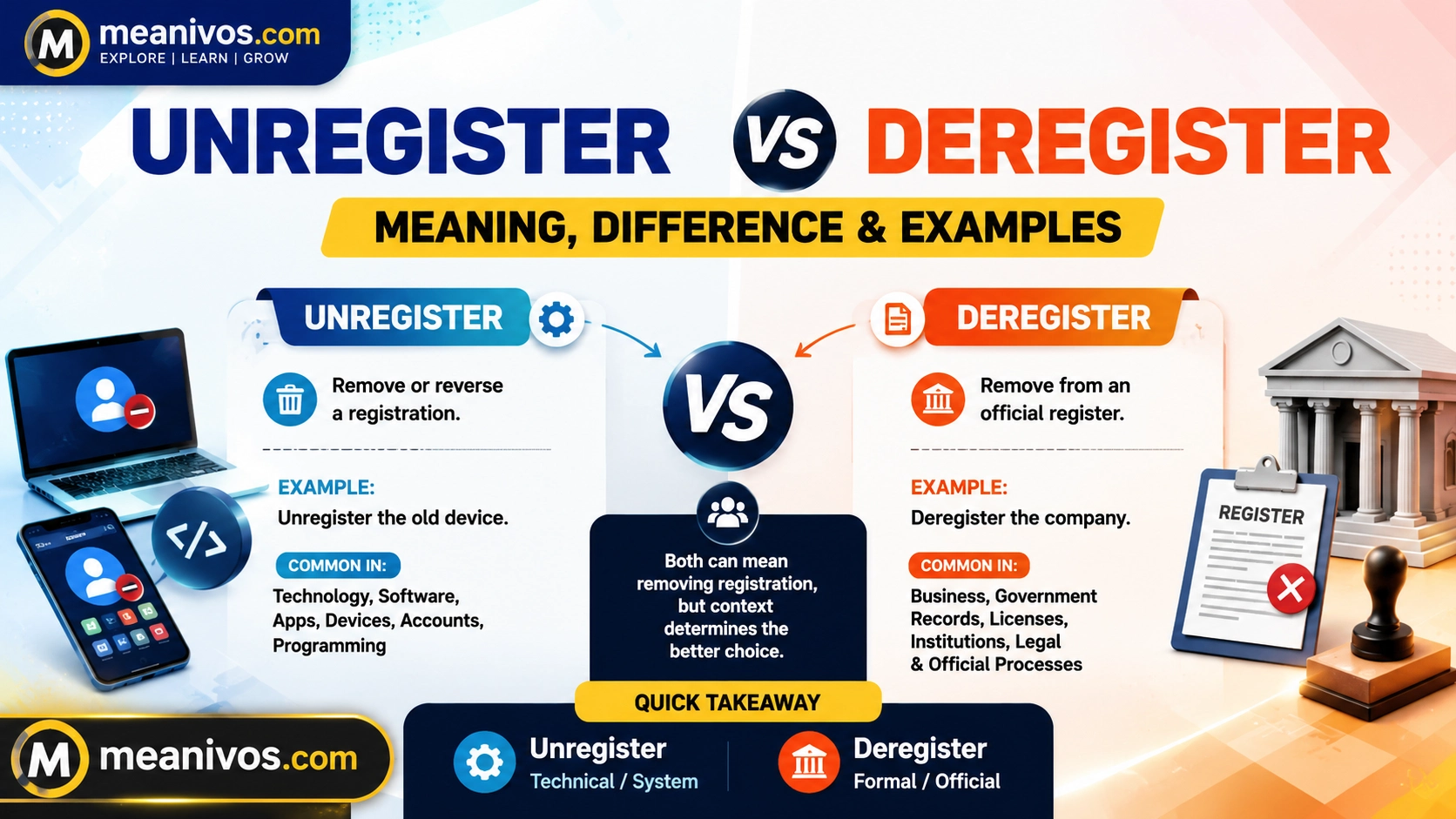
Unregister vs Deregister: What’s the Difference?
If you are unsure whether to write Unregister or deregister, you are not alone. The two verbs are closely related, and in many situations they can describe the same basic action: removing something from a registration system or register.
The important point is that there is no universal rule saying “unregister” means something was never registered while “deregister” means it was previously registered.” That distinction appears in some grammar articles, but real-world English—especially technical English—does not consistently follow it.
In fact, Wiktionary defines unregister as undoing the process of registration and lists deregister as a synonym. Collins, meanwhile, defines deregister as removing someone or something from a register.
A useful practical distinction is:
Unregister is especially common for software, devices, accounts, services and other technical systems, while deregister often sounds more formal and is common for official, institutional or regulatory registers.
For example:
- “Unregister the old device from your account.”
- “Unregister the event listener.”
- “Deregister the company from the official register.”
- “The authority deregistered the organisation.”
Both words are legitimate. Context usually determines which sounds more natural.
Quick Answer: Unregister vs Deregister
| Word | Basic meaning | Common contexts | Typical feel |
| Unregister | Undo or remove a registration | Software, devices, accounts, services | Neutral / technical |
| Deregister | Remove from a register | Official records, institutions, regulation | More formal |
| Unregistered | Not currently registered | General status | Neutral |
| Deregistered | Registration has been removed | Formal/administrative contexts | Formal |
The simplest rule
Use unregister when you’re talking about a technical system or user-facing registration process.
Use deregister when you’re talking about an official, institutional or regulatory register.
But treat this as a usage preference, not an absolute grammar rule.
What Does “Unregister” Mean?
Unregister means to undo or reverse a registration.
It can describe removing a person, device, component, service, account or other item from a registration system.
For example:
“Please unregister the old phone from my account.”
The sentence means that the phone should no longer have that registration or association with the account.
Wiktionary currently defines unregister as “to undo the process of registration” and also gives an intransitive sense involving undoing a registration process.
Unregister as a verb
Examples include:
- unregister a device
- unregister an account
- unregister a service
- unregister a plugin
- unregister a callback
- unregister an event listener
- unregister a component
- unregister a user
For example:
“The application unregisters the callback when the service shuts down.”
Here, unregister clearly describes an action that reverses an existing registration.
What Does “Deregister” Mean?
Deregister means to remove someone or something from a register.
Collins gives the definition as removing oneself, a car, or another item from a register.
Examples include:
- deregister a company
- deregister a vehicle
- deregister an organisation
- deregister a licence
- deregister from a programme
- deregister an official record
For example:
“The company was deregistered from the official register.”
The word often feels more formal, institutional or administrative than unregister.
Dictionary.com’s examples also show deregister being used for companies, planes, student organisations, phone numbers and other formal registration contexts.
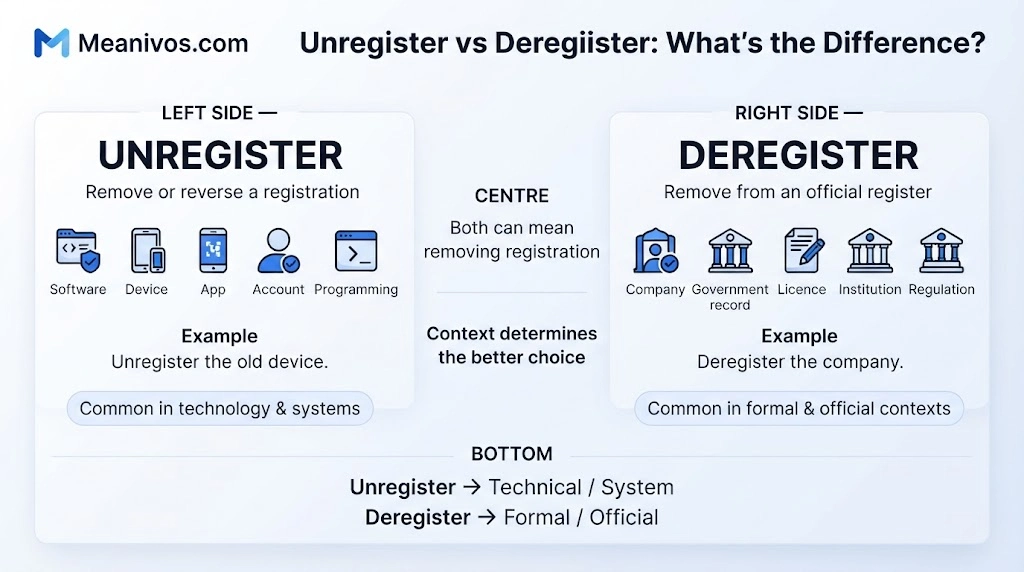
Unregister vs Deregister: Key Differences
1. Meaning
Both words can refer to removing something from registration.
Unregister commonly means:
undo a registration or remove something from a system.
Deregister commonly means:
remove someone or something from a register.
There is substantial semantic overlap.
2. Context
Context is probably the most useful way to choose.
Unregister
More natural in:
- software
- programming
- websites
- apps
- devices
- databases
- accounts
- services
- technical systems
Deregister
More natural in:
- government records
- official registers
- companies
- licences
- regulatory systems
- institutions
- formal programmes
- administrative processes
3. Formality
Deregister generally has a more formal or administrative tone.
Compare:
“Unregister the device.”
with:
“Deregister the company.”
The first sounds like an instruction inside an application.
The second sounds like an official administrative action.
That does not mean unregister is informal English or that deregister is always formal. These are tendencies rather than fixed rules.
Is “Unregister” a Correct Word?
Yes.
Unregister is a legitimate English verb and is widely used in modern technical documentation.
For example, Microsoft documentation describes tools that register and unregister software components.
Microsoft also documents an /unregister option for its Assembly Registration Tool.
The technology world therefore provides strong evidence that unregister is not simply an incorrect or informal substitute for deregister.
Is “Deregister” a Correct Word?
Yes.
Deregister is an established English verb.
Collins explicitly defines it as removing someone or something from a register and also lists deregistration as the related noun.
So both forms are valid:
- unregister
- deregister
The question is generally which one fits the context better, not whether one is grammatically legitimate.
Are Unregister and Deregister Synonyms?
They can be.
This is one of the most important points for understanding the keyword.
Wiktionary lists deregister as a synonym of unregister.
Its separate entry for deregister defines the verb as “to unregister.”
That does not mean the two words are interchangeable in every sentence. English often has near-synonyms that differ in tone, field or conventional usage.
For example:
“Unregister the service.”
sounds perfectly natural in software.
“Deregister the company.”
sounds more natural in an official business context.
So the best conclusion is:
Unregister and deregister overlap in meaning, but their preferred contexts can differ.
Unregister vs Deregister in Technology and Programming
This is where the strongest evidence against the simplistic “never registered” rule appears.
Modern technical documentation uses unregister to mean actively reversing an existing registration.
Unregister a service
Apple’s developer documentation describes an unregister() method that removes a service from its registered state and explicitly describes it as the opposite operation to register().
That gives us a very clear pattern:
register → unregister
Unregister a service worker
MDN documents the ServiceWorkerRegistration.unregister() method. It removes the service worker registration and returns a promise indicating the result.
This is another direct example of unregister meaning the reversal of an existing registration.
Unregister a JavaScript target
MDN also documents FinalizationRegistry.prototype.unregister(), which removes a registered target from the registry.
Again:
register something → unregister it
Unregister a WordPress block
WordPress Developer Resources documents WP_Block_Type_Registry::unregister() as a method that unregisters a block type. The underlying code checks whether the block is registered before removing it.
This is particularly useful evidence because it demonstrates that unregister can explicitly refer to something that is already registered.
Unregister vs Deregister in Business
In business contexts, either word may be possible, but Deregister often fits formal registration processes better.
Examples:
“The company was deregistered.”
“The business was removed from the official register.”
“The organisation was deregistered by the authority.”
For an internal software system, however, unregister may be more natural:
“Unregister the customer account from the platform.”
The difference is therefore often about what kind of registration you are talking about.
Unregister vs Deregister in Government
Government and regulatory language often favours deregister when an official record or register is involved.
For example:
“The authority deregistered the organisation.”
“The vehicle was deregistered.”
“The company was deregistered from the official register.”
Collins itself uses examples involving companies, systems and other formal registrations, showing that deregister is not restricted to one narrow legal meaning.
Unregister vs Deregister in Education
Education provides an interesting middle ground.
You might encounter:
“Unregister from the online course.”
This sounds natural when the action happens through a website or learning platform.
You might also see:
“Deregister from the programme.”
That sounds more formal and institutional.
So:
Online platform → unregister may be natural
Formal academic programme → deregister may be natural
The exact terminology used by a particular institution should always take priority.
Unregister vs Deregister in Legal and Regulatory English
For official or regulatory writing, deregister is often the safer choice when an entity is being removed from a formal register.
Examples:
- deregister a company
- deregister a vehicle
- deregister a professional
- deregister an organisation
- deregister a licence
- Explore More: https://meanivos.com/google-vs-microsoft/
However, avoid assuming that unregister is automatically wrong in legal or official writing. The correct word can depend on the terminology established by the relevant authority.
In legal and regulatory documents, follow the authority’s own terminology whenever possible.
Unregister vs Deregister in Everyday English
In everyday communication, both can sometimes sound more technical than necessary.
Instead, you may prefer:
- cancel the registration
- remove my name
- take me off the list
- cancel my enrolment
- remove the account
- cancel my registration
For example:
“I want to cancel my registration.”
This may be clearer to a general audience than:
“I want to deregister.”
Clarity should always come before forcing a particular synonym.
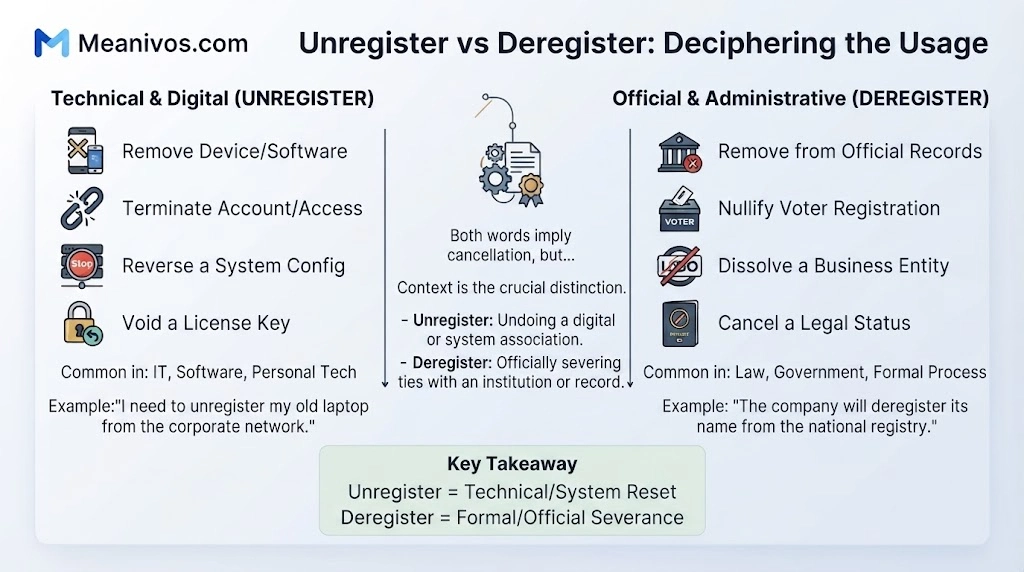
Unregistered vs Deregistered: Are They Different?
This is where the distinction becomes especially interesting.
Unregistered
Unregistered generally describes a current state: something is not registered.
It does not necessarily tell you the entire history of that item.
For example:
“The vehicle is unregistered.”
This tells us its current registration status.
It does not, by itself, prove whether the vehicle:
- was never registered,
- had registration expire,
- was removed from a register,
- or became unregistered for another reason.
Deregistered
Deregistering more strongly suggests an action that removed the registration.
For example:
“The company was deregistered.”
This normally suggests that someone or some authority carried out a deregistration process.
Therefore, a useful practical distinction is:
unregistered = current status
deregistered = removal process/status resulting from deregistration
But even here, context matters.
The Biggest Myth: “Unregister Means Never Registered”
Some competing pages present this as a hard rule.
For example, one 2026 competitor states that unregister refers to something that has never been registered, while deregister means removing existing registration.
Another competitor makes essentially the same claim, saying unregister should be used when something has never been registered and deregister when it was once registered.
The problem is that real technical usage directly contradicts such an absolute rule.
MDN’s unregister() method removes an existing service-worker registration.
Apple’s unregister() method is explicitly described as the opposite of register().
WordPress’s unregister() method checks that a block is registered before removing it.
Microsoft documentation likewise uses unregister for removing registered components.
Therefore, the absolute rule is not reliable.
Why Prefixes Do Not Give You a Perfect Rule
It is tempting to analyse the prefixes:
- un- = not/reverse
- de- = remove/reverse
and then create a strict semantic distinction.
But English does not always work that mechanically.
Both prefixes can contribute meanings associated with reversal or removal, and established usage ultimately determines how a word functions.
That is why the safest approach is not:
“The prefix tells you exactly what the verb means.”
Instead, ask:
What kind of registration am I talking about, and what terminology does that field normally use?
Unregister vs Deregister Examples
| Situation | Better choice | Example |
| Software component | Unregister | Unregister the component. |
| Event listener | Unregister | Unregister the event listener. |
| Service worker | Unregister | Unregister the service worker. |
| Device | Unregister | Unregister the old device. |
| User account | Unregister | Unregister the account. |
| Official company record | Deregister | Deregister the company. |
| Government register | Deregister | Deregister the vehicle. |
| Regulatory action | Deregister | The authority deregistered the organisation. |
| Formal academic programme | Deregister | The student deregistered from the programme. |
| Online learning platform | Unregister | Unregister from the course portal. |
These are usage preferences, not universal grammatical laws.
Common Mistakes to Avoid
Mistake 1: Saying “unregister” is incorrect
It is not.
Modern technical documentation uses it extensively.
Mistake 2: Saying “deregister” is the only formal word
Deregister is often formal, but context matters.
Mistake 3: Treating “never registered” as the definition of unregister
This fails in programming and software usage.
Mistake 4: Assuming the words are always interchangeable
They overlap, but conventional usage can make one sound much more natural than the other.
Mistake 5: Confusing “unregistered” with “unregister”
Unregister is an action.
Unregistered usually describes a state.
That distinction is important.
Unregister vs Deregister: Which Is More Formal?
Generally:
Deregister → more formal / institutional
Unregister → more neutral / technical
But this is a tendency rather than a strict rule.
For example:
“Unregister the service.”
is perfectly professional technical English.
Likewise:
“Deregister the device.”
could be completely acceptable if that is the terminology used by the particular organisation or system.
Unregister vs Deregister in British and American English
It is tempting to claim that unregister is American and deregister is British, but that is too broad.
One current competitor makes a US-versus-UK distinction, describing unregister as US-centric and deregister as UK-centric.
That framing should be treated cautiously.
Both words are encountered across varieties of English, and field-specific usage is often more important than nationality.
Technology documentation can strongly favour unregistering, regardless of the user’s country.
Official and institutional terminology can favour deregister, regardless of whether the document is British, American or international.
What Should You Use in Programming?
If you are writing code, APIs or technical documentation, unregister is often the natural choice when it is the established counterpart to register.
Examples:
register()
unregister()
You will find this pattern across major technical ecosystems.
MDN uses ServiceWorkerRegistration.unregister().
Apple uses unregister() as the opposite operation to register().
Microsoft uses unregister terminology for registered components.
So if your programming API already uses register, creating an unregister operation is entirely normal.
What Should You Use in Official Writing?
If an official authority maintains a register, deregister is often a natural choice.
For example:
“The regulator deregistered the company.”
“The organisation was deregistered.”
“The vehicle was deregistered.”
However, always check the terminology used by the specific authority. If its official documentation says unregister, follow that terminology rather than replacing it merely because deregister sounds more formal.
What Is the Best Word for “Cancel Registration”?
If your goal is maximum clarity rather than terminology precision, cancel the registration is often the safest phrase.
For example:
“I want to cancel my registration.”
This is immediately understandable to almost everyone.
You can also say:
“Remove the registration.”
or:
“Remove my name from the register.”
These alternatives are particularly useful when writing for a broad audience.
A Simple Memory Trick
Use this as a practical guide:
UNREGISTER → systems and technology
Think:
device → app → account → software → service → unregister
DEREGISTER → formal registers
Think:
company → authority → licence → official record → deregister
This will work in many everyday situations, while leaving room for legitimate exceptions.
People Also Ask
A:Not always, but the meanings overlap. Both can describe removing something from registration; unregister is especially common in technical contexts, while deregister often appears in formal or official contexts.
A:Yes. Unregister is an established English verb and is widely used in modern technology documentation.
A:Yes. Collins defines deregister as removing someone or something from a register.
A:No. That is an overly strict interpretation. Technical documentation uses unregister specifically to reverse existing registrations.
A:Usually, yes. Deregister often has a more institutional or administrative tone, but this is a usage tendency rather than a grammatical rule.
Topical Cluster Ideas
1: Registration Vocabulary
- register meaning
- registration meaning
- registered vs unregistered
- unregister vs deregister
- deregistration meaning
- registration vs enrolment
2: Commonly Confused Words
- requester vs requestor
- tear vs tare
- peak vs peek vs pique
- pre vs post
- forest vs Forrest
3: Technical English
- register vs unregister
- activate vs deactivate
- install vs uninstall
- subscribe vs unsubscribe
- connect vs disconnect
Conclusion
Unregister vs deregister is not a case where one word is correct and the other is wrong.
Both words can describe the reversal or removal of registration. Unregister is especially common in software, programming, devices, applications and online systems. Deregister is often preferred when the context involves an official register, institution, company, licence or regulatory process.
Most importantly, don’t rely on the oversimplified rule that “unregister means never registered” and “deregister means previously registered.” Real technical English provides many clear examples of unregister being used to remove something that was already registered.
If you remember only one rule, remember this:
Unregister is often the natural technical/system term; deregister is often the natural formal/official term.
When an organisation, application or authority already has its own terminology, follow that terminology. In English, context and established usage matter more than forcing a rigid rule onto two overlapping verbs.