ChatGPT Meaning: Full Form, Definition & How It Works
If you have searched for “ChatGPT Meaning,” you probably want a simple answer to one question: What does ChatGPT stand for?
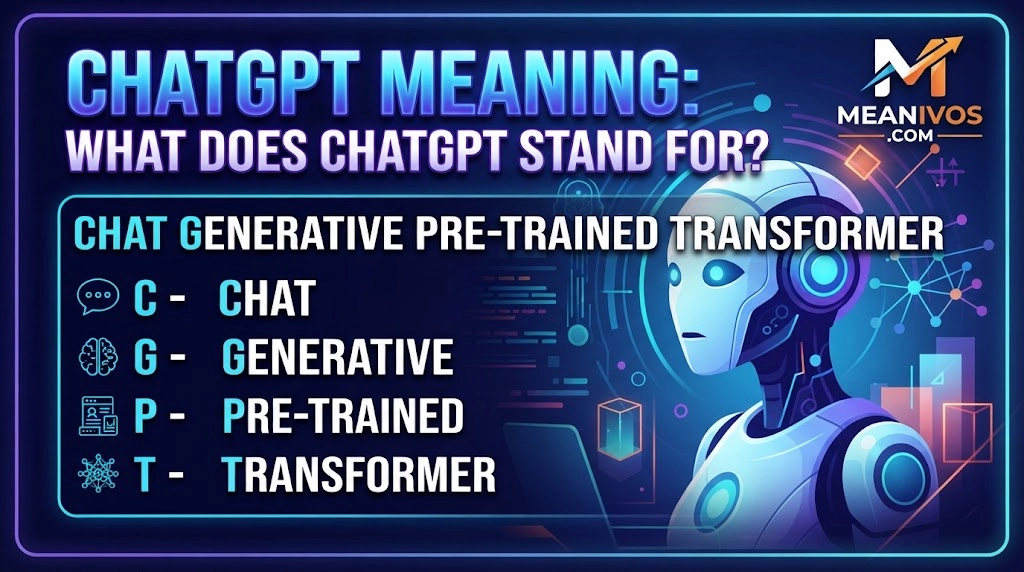
ChatGPT is the name of OpenAI’s conversational AI assistant. The name combines “Chat” with “GPT,” commonly expanded as “Generative Pre-trained Transformer.” “Chat” highlights the conversational way people interact with the system, while GPT refers to the family of generative language models behind the technology.
But there is more to the meaning than four words.
ChatGPT is not simply another chatbot or a digital dictionary. Today, it can help users write, study, brainstorm, plan, solve mathematical problems, code, analyse files and images, and perform many other tasks. OpenAI currently describes it as an AI assistant trained to follow instructions in conversation.
In this guide, you will learn exactly what ChatGPT means, what each part of the name represents, what GPT means, how ChatGPT works, when it was launched, what people use it for, and what its limitations are.
What Does ChatGPT Mean?
ChatGPT is a conversational AI assistant based on GPT technology.
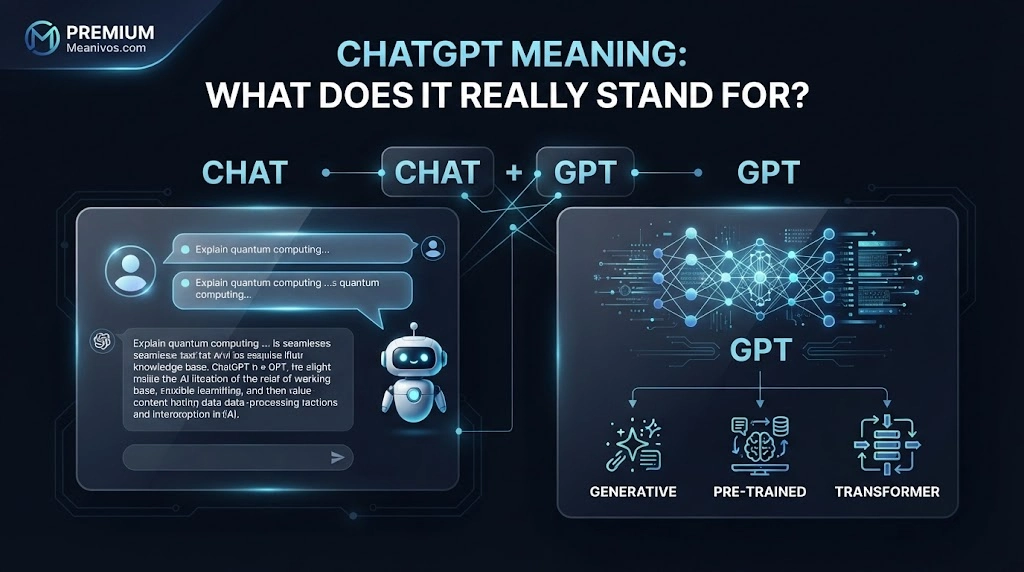
The name can be understood in two parts:
| Part | Meaning | Simple explanation |
| Chat | Conversation | Describes the conversational way users interact with the AI |
| GPT | Generative Pre-trained Transformer | Refers to the GPT family of generative language models |
So, when someone asks “What does ChatGPT stand for?”, the commonly given expansion is:
ChatGPT = Chat + Generative Pre-trained Transformer
However, it is important to understand the distinction between the name and the technology. ChatGPT is the user-facing AI service/assistant, while GPT refers to the model family and technology used in OpenAI’s AI systems. OpenAI’s current documentation describes ChatGPT as an AI-based service that can understand and respond to questions and instructions using patterns learned from large amounts of information.
ChatGPT meaning in one sentence
ChatGPT is an OpenAI conversational AI assistant that uses generative language-model technology to understand prompts and produce useful responses.
What Does ChatGPT Stand For?
The commonly used expansion of ChatGPT is:
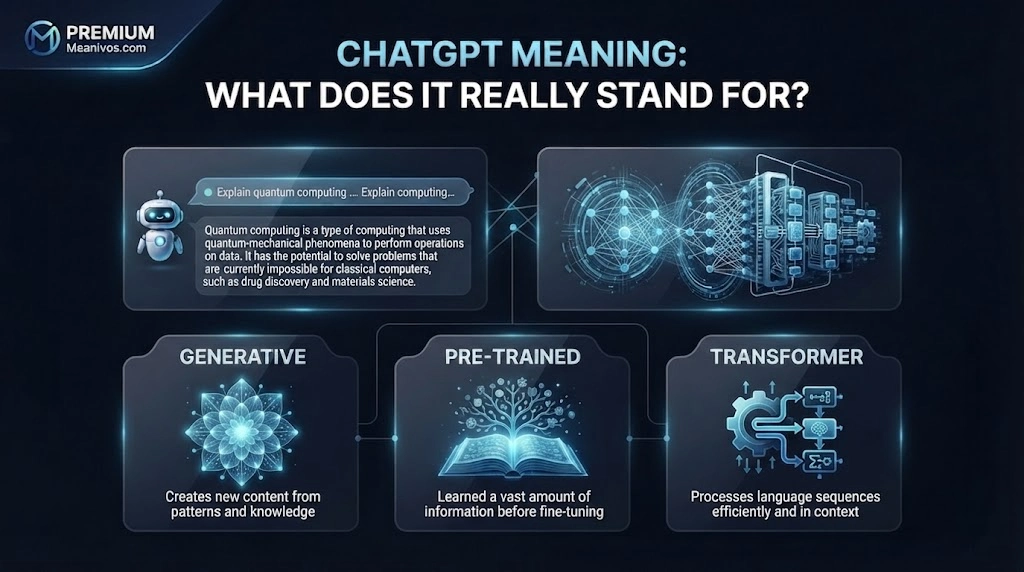
Chat Generative Pre-trained Transformer.
Let’s break it down:
- Chat = conversational interaction
- Generative = capable of generating new responses
- Pre-trained = trained before being used by an individual user
- Transformer = a neural-network architecture that became highly important for modern language models
The name therefore gives a broad description of how the technology is designed: it is intended for conversational interaction and is based on generative, pre-trained transformer-based language-model technology.
Grammarly similarly explains the name as Chat + GPT, with GPT standing for Generative Pre-trained Transformer.
Is “Chat Generative Pre-trained Transformer” the official product definition?
Not exactly.
This is an important distinction for a high-quality ChatGPT meaning article.
The phrase is commonly used to explain the acronym, but ChatGPT is primarily the name of OpenAI’s product/service, rather than the name of a single permanent model. The models and capabilities available through ChatGPT can change over time.
That is why it is better to say:
ChatGPT is OpenAI’s conversational AI assistant, and GPT stands for Generative Pre-trained Transformer.
This wording remains useful even as OpenAI changes the models available through the service.
What Does “Chat” Mean in ChatGPT?
The word “Chat” refers to the conversational nature of the system.
Instead of requiring users to communicate with a computer through complicated commands, ChatGPT allows people to interact using natural language.
For example, you can type:
“Explain photosynthesis in simple words.”
ChatGPT can respond with an explanation.
You can then ask:
“Now explain it like I’m 10 years old.”
And then:
“Give me a short quiz about it.”
This back-and-forth interaction is what makes the “Chat” part of ChatGPT meaningful.
OpenAI describes ChatGPT as an assistant designed to follow instructions in a conversation, and its current educational guidance encourages users to start with a prompt and refine the result through follow-up questions.
Why is conversation important?
Traditional software often expects users to learn specific controls.
Conversational AI changes that interaction model. Instead of learning a complicated interface, users can describe what they want.
For example:
- “Summarise this article.”
- “Help me understand this equation.”
- “Write five headline ideas.”
- “Find the mistake in this code.”
- “Turn these notes into a study guide.”
The user communicates the desired outcome through language.
What Does GPT Mean?
GPT stands for Generative Pre-trained Transformer.
It is one of the most important terms to understand when learning the ChatGPT meaning.
Each word describes a different aspect of the technology.
What Does “Generative” Mean?
Generative means the system can generate new output.
For example, it can generate:
- text
- explanations
- summaries
- ideas
- code
- other supported forms of content
When you give ChatGPT a prompt, it does not simply search a fixed list of answers and copy one into the chat.
The underlying models generate a response based on patterns learned during training and the context supplied to the system.
OpenAI explains that its foundation models learn relationships within large amounts of information and use that understanding when generating responses.
What Does “Pre-trained” Mean?
Pre-trained refers to training that happens before the model is used for a particular interaction.
A language model is exposed to large quantities of information during development. It learns patterns in language and other supported data.
After that initial training, additional processes can be used to improve how the model follows instructions, behaves, and performs particular tasks.
OpenAI describes model development as involving stages including preparing training data, pre-training, post-training, evaluation, and ongoing improvement.
In simple terms:
Pre-trained means the model learns general patterns before you open a chat and ask it a question.
What Does “Transformer” Mean?
A transformer is a type of neural-network architecture that became foundational to modern language-model development.
You do not need to understand the mathematics behind transformers to understand ChatGPT.
A simple way to think about the concept is that transformer-based systems can process relationships between pieces of information and use context when generating language.
For example, consider:
“The dog chased the ball because it was excited.”
Understanding what “it” refers to requires attention to the surrounding context.
Transformer-based language models are designed to process contextual relationships in language at scale.
What Is ChatGPT in Simple Words?
If you need to explain ChatGPT meaning to a beginner, you could say:
ChatGPT is an AI assistant that you can talk to using normal language. You ask it a question or give it an instruction, and it generates a response based on what it has learned and the information available to it.
For example, you might ask:
“Explain inflation in simple English.”
Then you could ask:
“Give me a real-world example.”
Then:
“Explain it in 50 words.”
The system can continue responding within the conversation.
OpenAI currently describes ChatGPT as a conversational AI assistant that can help users think, write, solve problems, study, plan, code, and perform other tasks.
Is ChatGPT an AI, a Chatbot, or an LLM?
The answer is all of these descriptions can be relevant, but they mean different things.
| Term | Meaning | Relationship to ChatGPT |
| Artificial Intelligence (AI) | Broad field of computer systems performing tasks associated with intelligence | ChatGPT is an AI-based service |
| Generative AI | AI that generates new content or responses | ChatGPT is a generative AI application |
| Chatbot | Software designed to interact conversationally | ChatGPT can function as an advanced AI chatbot |
| LLM | Large language model | Models underlying ChatGPT can be large language models |
| GPT | Generative Pre-trained Transformer | Refers to OpenAI’s GPT model family |
| ChatGPT | OpenAI’s conversational AI service/assistant | The product people interact with |
This distinction matters because people often use these terms interchangeably.
A simple hierarchy
You can think about the relationship like this:
Artificial Intelligence → Generative AI → Language Models → GPT → ChatGPT
That is simplified rather than a strict technical hierarchy, but it makes the terminology easier for beginners.
What Is the Difference Between ChatGPT and GPT?
This is one of the most common sources of confusion.
GPT refers to a family of generative language models developed by OpenAI.
ChatGPT refers to the conversational AI service through which users can interact with OpenAI’s models and other capabilities.
Think of it this way:
GPT = underlying model technology
ChatGPT = user-facing AI assistant/service
The distinction is especially important because ChatGPT can include more than simply a text-generation model. OpenAI’s current documentation describes capabilities involving tasks such as image and file analysis, coding, research, translation, and other activities.
How Does ChatGPT Work?
At a high level, using ChatGPT involves several stages.
1. You provide a prompt
A prompt is the question, instruction, or information you give the AI.
For example:
“Write a short introduction about renewable energy.”
2. The system processes your request
The model considers the words in your prompt and the relevant context available to it.
3. The model generates a response
The underlying model generates an answer based on learned patterns and the instructions it has received.
4. You can continue the conversation
You can ask follow-up questions, correct details, add constraints, or request a different format.
For example:
“Make it shorter.”
Then:
“Use simpler language.”
Then:
“Add three examples.”
This conversational process is central to the ChatGPT experience.
OpenAI explains that its models learn patterns from large amounts of information and use those patterns to generate responses.
Does ChatGPT Search the Internet for Every Answer?
No.
ChatGPT’s capabilities can include web search in supported experiences, but that does not mean every response is automatically produced by searching the live internet.
OpenAI’s current FAQ explicitly says ChatGPT can search the web and cite sources when it needs current information.
This distinction is important because users sometimes assume that every ChatGPT answer is a live Google-style search result.
It isn’t.
Depending on the feature, model, settings, and task, ChatGPT may generate an answer from the model’s learned information, supplied files or images, conversation context, connected tools, or web-search results.
- Explore More: https://meanivos.com/unregister-vs-deregister/
Who Created ChatGPT?
OpenAI developed ChatGPT.
OpenAI is an artificial intelligence research and technology organisation that develops AI models and products.
ChatGPT was publicly launched on November 30, 2022, and it subsequently evolved substantially beyond its original text-based conversational experience.
Today, OpenAI describes ChatGPT as an AI assistant with a broad range of capabilities rather than simply a basic question-and-answer chatbot.
When Was ChatGPT Released?
ChatGPT was publicly introduced on November 30, 2022.
Its original release attracted enormous public attention because people could interact with an advanced language model through a simple conversational interface.
Since then, ChatGPT has developed into a much broader AI service.
That historical context is useful when discussing ChatGPT meaning because the word “ChatGPT” originally became strongly associated with conversational text generation, while the product now supports a much wider range of tasks.
What Is ChatGPT Used For?
ChatGPT can be used for many different purposes.
OpenAI currently lists tasks such as brainstorming, writing, studying, planning, mathematics, coding, and analysing images and files among its everyday uses.
1. Writing
You can use ChatGPT to:
- brainstorm ideas
- create outlines
- improve wording
- summarise text
- rewrite content
- develop drafts
- generate variations
It can be particularly useful during the early stages of writing when you need ideas or structure.
2. Studying
Students can use ChatGPT as an interactive learning assistant.
For example:
“Explain photosynthesis step by step.”
Then:
“Ask me five questions to test my understanding.”
A good learning workflow involves checking answers and using the AI to support understanding rather than blindly accepting everything it says.
3. Coding
ChatGPT can help users:
- understand code
- find potential bugs
- explain programming concepts
- generate examples
- improve code structure
- brainstorm technical approaches
However, generated code should be tested before being used in production.
4. Brainstorming
You can ask ChatGPT for:
- business ideas
- blog topics
- names
- marketing concepts
- content angles
- project ideas
- questions to consider
The value often comes from using the conversation to develop and refine ideas.
5. Summarising
ChatGPT can help turn lengthy information into shorter explanations when the relevant text or file is provided.
For example:
“Summarise this report in five bullet points.”
6. Translation and language support
ChatGPT can assist with translations, explanations of wording, grammar, and language-learning exercises.
For important professional or legal translations, human review may still be necessary.
7. Planning
People can use ChatGPT to structure:
- study plans
- project plans
- writing schedules
- travel ideas
- workflows
- checklists
8. Image and file analysis
Current ChatGPT capabilities can include analysing supported images and files. OpenAI specifically identifies image/file analysis among ChatGPT’s capabilities.
ChatGPT Meaning on Social Media
Unlike slang terms such as “LOL” or “FR,” ChatGPT does not have a separate secret meaning on TikTok, Instagram, Snapchat, Facebook, Reddit, Discord, or X simply because people use the word there.
The meaning generally remains the same:
ChatGPT refers to OpenAI’s conversational AI assistant.
People may mention it in social-media posts about:
- AI
- school
- work
- writing
- coding
- productivity
- memes
- automation
- research
- image generation
So if you see someone write:
“I asked ChatGPT.”
They usually mean they asked the ChatGPT AI assistant for information or assistance.
ChatGPT vs. “Chat GPT” — Is There a Difference?
You may see both:
- ChatGPT
- Chat GPT
The standard product name is ChatGPT, written as one word with a capital C and G, followed by PT.
“Chat GPT” is a common informal spelling.
If you’re writing an article, webpage, or professional document, ChatGPT is the preferred form.
Is ChatGPT the Same as Artificial Intelligence?
No.
Artificial intelligence is a broad field. ChatGPT is one AI-based product/service within that broader field.
A simple analogy is:
AI is the category; ChatGPT is one example of an AI application.
There are many different forms of artificial intelligence, including systems for computer vision, recommendation, robotics, speech recognition, language processing, and generative content.
ChatGPT belongs primarily to the generative and conversational AI space.
Is ChatGPT a Search Engine?
ChatGPT is not simply a traditional search engine.
A search engine is primarily designed to find and rank information from the web.
ChatGPT is designed to interact with users conversationally and generate responses.
However, ChatGPT can also have web-search capabilities. OpenAI’s current FAQ confirms that ChatGPT can search the web and provide citations when that capability is used.
Therefore, the most accurate description is:
ChatGPT is a conversational AI assistant that can also use web search in supported experiences.
Is ChatGPT Free?
ChatGPT has a free tier, along with paid plans.
OpenAI’s current documentation lists Free, Plus, Pro, Business, and Enterprise offerings, although features, limits, and availability can change over time.
This is one reason evergreen articles should avoid claiming that a particular feature or model will always be available on a particular plan.
For the latest plan information, readers should check OpenAI’s current documentation.
What Are the Limitations of ChatGPT?
Understanding ChatGPT meaning also means understanding what it does not mean.
ChatGPT can produce fluent and convincing answers without guaranteeing that every statement is correct.
OpenAI explicitly warns that ChatGPT can produce inaccurate or misleading information.
Common limitations include:
Inaccurate information
ChatGPT can make factual mistakes.
Hallucinations
It may sometimes generate information that sounds plausible but is unsupported or incorrect.
Context limitations
The quality of an answer depends partly on the information and instructions supplied to the system.
Bias
AI systems can reflect biases present in their training and development processes.
Need for verification
Important claims should be checked against reliable sources.
Not a replacement for professional judgement
For high-stakes medical, legal, financial, or safety decisions, users should consult qualified professionals and authoritative sources.
The key lesson
Fluent does not always mean factual.
A confident-sounding answer should not automatically be treated as verified information.
Common Misunderstandings About ChatGPT
Misunderstanding 1: ChatGPT knows everything
It does not.
Its responses can contain errors, and available information and capabilities depend on the models and tools being used.
Misunderstanding 2: ChatGPT is Google
It isn’t.
ChatGPT is a conversational AI assistant, although supported versions can search the web.
Misunderstanding 3: GPT and ChatGPT mean exactly the same thing
They don’t.
GPT refers to a model family/technology term, while ChatGPT refers to OpenAI’s conversational AI service.
Misunderstanding 4: ChatGPT always gives verified facts
It doesn’t.
Users should verify important information.
Misunderstanding 5: ChatGPT is only for chatting
Not anymore.
OpenAI currently describes ChatGPT as useful for writing, studying, coding, planning, mathematics, file and image analysis, research, and many other tasks.
ChatGPT Meaning vs. GPT Meaning
Here is the easiest way to remember the difference:
| Term | Meaning |
| AI | Artificial intelligence |
| Generative AI | AI that can generate content |
| GPT | Generative Pre-trained Transformer |
| LLM | Large language model |
| Chatbot | Software designed for conversational interaction |
| ChatGPT | OpenAI’s conversational AI assistant/service |
In simple words
GPT describes the underlying model family, while ChatGPT describes the conversational product/service people interact with.
Why Is ChatGPT Called ChatGPT?
The name reflects its conversational purpose and its GPT technology.
“Chat” points to interaction through conversation.
“GPT” identifies the Generative Pre-trained Transformer model family.
Together, the name communicates the basic idea:
a conversational interface built around GPT technology.
The name is therefore more descriptive than many ordinary product names.
What Does ChatGPT Mean in Everyday Language?
If someone asks you to explain it without technical terms, you can say:
ChatGPT is an AI assistant from OpenAI that you can communicate with using normal language. It can understand instructions and generate responses to help with tasks such as writing, learning, coding, planning, and problem-solving.
That is probably the simplest practical definition.
ChatGPT Meaning Examples
Here are several examples of what the word means in real conversations.
Example 1: Student
Person A: “How did you prepare your exam notes?”
Person B: “I used ChatGPT to explain the difficult chapters.”
Here, ChatGPT means the AI assistant.
Example 2: Writer
Person A: “How did you come up with those article ideas?”
Person B: “I brainstormed them with ChatGPT.”
Again, ChatGPT refers to OpenAI’s AI assistant.
Example 3: Programmer
Person A: “How did you fix that error?”
Person B: “I asked ChatGPT to explain the code.”
Example 4: Researcher
Person A: “Can ChatGPT help analyse this document?”
Person B: “Yes, if you provide the supported file and ask it to analyse it.”
These examples show that ChatGPT is a name for an AI assistant, not a slang expression with a hidden meaning.
People Also Ask
A:ChatGPT is commonly explained as Chat Generative Pre-trained Transformer. “Chat” refers to conversational interaction, while GPT stands for Generative Pre-trained Transformer.
A:GPT stands for Generative Pre-trained Transformer. It refers to a family of generative language models developed by OpenAI.
A:The T stands for Transformer, a neural-network architecture that is central to modern language-model technology.
A:The G stands for Generative, meaning the model can generate new outputs rather than simply retrieve a fixed answer.
A:The P stands for Pre-trained, referring to training performed before the model is used for a particular interaction.
Final Takeaway
So, what does ChatGPT mean?
ChatGPT is the name of OpenAI’s conversational AI assistant. “Chat” refers to the conversational interaction, while “GPT” stands for “Generative Pre-trained Transformer.”
The important distinction is that ChatGPT is the product/service users interact with, while GPT refers to the generative model family and technology behind OpenAI’s systems.
Since its public launch in 2022, ChatGPT has developed far beyond a simple text chatbot. It can now support many activities, including writing, studying, coding, planning, mathematics, research, and analysing supported files and images.
At the same time, ChatGPT is not infallible. It can produce incorrect or misleading information, so important claims should be checked against reliable sources.
In the simplest possible words: ChatGPT is an AI assistant you can communicate with naturally, and GPT refers to the generative language-model technology associated with it.
That is the clearest way to understand the ChatGPT meaning without getting lost in technical jargon.