Unorganized vs Disorganized: What’s the Difference?
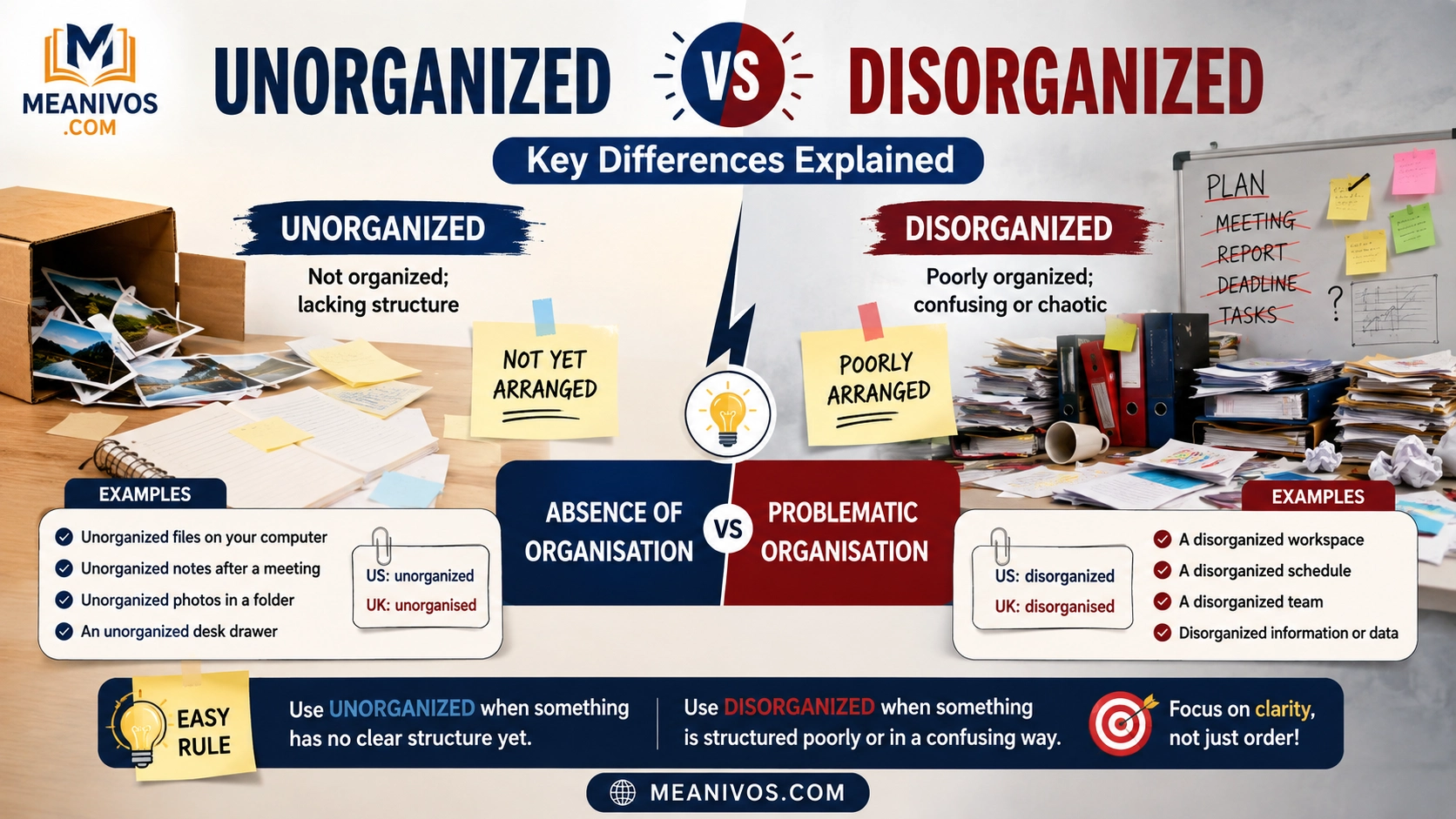
Unorganized and disorganized are both correct English words. They are closely related because both can describe a lack of order, structure, or organisation. However, they do not always communicate exactly the same idea.
The easiest distinction is:
- Unorganized usually focuses on something being not organized or lacking an established structure.
- Disorganized usually focuses on something being poorly organized, confusing, disorderly, or badly planned.
There is one important point that many online grammar guides get wrong. Unorganized describes a lack of organisation, while disorganized describes problematic organisation. However, disorganized does not always mean that someone organized something before.
Merriam-Webster defines disorganized broadly as lacking coherence, system, or a central guiding structure. Cambridge describes it as badly planned and without order and also uses it for people who are not good at planning or organizing things.
So, if you are wondering “Should I say unorganized or disorganized?”, the answer depends on what you want to emphasise.
Quick Answer: Unorganized vs Disorganized
| Word | Main meaning | Typical emphasis | Example |
| Unorganized | Not organized | Absence of structure | The files are still unorganized. |
| Disorganized | Poorly organized or lacking order | Disorder, confusion, or poor planning | The filing system is disorganized. |
The easiest rule
Use unorganized when you mainly mean “not organized.”
Use disorganized when you mean “poorly organized, confusing, messy, inefficient, or badly planned.”
For example:
The photographs are unorganized.
This can simply mean they have not been sorted.
The photographs are disorganized.
This suggests that the collection is difficult to manage or understand.
The distinction is subtle, and in some situations either word can work.
What Does “Unorganized” Mean?
Unorganized is an adjective meaning not organized or not brought into a coherent or well-ordered whole.
Merriam-Webster defines unorganized as “not organized” and illustrates the meaning with examples of photographs that people have not arranged into a coherent or well-ordered collection. It also records a specialised meaning for people who do not belong to a labour union.
In everyday English, unorganized often draws attention to the absence of an established system.
Examples of “Unorganized”
- The documents are still unorganized.
- I have a lot of unorganized data to sort.
- The photographs are unorganized by date.
- The new group is still unorganized.
- My study materials are completely unorganized.
- The archive contains thousands of unorganized photographs.
In these examples, the important point is that the material has not been systematically arranged.
Does “unorganized” mean messy?
Not necessarily.
Imagine receiving 5,000 photographs from several different sources. You put them all into one folder without sorting them by date, person, location, or event.
The folder is unorganized.
That does not necessarily imply that someone has badly managed it. The organisation process simply has not happened yet.
This is one reason unorganized can sound more neutral than disorganized.
What Does “Disorganized” Mean?
Disorganized is an adjective meaning lacking effective order, coherence, system, or good planning.
Merriam-Webster defines it as lacking coherence, system, or a central guiding structure.
Cambridge gives two particularly useful everyday meanings: something can be badly planned and without order, while a person can be disorganized if they are not good at planning or organizing things.
Examples of “Disorganized”
- The meeting was completely disorganized.
- His desk is extremely disorganized.
- The filing system is disorganized.
- Her schedule became disorganized.
- The presentation was disorganized and difficult to follow.
- The team gave a disorganized response.
- She is very disorganized.
Here, the emphasis is usually stronger than simply saying that something has not been organized.
It can suggest confusion, poor planning, inefficiency, messiness, lack of coordination, or difficulty following a system.
Unorganized vs Disorganized: The Key Difference
The most useful distinction is:
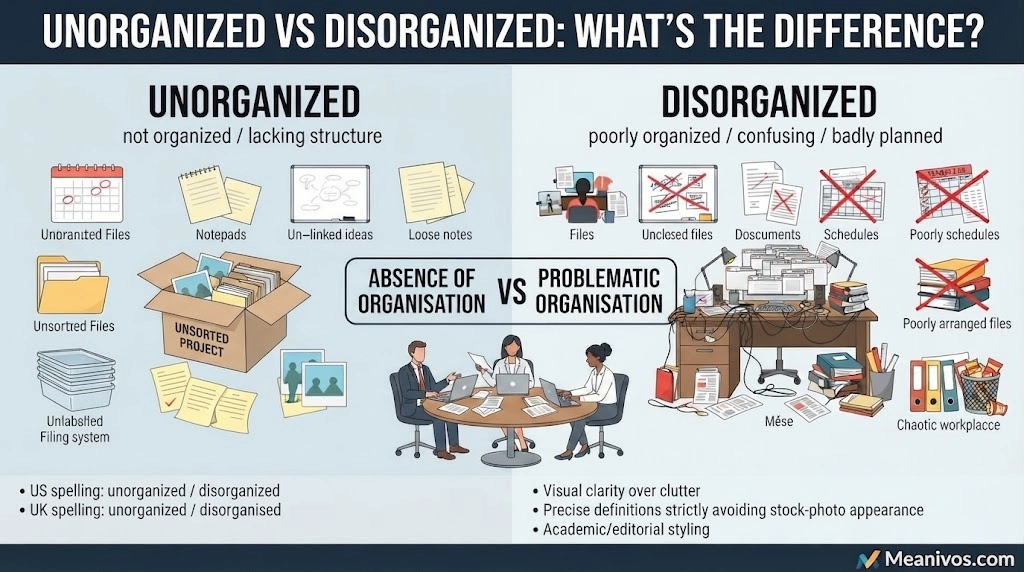
Unorganized = absence of organisation or structure.
Disorganized = disorder, poor organisation, or ineffective planning.
Think about two sets of documents.
Set A: Unorganized documents
You have just collected 1,000 documents. Nobody has sorted them into folders yet.
They are unorganized.
Set B: Disorganized documents
The documents were placed into a filing system, but the categories overlap, files are in the wrong places, naming conventions are inconsistent, and nobody can find anything.
The system is disorganized.
The difference is not necessarily about history. It is about what aspect of the situation you want to describe.
Is “Disorganized” Always Something That Was Organized Before?
No.
This is the most important correction to the common online explanation.
Many grammar websites present this as an absolute rule:
Unorganized = never organized.
Disorganized = organized before, then lost its order.
That can be a helpful memory aid, but it is not a complete definition.
Merriam-Webster defines disorganized as lacking coherence, system, or a central guiding structure.
Cambridge similarly defines it as badly planned and without order.
Neither definition requires proof that a previous organised system existed.
Therefore, a better rule is:
Unorganized highlights the absence of organisation. Disorganized highlights disorder or ineffective organisation.
That distinction is more reliable across real-world contexts.
Are “Unorganized” and “Disorganized” Interchangeable?
Sometimes.
Because the words overlap, either one may communicate the general idea that something lacks order.
For example:
The room is unorganized.
and:
The room is disorganized.
Both can tell the reader that the room lacks order.
However, the second sentence usually creates a stronger impression of mess, disorder, or poor organisation.
Compare the tone
The files are unorganized.
This may simply mean the files have not been sorted.
The files are disorganized.
This may suggest that the filing system is confusing or inefficient.
So, the words can overlap, but they are not always equally precise.
Unorganized vs Disorganized Examples
1. Notes
Unorganized:
My lecture notes are Unorganized because I haven’t sorted them by subject yet.
The focus is on the lack of sorting.
Disorganized:
My lecture notes are disorganized, so I can’t follow the main argument.
The focus is on confusion and poor arrangement.
2. Office
Unorganized:
The office supplies were unorganized after the move.
This can simply mean nobody had arranged them yet.
Disorganized:
The office was disorganized, with documents scattered across every desk.
This creates a stronger picture of disorder.
3. Meeting
Unorganized:
The new committee was unorganized because it had not assigned roles.
The group lacks an established structure.
Disorganized:
The meeting was disorganized because everyone kept talking at once.
The problem is poor coordination and order.
4. Data
Unorganized:
The researcher received unorganized data from several departments.
The data has not yet been systematically arranged.
Disorganized:
The database contains disorganized information that is difficult to analyse.
The focus is on poor arrangement and difficulty using the information.
5. Schedule
My schedule is unorganized.
This can mean it has not been properly arranged.
My schedule is disorganized.
This more strongly suggests conflicting appointments, poor planning, or difficulty managing time.
When to Use “Unorganized”
Use unorganized when you want to emphasise that something is not organized, not sorted, or lacking an established structure.
Use “unorganized” for:
Unsorted material
The documents are still unorganized.
Raw information
We received a large amount of unorganized data.
Collections
The photographs were unorganized by date.
New groups
The volunteers formed an unorganized network.
Missing formal structure
The new department is still unorganized.
Material waiting to be classified
The archive contains unorganized records.
The word is particularly useful when the organising process is incomplete or when a formal system does not exist.
When to Use “Disorganized”
Use disorganized when you want to emphasise poor order, confusion, inefficient planning, bad coordination, or difficulty managing something.
Use “disorganized” for:
People
She is extremely disorganized.
Meetings
The meeting was disorganized.
Events
The conference was disorganized from the beginning.
Workflows
The department has a disorganized workflow.
Writing
The essay becomes disorganized in the final section.
Offices
Their office is incredibly disorganized.
Schedules
His schedule is completely disorganized.
Cambridge specifically uses disorganisation for badly planned events and for people who are not good at planning or organising things.
Unorganized vs Disorganized for People
When describing a person’s habitual ability to plan, schedule, or keep things in order, disorganisation is normally the more natural choice.
For example:
Sarah is disorganized and frequently forgets appointments.
This clearly describes a person’s organisational habits.
You can say:
Sarah is unorganized.
People will understand it, but it can sound less natural if you specifically mean that she is poor at planning or managing tasks.
Cambridge explicitly includes this personal meaning for disorganized.
Compare:
Tom is unorganized because he has not created a filing system yet.
This describes a particular situation.
Tom is disorganized and constantly loses important documents.
This describes a recurring behavioural pattern.
Best choice for a person
If you mean:
“Someone who is bad at planning or keeping things in order,”
choose:
disorganized.
Unorganized vs Disorganized at Work
Both words are useful in professional writing, but they can communicate different things.
Unorganized workplace
The new department is still unorganized.
This may mean the department has not established clear roles, procedures, or systems.
Disorganized workplace
The department is disorganized.
This suggests that its operations are confusing, inefficient, or poorly coordinated.
Workplace comparison
| Situation | Better choice |
| A new team has no defined roles | Unorganized |
| Employees repeatedly miss deadlines | Disorganized |
| Raw documents have not been classified | Unorganized |
| The filing system is difficult to navigate | Disorganized |
| A new group has no formal leadership | Unorganized |
| A manager cannot coordinate the team | Disorganized |
| Data has not been sorted | Unorganized |
| Data is inconsistently arranged and difficult to use | Disorganized |
The important thing is not to memorise a rigid rule. Look at the specific problem.
Unorganized vs Disorganized for Files, Notes, and Data
These words are particularly easy to compare with digital information.
Unorganized files
The files are unorganized.
This usually suggests that the files have not been sorted into a useful system.
Disorganized files
The files are disorganized.
This suggests that the existing arrangement is confusing, inefficient, or difficult to use.
Unorganized notes
My notes are unorganized because I wrote everything in different notebooks.
Disorganized notes
My notes are disorganized, so I cannot follow the argument.
Unorganized data
The analyst received unorganized data from several departments.
Disorganized data
The database contains disorganized information that is difficult to analyse.
In many cases, both words are grammatically possible. The writer chooses between them according to the intended emphasis.
Unorganized Labour: A Special Meaning
There is an important specialised use of unorganized that many word-comparison articles overlook.
Merriam-Webster lists “not belonging to a labor union” as another meaning of unorganized.
For example:
The industry employs many unorganized workers.
Here, unorganized does not mean that the workers are messy or poorly managed.
It refers to workers who are not organised into or represented by a labour union.
This is a useful reminder that dictionary words can have more than one meaning depending on context.
Is “Unorganized” a Correct Word?
Yes.
Unorganized is a standard English word.
Merriam-Webster lists it as an adjective meaning not organized, including material that has not been brought into a coherent or well-ordered whole. It also records its specialised labour-related meaning.
Merriam-Webster gives 1653 as the first known use of unorganized.
So:
“Unorganized” is not a spelling mistake.
It is a legitimate English adjective.
However, a word being correct does not mean it is the best choice in every sentence.
For example:
He is very disorganized.
is generally more natural than:
He is very unorganized.
when describing someone’s regular planning and organisational habits.
- Explore More: https://meanivos.com/time-slot-vs-timeslot/
Is “Disorganized” a Correct Word?
Yes.
Disorganized is also a standard English adjective.
Merriam-Webster defines it as lacking coherence, system, or a central guiding agency.
Cambridge also recognises it as a word for things that are badly planned and people who are not good at planning or organising things.
Therefore, neither word is “wrong.”
The real question is:
Which word expresses your intended meaning more precisely?
Unorganized vs Disorganized: Tone and Connotation
Another useful difference is tone.
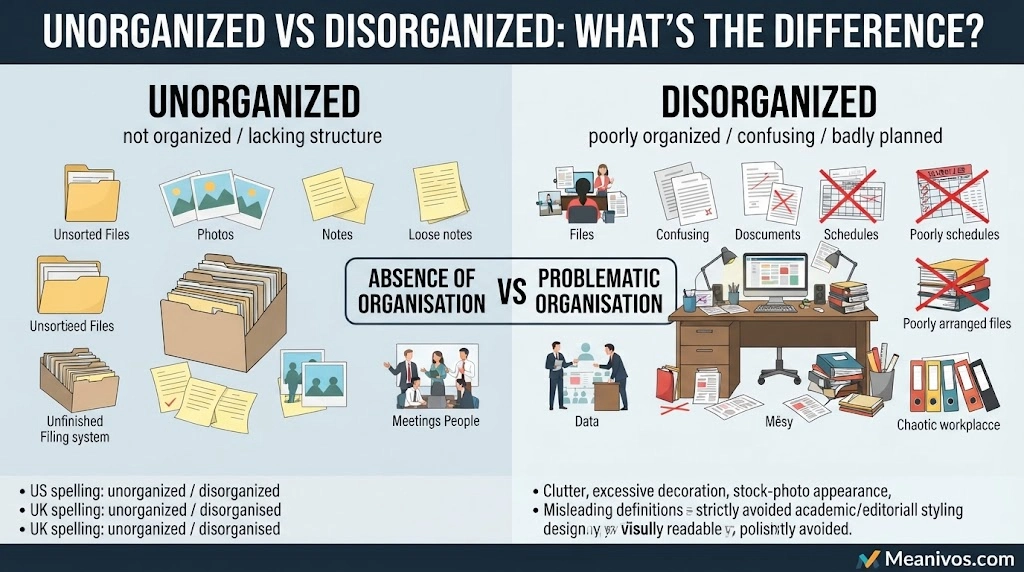
Unorganized often sounds:
- neutral
- descriptive
- unfinished
- factual
- focused on missing structure
Disorganized often sounds:
- negative
- critical
- messy
- confusing
- inefficient
- poorly planned
Compare:
The documents are unorganized.
This may simply state that they have not been sorted.
The documents are disorganized.
This can suggest that they are difficult to manage.
That distinction can be especially useful in workplace communication.
Instead of writing:
Your work is disorganized.
you might say:
The documents are currently unorganized and need to be sorted into the new filing system.
The second sentence focuses on the state of the documents rather than making a direct judgement about the person.
Unorganized vs Disorganized in Formal Writing
Both words are acceptable in formal writing.
The key is precision.
Academic writing
Use unorganized when describing material that has not been systematically arranged:
The researchers examined the unorganized observations before categorising them.
Use disorganized when describing poor structure:
The argument becomes disorganized in the final section.
Business writing
The customer records are unorganized.
This may mean they have not yet been arranged.
The customer-record system is disorganized.
This suggests that the system itself is poorly designed or maintained.
Professional feedback
For a person, disorganized is generally clearer:
The project manager appeared disorganized during the meeting.
Unorganized vs Disorganized in British English
The basic meanings are essentially the same in British and American English. The main difference is spelling.
American English
- organized
- organizing
- organization
- unorganized
- disorganized
British English
- organised
- organising
- organisation
- unorganised
- disorganised
Cambridge identifies disorganised as the usual UK spelling of disorganized.
So:
American English:
The meeting was disorganized.
British English:
The meeting was disorganised.
The same pattern applies to unorganized and unorganised.
Unorganised vs Disorganised: UK Spelling
If your audience uses British English, write:
The files remain unorganised.
The office looks completely disorganised.
For American English:
The files remain unorganized.
The office looks completely disorganized.
The meaning does not fundamentally change because of the spelling.
Unorganized Synonyms
Depending on context, possible synonyms for unorganized include:
- unstructured
- unsorted
- unordered
- unarranged
- unplanned
- unsystematic
- informal
- uncoordinated
However, these are not perfect substitutes in every sentence.
For example:
The data is unorganized.
could become:
The data is unsorted.
if the specific problem is that the information has not been sorted into categories.
Similarly:
The group is unorganized.
could become:
The group is informal.
if the important point is that the group has no formal structure.
Choose the synonym that identifies the actual problem.
Disorganized Synonyms
Possible synonyms for Disorganized include:
- chaotic
- messy
- confused
- disorderly
- scattered
- untidy
- haphazard
- poorly planned
- uncoordinated
- unsystematic
Again, context matters.
For example:
The meeting was disorganized.
could become:
The meeting was poorly planned.
if planning was the specific problem.
Or:
The meeting was chaotic.
if the level of disorder was particularly high.
The strongest synonym is not always the most accurate synonym.
Unorganized vs Disorganized: Side-by-Side Comparison
| Feature | Unorganized | Disorganized |
| Basic meaning | Not organized | Lacking effective order |
| Main focus | Absence of structure | Disorder or poor organisation |
| Tone | Often neutral | Often more negative |
| Can you describe people? | Yes, but less natural for habits | Yes, very common |
| Can you describe files? | Yes | Yes |
| Can describe meetings? | Yes | Yes |
| Can you describe groups? | Yes | Yes |
| Can you describe data? | Yes | Yes |
| Can you describe workplaces? | Yes | Yes |
| Suggests confusion? | Not necessarily | Often |
| Suggests poor planning? | Not necessarily | Often |
| US spelling | Unorganized | Disorganized |
| UK spelling | Unorganised | Disorganised |
| Special labour meaning | Yes | Not in the same sense |
Common Mistakes to Avoid
Mistake 1: Saying “disorganized” always means previously organized
This is the biggest oversimplification.
It can be a useful memory trick, but authoritative dictionary definitions are broader. Merriam-Webster defines disorganized as lacking coherence, system, or a central guiding structure.
Mistake 2: Assuming “unorganized” is incorrect
It is not.
Unorganized is a standard dictionary word.
Mistake 3: Always using “unorganized” for people
If you mean that someone is habitually poor at planning or organisation, disorganized is normally more natural.
Mistake 4: Treating the words as perfect synonyms
They overlap, but their connotations differ.
Unorganized can simply describe an absence of structure.
Disorganisation often suggests disorder, confusion, inefficiency, or poor planning.
Mistake 5: Ignoring specialised meanings
Unorganized labour can refer to workers who are not members of a labour union.
A Simple Memory Trick
Here is a useful shortcut:
UN = NOT
Think:
Unorganized = not organized.
There may simply be no established structure yet.
DIS = DISORDER
Think:
Disorganized = disorder or poor organization.
Something may be difficult to manage, follow, or understand.
But remember: this is a memory aid, not a strict rule about what happened in the past.
Which Is More Natural for a Person?
If you are describing someone’s general personality, work habits, time management, or planning ability:
Disorganized is usually the better choice.
Examples:
He is disorganized.
She is extremely disorganized.
My manager is disorganized and often misses deadlines.
The student became disorganized during exam season.
This matches Cambridge’s use of disorganisation for someone who is not good at planning or organising things.
Which Is More Natural for a Messy Room?
Disorganized is generally more natural when you want to emphasise the messy condition of the room.
My bedroom is disorganized.
The office is completely disorganized.
However, unorganized is not automatically grammatically wrong. It may work when you simply want to say that things have not been arranged.
Which Word Should You Use for a Meeting?
Usually:
The meeting was disorganized.
This is natural when the meeting was poorly planned, confusing, or badly managed.
Cambridge is disorganized specifically for things that are badly planned and without order.
If you want to describe a newly formed group that has not established roles or procedures, however, unorganized may be more precise:
The committee is still unorganized.
Which Word Should You Use for Files?
Both can work.
Use unorganized when the files have simply not been sorted:
The files are unorganized.
Use disorganized when the arrangement itself is confusing or inefficient:
The filing system is disorganized.
This is a perfect example of why context matters more than a rigid rule.
Unorganized vs Disorganized: Quick Decision Guide
Ask yourself what you are actually trying to say.
Does it simply lack organisation?
Use:
unorganized
The files are unorganized.
Is it confusing or poorly arranged?
Use:
disorganized
The files are disorganized.
Are you describing someone’s poor planning habits?
Use:
disorganized
She is disorganized.
Has a group not established a formal structure?
Use:
unorganized
The volunteer group is still unorganized.
Is a meeting poorly planned?
Use:
disorganized
The meeting was disorganized.
Are you referring to workers who are not represented by a labour union?
Use:
unorganized
The industry has many unorganized workers.
People Also Ask
A:Yes. Unorganized is a standard English adjective meaning not organized or not brought into a coherent or well-ordered whole. It also has a specialised labour-related meaning.
A:Yes. Disorganized is a standard English adjective meaning lacking coherence, system, or effective organisation.
A:Unorganized generally focuses on the absence of organisation or structure. Disorganized generally focuses on disorder, poor planning, confusion, or ineffective organisation.
A:No. That is a useful shortcut, but not an absolute rule. Major dictionary definitions do not require that a previous organised system existed.
A:Yes, but it may sound less natural when you mean that someone is habitually poor at planning or keeping things in order. Disorganized is usually the better choice for that meaning.
Final Verdict
Both unorganized and disorganized are correct English words.
The most useful distinction is:
Unorganized = not organized or lacking an established structure.
Disorganized = lacking effective order, coherence, or planning; messy or poorly organized.
Do not assume that Disorganization always describes something that someone organized in the past. Current authoritative dictionary definitions are broader. Merriam-Webster describes disorganisation as lacking coherence, system, or a central guiding structure, while Cambridge describes it as badly planned and without order.
Use unorganized when you mean that something lacks an established structure or arrangement.
When you mean that something is messy, confusing, inefficient, poorly planned, or badly arranged, disorganized is usually the stronger choice.
And when you are describing a person who struggles with planning and organisation, disorganized is normally the most natural word.
In one sentence:
Unorganized describes the absence of organisation; disorganized describes problematic or ineffective organisation.
That is the safest and most useful way to understand the difference.