Time Slot vs Timeslot: Correct Spelling & Usage Guide
If you are writing about appointments, meetings, television programmes, deliveries, classes, or schedules, you may wonder whether the correct form is time slot, timeslot, or time-slot.
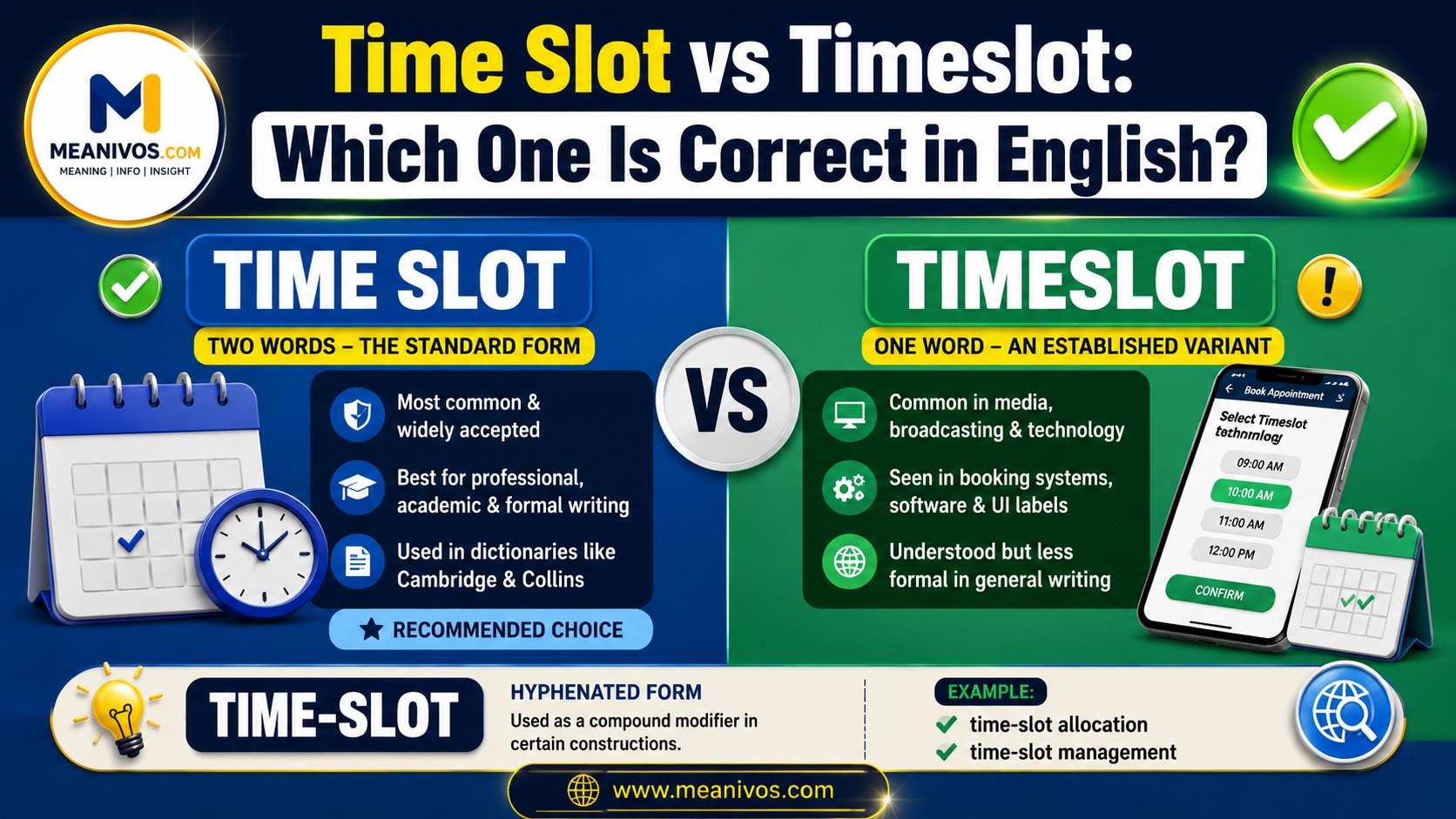
The safest choice in standard English is the time slot — two words. Cambridge Dictionary defines time slot as a time when something can happen or is planned to happen, especially when it is one of several possible times.
However, the story does not end there. Timeslot is also found in real English usage, particularly in areas such as broadcasting, technology and scheduling. So calling it an outright spelling mistake is too simplistic.
For general, professional, academic and website writing, time slots remain the best default. If you encounter a timeslot, you should understand it as a closed variant rather than assuming the writer does not know English.
Time Slot vs Timeslot: Quick Answer
Time slot is the safest and most conventional spelling for general English.
Timeslot is also used, especially in some media, technology and scheduling contexts, but it is less universally preferred.
Time-slot can occur in compound modifiers, although the ordinary noun is normally written as time slot.
| Form | Status | Recommended use |
| time slot | Standard, widely established | General, professional and academic writing |
| timeslot | Established variant in real usage | Context-dependent; especially seen in digital and media contexts |
| time-slot | Hyphenated compound form | When a particular compound construction benefits from a hyphen |
Cambridge lists time slot as the established noun, while Collins also gives time slot and its plural time slots.
The simple rule
If you are unsure which spelling to use, write:
time slot
It is the clearest choice for most readers.
What Does “Time Slot” Mean?
A time slot is a specific period of time reserved, assigned, or available for an activity.
For example:
- I booked a time slot for my dentist appointment.
- Please choose a time slot for the interview.
- Each speaker has a 20-minute time slot.
- The programme has a 9 p.m. time slot.
- Select an available delivery time slot.
Cambridge defines time slot as a time when something can happen or is planned to happen, particularly when there are several possible times.
Simple definition
Time slot = a specific period reserved or assigned for an activity, event, appointment, programme or other scheduled purpose.
The word is useful because it can describe both a fixed period and one option among several available periods.
Is “Time Slot” One Word or Two?
In standard general English, time slot is written as two words.
It is an open compound noun:
time + slot = time slot
Examples include:
- a time slot
- the time slot
- available time slots
- a morning time slot
- a 30-minute time slot
- an interview time slot
- a delivery time slot
Cambridge and Collins both represent the expression as time slot, and Collins explicitly gives the plural as time slots.
Correct examples
Please select a time slot.
We have three available time slots.
My preferred time slot is 10:30 a.m.
Incorrect standard form
Please select a timeslot.
This last version is not necessarily meaningless or incomprehensible, but time slot is the safer conventional form for edited general English.
Is “Timeslot” Correct?
Timeslot is a real form found in English usage, but it is not the safest default for general formal writing.
This distinction is important.
Some online grammar articles claim that the timeslot is always wrong. That goes further than the evidence supports. Your competitor research also identified this weakness: some pages treat timeslot as entirely incorrect even though the closed form occurs in real usage.
So there are really two questions:
Is “timeslot” used in English?
Yes.
You can find the closed form in real-world writing, particularly around broadcasting, software and scheduling.
Is “timeslot” the safest spelling for standard English?
Usually no.
For general professional or academic writing, time slot is the better choice.
This distinction gives a more accurate answer than simply saying:
“Timeslot is wrong.”
Time Slot vs Timeslot: What Is the Difference?
The main difference is spelling and editorial convention, not meaning.
Both forms can refer to a scheduled or allocated period.
Compare:
Please choose a time slot for your appointment.
and:
Please choose a timeslot for your appointment.
The intended meaning is essentially the same.
The important difference is that time slot is the more conventional form in general edited English.
| Feature | Time slot | Timeslot |
| Words | Two | One |
| Basic meaning | Scheduled period | Scheduled period |
| Standard general usage | Preferred | Less consistently preferred |
| Professional writing | Recommended | Use according to context |
| Academic writing | Safer choice | Usually avoid |
| Technology | Common | Also encountered |
| Broadcasting | Common | Also encountered |
| Meaning | Same | Same |
So this is primarily a usage and spelling question, rather than a difference in definition.
What About “Time-Slot”?
The hyphenated form time-slot can appear, but it is usually unnecessary when the expression is functioning as an ordinary noun.
Write:
I booked a time slot.
rather than:
I booked a time-slot.
When can a hyphen help?
A hyphen can sometimes be useful when multiple words work together as a compound modifier before another noun.
For example:
The company introduced a time-slot allocation system.
Here, time-slot functions together as a modifier of allocation.
Another possible construction is:
We need better time-slot management.
However, hyphenation depends on the construction and the style guide being followed. Do not automatically hyphenate the time slot every time it appears.
Easy rule
Ordinary noun:
Use time slot
Compound modifier:
A hyphen may sometimes improve clarity: time-slot allocation
When Should You Use “Time Slot”?
Use a time slot when writing ordinary English for a broad audience.
It works particularly well in these situations.
1. Appointments
Please select a time slot for your appointment.
The next available time slot is 3:00 p.m.
2. Meetings
Each team has a 30-minute time slot.
Can we move our meeting to another time slot?
3. Interviews
Please choose an interview time slot.
4. Classes
Students can select their preferred time slot.
5. Deliveries
Choose a delivery time slot at checkout.
6. Events
Visitors must reserve a Time Slot before entering.
7. Presentations
Each presenter has a 15-minute time slot.
8. Healthcare
The clinic offers 20-minute time slots for consultations.
9. Online bookings
Select an available time slot before completing your booking.
These examples demonstrate why the expression has such broad everyday use.
When Might You See “Timeslot”?
Although time slot is the safer general form, you may encounter timeslot in several specialised environments.
Broadcasting
Television and radio are common contexts.
You may see:
The programme moved to a later timeslot.
The same sentence can naturally be written:
The programme moved to a later time slot.
The meaning does not materially change.
Collins defines a television or radio programme’s time slot as the time when it is broadcast.
Software
Scheduling applications sometimes use compact interface labels such as:
Available Timeslots
A software interface may favour a closed compound because shorter labels fit better into buttons, menus or database fields.
That does not automatically establish the interface spelling as the preferred form for all English prose.
Booking systems
You may also encounter:
Select a timeslot.
or:
Available timeslots: 9:00–11:00.
These forms are understandable and appear in real digital environments.
If you are writing the website copy yourself rather than reproducing an established product label, time slot remains the safer editorial choice.
Time Slot vs Timeslot in British and American English
A common question is whether time slot is British English while timeslot is American English.
That is not the best way to understand the difference.
Time slots are established in both British and American English. Cambridge provides UK and US pronunciation information for the expression.
British English
Prefer:
time slot
American English
Prefer:
time slot
International English
For an international website, the time slot is particularly safe because it is immediately recognisable and conventional.
Therefore, do not treat this as a normal British-versus-American spelling difference like colour and color.
The distinction is better explained through editorial preference, compound spelling and context.
Why Does “Timeslot” Exist?
English compound words do not always remain in the same written form forever.
A combination can develop from:
open compound → hyphenated compound → closed compound
English has many examples of words becoming increasingly compressed over time.
For example:
- web site → website
- on line → online
- time table → timetable
This helps explain why the timeslot looks perfectly natural to many readers.
Digital communication can also encourage shorter forms. Software interfaces, product terminology, database fields and website labels often favour compact compounds.
But familiarity does not automatically mean that the closed form is the preferred spelling in every type of writing.
That is why timeslot can exist in genuine usage while time slot remains the safer conventional form.
Time Slot in Different Contexts
The phrase appears across many industries.
Appointment Scheduling
Doctors, dentists, salons and service providers divide working hours into appointment periods.
The clinic offers 20-minute time slots.
Business Meetings
Businesses use time slots to organise calendars and workloads.
I have a free time slot between 2 and 3 p.m.
Television
A television programme can be assigned a particular broadcasting period.
The show received a prime-time slot.
Cambridge’s examples include television programming and other scheduled activities.
Radio
The station moved the programme to a later time slot.
Events
Museums, exhibitions and attractions may ask visitors to reserve arrival periods.
Visitors must reserve a time slot online.
Deliveries
Retailers can divide delivery schedules into periods.
Your order is scheduled for the 4–6 p.m. delivery time slot.
Education
Schools and training providers can allocate periods for classes or presentations.
Each student received a 10-minute presentation time slot.
Technology
Scheduling systems may use either time slot or timeslot in labels and terminology.
This is one reason people encounter both forms online.
Time Slot Plural: Time Slots or Timeslots?
If you use the standard two-word form, the plural is:
time slots
Examples:
We have five available time slots.
All morning time slots are booked.
The system displays available time slots.
Collins explicitly lists the plural of time slot as time slots.
If you intentionally use the closed variant, its plural is:
timeslots
For general professional writing, however, time slots are the safer choice.
- Explore More: https://meanivos.com/trailer-or-trailor/
What about “time-slots”?
The ordinary plural should not normally be written:
time-slots
When the noun is simply time slot, the natural plural is:
time slots
Is “Time Slot” Better for SEO?
If you are creating website content, do not force a timeslot into every sentence simply because it is a search variation.
A strong SEO article should naturally cover:
- time slot vs timeslot
- time slot or timeslot
- is timeslot correct
- is timeslot one word
- time slot meaning
- timeslot meaning
- time-slot
- time slots
- scheduling time slots
The goal is not to repeat the keyword unnaturally.
Instead, answer the different questions searchers have.
For example:
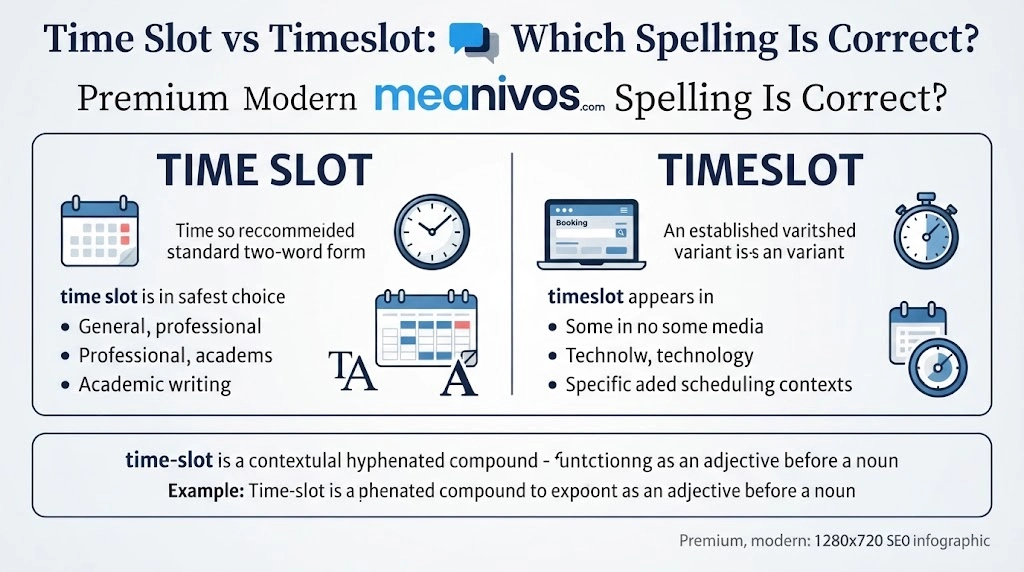
Time Slot is the safest standard form, while timeslot is a recognised variant that appears in some media, technology and scheduling contexts.
That sentence gives readers the answer while naturally covering the central semantic relationship.
Common Mistakes to Avoid
Mistake 1: Saying “Timeslot Is Always Wrong”
This is too absolute.
Real English usage includes the closed form, particularly in some specialised contexts. Your source research specifically identified this as a weakness in competing articles.
Mistake 2: Saying Both Forms Are Equally Preferred Everywhere
That is also misleading.
For general standard writing, the time slot remains the safer choice.
Mistake 3: Automatically Hyphenating It
Do not write:
I booked a time-slot.
when the expression is simply being used as a noun.
Prefer:
I booked a time slot.
Mistake 4: Assuming Software Labels Set Grammar Rules
A scheduling application may use timeslot because of its own product terminology.
That does not mean every article, email or academic paper should copy the interface wording.
Mistake 5: Ignoring Context
Broadcasting, technology and scheduling systems can make timeslot more visible.
Context matters.
Mistake 6: Treating It as a British-American Spelling Difference
The time slot is used in both British and American English.
Time Slot vs Timeslot: Examples
Here is a quick practical reference.
Standard form
Please select a time slot for your appointment.
Closed variant
The programme was moved to a later timeslot.
Standard plural
Several morning time slots are still available.
Closed plural
The booking system automatically generates timeslots.
Compound modifier
The company needs a better time-slot allocation system.
Business example
We can offer you a different time slot tomorrow.
Academic example
Each speaker was assigned a 20-minute time slot.
Media example
The programme received a new evening time slot.
Time Slot vs Timeslot: Which One Should You Use?
Use this decision guide:
| Situation | Best choice |
| General English | time slot |
| Professional email | time slot |
| Academic writing | time slot |
| Business website | time slot |
| Appointment booking | time slot |
| Customer communication | time slot |
| International audience | time slot |
| Software interface | Follow the product’s terminology |
| Broadcasting terminology | time slot is safe; timeslot may appear |
| Compound modifier | time-slot may sometimes be appropriate |
The easiest rule
If you are writing something yourself and have no specific style guide or terminology requirement:
Choose “time slot.”
Topical Cluster Ideas
1: Compound Words
- Time slot vs timeslot
- Timetable vs time table
- Website vs web site
- Online vs on line
2: Hyphenation
- Time-slot vs time slot
- Check-in vs check in
- Follow-up vs follow up
- Login vs log in
3: Commonly Confused Spellings
- Requester vs requestor
- Ingrained vs engrained
- Trailer vs trailor
- Peak vs peek vs pique
A Simple Memory Trick
Think of the expression as:
time + slot = time slot
A slot is a place or position reserved for something.
Therefore, a time slot is simply a reserved position in a schedule.
If you are writing an email, article, essay, report, business document or website page and hesitate between the forms, remember:
When in doubt, use “time slot.”
People Also Ask
A:Time slot is normally written as two words in standard general English. Cambridge and Collins both use this form.
A:Timeslot is found in real English usage, especially in some media, technology and scheduling contexts. It should not automatically be dismissed as a meaningless typo.
A:For: general, professional and academic writing, a time slot is the better default.
A:It can appear as a hyphenated compound modifier in certain constructions, but the ordinary noun is normally a time slot.
A:The standard plural is time slots. Collins explicitly lists this plural form.
Final Verdict
If you need one clear answer, choose:
Time Slot
It is the conventional two-word form represented by major dictionaries such as Cambridge and Collins.
But there is an important nuance: Timeslot is not simply a meaningless spelling error. The closed form occurs in real English usage, particularly in some media, technology and scheduling contexts.
So the most accurate rule is:
- Use “time slot” for general, formal and professional writing.
- Recognise “timeslot” as a real variant that you may encounter.
- Use “time-slot” only where a hyphenated compound construction makes sense.
- Use “time slots” as the normal plural of the standard two-word form.
One-line answer
Time slot is the safest standard choice; timeslot is a recognised variant used in some contexts, while time-slot is mainly a contextual hyphenated form.