Extensible vs Extendible: Meaning & Key Differences
Extensible and extendible look almost identical, and both are related to the verb extend. That similarity makes the two words easy to confuse, especially when you are writing about software, contracts, systems or physical objects.
So, which one is correct?
Both “extensible” and “extendible” are legitimate English words. However, they are not equally common in every context. Extensible is especially well established in technology and software, while extendible is less common and overlaps closely with extendable. Cambridge specifically uses extensible for computer programs and languages that can be modified to meet users’ needs, while Collins defines it more broadly as something capable of being extended.
There is also a third word worth knowing: extendable. It is often the clearest choice when something can literally be made longer or when a period can be prolonged. Cambridge gives examples such as an extendable ladder and an extendable lease.
That means the real question is not simply “Which spelling is right?” It is:
Which word is most natural for the context?
Extensible vs Extendible: Quick Answer
| Word | Basic meaning | Typical use | Practical choice |
| Extensible | Capable of being extended or expanded | Software, systems, APIs, frameworks, technical writing | Best for many technical contexts |
| Extendible | Capable of being extended | General or technical contexts | Correct, but less common |
| Extendable | Able to be made longer or continued | Objects, periods, contracts, leases | Often clearest in everyday English |
The key distinction is usage rather than a simple right-versus-wrong spelling rule.
For software, programming and system architecture, extensible is normally the natural choice.
For something that can be physically made longer or can continue for a longer period, extendable is often more straightforward.
Extendible is valid English, but because it is less familiar to many readers, it may not always be the best stylistic choice.
What Does “Extensible” Mean?
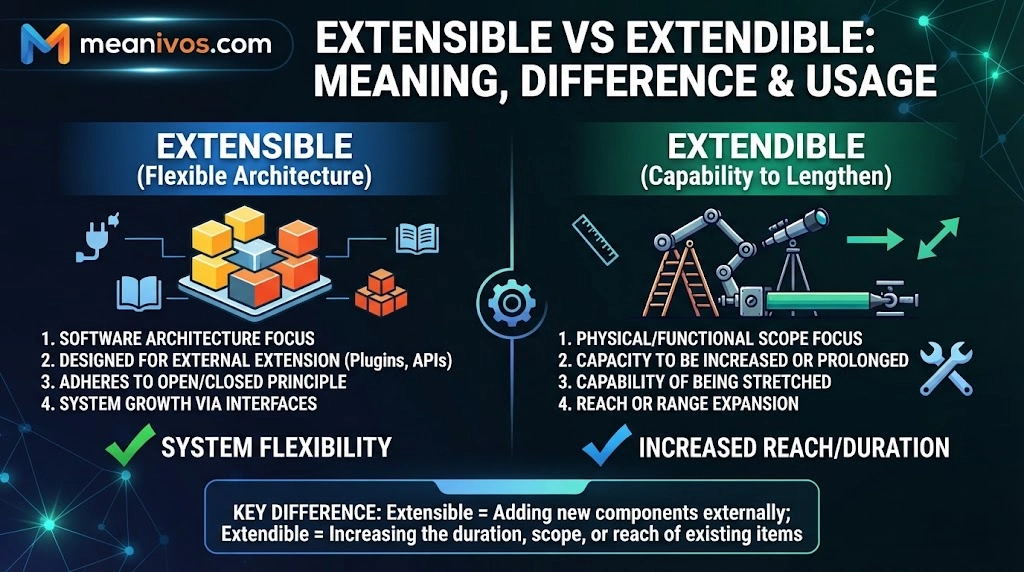
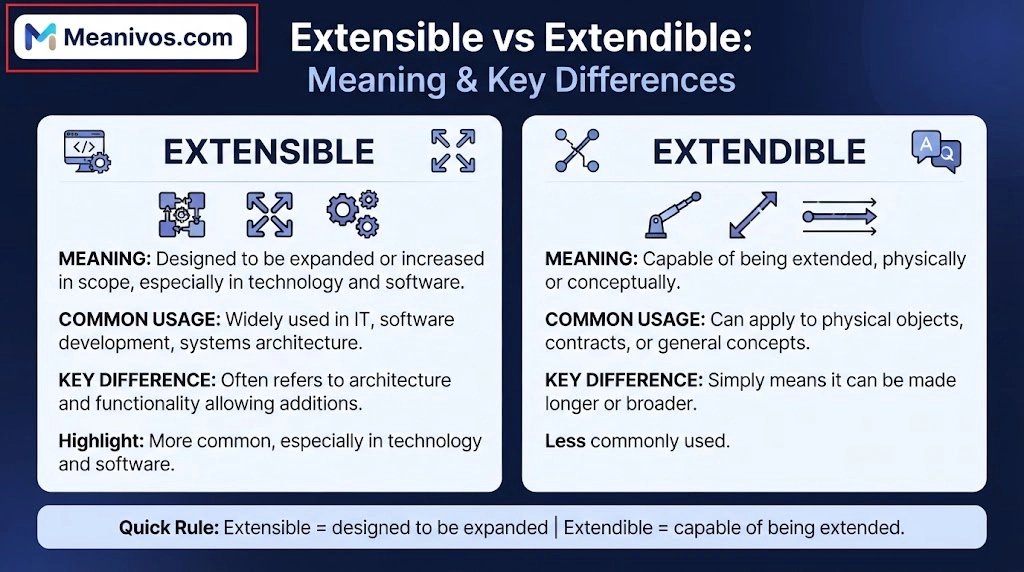
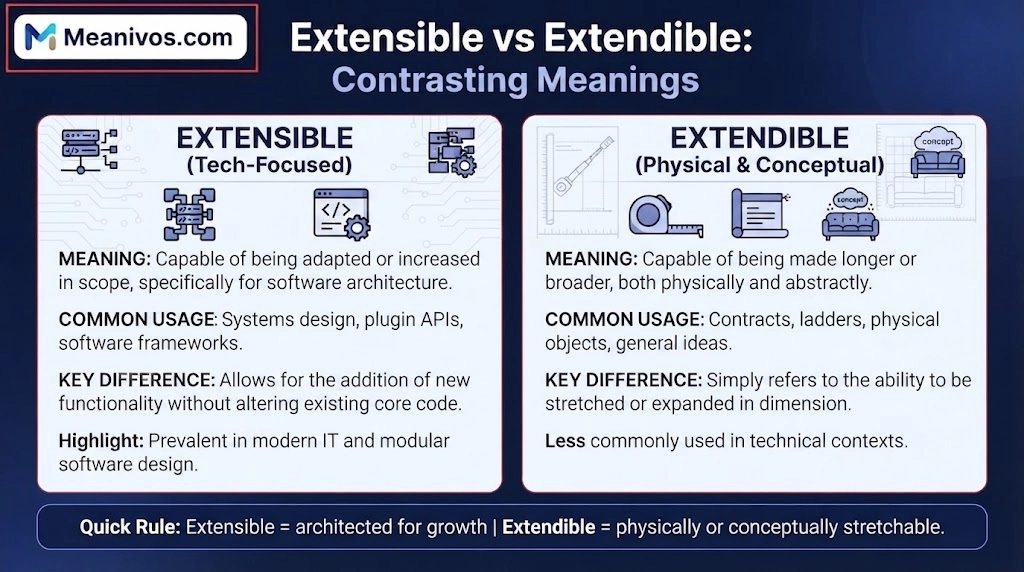
Extensible is an adjective meaning capable of being extended.
Cambridge gives extensible a specific information-technology meaning: it can describe a computer program or language that users can change to make it suitable for their needs. Cambridge’s examples also show that the word is used beyond computing.
Collins likewise defines extensible as capable of being extended.
Extensible in Software
This is where extensibility becomes especially important.
In software development, an extensible system is designed so that new functionality can be added without completely rebuilding the original system.
For example:
- The application has an extensible architecture.
- The framework provides an extensible plugin system.
- The API is designed to be extensible.
- The platform supports an extensible module system.
- The software has an extensible design.
- Developers can add new features because the system is highly extensible.
Here, extensible communicates more than simply “longer.”
It suggests that the capabilities, functionality, structure or scope of something can be expanded.
Why Is “Extensible” Common in Technology?
Modern software frequently grows through additions such as:
- plugins
- extensions
- modules
- integrations
- APIs
- themes
- custom functions
- third-party components
This is why the related noun Extensibility is so familiar in technical writing.
For example:
The framework’s extensibility makes it suitable for third-party development.
Collins defines extensibility as the quality or ability of being capable of extension.
A useful mental connection is:
Extensible → extensions → software can gain new capabilities.
Extensible Examples
Here are some natural examples:
- The platform has an extensible architecture.
- Developers created an extensible API for third-party integrations.
- The software is highly extensible through plugins.
- We need an extensible system that can support future requirements.
- The framework provides an extensible component model.
- The application was designed to remain extensible as it grows.
- The programming language is highly extensible.
- The company chose an extensible architecture for its new product.
Notice how many examples involve abstract systems or functionality, rather than something simply becoming physically longer.
What Does “Extendible” Mean?
Extendible means capable of being extended.
Most importantly, extendible is a real English word.
Collins explicitly defines extendible as extensible; also extendable and lists related forms including extendibility and extendability.
So it is inaccurate to say that extendible is always a misspelling.
However, correctness and frequency are not the same thing.
A word can be legitimate while still being less common or less natural in a particular context.
Is “Extendible” a Correct Word?
Yes.
If you see extendible in a dictionary or a professionally written document, you should not automatically treat it as an error.
The practical issue is that many modern writers have more familiar alternatives:
- extensible for software and expandable systems
- extendable for things that can be made longer or continued
Because extendible is less familiar, some readers may initially think it is a spelling mistake.
That is a usage and style issue, not evidence that the word is invalid.
Extendible Examples
You may encounter sentences such as:
- The contract is extendible under certain conditions.
- The equipment has an extendible arm.
- The agreement contains an extendible term.
- The structure uses an extendible section.
- The table has an extendible design.
These sentences are understandable, and extendible is a recognised word.
However, in several everyday contexts, extendable may sound more natural:
The contract is extendable.
may feel more familiar to a general reader than:
The contract is extendible.
Again, that does not make it extendible wrong.
Extensible vs Extendible: What’s the Difference?
The two words have substantial semantic overlap.
Both can communicate the basic idea:
“capable of being extended.”
The most useful difference is therefore context, conventional usage and frequency.
Extensible
Extensible is especially natural when discussing:
- software
- programming
- APIs
- frameworks
- systems
- architectures
- platforms
- technical designs
- abstract structures
Example:
The software uses an extensible architecture.
This tells the reader that the system can be expanded or adapted with additional functionality.
Extendible
Extendible can also express the idea of being capable of extension.
Example:
The agreement is extendible for another year.
However, because extendible is less common, extendable may often be a more familiar alternative in general English.
Extensible vs Extendible vs Extendable
This three-way comparison is one of the most important parts of the distinction.
| Word | What it generally communicates | Example |
| Extensible | Capable of being extended or expanded | An extensible software architecture |
| Extendible | Capable of being extended | An extendible agreement |
| Extendable | Able to be made longer or last longer | An extendable ladder or lease |
Cambridge defines extendable in terms of something that can be made longer and also uses it for something that can last longer.
Collins likewise describes an extendable thing as something that can be made longer.
So, if you are writing about a ladder, table or lease, extendable is often the clearest choice.
If you are writing about software architecture, extensible is usually much more natural.
When Should You Use “Extensible”?
Use extensible when you mean that something can gain additional functionality, capability, scope or components.
Software
The application is extensible through plugins.
Architecture
The company needs an extensible architecture.
API
The API was designed to be extensible.
Framework
This framework provides an extensible component system.
System
The system is sufficiently extensible to support future requirements.
A useful memory rule is:
EXTENSIBLE → EXTENSIONS
If you can add plugins, modules, extensions or functionality, extensible is often the best choice.
When Should You Use “Extendible”?
Use extendible when it genuinely matches the terminology of your context, organisation or technical document.
For example:
The agreement is extendible for an additional six months.
There is nothing inherently wrong with the sentence.
However, if your main goal is maximum clarity for a broad audience, consider whether extendable would be more familiar.
This is particularly relevant when you mean:
- made longer
- continued for more time
- physically lengthened
In those situations, extendable is often the easier word for readers.
When Should You Use “Extendable”?
Extendable is often the clearest everyday choice when something can be made longer or last longer.
Cambridge gives examples including:
an extendable ladder
and:
an extendable lease.
Other natural examples include:
- an extendable table
- an extendable handle
- an extendable deadline
- an extendable contract
- an extendable term
- an extendable pole
For example:
We bought an extendable ladder.
This is generally more natural for everyday English than:
We bought an extendible ladder.
- Explore More: https://meanivos.com/chatgpt-meaning/
Extensible vs Extendible: Real-World Examples
Example 1: Software
Natural:
The application is extensible through plugins.
Possible but less conventional:
The application is extensible through plugins.
For modern software writing, extensible is the stronger choice.
Example 2: Ladder
Natural:
The ladder is extendable.
Less familiar:
The ladder is extendible.
When the meaning is physical length, extendable is usually clearer.
Example 3: Contract
Natural:
The contract is extendable for another year.
Also possible:
The contract is extendible for another year.
The second version is not automatically wrong; the first is simply more familiar to many readers.
Example 4: Architecture
Natural:
The architecture is extensible.
Possible but less conventional:
The architecture is extendible.
In software and technical architecture, extensibility is strongly established.
Example 5: Deadline
The deadline is extendable under certain conditions.
Here, extendable works naturally because the meaning is that the period can be prolonged.
Is “Extensible” Only Used for Software?
No.
This is another common oversimplification.
Although extensible is strongly associated with computing, its general meaning is simply capable of being extended. Collins gives the broad definition without restricting it to technology.
Cambridge’s corpus also contains extensible in contexts outside software, including scientific and physical uses.
Therefore:
Extensible is especially common in technology, but it is not exclusively a technology word.
Is “Extendible” a Misspelling of “Extensible”?
No.
They are separate words.
Extensible means capable of being extended.
Extendible is also a recognised adjective and overlaps with extendable. Collins explicitly records this relationship.
The confusion is understandable because all three words are built around the same underlying idea:
- extensible
- extendible
- extendable
But spelling similarity does not mean that one of them is necessarily an error.
Why Do People Confuse Extensible and Extendible?
The confusion comes from their shared connection with extend.
Compare the forms:
- extend + ible → extendible
- extensible → extendable
- extend + able → extendable
All three are related to the concept of extension.
The spelling difference is small, but English does not always use similar suffixes in identical ways. Context and established usage are therefore more useful than trying to decide based on spelling alone.
Extensible vs Extendible in Technical Writing
Technical writers should pay particular attention to conventional terminology.
In software documentation, extensible is strongly established.
For example:
The framework provides an extensible plugin architecture.
This immediately tells developers that additional functionality can be added.
Common technical phrases include:
- extensibility
- extensible architecture
- extensible framework
- extensible API
- extensible platform
- extensible system
- extensible plugin model
- extensible component system
For professional software writing, prefer “extensible” unless a project’s established terminology specifically uses another form.
Extensibility vs Extendibility
The corresponding nouns are also worth understanding.
Extensibility
Extensibility means the quality or ability of being extensible.
Example:
The framework’s extensibility makes it suitable for third-party developers.
This is a particularly familiar term in software engineering. Collins defines extensibility as the quality of being capable of extension or the ability to be extended.
Example:
Extendibility
Extendibility refers to the quality or capability of being extendible.
The extendibility of the agreement depends on its renewal clause.
Both forms are possible, but in software and programming, extensibility is far more conventional.
Extensible vs Extendible in British and American English
Both words can occur in British and American English.
There is no useful universal rule saying:
British English = one word
American English = the other
Instead, consider:
- the subject,
- the intended meaning,
- the publication’s style guide,
- established terminology in the relevant industry.
For international English, extensible is a safe and familiar choice for software and technical systems.
For physical objects or periods that can be made longer, extendable is usually straightforward.
Pronunciation of Extensible and Extendible
Extensible
Cambridge gives the pronunciation:
/ɪkˈstensɪbl/
A simple approximation is:
ik-STEN-suh-buhl.
Extendible
A common pronunciation is approximately:
ik-STEN-duh-buhl
The words are similar enough in sound that writers may become unsure about their spelling when they have heard rather than read the word.
Word Origins
The three words ultimately connect to the verb extend.
The underlying idea is associated with stretching or drawing something out.
Collins traces extend to Latin extendere, from tendere, meaning “to stretch.”
The history helps explain why extensible, extendible and extendable have such closely related meanings.
Collins dates extensible to the early seventeenth century and gives its origin through French and Medieval Latin from Latin extendere.
Common Mistakes to Avoid
Mistake 1: Saying “extendible is always wrong”
This is the biggest mistake.
Extendible is a recognised English word.
It should not automatically be marked as a spelling error.
Mistake 2: Automatically using “extendible” for software
Although readers may understand it, extensible is generally the more conventional choice in modern technical writing.
The API is extensible.
is more natural than:
The API is extensible.
Mistake 3: Assuming “extensible” only means software
It does not.
The general meaning is capable of being extended, although software and computing provide one of its strongest modern contexts.
Mistake 4: Forgetting “extendable”
Sometimes neither extensible nor extendible is the clearest option.
For example:
extendable ladder
extendable lease
Cambridge explicitly uses both types of examples.
A Simple Memory Trick
Remember this three-part rule:
EXTENSIBLE → EXTENSIONS
Think:
software + plugins + modules = extensible
EXTENDABLE → MADE LONGER
Think:
ladder + table + lease = extendable
EXTENDIBLE → VALID BUT LESS COMMON
Think:
correct word, but often replaced by “extendable” or “extensible” depending on context.
Extensible vs Extendible: Which One Should You Use?
If you are writing about:
- software
- programming
- APIs
- frameworks
- plugins
- system architecture
- technical platforms
choose:
Extensible
If you mean something can be:
- physically made longer
- continued
- prolonged
- given additional time
choose:
Extendable
If you encounter:
Extendible
do not automatically call it wrong.
It is a legitimate English word, but it is less common and may not be the most natural option for your audience.
The practical rule
Extensible = especially common for expandable systems and software.
Extendable = especially clear for things that can be made longer or prolonged.
Extendible = correct, but less common.
People Also Ask
A:They overlap heavily and can both describe something capable of being extended. However, extensible is much more conventional in many technical contexts, while extendible is less common.
A:Software can be designed to accept additional functionality through plugins, modules, APIs and extensions. Extensible is therefore a well-established technical term for systems designed to grow or adapt.
A:Yes. Extendible is a legitimate adjective. The issue is usually not grammar but whether it is the most familiar or appropriate word for the context.
A:Often, yes, when talking about something that can be physically made longer or a period that can be prolonged. But extendible remains valid.
A:Extensible API is the conventional choice in modern technical writing.
Conclusion
In summary, extensible and Extendible are both legitimate English words, but extensible is the more common and preferred choice, especially in modern technical and software-related writing. Extensible generally describes something that can be expanded or enhanced without fundamentally changing its existing structure.
Extendible can also mean capable of being extended, but it is less common and is often used in more general contexts. When writing about software, programming, systems, APIs, or technology, extensible is usually the clearest and most natural option.
So, if you are unsure which spelling to use, remember this simple rule: use “extensible” when you mean designed or able to be expanded, particularly in technology; use “extendible” when the context specifically calls for the alternative form.
Understanding this small difference can help you choose the right word and make your writing more precise, professional, and natural.