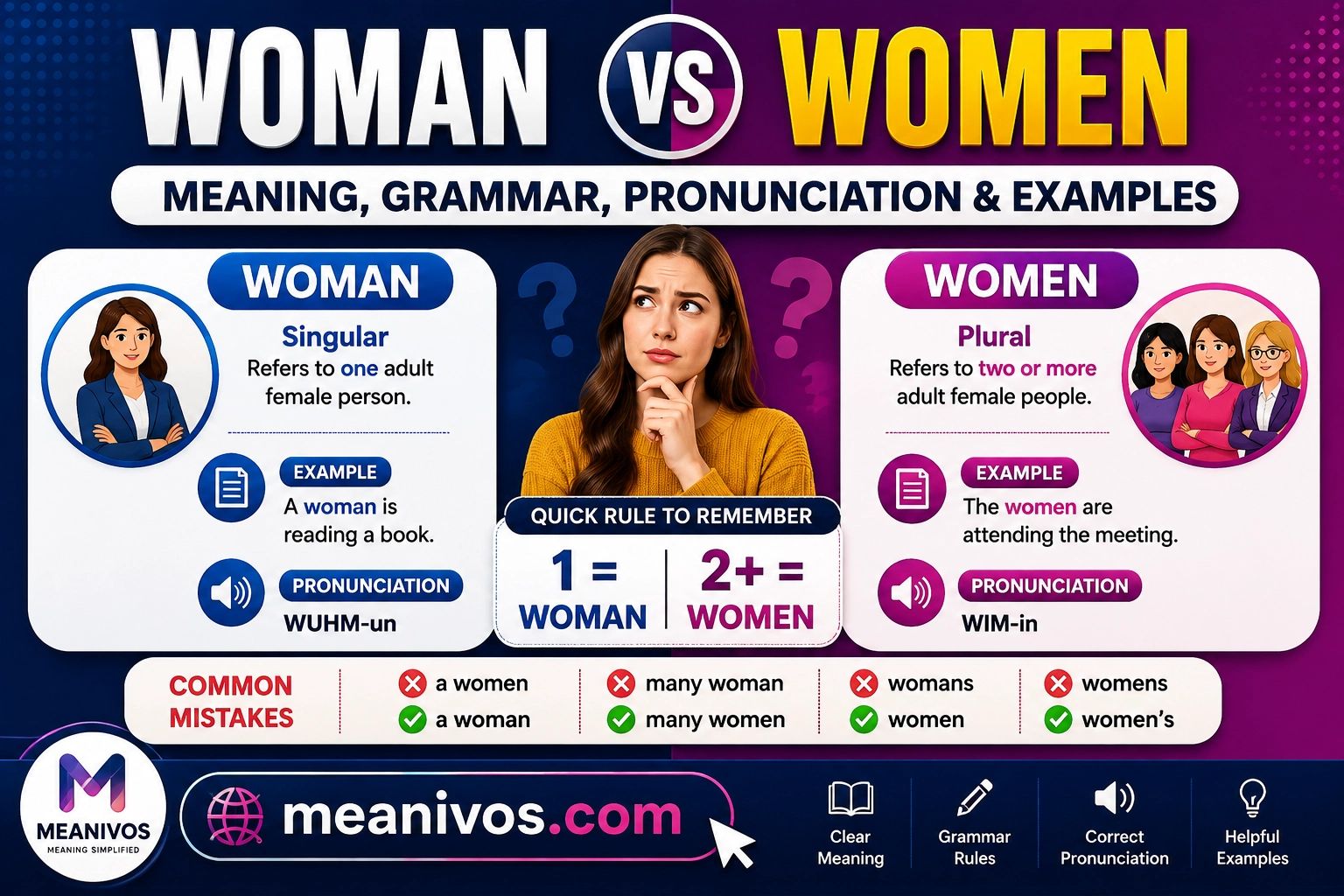
Woman vs Women: What’s the Difference? Complete Grammar Guide
If you have ever paused while writing and wondered whether to use woman or women, you are not alone. These two words look very similar, but they have different grammatical meanings.
The simplest rule is:
Woman = one adult female person.
Women = two or more adult female people.
For example:
- One woman is waiting outside.
- Three women are waiting outside.
The confusion becomes easier to understand when you remember that woman is singular and women is its irregular plural form. The pronunciation changes too: woman is generally pronounced /ˈwʊmən/, while women is generally pronounced /ˈwɪmɪn/.
This guide explains the difference between woman vs women, including meaning, grammar, pronunciation, possessives, verb agreement, common mistakes, examples, memory tricks, and frequently asked questions.
Woman vs Women: The Quick Answer
| Word | Number | Meaning | Example |
| woman | Singular | One adult female person | She is a talented woman. |
| women | Plural | Two or more adult female people | The women are talented. |
The fastest rule to remember is:
1 = woman
2 or more = women
Compare:
- The woman is a doctor.
- The women are doctors.
Notice that changing woman to women also changes the verb from is to are.
What Does “Woman” Mean?
Woman is a singular noun referring to an adult female person.
It is used when you are talking about one person.
Examples:
- She is a successful woman.
- I spoke with a woman at the reception desk.
- That woman is my teacher.
- A woman called earlier.
- Every woman deserves respect.
- One woman answered the question.
Dictionary sources identify woman as a singular noun and women as its plural form.
When should you use “woman”?
Use woman when the sentence refers to exactly one person.
It commonly appears after words such as:
- a
- one
- this
- that
- each
- every
For example:
A woman is waiting outside.
Not:
❌ A women is waiting outside.
The reason is simple: a is used with a singular countable noun.
What Does “Women” Mean?
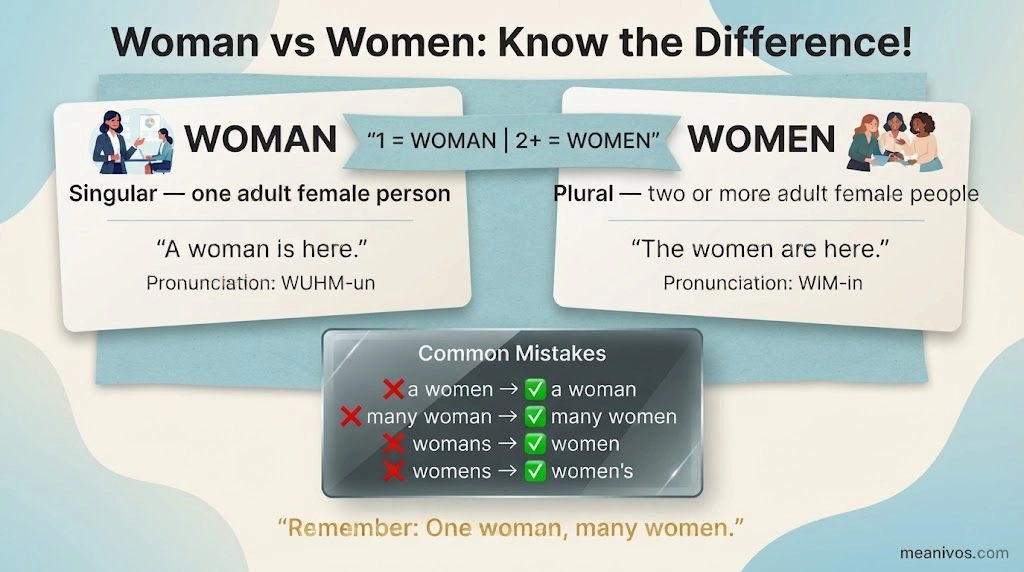
Women is the plural form of woman.
It refers to two or more adult female people.
Examples:
- Two women entered the room.
- Many women work in technology.
- Several women attended the conference.
- These women are scientists.
- The women were waiting for the bus.
- Three women joined the team.
Because women is plural, it normally works with plural verbs and plural determiners.
For example:
Many women are interested in the program.
Not:
❌ Many woman is interested in the program.
Woman vs Women: Key Differences
The central difference is grammatical number.
Woman = singular
Use woman for exactly one adult female person.
The woman is reading a book.
Women = plural
Use women for more than one adult female person.
The women are reading books.
The plural is irregular because English does not simply add -s to woman. Instead:
woman → women
This pattern is similar to other irregular plurals:
- man → men
- child → children
- tooth → teeth
- mouse → mice
Is “Woman” Singular or Plural?
Woman is singular.
It refers to one adult female person.
Examples:
- A woman is standing near the door.
- The woman was very helpful.
- One woman has submitted the application.
- That woman is my neighbor.
A useful test is to ask:
How many people am I talking about?
If the answer is one, use woman.
Is “Women” Singular or Plural?
Women is plural.
It refers to more than one adult female person.
Examples:
- The women are working together.
- Two women were waiting outside.
- Many women have contributed to the project.
- Those women are teachers.
You can also use pronouns as a quick check:
The woman is ready. → She is ready.
The women are ready. → They are ready.
In standard modern English, women is the plural form of woman, not its ordinary singular form.
How to Use “Woman” in a Sentence
Because woman is singular, it usually takes singular grammar.
With “a”
She is a woman.
With “one”
One woman answered the question.
With “this”
This woman is a professional artist.
With “every”
Every woman received a certificate.
With singular verbs
The woman is speaking.
Woman was waiting.
The woman has finished her work.
The important rule is to keep the noun, determiner, pronoun, and verb consistent with singular meaning.
How to Use “Women” in a Sentence
Use women when you mean two or more people.
With numbers
Two women joined the team.
Five women attended the meeting.
With plural quantifiers
Many women enjoy reading.
Several women participated in the event.
With plural verbs
The women are working.
Women were invited.
The women have completed the project.
A simple formula is:
woman + singular grammar
women + plural grammar
Woman vs Women Pronunciation
Pronunciation is one of the main reasons these words confuse English learners.
How do you pronounce “woman”?
Woman is generally pronounced:
/ˈwʊmən/
A simple approximation is:
WUHM-un
Example:
She is a woman.
How do you pronounce “women”?
Women is generally pronounced:
/ˈwɪmɪn/
A simple approximation is:
WIM-in
Example:
The women are here.
The first vowel sound is the major difference:
- woman → “wuh”
- women → “wih”
Dictionary sources provide these differing pronunciations for the singular and plural forms.
Why do “woman” and “women” sound so different?
English has many words whose spelling and pronunciation developed through historical changes. Woman and women are examples of this irregular pattern.
So do not try to pronounce women as “woman + s.”
Instead, learn the pair together:
woman → WUHM-un
women → WIM-in
Saying the two words aloud is a useful way to reinforce the difference.
Why Is the Plural of Woman “Women”?
The plural women comes from the historical development of the English language.
Woman developed from Old English forms associated with wīfman, and its plural developed through older vowel changes. English eventually retained the irregular pattern woman → women rather than creating a regular plural such as womans. The Oxford English Dictionary documents the historical development of the word.
You do not need to memorize the entire history to use the word correctly.
Just remember:
woman → women
The same type of vowel change appears in:
man → men
Woman’s vs Women’s: What’s the Difference?
This is one of the most common follow-up questions about woman vs women.
Woman’s
Woman’s is the possessive form associated with one woman.
Examples:
- The woman’s bag is on the table.
- I found the woman’s phone.
- The woman’s car is outside.
- She admired the woman’s work.
Think:
one woman → woman’s
Women’s
Women’s is the possessive form associated with multiple women or women as a group.
Examples:
- The women’s team won the championship.
- The women’s clothing section is upstairs.
- The organization supports women’s education.
- We attended a women’s conference.
Think:
women → women’s
Quick comparison
| Form | Meaning | Example |
| woman | One person | She is a woman. |
| women | More than one | They are women. |
| woman’s | Associated with one woman | The woman’s coat |
| women’s | Associated with women | The women’s team |
Remember that women’s needs an apostrophe before the s.
❌ womens
✅ women’s
- Explore More: https://meanivos.com/awhile-vs-a-while/
Woman vs Women and Subject-Verb Agreement
The noun form affects the verb that follows it.
Singular: Woman
Use singular verbs such as:
- is
- was
- has
- does
Examples:
The woman is happy.
Woman was here.
The woman has arrived.
Plural: Women
Use plural verbs such as:
- are
- were
- have
- do
Examples:
The women are happy.
Women were here.
The women have arrived.
Common corrections
❌ The women is waiting.
✅ The women are waiting.
❌ The woman are waiting.
✅ The woman is waiting.
❌ Many woman was invited.
✅ Many women were invited.
A useful editing trick is to check both the noun and the verb.
Common Mistakes With Woman and Women
1. “A women”
❌ She is a women.
✅ She is a woman.
Why?
The article a introduces a singular countable noun.
2. “Many woman”
❌ Many woman attended the event.
✅ Many women attended the event.
Why?
Many is used with plural countable nouns.
3. “Womans”
❌ Three womans were there.
✅ Three women were there.
Why?
The standard plural of woman is women, not womans.
4. “Womens”
❌ The womens team won.
✅ The women’s team won.
Why?
When possession or association is intended, the plural possessive is women’s.
5. “The woman are”
❌ The woman are waiting.
✅ The woman is waiting.
Why?
Woman is singular.
6. “The women is”
❌ The women is waiting.
✅ The women are waiting.
Why?
Women is plural.
Woman vs Female: Are They the Same?
Female and Woman overlap in meaning, but they are not interchangeable in every context.
Woman is primarily a noun referring to an adult female person.
Female has broader sex-related uses and can function as both an adjective and a noun.
Compare:
She is a woman.
She is female.
In everyday writing, woman or women is often the more natural choice when referring to adult people.
The choice can depend on context. For example, scientific or medical writing may require females when biological sex is specifically relevant.
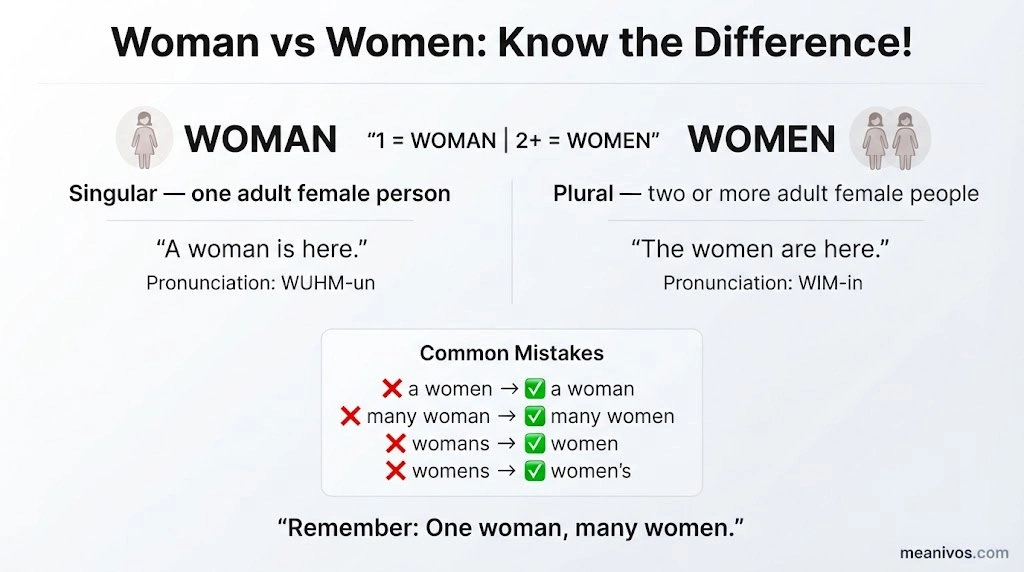
Woman vs Girl: What’s the Difference?
Generally:
- girl refers to a female child or young person.
- woman refers to an adult female person.
Examples:
The girl is learning to play the piano.
The Woman is teaching the class.
The appropriate term can depend on age, context, and how a person identifies or describes themselves, but the basic vocabulary distinction is useful:
girl → child/young person
woman → adult
Likewise:
boy → man
girl → woman
Easy Ways to Remember Woman vs Women
Trick 1: One Woman, Many Women
Repeat:
One woman. Two women.
This is the simplest memory rule.
Trick 2: Match “Man” and “Men”
Remember the familiar pair:
man → men
Then apply the same pattern:
woman → women
Trick 3: Watch the Words Around It
Words such as these usually point toward the singular:
- a
- one
- this
- that
- each
- every
Examples:
A woman is here.
Every woman received a ticket.
Words such as these usually point toward the plural:
- two
- many
- several
- these
- those
- all
Examples:
Several women are here.
Those women are teachers.
Trick 4: Check the Verb
Compare:
The woman is here.
The women are here.
If you are unsure, checking the verb can help you identify whether the noun should be singular or plural.
Woman and Women: Example Sentences
10 examples with “woman”
- She is a remarkable woman.
- I met a woman at the station.
- The woman is a doctor.
- Every woman received a ticket.
- That woman lives nearby.
- One woman answered the phone.
- The woman was carrying a bag.
- A woman helped us find the building.
- The woman has written several books.
- This woman is an experienced teacher.
10 examples with “women”
- The women are waiting outside.
- Two women joined our group.
- Many women attended the conference.
- Several women work in the department.
- The women were invited to the event.
- These women are talented musicians.
- The women have completed the project.
- Three women entered the competition.
- The organization helps women in the community.
- The women discussed the new plan.
Woman vs Women: Quick Comparison Chart
| Feature | Woman | Women |
| Number | Singular | Plural |
| Refers to | One adult female person | Two or more adult female people |
| Article | a woman | Not “a women” |
| Example | A woman is here. | Women are here. |
| Verb | is / was / has | are / were / have |
| Possessive | woman’s | women’s |
| Pronunciation | /ˈwʊmən/ | /ˈwɪmɪn/ |
| Plural form | — | women |
Mini Quiz: Woman or Women?
Test yourself before looking at the answers.
1. She is a talented _____.
A. woman
B. women
2. Three _____ entered the room.
A. woman
B. women
3. The _____ are talking.
A. woman
B. women
4. I spoke with one _____ yesterday.
A. woman
B. women
5. Many _____ attended the meeting.
A. woman
B. women
6. The _____ is a professional engineer.
A. woman
B. women
Answers
- woman
- women
- women
- woman
- women
- woman
If you got all six correct, you have mastered the basic distinction.
People Also Ask
A:Woman is singular. It refers to one adult female person.
A:Women is plural. It refers to two or more adult female people.
A:The plural of woman is women, not womans. It is an irregular plural form.
A:No. The standard phrase is a woman because a is used with a singular countable noun.
A:No. Use many women because many normally takes a plural countable noun.
Related Terms You Should Know
Once you understand woman vs women, these related forms become easier:
| Term | Meaning | Example |
| woman | One adult female person | She is a woman. |
| women | More than one adult female person | They are women. |
| woman’s | Possessive/associated with one woman | The woman’s phone |
| women’s | Possessive/associated with women | Women’s education |
| female | Sex-related adjective or noun | Female athletes |
| girl | Female child or young person | The girl smiled |
| man | One adult male person | He is a man. |
| men | More than one adult male person | They are men. |
Final Takeaway
The difference between woman and women is straightforward when you focus on number.
Woman = one adult female person.
Women = two or more adult female people.
Remember the core pattern:
one woman → two women
For possession:
one woman → woman’s
multiple women → women’s
And for pronunciation:
woman → /ˈwʊmən/
women → /ˈwɪmɪn/
The most useful memory trick is simply:
One woman, many women.
Once you identify whether you are talking about one person or more than one, the correct noun, verb, pronoun, and possessive form usually becomes much easier to choose.
Absolutely. Based on the article’s focus on woman vs women, singular/plural usage, pronunciation, possessives, common mistakes, and examples, I’d make the infographic visually simple and highly scannable rather than text-heavy.