Awhile vs. A While: Easy Grammar Guide With Examples & Tips
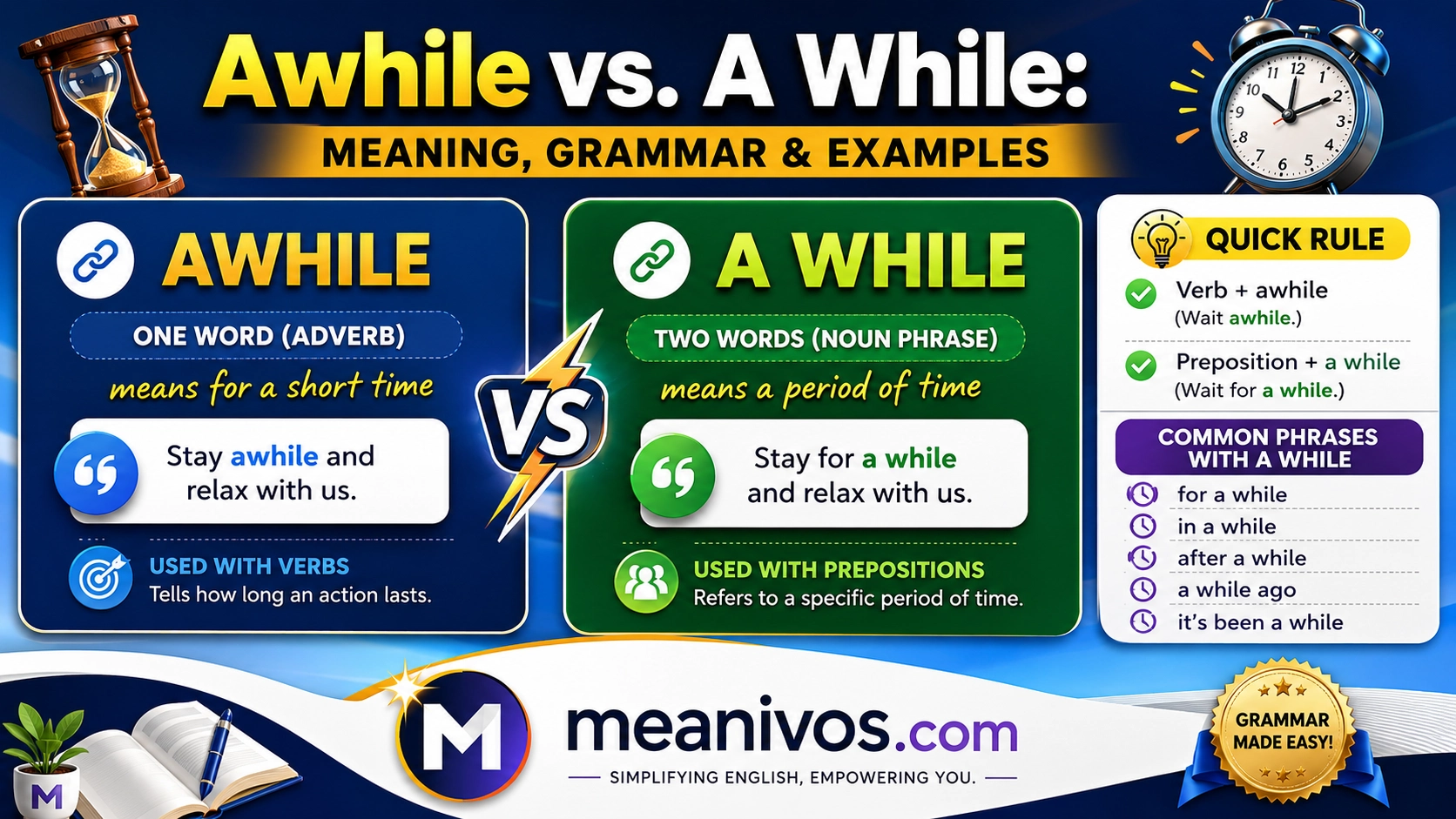
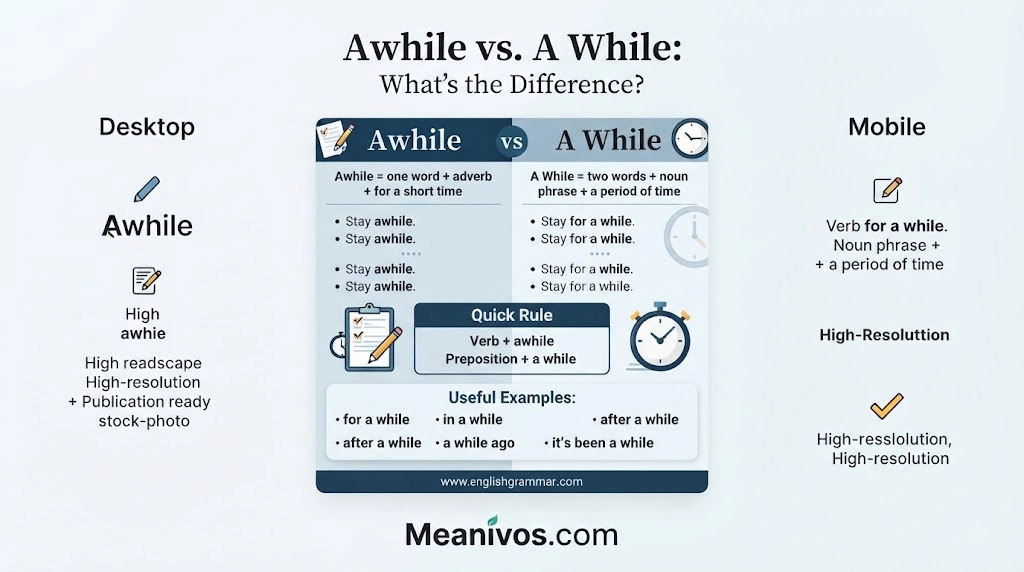
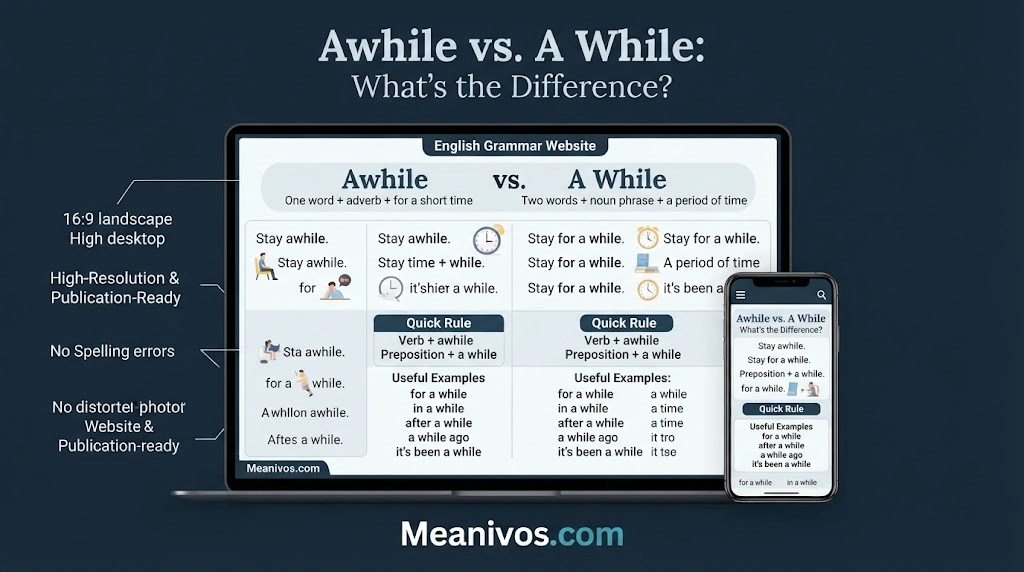
Awhile and a while sound the same, but they are written differently and traditionally serve different grammatical functions. Awhile is a one-word adverb meaning “for a while” or “for a short time,” while a while is a two-word noun phrase referring to a period of time.
For example:
- Please stay awhile. ✅
- Please stay for a while. ✅
- I’ll see you in a while. ✅
- After a while, everyone left. ✅
- It’s been a while since we talked. ✅
The easiest traditional rule is to use awhile when it directly modifies a verb, while a while is normally used after a preposition such as for or in, and in expressions such as a while ago.
However, there is an important nuance: a while can also function adverbially without a preposition, as in “Wait a while.” Major usage references recognize this construction, so the distinction is more useful when understood as a difference in grammatical structure rather than an absolute “one word versus two words” rule.
Awhile vs. A While: Quick Answer
| Awhile | A while |
| One word | Two words |
| Adverb | Noun phrase |
| Means “for a while” or “for a short time” | Means “a period of time” |
| Commonly modifies a verb | Commonly follows a preposition |
| Stay awhile. | Stay for a while. |
| She rested awhile. | She rested for a while. |
| Often appears directly with an action | Used in phrases such as in a while and a while ago |
The simplest rule
Think of the difference this way:
awhile = for a while
a while = a period of time
So you can write:
We waited awhile.
or:
We waited for a while.
Both express essentially the same duration, but the grammar is different.
What Does “Awhile” Mean?
Awhile is an adverb meaning “for a short time” or “for a while.” Oxford lists it as a formal or literary adverb and gives “Stay awhile” as an example.
Merriam-Webster similarly defines awhile as an adverb meaning “for a while” and notes that it typically modifies a verb.
Examples of “awhile”
- Please wait awhile.
- Stay awhile and talk with us.
- She rested awhile before continuing.
- We sat awhile in the garden.
- He paused awhile to think.
- The children played awhile.
- Come sit awhile.
- They talked awhile before leaving.
- I decided to stay awhile longer.
- She waited awhile for the bus.
In these examples, awhile describes the duration of an action.
“Awhile” in a sentence
She stayed awhile after the meeting.
Here, awhile modifies the action stayed.
You could express the same basic idea with:
She stayed for a while after the meeting.
The first sentence uses the adverb awhile; the second uses the noun phrase a while after the preposition for.
What Does “A While” Mean?
A while is a two-word phrase consisting of a plus the noun while.
As a noun, while means a period of time. Oxford gives examples such as for a while, after a while, in a while, and a while ago.
Merriam-Webster likewise defines the noun while as a period of time, especially one that is relatively short.
Examples of “a while”
- We talked for a while.
- I’ll be back in a while.
- It took a while to finish.
- After a while, she felt better.
- I haven’t seen him for a while.
- She left a while ago.
- We’ve been waiting for quite a while.
- It may take a while.
- They stayed for a little while.
- I haven’t visited there in a while.
In these constructions, a while refers to a period or amount of time.
Awhile vs. A While: The Main Grammar Difference
The traditional distinction comes down to part of speech and sentence structure.
Awhile is an adverb
Consider:
We waited awhile.
Awhile tells us how long the action of waiting continued.
It behaves like an adverb.
A while is a noun phrase
Now consider:
We waited for a while.
Here, for is a preposition, and a while is the noun phrase that follows it.
The noun while means a period of time.
This is why the traditional distinction is useful:
Wait awhile.
versus:
Wait for a while.
Merriam-Webster describes this as the conventional distinction: awhile normally modifies a verb, while a while is commonly used after prepositions and in Awhile vs. A While phrases such as a while ago or a while back.
The Preposition Test
One of the easiest practical tests is to look for a preposition immediately before the expression.
Common examples include:
- for a while
- in a while
- after a while
In traditional edited English, use a while after these prepositions.
Correct
We stayed for a while.
I’ll call you in a while.
After a while, everyone relaxed.
I haven’t seen her in a while.
Usually avoided in formal writing
We stayed for awhile.
I’ll call you in awhile.
The reason is grammatical: a preposition normally takes a noun phrase as its complement, whereas awhile is an adverb. American Heritage specifically explains that a while can follow a preposition, while awhile cannot in the traditional prepositional construction.
Important usage nuance
Real-world English is less rigid than this rule sometimes suggests. Dictionary.com notes that awhile increasingly appears after prepositions in actual usage, while a while remains the preferred form in edited writing.
Therefore, for academic, professional, or carefully edited content, the safest choices are:
- for a while
- in a while
- after a while
“For Awhile” or “For a While”?
The standard edited-English choice is:
for a while ✅
For example:
We talked for a while before dinner.
The less traditional form:
We talked for awhile.
can be found in modern informal and published usage, but it is generally better to avoid it in formal writing. Dictionary.com explicitly notes that Awhile is increasingly used in this position, even though a while remains the conventional edited choice.
Compare these sentences
We talked awhile. ✅
We talked for a while. ✅
We talked for awhile. ⚠️ Usually avoid in formal writing.
The first two are the clearest standard constructions.
“In Awhile” or “In a While”?
For standard edited English, use:
in a while ✅
Examples:
- I’ll see you in a while.
- The food should be ready in a while.
- I’ll call you in a while.
- We haven’t spoken in a while.
- I haven’t been there in a while.
The phrase can describe a period of time before something happens:
I’ll be back in a while.
It can also describe a period of time that has passed:
I haven’t seen her in a while.
Oxford lists in a while as a standard expression referring to a period of time.
What about “in awhile”?
You may encounter:
I’ll see you in awhile.
This occurs in informal and contemporary usage, but in a while is the safer choice for edited English.
“It’s Been Awhile” or “It’s Been a While”?
For formal and carefully edited writing, the preferred form is:
It’s been a while. ✅
For example:
It’s been a while since we last talked.
Here, a while refers to the period of time that has passed.
You will also see:
It’s been awhile.
This form is common in informal writing and appears frequently in contemporary published material. Dictionary.com even documents modern examples of awhile being used this way.
So the practical advice is:
Formal or edited writing:
It’s been a while.
Informal communication:
It’s been awhile since it was widely encountered.
If your goal is grammatical clarity, especially in an educational article, “It’s been a while” is the best recommendation.
“Stay Awhile” or “Stay a While”?
Both constructions can be found, but the traditional distinction makes stay awhile particularly straightforward.
Stay awhile
Please stay awhile.
Here, awhile is an adverb modifying stay.
Oxford specifically gives “Stay awhile” as an example of the adverbial use of awhile.
Stay for a while
Please stay for a while.
Here, a while follows the preposition for.
Both sentences are natural and express essentially the same idea.
What about “stay a while”?
This is also possible.
American Heritage explains that a while can function adverbially when the preposition is omitted. Thus both:
Stay awhile.
and:
Stay a while.
can be grammatically acceptable.
This is an important exception to the overly simple rule that says every adverbial use must be awhile.
Can “A While” Be Used Without “For”?
Yes.
This is one of the most important nuances in the awhile vs. a while debate.
Consider:
Wait a while.
There is no for, yet a while is perfectly understandable and grammatical.
American Heritage explains that noun phrases denoting periods of time can function adverbially. It specifically gives constructions equivalent to “rest a while” as acceptable.
Therefore, these can all be acceptable:
Rest awhile.
Rest a while.
Rest for a while.
The forms differ in structure, but they communicate essentially the same duration.
Why this matters
The rule:
“If there is no preposition, use awhile.”
is too absolute.
A better rule is:
Use awhile when you want the single-word adverb; use a while when while is functioning as a noun phrase.
That explanation is more grammatically accurate and gives readers a better understanding of how English actually works.
Awhile vs. A While Examples
Examples with “awhile”
- Please wait awhile.
- Stay awhile and enjoy the view.
- She rested awhile after lunch.
- We sat awhile by the river.
- He paused awhile before answering.
- The dog slept awhile.
- Come visit awhile.
- They talked awhile before dinner.
- I decided to remain awhile longer.
- She watched awhile before joining them.
Examples with “a while”
- We waited for a while.
- I’ll be back in a while.
- It took a while to understand.
- After a while, the rain stopped.
- I haven’t seen him in a while.
- She left a while ago.
- We stayed for quite a while.
- It may take a while.
- They talked for a little while.
- I haven’t visited that restaurant in a while.
- Explore More: https://meanivos.com/wyf-meaning-in-text/
Awhile vs. A While: Correct or Incorrect?
| Sentence | Verdict | Explanation |
| Please stay awhile. | ✅ Correct | Awhile is an adverb modifying stay. |
| Please stay for a while. | ✅ Correct | A while follows the preposition for. |
| We waited awhile. | ✅ Correct | Awhile modifies waited. |
| We waited for a while. | ✅ Correct | A while is the object of for. |
| Wait a while. | ✅ Correct | A while can function adverbially without for. |
| I haven’t seen her in a while. | ✅ Correct | Standard prepositional phrase. |
| After a while, he left. | ✅ Correct | A while follows after. |
| It’s been a while. | ✅ Correct | Standard noun-phrase construction. |
| She rested awhile. | ✅ Correct | Awhile functions as an adverb. |
| She rested for a while. | ✅ Correct | Standard for + noun phrase structure. |
| She rested for awhile. | ⚠️ Avoid in formal writing | For a while is the traditional edited form. |
| I’ll call you in awhile. | ⚠️ Avoid in formal writing | In a while is the conventional edited form. |
| She left awhile ago. | ❌ Standard form is different | Write a while ago. |
| We met a while back. | ✅ Correct | A while back is a standard expression. |
“A While Ago” or “Awhile Ago”?
Use:
a while ago ✅
Examples:
I saw him a while ago.
She called a while ago.
We moved here a while ago.
The phrase a while ago is one of the constructions where the two-word form is traditionally required. Merriam-Webster specifically identifies a while ago and a while back as standard uses of the two-word form.
Avoid:
awhile ago
Even though readers will understand it, a while ago is the standard form to use in polished writing.
Common Mistakes With Awhile and A While
1. “For awhile”
❌ We waited for awhile.
✅ We waited for a while.
2. “In awhile”
❌ I’ll see you in awhile.
✅ I’ll see you in a while.
3. “Awhile ago”
❌ She called awhile ago.
✅ She called a while ago.
4. Assuming they are always interchangeable
Although the meanings overlap, the words have traditionally different grammatical functions.
Awhile is an adverb.
A While is a noun phrase.
5. Assuming “a while” always needs “for”
Not true.
Wait a while.
is perfectly acceptable.
American Heritage specifically recognizes the adverbial use of the noun phrase a while.
A Simple Trick to Remember Awhile vs. A While
Try this three-step method.
Step 1: Look for a preposition
If you see:
- for
- in
- after
the safest standard form is usually:
a while
Examples:
- for a while
- in a while
- after a while
Step 2: Check whether “awhile” means “for a while”
If replacing awhile with for a while preserves the sentence structure, awhile may be appropriate.
Please stay awhile.
≈
Please stay for a while.
Step 3: Remember the fixed expressions
Memorize these:
a while ago
a while back
for a while
in a while
after a while
And these common adverbial uses:
stay awhile
wait awhile
rest awhile
This covers most everyday situations.
Awhile vs. A While Pronunciation
Awhile and a while are normally pronounced essentially the same.
The common pronunciation is approximately:
/əˈwaɪl/
The difference is therefore primarily visible in writing and grammar, rather than pronunciation.
Oxford gives awhile as /əˈwaɪl/, while Cambridge also lists the pronunciation with the same basic sound.
This is one reason the two forms are so easy to confuse when writing.
Is “Awhile” Formal or Informal?
Awhile is a legitimate English word; it is not simply a misspelling of a while.
Oxford labels the adverb awhile as formal or literary, while Cambridge also labels it literary in its dictionary entry.
That does not mean awhile is wrong in everyday English. It means that its use may have a somewhat more formal or literary character in some contexts.
For example:
Stay awhile and enjoy the evening.
is perfectly legitimate.
In contemporary writing, however, you’ll also frequently encounter a while in places where traditional grammar would distinguish the two forms.
Are “Awhile” and “A While” Interchangeable?
Sometimes, but not always.
They overlap in meaning because awhile essentially means “for a while.”
For example:
We waited awhile.
and:
We waited for a while.
have nearly the same meaning.
However, you cannot simply replace one with the other in every expression.
Use “a while”
a while ago
a while back
for a while
in a while
after a while
Use “awhile” naturally
stay awhile
wait awhile
rest awhile
sit awhile
Modern usage does show increasing overlap, but the traditional distinction remains useful, particularly in edited writing. Merriam-Webster explicitly notes that the two forms are increasingly used interchangeably while still describing the conventional distinction.
The History of “Awhile”
The distinction has a long history.
Oxford traces awhile to Old English āne hwīle, meaning roughly “(for) a while.”
The noun while itself is much older. Oxford traces it to Old English hwīl, meaning a period of time. Merriam-Webster likewise records the noun’s first known use before the 12th century.
This history helps explain why the modern forms are so closely related: awhile developed as a single adverbial word, while a while remains a phrase containing the article a and the noun while.
Why Do People Confuse Awhile and A While?
There are three main reasons.
1. They sound the same
When spoken, the distinction between the one-word and two-word forms usually disappears.
2. Their meanings overlap
Awhile means roughly for a while, while a while means a period of time.
3. Modern usage is flexible
Writers increasingly use the forms interchangeably in some contexts. Merriam-Webster and Dictionary.com both acknowledge this development.
That means a rigid rule can sometimes give readers an incomplete picture.
Awhile vs. A While: The Best Rule for Formal Writing
If you’re writing an academic paper, professional article, business document, or educational resource, use this practical guideline:
Choose “awhile” when it directly modifies an action
Please wait awhile.
She rested awhile.
We stayed awhile.
Choose “a while” after a preposition
for a while
in a while
after a while
Choose “a while” in fixed expressions
a while ago
a while back
quite a while
a little while
This approach follows the traditional distinction and minimizes ambiguity.
People Also Ask
A:Yes. Awhile is one word and functions as an adverb meaning “for a while” or “for a short time.” Oxford and Merriam-Webster both classify it as an adverb.
A:Yes. A while consists of the article a and the noun while, which means a period of time.
A:For a while is the traditional and safest form in formal or edited English. For awhile appears increasingly in real-world usage, but it is better avoided when you want conventional grammar.
A:In a while is the conventional edited form.
I’ll see you in a while.
A:It is common in informal and contemporary usage, but it’s been a while is the safer standard form for formal and edited writing.
Quick Reference: Which One Should You Use?
| If you want to say… | Preferred form |
| for a short time | awhile |
| for a period of time | a while |
| after some time | after a while |
| some time from now | in a while |
| some time ago | a while ago |
| some time in the past | a while back |
| remain temporarily | stay awhile |
| remain for a period | stay for a while |
| pause temporarily | wait awhile |
| pause for a period | wait for a while |
Final Verdict
The difference between awhile and a while is mainly grammatical.
Awhile is a one-word adverb meaning approximately “for a while” or “for a short time.”
Please stay awhile.
A while is a two-word noun phrase referring to a period of time.
Please stay for a while.
For standard edited English, remember these patterns:
- stay awhile
- wait awhile
- rest awhile
- for a while
- in a while
- after a while
- a while ago
- a while back
- it’s been a while
But don’t treat the distinction as an absolute spelling law. A while can also function adverbially, as in “Wait a while,” and modern usage increasingly shows overlap between the forms.
If you need the safest choice for formal writing, use the traditional pattern:
Awhile when it functions as the adverb.
A while when it functions as a noun phrase, especially after a preposition.
Once you understand the grammar behind the two forms, awhile vs. a while becomes much easier to get right.
Absolutely — here’s a CTR-friendly infographic package designed for your “Awhile vs. A While” article and branded for Meanivos.com.