Cacoon or Cocoon: Which Spelling Is Correct?
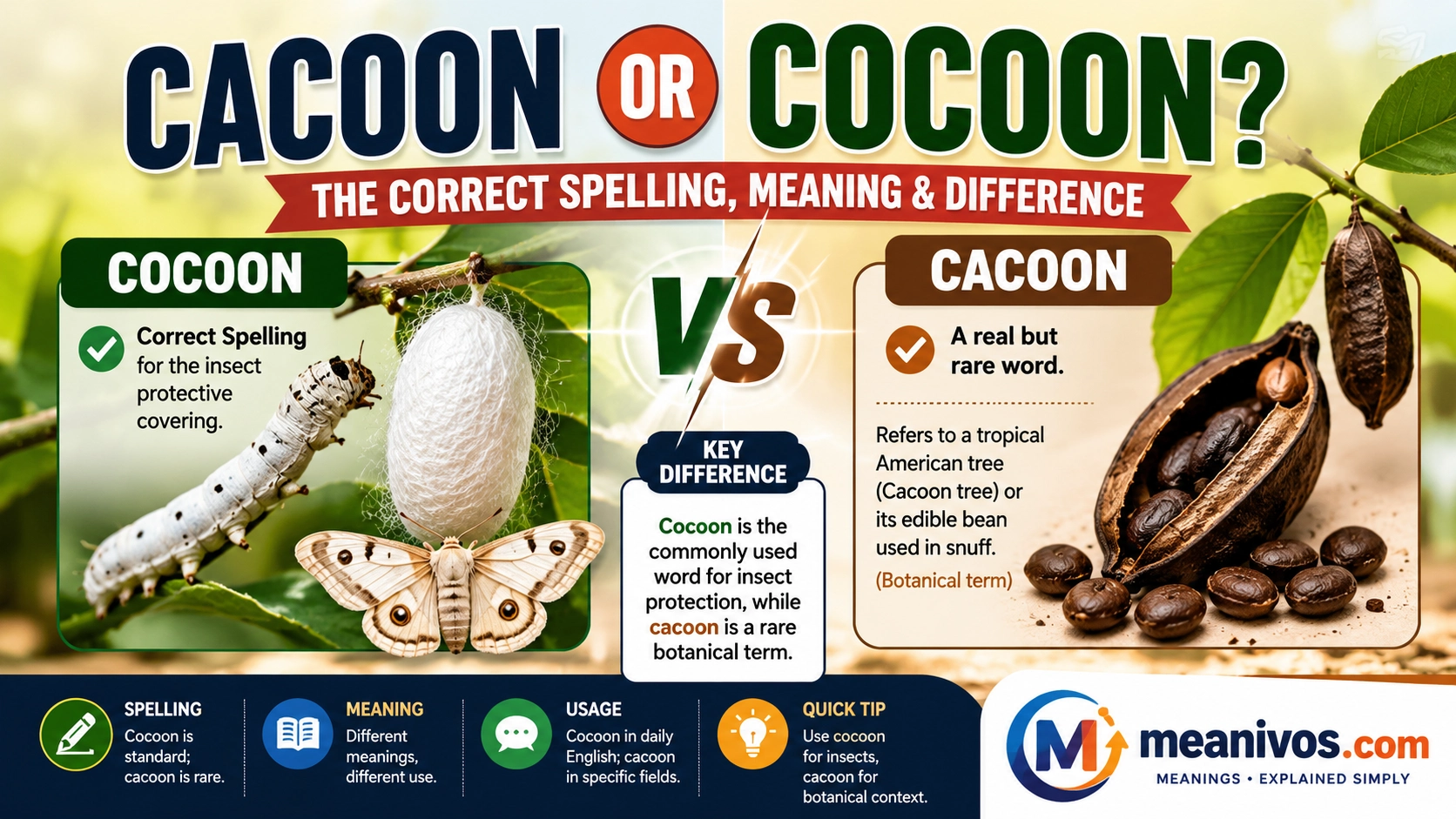
Cacoon or Cocoon—which spelling is correct? If you’re talking about the protective covering made by certain insects, the correct spelling is cocoon.
But there’s an important detail that many spelling guides miss: cacoon is also a real English word. It is a rare botanical noun associated with the West Indian snuffbox bean and the tropical American plant Fevillea cordifolia. Merriam-Webster lists cacoon as a dictionary word and gives its first known English use as 1797.
So the answer depends on context:
- Cocoon = the protective covering associated with certain insects.
- Cacoon = a rare botanical term for a snuffbox bean or tropical plant.
- If you’re writing about moths, insect development, metamorphosis, or a protective covering, use cocoon.
Let’s look at the difference, meanings, spelling, pronunciation, examples, and common mistakes.
Cacoon or Cocoon: Which Is Correct?
If you mean the protective covering made by certain insects, cocoon is the correct spelling.
Correct
The moth emerged from its cocoon.
Incorrect for the insect meaning
The moth emerged from its cacoon.
Oxford defines cocoon as a silk-thread covering that some insects, particularly moths, make to protect themselves before becoming adults.
However, calling cacoon universally incorrect would be misleading. It has an independent dictionary meaning that has nothing to do with an insect’s protective covering.
Quick Meaning Summary
| Word | Meaning | Commonness | Typical Context |
| Cocoon | Protective covering made by certain insects | Common | Biology, everyday English |
| Cacoon | Snuffbox bean or tropical American plant | Rare | Botany |
| Cocooned | Protected, enclosed, or surrounded | Common | Figurative/everyday use |
| Cocooning | The act of protecting or isolating | Less common | Figurative/social use |
The key distinction is simple: cocoon is the normal word for the insect covering, while cacoon has a separate botanical meaning.
Is “Cacoon” a Real Word?
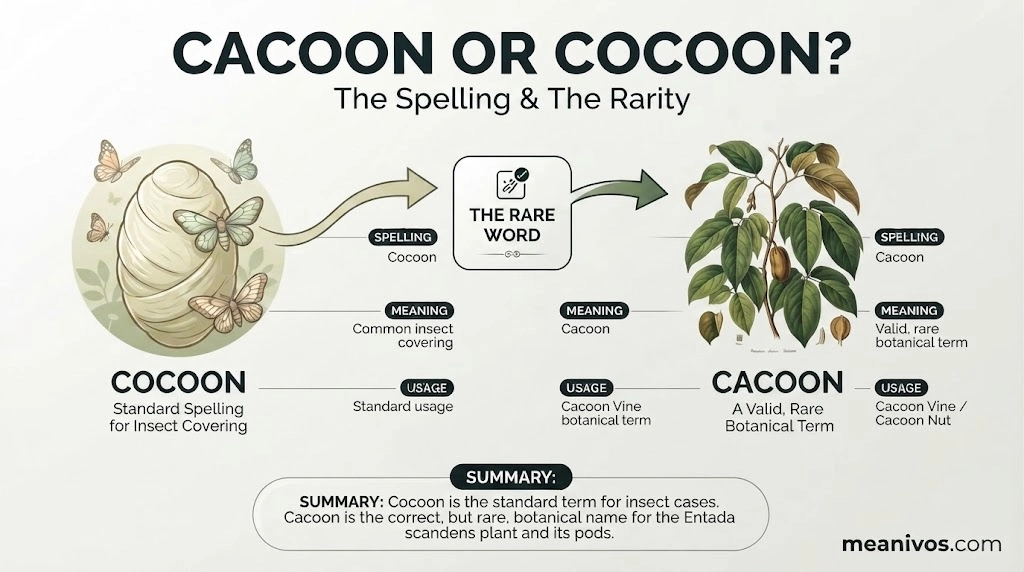
Yes, cacoon is a real word.
Merriam-Webster lists cacoon as a noun with two closely related botanical senses:
- A West Indian snuffbox bean.
- A tropical American plant, Fevillea cordifolia, belonging to the cucumber family, Cucurbitaceae.
The dictionary gives pronunciations including ka-KOON and a variant beginning with a reduced vowel, and records the first known English use as 1797.
Therefore, there are two different words rather than two interchangeable spellings.
If you see cacoon in a botanical or historical text, it may be completely intentional.
What Does “Cocoon” Mean?
A cocoon is a protective covering made by certain insects during their development.
Oxford describes it as a cover or case of silk threads that some insects, especially moths, make to protect themselves before becoming adults.
Cambridge similarly defines a cocoon as the covering made from soft, smooth threads that surrounds and protects certain insects during the pupal stage.
For example:
The moth remained inside its cocoon while it developed.
The word also has a figurative meaning. A cocoon can describe a safe, quiet, comfortable, or protective environment.
For example:
She enjoyed the warm cocoon of blankets on a cold evening.
Cambridge recognizes this figurative sense as a safe or quiet place.
What Does “Cacoon” Mean?
Cacoon has a rare botanical meaning.
It can refer to the snuffbox bean found in the West Indies and to the tropical American plant Fevillea cordifolia.
This means the sentence:
The moth formed a cacoon.
is wrong if the writer means an insect’s protective covering.
But a botanical reference to:
cacoon
may be perfectly legitimate.
This distinction is especially important because many online spelling articles simply label cacoon as nonexistent, overlooking its dictionary definition.
Cacoon vs. Cocoon: Key Difference
The easiest way to remember the difference is to focus on context.
| Feature | Cocoon | Cacoon |
| Is it a real word? | Yes | Yes |
| Main meaning | Insect protective covering | Snuffbox bean / tropical plant |
| Common in everyday English? | Yes | No |
| Biology context | Yes | Generally no |
| Botany context | Generally no | Yes |
| Typical spelling question | Correct form | Usually a mistaken spelling when insect meaning is intended |
| Example | The moth spun a cocoon. | The botanical text mentioned cacoon. |
So cacoon and cocoon are not simply alternative spellings of the same word.
How Do You Spell Cocoon?
The correct spelling is:
C-O-C-O-O-N
The complete word is:
COCOON
A useful way to remember it is:
CO + COON = COCOON
Don’t replace the first o with a when you’re talking about the insect covering.
Common forms
- cocoon — singular
- cocoons — plural
- cocooned — past tense/past participle
- cocooning — -ing form
Why Do People Spell Cocoon as Cacoon?
The confusion is understandable because the pronunciation does not make the spelling completely obvious.
Cambridge gives the pronunciation of cocoon as /kəˈkuːn/, with the main stress on the second syllable.
In simple terms, it sounds approximately like:
kuh-KOON
Someone who hears the word before seeing it written may therefore guess:
cacoon
instead of:
cocoon
Other common reasons include:
- hearing the word rather than reading it;
- typing quickly;
- unfamiliarity with the spelling;
- relying too heavily on pronunciation;
- remembering the sound but not the written form.
Because cacoon is also a legitimate but rare word, the confusion is particularly interesting: the apparent “misspelling” happens to produce another dictionary word.
Cocoon vs. Chrysalis: Are They the Same?
No. A cocoon and a chrysalis are related, but they are not exactly the same thing.
A pupa is a developmental stage in insects that undergo complete metamorphosis.
A cocoon is generally an external protective covering made by certain insects, especially moths.
A chrysalis refers to the pupal stage of a butterfly. Butterflies generally do not make a separate silk cocoon around the chrysalis in the same way that many moths do.
A simple way to remember the distinction is:
Moth → pupa inside a cocoon
Butterfly → pupa in a chrysalis
However, biology is more diverse than this simplified comparison, so these should be treated as useful generalizations rather than absolute rules.
What Is a Cocoon Used For?
A cocoon provides protection during a vulnerable period of an insect’s development.
Depending on the species, it can help shield the developing insect from environmental conditions and physical disturbance while it undergoes transformation.
The cocoon is therefore more than just a “shell.” It is a protective structure associated with a particular stage of an insect’s life cycle.
How to Use “Cocoon” in a Sentence
Here are several natural examples:
- The moth emerged from its cocoon.
- We discovered a small cocoon hanging from a branch.
- The caterpillar disappeared into its cocoon.
- The insect eventually emerged from the cocoon.
- She wrapped herself in a cozy cocoon of blankets.
- He stayed cocooned indoors during the storm.
- The family home became a comforting cocoon after a difficult day.
These examples show both the literal and figurative meanings of cocoon.
Can “Cocoon” Be Used as a Verb?
Yes.
As a verb, cocoon can mean to surround, wrap, protect, or isolate someone or something.
Oxford gives examples of the verb being used for surrounding or protecting someone or something completely.
For example:
The blanket cocooned the sleeping child.
Or:
She cocooned herself in warm clothes.
Common forms include:
- cocoon
- cocoons
- cocooned
- cocooning
The word can also describe spending more leisure time at home rather than going out, particularly in North American usage.
What Is the Plural of Cocoon?
The plural of cocoon is:
cocoons
Example:
Several cocoons were attached to the branches.
Simply add -s to form the plural.
What Is the Plural of Cacoon?
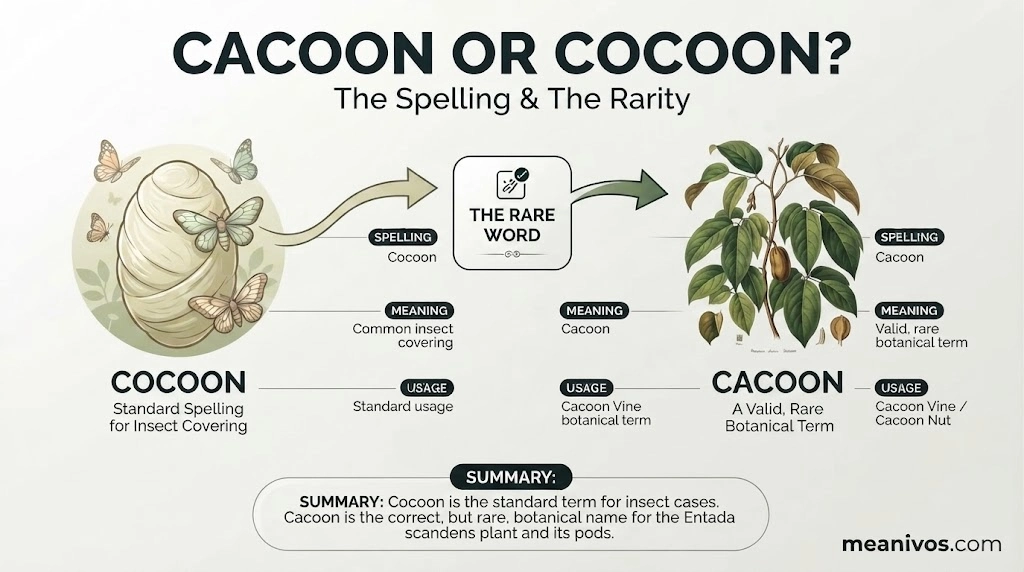
The plural of cacoon is:
cacoons
Because cacoon is rare, you’re much less likely to encounter cacoons in ordinary English.
It is mainly relevant when discussing the botanical noun.
Cocoon Pronunciation
Cocoon is pronounced approximately:
kuh-KOON
Cambridge lists the pronunciation as:
/kəˈkuːn/
The second syllable receives the main stress:
co-COON
This pronunciation is one reason people may be uncertain about the written form.
- Explore More: https://meanivos.com/witnesss-or-witness/
What Is the Origin of “Cocoon”?
The word cocoon has been part of English for centuries.
Oxford traces it through French cocon and medieval Provençal/Occitan coucoun, associated with words meaning eggshell or cocoon. Oxford dates the English word to the late 17th century.
This history explains why cocoon has a long-established spelling rather than being a recent English invention.
What Is the Origin of “Cacoon”?
The history of cacoon is different from that of cocoon.
Merriam-Webster suggests that the word may have entered English through a Yoruba term associated with a woody vine. Its first known English use is recorded as 1797.
This separate history reinforces an important point:
Cacoon is not simply a misspelled version of cocoon in every context.
The two words have different meanings and different histories.
Why Does “Cacoon” Look Like a Spelling Mistake?
When someone is discussing insects, cacoon usually is a spelling mistake because the standard spelling for that meaning is cocoon.
Compare:
❌ The butterfly came out of its cacoon.
✅ The butterfly came out of its cocoon.
But there is an important qualification:
Cacoon is a legitimate rare word in its own right.
Therefore, the most accurate explanation is:
“Cacoon” is incorrect when you mean the insect covering, but it is a valid rare word when referring to the botanical term.
That is more precise than simply saying that cacoon is “not a word.”
Common Cacoon and Cocoon Mistakes
Mistake 1: Using “cacoon” for an insect
❌ The moth emerged from its cacoon.
✅ The moth emerged from its cocoon.
Mistake 2: Treating them as interchangeable
❌ Cacoon and cocoon are two spellings for the same thing.
✅ Cocoon is the standard insect-related word, while cacoon has a separate rare botanical meaning.
Mistake 3: Forgetting the extra “o”
❌ cocon
✅ cocoon
Mistake 4: Confusing a cocoon with a chrysalis
A cocoon is generally a protective covering made by certain insects, while a chrysalis refers to the pupal stage of a butterfly.
Mistake 5: Assuming every appearance of “cacoon” is a typo
This is also incorrect.
If cacoon appears in a botanical context, it may be the legitimate noun documented by Merriam-Webster.
Easy Trick to Remember “Cocoon”
Try this:
CO + COON = COCOON
Or simply visualize:
COCOON
Notice the repeated O pattern.
Another memory trick is to associate cocoon with words containing the familiar oo sound, such as moon.
The important visual pattern is:
CO → COON
not:
CA → COON
Quick Answer: Cacoon or Cocoon?
If you’re talking about an insect’s protective covering, use:
COCOON ✅
If you’re talking about the rare botanical noun, CACOON can be correct.
Remember:
Cocoon = insect covering
Cacoon = rare botanical term
Is “Cacoon” a Misspelling of “Cocoon”?
Usually, yes, when the writer means the insect covering.
For example:
❌ The caterpillar entered its cacoon.
✅ The caterpillar entered its cocoon.
However, cacoon is also a legitimate dictionary word with a separate botanical meaning.
So it is better to say that cacoon is a context-dependent word, not universally an invalid spelling.
Is “Cocoon” Only Used for Insects?
No.
The word has both literal and figurative uses.
Literally, a cocoon is associated with the protective covering made by certain insects.
Figuratively, it can describe a comfortable, safe, sheltered, or isolated environment. Cambridge recognizes this figurative meaning.
For example:
The quiet room felt like a cocoon from the outside world.
Can You Use “Cocoon” for a Person?
Yes, particularly in a figurative sense.
You might say:
She cocooned herself in a blanket.
Or:
The small apartment became a cocoon of comfort.
The idea is that the person is surrounded, protected, sheltered, or isolated.
Does “Cacoon” Mean a Caterpillar’s Covering?
No.
If you mean the protective covering associated with the development of a moth or another insect, the word is:
cocoon
The rare word cacoon has a botanical meaning instead.
People Also Ask
A:Cocoon is correct when you mean the protective covering made by certain insects. Cacoon is also a real but uncommon word referring to a snuffbox bean or tropical plant.
A:Yes. Cacoon is a legitimate dictionary word. Merriam-Webster defines it as a West Indian snuffbox bean and a tropical American plant called Fevillea cordifolia.
A:The correct spelling is C-O-C-O-O-N: cocoon.
A:A cocoon is a protective covering made by certain insects during development. The word can also describe a safe, quiet, or protected environment in a figurative sense.
A:A cocoon is generally an external covering made by certain insects, particularly moths. A chrysalis is the pupal stage of a butterfly and is not the same structure as a silk cocoon.
Related Terms and Similar Words
Understanding these related terms can make the difference easier to remember:
- Cocoon — protective covering associated with certain insects.
- Chrysalis — butterfly’s pupal stage.
- Pupa — developmental stage between larva and adult in insects with complete metamorphosis.
- Metamorphosis — major transformation during an insect’s development.
- Cocooned — surrounded or protected.
- Cocooning — the act or state of being cocooned.
- Cacoon — rare botanical noun associated with the snuffbox bean.
Final Verdict
The answer depends on what you’re trying to say.
If you’re writing about moths, insect development, metamorphosis, or a protective covering, the correct word is:
COCOON
But CACOON is not simply a nonexistent word. It is a rare dictionary term associated with a West Indian snuffbox bean and the tropical American plant Fevillea cordifolia.
So the easiest rule is:
Cocoon = insect covering 🐛
Cacoon = rare botanical word 🌱
If you remember that distinction, you’ll know exactly which spelling to choose.
Cocoon is the word you almost certainly want in ordinary writing about insects. Cacoon should be reserved for its specific botanical meaning.