Is It Witnesss or Witness? The Correct Spelling Explained
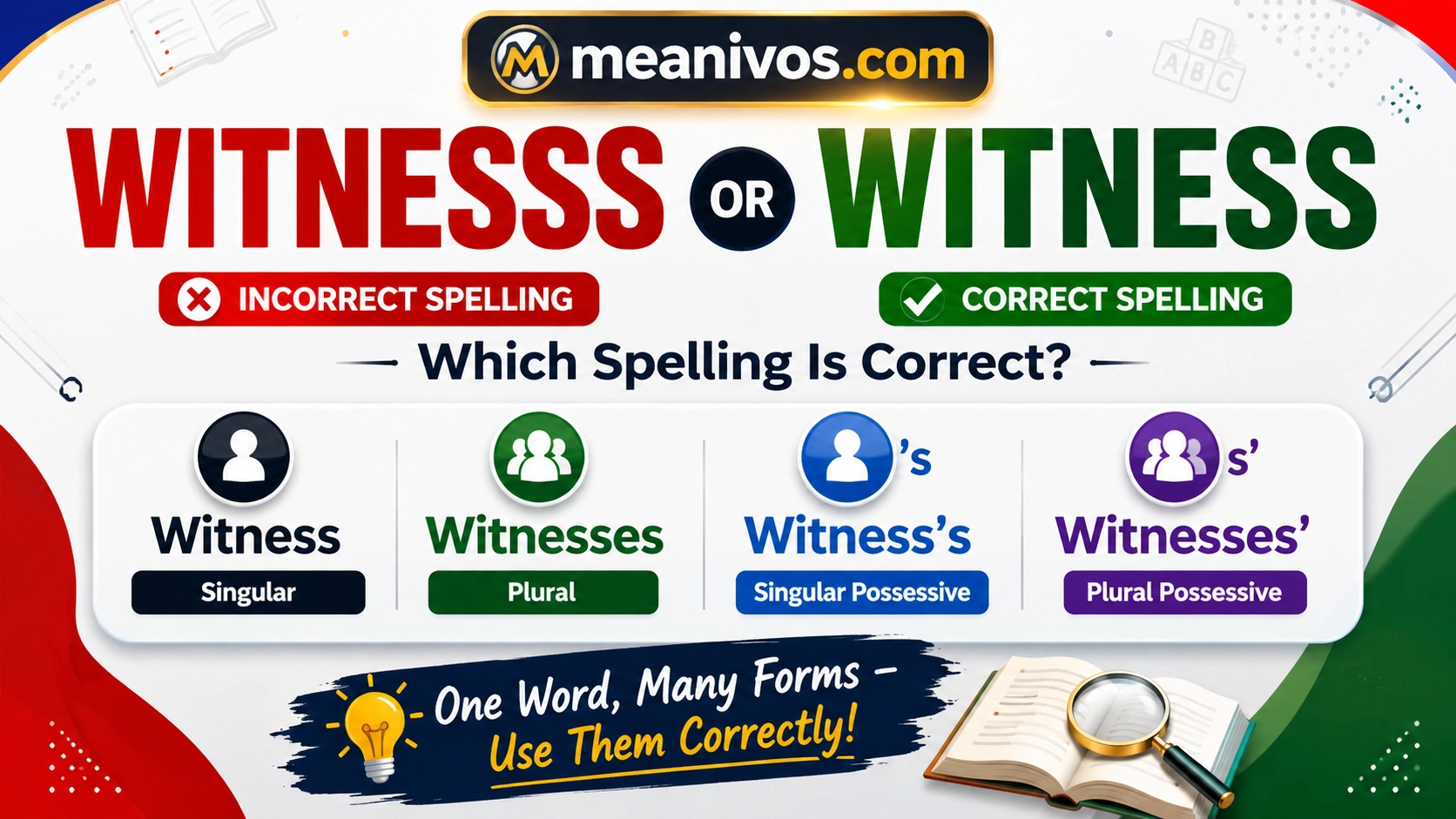
Witness is the correct spelling. Witnesss is incorrect in standard English.
If you searched for “witnesss or witness,” you probably want to know whether the word needs one, two, or three s letters. The answer is simple: the standard word is spelled W-I-T-N-E-S-S — witness.
But there is more to the confusion than one spelling mistake. You may also come across witnesses, witness’s, witness’, and witnesses’. These forms are not interchangeable because they perform different grammatical jobs.
This guide explains each form in plain English, including the plural, singular possessive, plural possessive, verb forms, common mistakes, and examples.
Witnesss or Witness: The Quick Answer
The correct spelling is:
Witness ✅
The incorrect spelling is:
Witnesss ❌
There is no standard English word witnesss with three consecutive s letters.
For example:
- Correct: The witness saw the accident.
- Incorrect: The witnesss saw the accident.
The word witness is an established English noun and verb. As a noun, it can refer to someone who gives evidence or has personal knowledge of an event. As a verb, it can mean to see, experience, testify to, or provide evidence of something. Merriam-Webster traces the noun to Middle English witnesse and Old English witnes, with the noun in use before the 12th century.
Quick comparison
| Form | Correct? | What it means |
| witness | ✅ | One witness; also a verb |
| witnesss | ❌ | Incorrect spelling |
| witnesses | ✅ | More than one witness; also a verb form |
| witness’s | ✅ | Singular possessive |
| witness’ | ✅* | Alternative singular possessive style |
| witnesses’ | ✅ | Plural possessive |
*The preferred singular possessive style can depend on the style guide being followed.
Why Is “Witnesss” Incorrect?
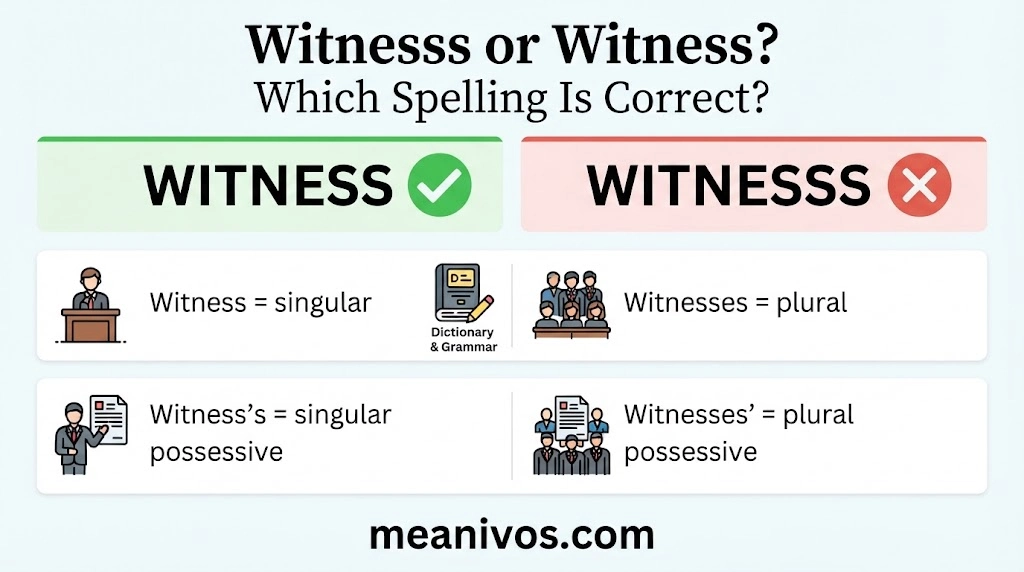
The confusion usually happens because witness already ends with s.
A writer may incorrectly think:
witness + s = witnesss
But English does not form the plural that way.
The singular noun is:
witness
The regular plural is:
witnesses
So the basic pattern is:
witness → witnesses
Not:
witness → witnesss
Examples
Correct:
A witness reported the incident.
Several witnesses reported the incident.
Incorrect:
A witnesss reported the incident.
The extra s in witnesss is simply a spelling error.
What Does “Witness” Mean?
A witness is generally a person who sees, experiences, or has personal knowledge of something.
The word is especially common in legal contexts, but it is not limited to courtrooms. Merriam-Webster defines witness in several ways, including someone who gives evidence, someone with personal knowledge of something, and someone present at a transaction who can later testify that it occurred.
Witness as a noun
When used as a noun, witness refers to a person or, in some contexts, something that provides evidence or testimony.
Examples:
- The witness described the accident.
- The lawyer questioned the witness.
- A witness gave a statement to police.
- She was a witness to the event.
- The court called an important witness.
Witness as a verb
Witness can also function as a verb.
Examples:
- I witnessed the accident.
- They witnessed the signing of the document.
- Thousands witnessed the historic event.
- She witnessed the entire ceremony.
Merriam-Webster lists witnessed, witnessing, and witnesses among the verb’s forms.
Witness vs. Witnesses
This is one of the most important distinctions to understand.
Witness = one
Use Witness when you are talking about one person.
Examples:
- The witness arrived at court.
- A witness gave evidence.
- The lawyer interviewed the witness.
- One witness saw the vehicle.
Witnesses = more than one
Use witnesses when you mean two or more people.
Examples:
- Several witnesses arrived at court.
- The witnesses gave statements.
- Police interviewed three witnesses.
- Multiple witnesses described the event.
The plural is:
witness → witnesses
Merriam-Webster also recognizes witnesses as the third-person singular present form of the verb witness.
For example:
He witnesses the signing of every document.
That is different from:
Three witnesses signed the document.
In the first sentence, witnesses is a verb. In the second, witnesses is a plural noun.
Witness vs. Witness’s vs. Witness’ vs. Witnesses’
These forms look similar, but their meanings are different.
| Form | Meaning | Example |
| witness | One person | The witness arrived. |
| witnesses | Two or more people | The witnesses arrived. |
| witness’s | Something associated with one witness | The witness’s statement was clear. |
| witness’ | Alternative singular possessive form | The witness’ statement was clear. |
| witnesses’ | Something associated with multiple witnesses | The witnesses’ statements were clear. |
| witnesss | Incorrect spelling | ❌ Do not use it. |
The easiest way to understand the difference is to separate plural from possession.
When to Use “Witness”
Use witness when you mean one person or when the word is being used as the base form of the verb.
Singular noun
The witness entered the courtroom.
We need to speak with the witness.
A witness reported the incident.
Verb
They witnessed the accident.
She witnessed the signing.
I witnessed the event personally.
Remember:
One person = witness
When to Use “Witnesses”
Use witnesses when you mean more than one witness.
Examples
The witnesses arrived together.
Several witnesses gave evidence.
Police interviewed the witnesses.
Three witnesses described what they saw.
There is no apostrophe in witnesses when you are simply making the noun plural.
This is an important rule:
Plural does not automatically mean apostrophe.
Compare:
- one teacher → teachers
- one student → students
- one lawyer → lawyers
- one witness → witnesses
The apostrophe is needed when you are expressing possession or another grammatical relationship, not merely because a word is plural.
- Explore More: https://meanivos.com/xx-meaning/
When to Use “Witness’s”
Witness’s is the singular possessive form commonly used in general and academic writing.
Use it when something belongs to, comes from, or is associated with one witness.
Examples:
The witness’s testimony was important.
The witness’s statement was recorded.
Its witness’s account differed from the report.
The lawyer questioned the witness’s credibility.
Here, there is only one witness.
The pattern is:
one witness + possession → witness’s
Chicago’s guidance says singular nouns generally form the possessive by adding an apostrophe and s, including singular nouns ending in s.
So:
witness → witness’s
Not:
witnesss’s ❌
Is “Witness’” Also Correct?
Yes, witness’ can be found as a singular possessive form under certain style conventions.
For example:
The witness’ testimony was entered into evidence.
The witness’ account was reviewed.
However, it is important not to present witness’ as universally superior or claim that it becomes correct simply because the next word starts with s.
Different style systems have different conventions. Chicago generally favors witness’s for singular possessives, while some editorial styles permit or prescribe apostrophe-only forms in particular circumstances.
Which should you use?
If you are writing a general article, school assignment, business document, or ordinary professional text and no particular style guide has been specified, witness’s is a clear, conventional choice.
If your employer, publication, academic institution, or client follows a specific style guide, follow that guide consistently.
When to Use “Witnesses’”
Witnesses’ is the plural possessive form.
Use it when something is associated with or belongs to multiple witnesses.
The formation is:
witness → witnesses → witnesses’
Examples:
The witnesses’ statements were consistent.
The witnesses’ accounts were compared.
The lawyer reviewed the witnesses’ testimony.
The witnesses’ observations supported the report.
Notice where the apostrophe goes:
witnesses’
The apostrophe comes after the final s because witnesses is already a regular plural ending in s.
Do not write:
witnesses’s ❌
Witness’s vs. Witnesses’: What Is the Difference?
This is a very common source of confusion.
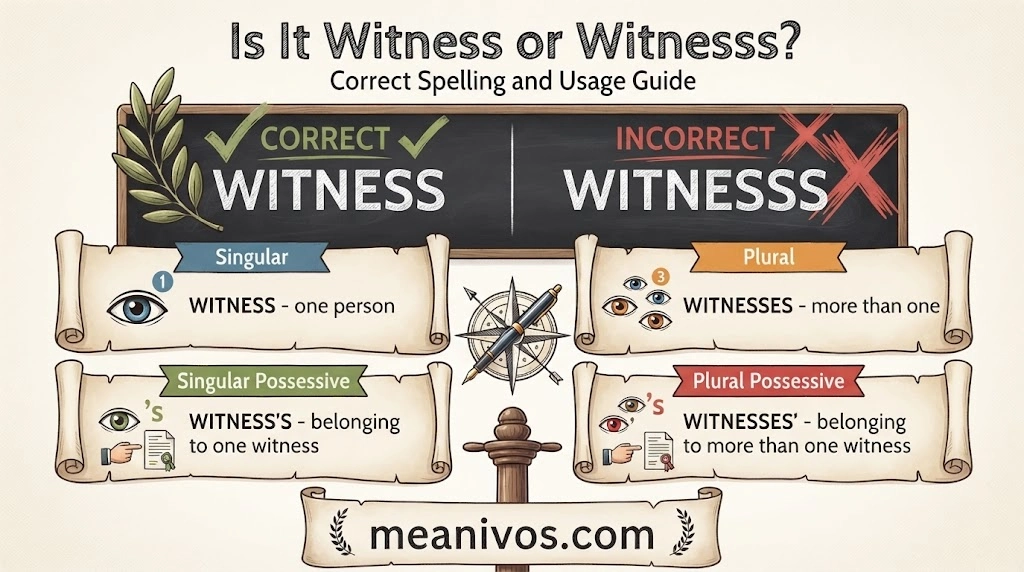
One witness
Use:
witness’s
Example:
The witness’s statement was recorded.
This means the statement belongs to or is associated with one witness.
Multiple witnesses
Use:
witnesses’
Example:
The witnesses’ statements were recorded.
This means the statements belong to or are associated with multiple witnesses.
Compare them
| Number | Possessive | Example |
| One witness | witness’s | The witness’s statement was clear. |
| Multiple witnesses | witnesses’ | The witnesses’ statements were clear. |
This distinction becomes much easier once you identify the number first.
A Simple Rule for Remembering Witness Grammar
Use this four-step shortcut:
1. One person
witness
The witness spoke.
2. More than one
witnesses
The witnesses spoke.
3. One person’s possession
witness’s
The witness’s statement was helpful.
4. Multiple people’s possession
witnesses’
The witnesses’ statements were helpful.
In short:
1 → witness
2+ → witnesses
1 + possession → witness’s
2+ + possession → witnesses’
And:
witnesss → incorrect
Common Mistakes With “Witness”
1. Writing “witnesss”
❌ The witnesss saw the accident.
✅ The witness saw the accident.
The base word already has the correct spelling witness.
2. Using “witness” as the plural
❌ Several witness gave statements.
✅ Several witnesses gave statements.
More than one person requires the plural witnesses.
3. Adding an apostrophe to make a plural
❌ Two witness’s arrived.
✅ Two witnesses arrived.
An apostrophe is not used simply to make a regular noun plural.
4. Confusing “witnesses” and “witnesses’”
❌ The witnesses statements were recorded.
✅ The witnesses’ statements were recorded.
The second sentence needs the plural possessive because the statements are associated with the witnesses.
5. Writing “witnesses’s”
❌ The witnesses’s accounts were compared.
✅ The witnesses’ accounts were compared.
The regular plural is already witnesses, so the plural possessive is formed with an apostrophe:
witnesses → witnesses’
6. Confusing “witness” and “witnessed”
These are different forms.
I witnessed the accident.
I spoke to a witness.
Witnessed is a past-tense verb, while witness can be a noun or the base form of a verb.
Witness Spelling Examples
Here are the main forms in context.
Singular
The witness gave evidence.
Plural
The witnesses gave evidence.
Singular possessive
The witness’s evidence was important.
Alternative singular possessive
The witness’ evidence was important.
Plural possessive
The witnesses’ evidence was compared.
Past-tense verb
She witnessed the accident.
Present-tense verb
He witnesses the signing of each document.
These examples demonstrate why context matters more than simply counting the letter s.
Witness in Legal and Everyday English
The word witness is strongly associated with courts and legal proceedings, but its use is much broader.
Merriam-Webster includes legal meanings involving someone who gives evidence or is present at a transaction, as well as broader meanings involving personal knowledge or direct observation.
Legal examples
The witness testified in court.
The defense called another witness.
The witness’s statement was reviewed.
The witnesses’ accounts were compared.
Everyday examples
I was a witness to the celebration.
She witnessed the accident from her window.
Thousands witnessed the historic event.
We witnessed an incredible performance.
So you should not assume that witness is only a legal word.
Witness vs. Witnesses: Quick Test
If you’re unsure which form to use, ask:
“Am I talking about one person or more than one?”
If the answer is one:
witness
If the answer is more than one:
witnesses
Then ask:
“Am I showing possession or association?”
If one witness is involved:
witness’s
If multiple witnesses are involved:
witnesses’
This two-question method solves most spelling and apostrophe problems involving this word.
Is “Witnesss” Ever Correct?
In standard English, Witnesss is not the correct spelling of the noun witness.
If you encounter witnesss in ordinary English text, it is normally a typo or spelling error.
The correct forms are:
- witness — singular
- witnesses — plural
- witness’s — singular possessive
- witness’ — alternative singular possessive style
- witnesses’ — plural possessive
There is no standard grammatical situation in which you need to spell the basic word witnesss.
British English vs. American English
The basic spelling witness is used in both British and American English.
The spelling does not change to witnesss in either variety.
However, punctuation and possessive preferences can vary between style guides and publications. That is why you may encounter both witness’s and witness’ in published writing.
For general writing, the important thing is to distinguish the base word and plural from the possessive forms and then follow the style required by your publication or organization.
Why the Word “Witness” Is Easy to Misspell
There are several reasons people make this mistake.
It already ends in “s”
Writers may instinctively add another s.
The plural sounds different
The plural is witnesses, which may encourage people to think the singular needs another letter.
Apostrophes create another layer of confusion
The forms witness’s, witness’, and witnesses’ look extremely similar.
Fast typing causes errors
When typing quickly, it is easy to accidentally produce witnesss.
The solution is not to memorize dozens of complicated rules. Start with the base word:
witness
Then build from there.
Related Words and Forms
Understanding related forms can make the spelling easier to remember.
| Form | Function | Example |
| witness | Singular noun/base verb | The witness spoke. |
| witnesses | Plural noun | Two witnesses spoke. |
| witnesses | Third-person singular verb | She witnesses the ceremony. |
| witnessed | Past-tense verb | He witnessed the accident. |
| witnessing | Present participle/gerund | They are witnessing the event. |
| witness’s | Singular possessive | The witness’s account mattered. |
| witness’ | Alternative singular possessive | The witness’ account mattered. |
| witnesses’ | Plural possessive | The witnesses’ accounts differed. |
Merriam-Webster confirms the noun and verb uses and lists forms including witnessed, witnessing, and witnesses.
People Also Ask
A:No. Witnesss is not the standard spelling. The correct spelling is witness.
A:The plural is witnesses.
Example:
One witness was present.
Several witnesses were present.
A:Use witnesses for one person and witnesses for two or more people.
The witness arrived.
The witnesses arrived.
A:Yes. Witness is a standard singular possessive form.
The witness’s testimony was important.
A:It can be, depending on the style convention being followed. Some style systems use an apostrophe-only form for certain singular nouns ending in s, while Chicago generally favors ’s for singular possessives.
Quick Cheat Sheet
If you only remember one section, remember this:
| What you mean | Correct form |
| One person | witness |
| More than one person | witnesses |
| Something associated with one witness | witness’s |
| Alternative singular possessive | witness’ |
| Something associated with multiple witnesses | witnesses’ |
| Three-s spelling | witnesss ❌ |
Final Answer
So, witnesss or witness—which is correct?
The answer is:
Witness is correct.
Witnesss is incorrect.
But the complete picture includes several related forms:
- Witness = one person or the base verb
- Witnesses = more than one person
- Witness’s = singular possessive
- Witness’ = alternative singular possessive style
- Witnesses’ = plural possessive
- Witnesss = incorrect spelling
The key is to avoid treating every ending in s as the same grammatical form.
Start with the base word witness, decide whether you mean one or multiple people, and then add the appropriate possessive punctuation if necessary.
That simple process will help you avoid nearly every common witnesss vs. witness spelling and grammar mistake.