Connector or Connecter? Which Spelling Is Correct?
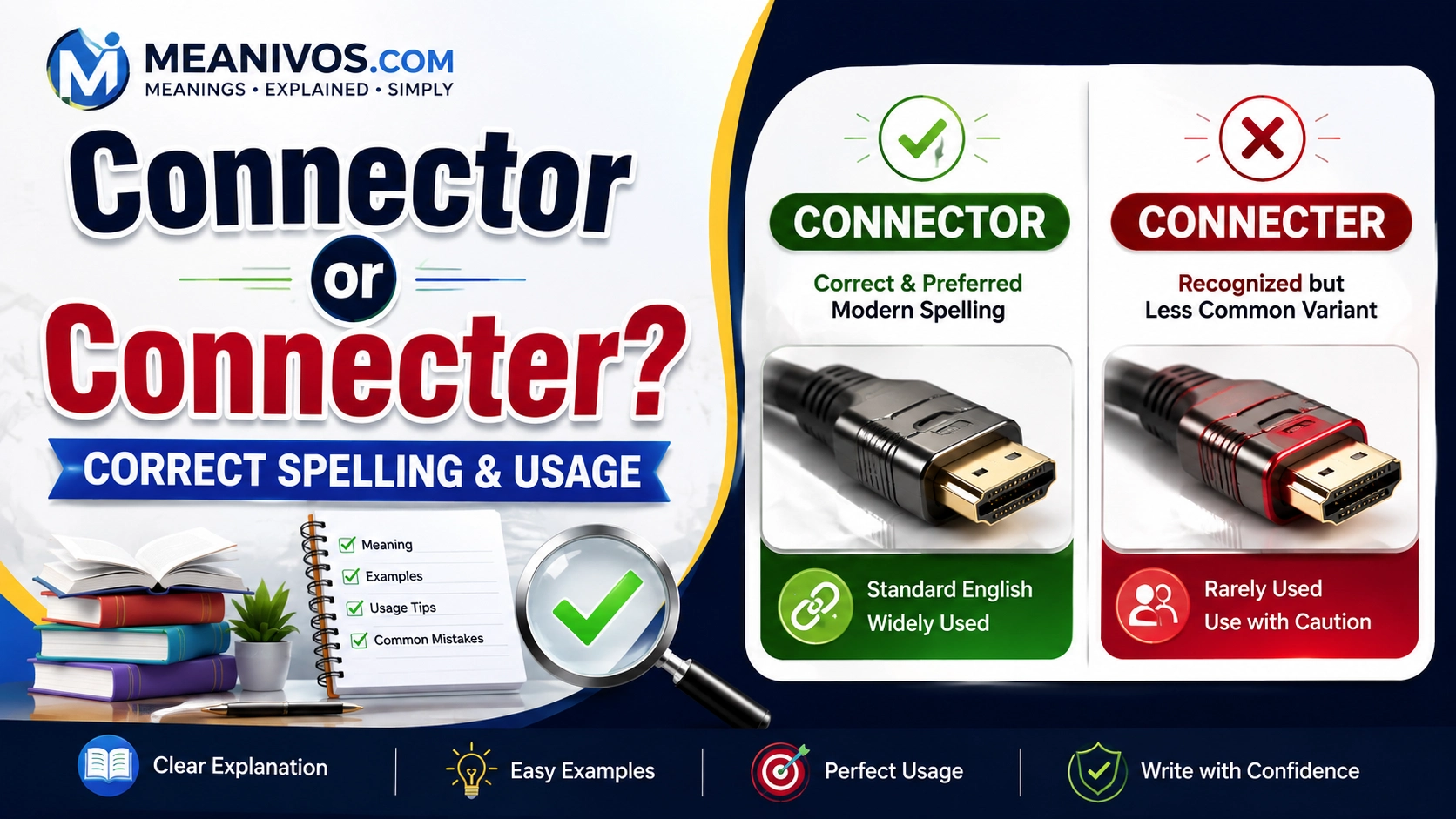
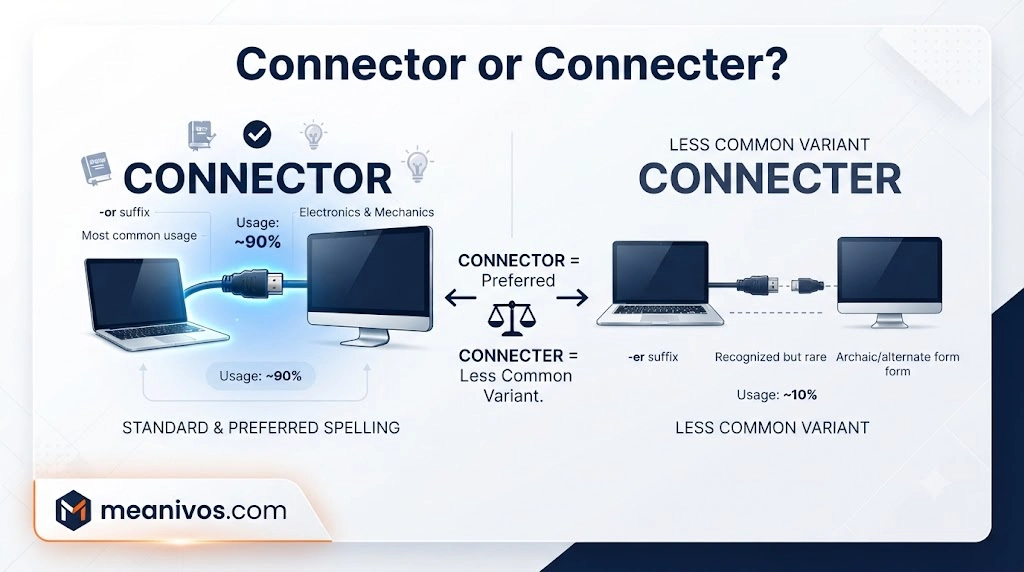
Are you unsure whether connector or connecter is the correct spelling? You’re not alone. Because English often forms nouns with -er, it can be tempting to write connecter from the verb connect. However, the standard and preferred spelling in modern English is connector.
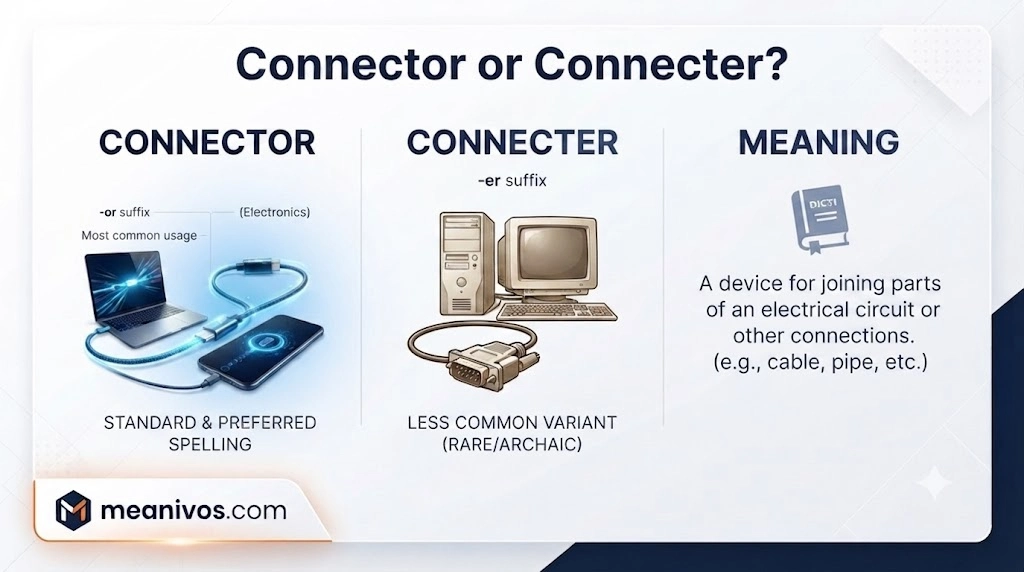
A Connector is a person or thing that connects, joins, or links two or more things together. You might see the word when talking about cables, USB devices, electrical components, pipes, computer equipment, or even a person who brings people together. Connecter does appear in dictionaries as a less-common variant, but it is far less widely used.
So, which should you use? In most situations, choose connector. It is the safer spelling for academic, professional, technical, and everyday writing.
In this guide, you’ll learn the difference between connector and connecter, whether connecter is a real word, what connector means, why the spelling causes confusion, and how to use the correct form naturally in sentences.
Connector or Connecter: Quick Answer
Connector is the standard and preferred spelling in modern English. Connecter is also recognised as a much less common variant, so it is not completely accurate to call it a nonexistent English word.
If you are writing an email, essay, report, technical document, product description, website, or professional message, connector is the spelling you should normally choose. Merriam-Webster lists connector as the noun and notes connecter as less common, while Dictionary.com defines connecter as a variation of connector.
In simple terms:
Connector = standard and preferred
Connecter = recognised but uncommon variant
So, if you’re unsure which spelling to use, choose connector.
Quick Meaning Summary
| Word | Status | Meaning | Best Choice? |
| Connector | Standard/common noun | A person or thing that connects | Yes |
| Connecter | Less-common variant | A person or thing that connects | Usually avoid |
| Connect | Verb | To join, link, or bring together | Yes |
| Connection | Noun | A link, relationship, or state of being connected | Yes |
| Connected | Adjective/past participle | Joined or linked | Yes |
The easiest rule
If you’re talking about a person, component, device, object, or element that connects something, use connector in normal modern writing.
Examples:
- I need a new connector for this cable.
- The USB connector is damaged.
- She is a natural connector who brings people together.
- The pipe connector is leaking.
- This component acts as a connector between two systems.
What Does “Connector” Mean?
Connector is a noun that refers to a person or thing that connects, joins, or links two or more things.
Oxford Learner’s Dictionaries defines connector as a thing that links two or more things together.
The word can describe several different things depending on context.
1. A physical component
A connector can be a physical part used to join electrical equipment, cables, wires, pipes, or other components.
For example:
The cable connector is loose.
I need the correct connector for this charger.
Cambridge Dictionary specifically includes electrical equipment and components among the common uses of connector. It also uses the word for an object that joins pipes or tubes.
2. A person who connects people
A connector can also be someone who introduces people or brings groups together.
For example:
Sarah is a great connector who knows people across the industry.
Here, connector refers to a person who creates useful social, professional, or business relationships.
3. Something that links things together
The meaning can also be broader:
This section acts as a connector between the two chapters.
In this sense, a connector can be a link, bridge, joining element, or transition between separate things.
Is “Connecter” a Word?
Yes, connecter is recognised as an English word, but it is much less common than connector.
This is the important point that many spelling articles overlook.
Merriam-Webster gives connector as the noun and lists connecter as a less-common form.
Dictionary.com similarly has a separate entry for connecter and defines it as a variation of connector.
Therefore, saying:
“Connecter is not a word.”
is too absolute.
A more accurate explanation is:
Connecter is a recognised but uncommon variant of connector.
That distinction matters because a dictionary can recognise a word without suggesting that it is the most common or recommended form.
Connector vs Connecter: What Is the Difference?
The main difference is usage and frequency rather than basic meaning.
Both forms can refer to something or someone that connects things.
Connector
Connector is the normal modern spelling and the form readers are most likely to expect.
Use it in:
- academic writing
- business communication
- technical documentation
- product descriptions
- websites
- reports
- essays
- emails
- everyday English
- professional writing
Connecter
Connecter is a recognised but considerably less common variant.
You may encounter it in dictionaries or occasional real-world usage, but it is not the form most modern readers expect.
The difference in one sentence
Connector is the preferred modern form; connecter is a less-common variant with essentially the same basic meaning.
Why Do People Spell It “Connecter”?
The confusion is understandable because connecter looks like it follows a very common English spelling pattern.
Many nouns are formed by adding -er to a verb:
- teach → teacher
- write → writer
- drive → driver
- work → worker
- run → runner
So it is natural for someone to think:
connect + er = connecter
But English word formation does not always work by applying one simple suffix rule.
The established noun is connector, with -or.
That means the safest approach is not to invent the noun from the verb. Instead, remember the established spelling:
connect → connector
Why Is “Connector” the Preferred Spelling?
There are several reasons connector is the better choice for modern writing.
1. It is the established standard form
Major dictionary sources identify connector as the main form. Merriam-Webster explicitly gives connector and notes connecter as less common.
2. It is widely used in technical English
Terms such as:
- USB connector
- cable connector
- electrical connector
- power connector
- network connector
- HDMI connector
- audio connector
are familiar modern expressions.
3. It is immediately recognisable
Readers generally expect connector when they encounter the noun.
4. It works across different contexts
The spelling is used for physical devices, people, systems, and things that link ideas or objects.
Connector in Technology and Electronics
One of the most common meanings of connector appears in technology and electronics.
A connector is a component that allows electrical or electronic equipment to connect.
Cambridge Dictionary describes a connector as a device or part that allows electrical equipment to connect, and it also uses the term for objects joining pipes and tubes.
Common types of connectors
You may encounter phrases such as:
- USB connector
- HDMI connector
- audio connector
- cable connector
- electrical connector
- power connector
- network connector
- wire connector
- pipe connector
- charging connector
Examples:
The USB connector is damaged.
Make sure the cable connector fits the device.
The technician replaced the electrical connector.
This charger uses a different connector.
Connector vs Port: Are They the Same?
Not necessarily.
In technology, connector and port can describe different parts.
A connector is generally the part that physically makes the connection.
A port is the socket or interface into which a connector is inserted.
For example:
Insert the USB connector into the USB port.
This distinction is useful when discussing computers, phones, chargers, cables, and other electronic equipment.
Connector for People and Relationships
Not every connector is a piece of hardware.
The word can also describe a person who brings people together.
For example:
David is a natural connector and knows people in almost every part of the industry.
Here, connector refers to someone who introduces people, creates relationships, or helps different groups communicate.
More examples
- She is a natural connector.
- He acts as a connector between two teams.
- Our manager is an excellent connector.
- A good connector can introduce you to useful contacts.
- She became a connector between local businesses and community groups.
This usage is especially common when discussing networking, business, leadership, and communities.
Connector in Writing and Ideas
Connector can also be used more broadly for something that links ideas, sections, systems, or concepts.
For example:
The final paragraph acts as a connector between the two sections.
Related words include:
- link
- bridge
- transition
- connection
- joining element
However, be careful not to assume that connector is automatically the exact grammatical term for every word that joins ideas.
Words such as and, but, and because may have more specific grammatical classifications depending on how they function in a sentence.
Connector vs Connecter Examples
Here are some practical examples.
Preferred modern usage
I need a new connector for my headphones.
The cable connector does not fit the port.
She is an excellent connector in the business community.
This device uses a special electrical connector.
The pipe connector needs tightening.
Check the connector before replacing the cable.
Less-common variant
The device uses a connecter.
The second form can be understood, and dictionary sources recognise connecter, but connector remains the safer and more conventional choice for modern standard writing.
Should You Use Connector or Connecter in Formal Writing?
Choose connector.
This applies to:
- resumes/CVs
- Cover Letters
- essays
- academic papers
- reports
- technical manuals
- product descriptions
- websites
- business emails
- documentation
- presentations
For example:
❌ The device includes a special connecter.
✅ The device includes a special connector.
The second sentence uses the form most readers expect and is therefore the better choice for polished modern English.
What About Everyday Writing?
The same advice applies.
Use connector rather than connecter when you’re writing a normal message, article, school assignment, email, or social post.
For example:
Do you have the right connector for this cable?
You do not need to use connecter merely because it exists in some dictionaries.
A dictionary entry tells you that a form is recognised; it does not necessarily mean that all recognised forms are equally common or equally suitable for every situation.
Is “Connecter” Wrong?
Not exactly—but it is usually not the best choice.
This is where the distinction becomes important.
Calling connecter completely wrong ignores the evidence from major dictionaries. Merriam-Webster lists connector and notes connecter as less common, while Dictionary.com describes connecter as a variation of connector.
So the most accurate summary is:
- Connector: standard and preferred
- Connecter: recognised but uncommon
- Professional writing: use connector
- Technical writing: use connector
- Academic writing: use connector
- Everyday modern English: use connector
If your goal is conventional, clear English, connector is the obvious choice.
Why Does “Connecter” Look So Natural?
The spelling confusion comes from several factors.
The “-er” pattern
English has many familiar nouns ending in -er:
- teach → teacher
- write → writer
- drive → driver
- work → worker
- paint → painter
That makes connecter look logical.
Similar pronunciation
The two spellings are pronounced very similarly, so hearing the word does not reliably tell you whether it should be written with -er or -or.
Cambridge gives the pronunciation of connector in both UK and US English, with the spelling remaining the same.
The verb “connect”
People naturally see:
connect
and then create:
connecter
But the established noun is:
connector
Seeing both forms online
People can encounter connecter in search results, dictionaries, forums, or other material. That can make the two spellings appear equally common.
They are not.
- Related to other Article: https://meanivos.com/down-bad-meaning/
A Simple Trick to Remember “Connector”
Use this memory trick:
CONNECT + OR = CONNECTOR
Think:
connect + or → connector
Or remember:
A connector connects.
You can also associate connector with familiar -or words such as:
- collector
- director
- operator
- projector
This is only a memory aid, not a universal rule for English suffixes.
Connector vs Connecter: Comparison Table
| Feature | Connector | Connecter |
| Word status | Standard noun | Recognised less-common variant |
| Basic meaning | Person or thing that connects | Same basic meaning |
| Modern frequency | Common | Uncommon |
| Technical writing | Recommended | Usually avoid |
| Academic writing | Recommended | Usually avoid |
| Business writing | Recommended | Usually avoid |
| Dictionary recognition | Yes | Yes, as a less-common form |
| Best choice for most writers | Yes | No |
The key distinction is preference, not a completely different definition. Merriam-Webster’s current entry explicitly lists connector and “less commonly connecter.”
Connector in American vs British English
Connector is the safest spelling in both American and British English.
There is no need to switch to connecter depending on your audience.
Cambridge lists both UK and US pronunciations of connector, while the spelling remains connector.
American English
The connector is damaged.
British English
The connector is damaged.
The spelling is the same.
Connector vs Connection vs Connect
These words are related, but they have different grammatical roles.
| Word | Part of Speech | Meaning | Example |
| connect | Verb | To join or link | Connect the cable. |
| connection | Noun | A link, relationship, or state of being connected | The connection is weak. |
| connector | Noun | A person or thing that connects | The connector is broken. |
| connected | Adjective / past participle | Joined or linked | The devices are connected. |
Connect
Please connect the two cables.
Connection
The internet connection is unstable.
Connector
The USB connector is damaged.
Understanding this distinction makes your writing more precise.
Connector vs Connecter vs Connection
Don’t confuse the spelling question with the meaning of connection.
Connector refers to the person or thing doing the connecting.
Connection refers to the link, relationship, act, or state of being connected.
For example:
The connector is broken.
versus:
The internet connection is slow.
Merriam-Webster defines connection broadly as the act or state of connecting and also as a link, relationship, or means of communication.
20 Examples Using “Connector”
- I need a new cable connector.
- The USB connector is too small.
- Check the connector before replacing the cable.
- This device has a damaged connector.
- The technician replaced the electrical connector.
- The pipe connector needs tightening.
- The network connector is not working.
- Make sure the connector is properly attached.
- The charger has a different connector.
- The connector does not fit the port.
- She is a natural connector.
- He acts as a connector between the two teams.
- The manager became an important connector.
- A good connector can introduce useful contacts.
- The cable uses a standard connector.
- Replace the broken connector immediately.
- The two systems require a compatible connector.
- The connector joins the two sections.
- The technician inspected the connector.
- Always use the correct connector for the device.
Common Mistakes to Avoid
Mistake 1: Automatically writing “connecter”
Because -er is common in English, you may instinctively write:
connect + er = connecter
But the established modern noun is:
connect + or = connector
Mistake 2: Confusing connector with connection
These words are related but different.
Connector = something or someone that connects.
Connection = the link, relationship, or state of being connected.
Mistake 3: Confusing connector with port
In technology, a connector and a port can refer to different physical parts.
Plug the connector into the port.
Mistake 4: Assuming every verb takes “-er”
English noun formation contains many patterns and exceptions. You cannot always predict the established noun simply by attaching -er to a verb.
What Is the Plural of Connector?
The plural of connector is:
connectors
Example:
The computer has several different connectors.
This is straightforward because connector follows the normal English plural pattern.
Can “Connecter” Be Used in English?
Yes, but with an important qualification.
Connecter is a recognised English variant, but it is much less common than connector.
Dictionary.com lists connecter as a variation of connector, and Merriam-Webster identifies it as the less-common form.
Therefore, if you encounter connecter, you can understand what it means. But if you are choosing the spelling yourself, connector is the better option in almost every modern context.
Is “Connecter” an Old Word?
It is better not to describe connecter automatically as simply “old” or “obsolete.”
Some competing pages make that claim, but the current dictionary evidence is more nuanced. Merriam-Webster identifies it as a less-common form, while Dictionary.com describes it as a variation of connector.
So less common is the safer and more accurate description.
Does Connector Mean a Person?
Yes.
A connector can mean someone who brings people together, makes introductions, or maintains useful relationships.
Example:
Emma is a powerful connector in the local business community.
The meaning comes from the broader idea of connecting people rather than physical objects.
Does Connector Mean a Cable Part?
Yes.
In technology, a connector can be the physical component that joins a cable or wire to another device or component.
Examples include:
- USB connector
- HDMI connector
- audio connector
- power connector
- network connector
- electrical connector
Cambridge specifically includes electrical equipment and cable-related contexts in its definition.
Is “Connector” the Correct Spelling in Technical Writing?
Yes.
Technical documentation should normally use connector.
For example:
Connect the cable to the correct connector.
Inspect the connector for damage.
The device requires a compatible connector.
Because technical writing depends on consistency and clarity, the standard form is the better choice.
Is “Connector” Correct in Academic Writing?
Yes.
Use connector when the word refers to a person or thing that connects.
For example:
The bridge acts as a connector between the two systems.
The device uses a specialised electrical connector.
If your goal is polished standard English, connector is preferable to the less-common variant.
Does “Connector” Have a Different Meaning From “Connecter”?
Generally, no major difference in basic meaning exists.
Both forms can refer to a person or thing that connects.
The important difference is how common and preferred each spelling is.
Connector is the established standard form.
Connecter is a less-common variant.
People Also Ask
A:Connector is the standard and preferred spelling in modern English. Connecter is also recognised as a less-common variant, so it is not completely nonexistent.
A:Yes. Dictionary.com lists connecter as a variation of connector, and Merriam-Webster identifies it as the less-common form.
A:Yes. Connector is the safest choice for professional, academic, technical, and everyday modern writing.
A:A connector is a person or thing that connects, joins, or links things together. It can describe an electronic component, cable part, pipe fitting, person, or linking element.
A:Not necessarily. It is a recognised but uncommon variant. However, connector is the preferred form for most modern writing.
Conclusion
When choosing between connector or connecter, the answer is clear: connector is the standard and preferred spelling in modern English. It is the form you should normally use in academic, professional, technical, and everyday writing.
Although Connecter can be found as a recognised but much less common variant, it is not the spelling most readers expect. So, if you want your writing to look natural, clear, and professional, connector is the safer choice.
Remember this simple rule: connect + or = connector. A connector can refer to a device, cable component, person, or anything else that joins or links things together.
In short, choose a connector whenever you are unsure. It is the widely recognised form and the best choice for modern English.