Dieing or Dying: What’s the Difference?
If you mean the process of losing life, fading away, declining, or approaching an end, the correct spelling is dying.
- ✅ The plant is dying.
- ✅ My phone battery is dying.
- ✅ The old tradition is dying out.
- ❌ The plant is dieing.
The reason is that verbs ending in -ie generally change ie to y before -ing:
die → dying
lie → lying
tie → tying
vie → vying
This spelling rule is explicitly documented by the Government of Canada.
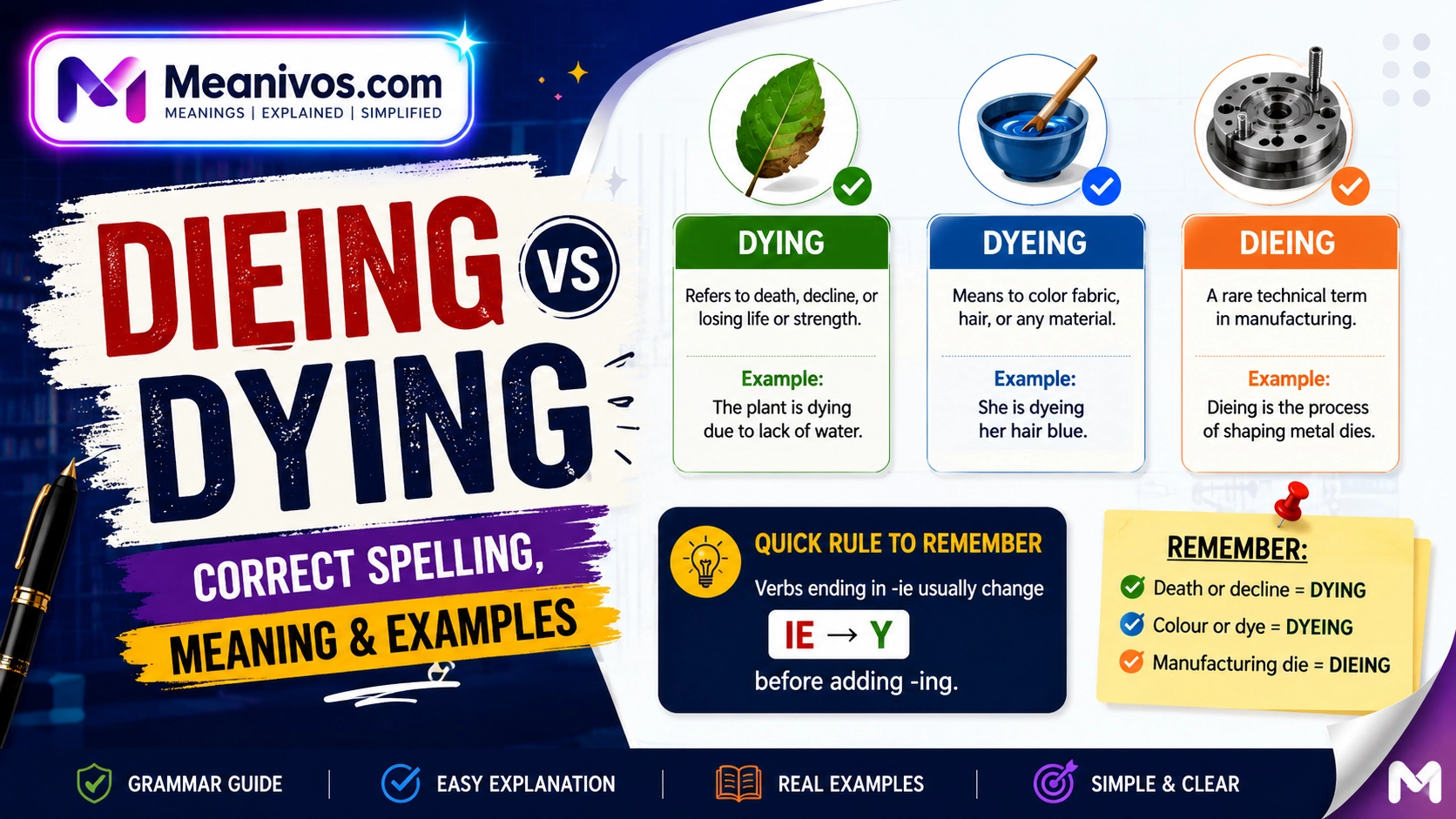
However, there is an important exception to the simple “dieing is wrong” explanation: dieing can occur as a rare technical term related to a manufacturing die. That meaning is completely different from ordinary dying.
There is also a third word worth remembering:
dyeing = changing something’s colour
So:
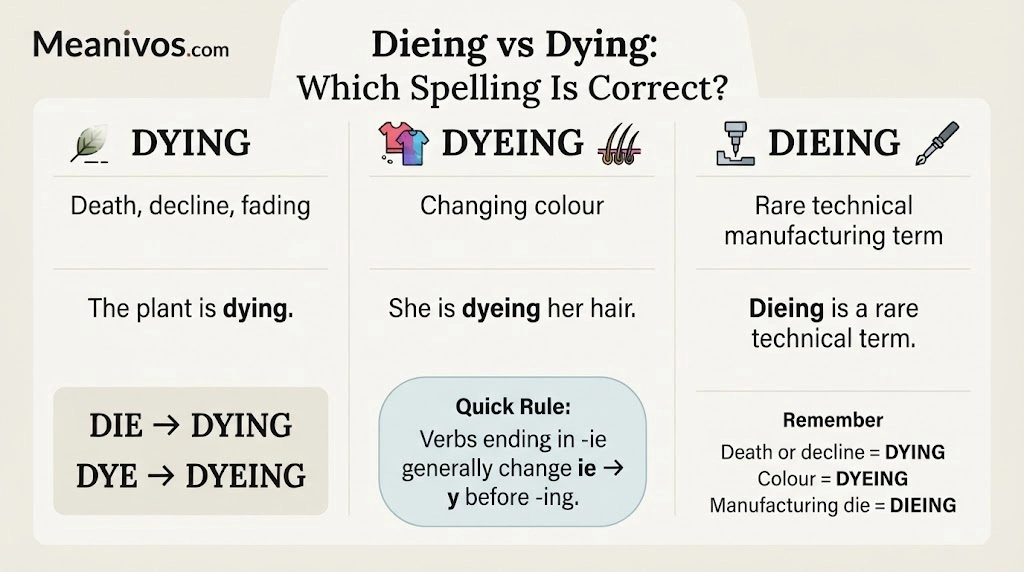
dying = death, decline, or fading
dyeing = adding or changing colour
dieing = rare technical manufacturing usage
What Does “Dying” Mean?
Dying is the present participle of the verb die.
The basic meaning is the process of ceasing to live.
For example:
The patient is dying.
Here, dying describes a person who is approaching death.
But the word has several broader meanings in everyday English.
Dying can describe living things
The flowers are dying because they have not received enough water.
The injured animal was slowly dying.
The tree is dying.
In each sentence, dying refers to the loss of life.
Dying can describe decline
English also uses dying figuratively for things that are becoming less common, weaker, or less important.
The old tradition is dying.
The industry is slowly dying.
Interest in the trend is dying.
This does not mean that the industry or tradition is literally alive. It means it is gradually disappearing or declining.
Dying can describe a battery or machine
In informal English, dying can describe something that is close to stopping or running out of power.
My phone is dying.
The laptop battery is dying.
The car engine sounds like it is dying.
Cambridge includes these broader figurative and informal uses of die and dying.
Why Is It “Dying” and Not “Dieing”?
This is the spelling question behind the entire dieing vs dying confusion.
At first glance, die + ing appears to give:
dieing
But standard English does not normally form the present participle this way.
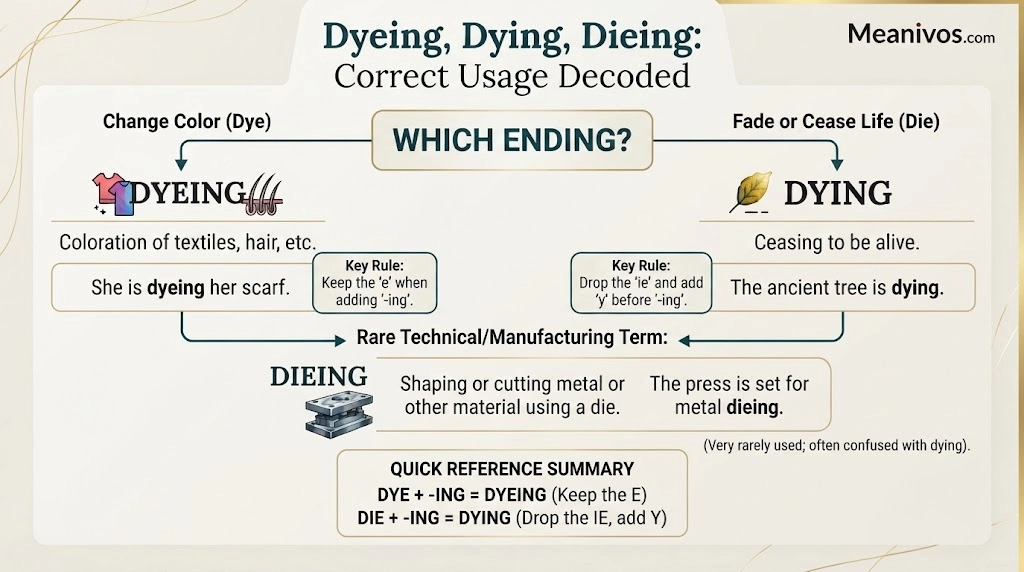
When a verb ends in -ie, the ie changes to y before -ing is added.
The rule
-ie → -y + -ing
Therefore:
die → dy + ing → dying
The Government of Canada gives the same pattern:
- die → dying
- lie → lying
- tie → tying
- vie → vying
So the normal spelling is:
D-I-E → D-Y-I-N-G
Not:
D-I-E-I-N-G
Why does English do this?
English spelling does not always work by simply attaching a suffix to the unchanged base word. Certain spelling patterns modify the final letters to produce an established form.
Compare:
| Base verb | Correct -ing form |
| die | dying |
| lie | lying |
| tie | tying |
| vie | vying |
Once you learn this group, the spelling becomes much easier to remember.
Is “Dieing” a Word?
Yes, but not in the way most people think.
If you are using the verb die to mean “cease living,” then dieing is not the standard -ing form.
The normal form is:
die → dying
However, dieing has been recorded in a rare technical sense connected with a manufacturing die. Historical and specialist usage distinguishes this meaning from the ordinary verb die.
This is an important detail because simply saying “dieing is never a word” is too absolute.
What is a manufacturing die?
In manufacturing, a die can be a tool used to cut, shape, form, or stamp material.
The technical word dieing can therefore refer to work involving such a die.
This is very different from:
The patient is dying.
The first concerns a manufacturing process.
The second concerns death.
Should you use “dieing” in normal writing?
Usually, no.
If your sentence means that a person, animal, plant, battery, trend, tradition, or industry is approaching an end, use:
dying
For example:
The old machine is dying.
Not:
The old machine is dieing.
If you are writing specialised manufacturing documentation and the technical meaning is genuinely intended, dieing may appear. But ordinary readers are overwhelmingly more likely to encounter dying.
Dieing vs Dying: Side-by-Side Comparison
| Word | Meaning | Normal use? | Example |
| dying | Approaching death | Yes | The tree is dying. |
| dying | Declining or disappearing | Yes | The tradition is dying. |
| dying | Losing power or stopping | Yes, informal | My phone is dying. |
| dieing | Technical work involving a manufacturing die | Rare | A specialised dieing process |
| dyeing | Changing colour | Yes | She is dyeing her hair. |
The most important point is that meaning determines the spelling.
Dieing vs Dying vs Dyeing
Many spelling articles stop after explaining dieing vs dying. But there is a third word that causes even more confusion:
dyeing.
The three words look almost identical, but their meanings are different.
Dying = death or decline
Dying comes from the verb die.
The flowers are dying.
The patient is dying.
The old industry is dying.
My phone is dying.
Dyeing = changing colour
Dyeing comes from the verb dye, which means to change the colour of something.
She is dyeing her hair.
They are dyeing the fabric blue.
I am dyeing my clothes black.
The extra e is important:
dye → dyeing
Dieing = rare technical usage
Dieing is associated with the specialist manufacturing sense of die.
So the easiest three-word rule is:
Dying → death or decline
Dyeing → colour
Dieing → manufacturing die
Dying vs Dyeing: The Hair Example
Hair is one of the easiest ways to understand the difference.
If someone changes the colour of their hair, write:
She is dyeing her hair.
Not:
❌ She is dying her hair.
Why?
Because dye means to colour something.
Its present participle is:
dye → dyeing
But compare:
Her hair is dying.
This would mean the hair is deteriorating or, in a figurative sense, “dying.”
Therefore:
Changing hair colour = dyeing hair
Hair deteriorating = dying
This distinction is particularly useful because searchers often type “Dying vs Dyeing” after first encountering the dieing vs dying spelling problem.
Examples of “Dying” in Sentences
Here are practical examples covering different meanings of dying.
1. Physical death
The elderly man was dying peacefully.
2. A sick animal
The injured bird was slowly dying.
3. A plant
The flowers are dying without water.
4. Declining traditions
Some traditional crafts are dying out.
5. Declining industries
The industry is slowly dying.
6. Fading interest
Public interest in the trend is dying.
7. A battery
My phone battery is dying.
8. A machine
The old engine sounds like it is dying.
9. Strong desire
I’m dying to see the new film.
Here, dying is figurative. It means extremely eager.
10. Curiosity
I’m dying to know the answer.
11. Sports
The goal came in the dying seconds of the match.
Here, dying seconds means the final seconds.
12. A final period
The project was completed during the dying days of the year.
These examples demonstrate why dying has a much wider use than literal death.
Common Incorrect Uses of “Dieing”
If you mean death, decline, or fading, these sentences should normally use dying.
Incorrect:
❌ The plant is dieing.
Correct:
✅ The plant is dying.
Incorrect:
❌ My battery is dieing.
Correct:
✅ My battery is dying.
Incorrect:
❌ The old tradition is dieing out.
Correct:
✅ The old tradition is dying out.
Incorrect:
❌ He is dieing.
Correct:
✅ He is dying.
Incorrect:
❌ I’m dieing to know.
Correct:
✅ I’m dying to know.
The mistake usually occurs because writers apply the familiar rule:
verb + ing
They see die and naturally think:
die + ing = dieing
But die belongs to the special -ie → -y spelling pattern.
Why Do People Spell “Dieing” Incorrectly?
The mistake is completely understandable.
Consider ordinary verbs:
- work → working
- play → playing
- talk → talking
- read → reading
- jump → jumping
In these examples, the writer simply adds -ing.
So someone seeing die may naturally assume:
die + ing = dieing
But English has several spelling changes when suffixes are added.
The important pattern here is:
Verbs ending in -ie change -ie to y before -ing.
Therefore:
die → dying
The same pattern appears in:
lie → lying
and
tie → tying
The official Canadian spelling guidance specifically documents these forms.
Is “Dying” a Verb?
Yes.
Dying is the present participle of die.
The main verb forms are:
| Form | Word |
| Base form | die |
| Past tense | died |
| Present participle | dying |
Examples:
People die.
He died yesterday.
He is dying.
The same dying form can appear in different grammatical constructions.
“Dying” as a Gerund
An -ing form can function as a gerund when it behaves like a noun.
For example:
Dying is a natural part of life.
Here, dying functions as the subject of the sentence.
Another example:
She was afraid of dying.
Here, dying follows the preposition of and has a noun-like grammatical role.
So it is not accurate to think of dying as having only one grammatical function.
Its grammatical role depends on the sentence.
“Dying” as an Adjective
Dying can also describe a person, thing, or situation.
For example:
The dying patient needed constant care.
Here, dying modifies the patient.
It can also describe something that is disappearing:
The town is trying to preserve its dying traditions.
This figurative use describes traditions that are becoming less common or are at risk of disappearing.
- Explore More: https://meanivos.com/google-meaning/
Common Expressions With “Dying”
You will encounter dying in many established expressions.
“Dying to”
I’m dying to hear the news.
Meaning: I am extremely eager to hear the news.
“Dying for”
I’m dying for a cup of coffee.
Meaning: I strongly want a cup of coffee.
“Dying out”
The language is slowly dying out.
Meaning: The language is gradually disappearing.
“Dying down”
The noise is dying down.
Meaning: The noise is becoming weaker or quieter.
“A dying breed”
Traditional bookshops are becoming a dying breed.
Meaning: They are becoming increasingly rare.
“Dying moments”
The team scored in the dying moments of the match.
Meaning: The final moments of the match.
These expressions use dying, not dieing.
Is “Dying” British or American English?
Dying is standard in both British and American English.
There is no normal UK-versus-US spelling difference in this word.
So whether your audience is in:
- the United Kingdom
- the United States
- Canada
- Australia
- New Zealand
- Pakistan
- India
the ordinary spelling is:
dying
Do not assume that dieing is an American spelling. It is not the American equivalent of British dying.
When Could “Dieing” Be Correct?
The answer requires context.
If Dieing is intended as the technical form associated with a manufacturing die, it can appear in specialist writing.
A manufacturing die may be used to shape or form material.
The technical sense is therefore completely separate from the ordinary verb die meaning “cease living.”
This distinction is supported by historical linguistic discussion and specialist usage.
However, there is a practical rule for general readers:
If you are talking about death, decline, fading, or something running out, use “dying.”
Do not choose dieing simply because die + ing looks logical.
A Simple Decision Rule: Dieing or Dying?
When you are unsure, ask:
Does the sentence mean “losing life,” “ending,” “fading,” or “declining”?
Use:
dying
Example:
The flower is dying.
Does the sentence mean “changing colour”?
Use:
dyeing
Example:
She is dyeing the fabric.
Does it specifically concern a manufacturing die?
A specialised technical use of:
dieing
may be appropriate.
For normal English writing, however, the answer will almost always be:
dying
Dieing vs Dying: Easy Memory Trick
Remember these three formulas:
For death:
DIE → DYING
The IE changes to Y before -ing.
For colour:
DYE → DYEING
Keep the e before -ing.
For manufacturing:
DIE → DIEING
Only consider this rare form when the word relates to a manufacturing die.
A simple memory chart:
| Situation | Correct word |
| Losing life | dying |
| Fading or declining | dying |
| Battery losing power | dying |
| Changing colour | dyeing |
| Working with a manufacturing die | dieing, rare |
Dieing vs Dying vs Dyeing: Three Examples
Compare these sentences:
The plant is dying.
The plant is losing life.
She is dyeing the fabric.
She is changing the fabric’s colour.
The specialist process involves dieing.
The context is manufacturing and uses the specialist sense.
The spelling changes because the meaning and source word are different.
Common Mistakes to Avoid
Mistake 1: Writing “dieing” for death
❌ He is dieing.
✅ He is dying.
Mistake 2: Thinking “die + ing” automatically becomes “dieing”
❌ die + ing = dieing
✅ die → dy + ing = dying
Mistake 3: Confusing dying with dyeing
❌ She is dying her hair blue.
✅ She is dyeing her hair blue.
Mistake 4: Assuming “dieing” can never exist
It is more accurate to say that dieing is rare and specialised, rather than claiming that the sequence of letters can never occur in English. Historical and technical usage provides a separate meaning.
Mistake 5: Assuming British English uses “dieing”
It does not.
Dying is standard in both British and American English.
Dieing vs Dying: Quick Comparison Chart
| Question | Answer |
| What is the -ing form of die? | dying |
| Is dying correct for death? | Yes |
| Is dieing the normal spelling for death? | No |
| Is dieing ever used? | Yes, rarely in a technical context |
| What does dyeing mean? | Changing colour |
| How do you spell “dying”? | D-Y-I-N-G |
| Why is there a Y? | ie changes to y before -ing |
| Is “dying” British or American? | Both |
| Is “dying” a verb? | Yes |
| Can “dying” be an adjective? | Yes |
| Can “dying” function as a gerund? | Yes, depending on context |
Topical Cluster Ideas
1: -IE to -Y Spelling Rules
Cover:
- die → dying
- lie → lying
- tie → tying
- vie → vying
2: Similar-Looking Words
Cover:
- die vs dye
- dying vs dyeing
- died vs dyed
- lie vs lay
- advice vs advise
3: Common Spelling Questions
Cover:
- correct spelling
- British vs American spelling
- present participles
- gerunds
- irregular spelling patterns
- confusing English words
People Also Ask
A:Dying is correct when you mean the process of dying, fading, declining, or approaching an end. Dieing is not the normal -ing form of die.
A:English verbs ending in -ie generally change ie to y before adding -ing. Therefore, die → dying.
A:Yes, but only in a rare and specialised technical sense associated with a manufacturing die. For ordinary writing about death, use dying.
A:It is dyeing your hair when you are changing its colour. Dying means losing life or, figuratively, fading or declining.
V
Related Words You Should Know
Understanding dieing vs dying becomes easier when you connect it to related spelling pairs.
Die → dying
The tree is dying.
Lie → lying
He is lying on the sofa.
Tie → tying
She is tying her shoes.
Vie → vying
Several companies are vying for the contract.
Dye → dyeing
They are dyeing the fabric.
These examples reinforce the important difference between the -ie → -y pattern and the separate verb dye.
Why “Dying” Is the Best Choice in Normal Writing
If your goal is clear everyday English, dying is the word your reader expects.
Use it for:
- people approaching death
- animals losing life
- plants deteriorating
- traditions disappearing
- industries declining
- trends fading
- batteries running out
- machines approaching failure
- strong figurative expressions
Use dyeing when colour is involved.
Only consider dieing when you genuinely have the specialist manufacturing meaning.
This distinction gives you a much more reliable rule than simply memorising that one spelling is “right” and another is “wrong.”
Final Verdict
So, dieing vs dying—which one should you use?
For almost every ordinary English sentence, choose:
DYING
If you mean death, decline, fading, Disappearance, or something losing power, use dying.
The plant is dying.
My phone is dying.
The old tradition is dying out.
I’m dying to know the answer.
If you mean changing colour, use:
DYEING
She is dyeing her hair.
They are dyeing the fabric.
And if you encounter dieing, remember that it can have a rare technical meaning connected with a manufacturing die, but it is not the ordinary present participle of die.
The spelling rule is simple:
DIE → DYING
The Government of Canada’s spelling guidance confirms this -ie → -y before -ing pattern.
The three-word rule
Die → dying = death or decline
Dye → dyeing = colour
Die + manufacturing die → dieing = rare technical usage
If you remember only one thing, remember this:
When “die” means to stop living, the correct -ing form is “dying.”