Fair vs Good: Meaning, Usage, Comparison & Examples
Fair vs Good can both describe something positively, but they do not always mean the same thing.
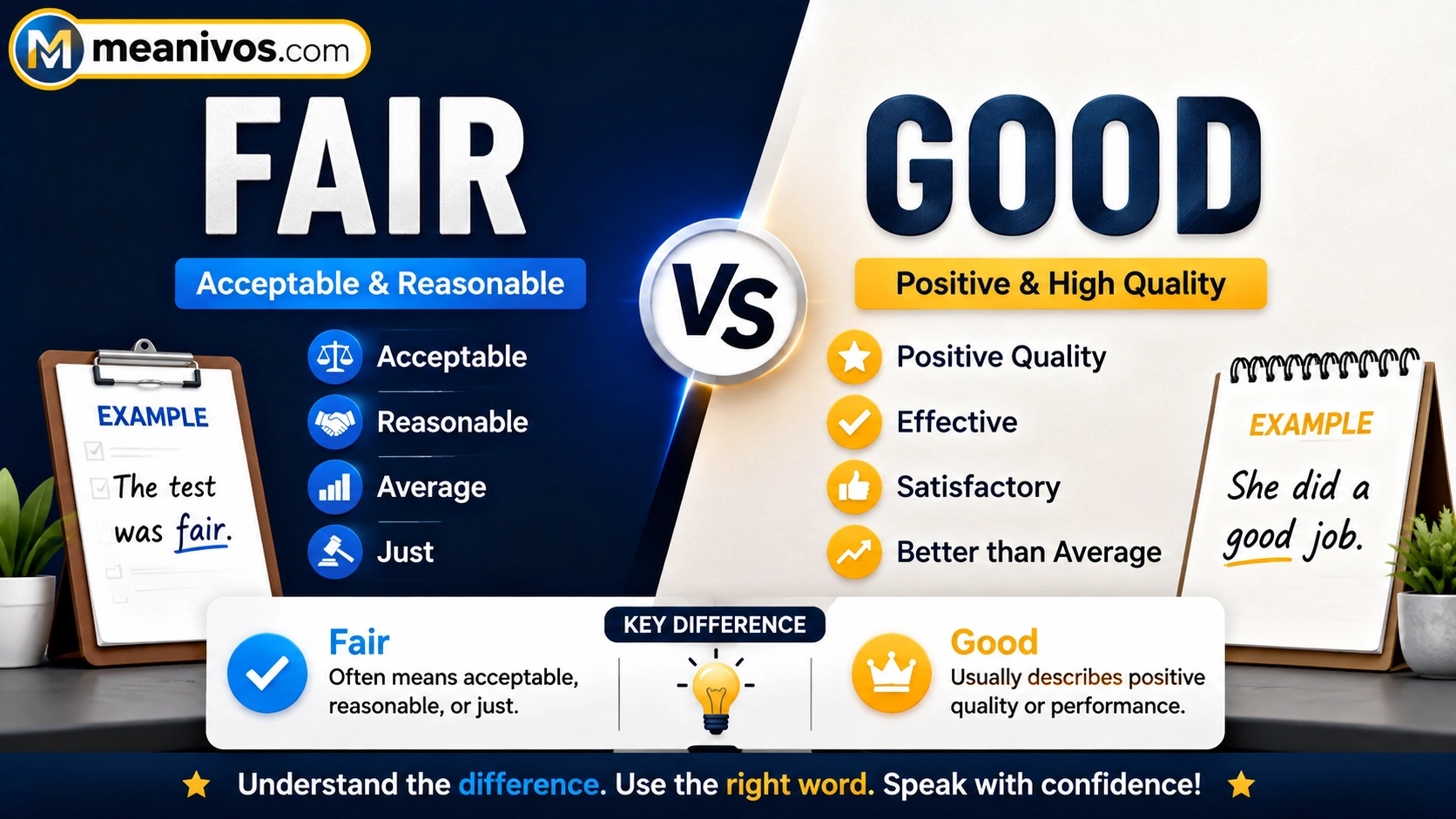
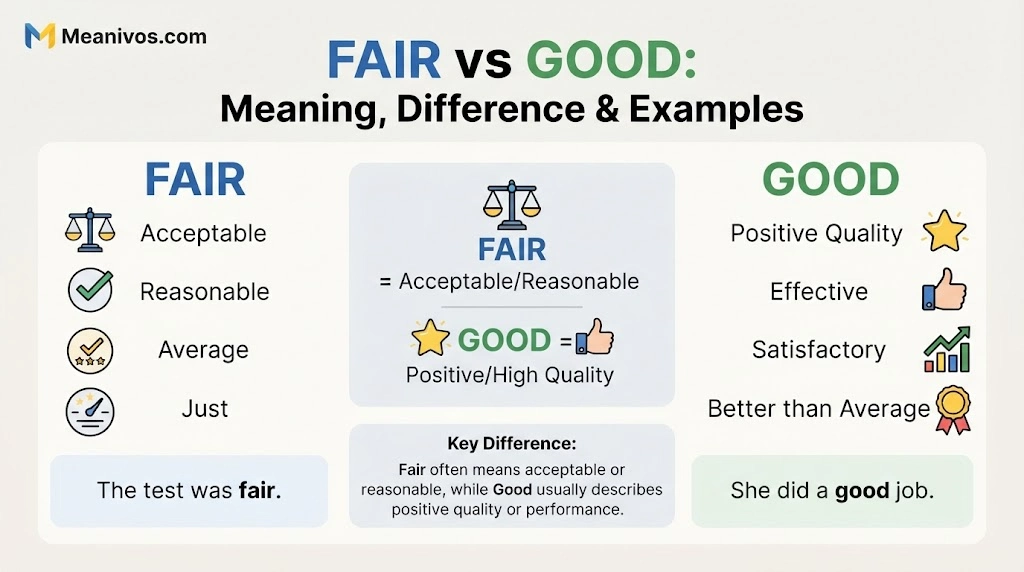
When fair describes quality, it often means acceptable, moderate, or good enough but not excellent. Good usually expresses stronger approval and can mean satisfactory, enjoyable, successful, suitable, or of high quality.
But there is an important distinction: fair is not always a quality rating.
It can also mean just, reasonable, impartial, equal, or according to the rules. For example, “The referee made a fair decision” is not saying the decision was average. It means the decision was just or impartial.
So, when comparing quality, a useful scale is:
Poor → Fair → Good → Very Good → Excellent
However, that scale does not work in every sentence.
For example:
- The food was fair. → The food was acceptable but not especially impressive.
- The food was good. → The food was clearly positive or enjoyable.
- The price was fair. → The price was reasonable.
- The referee was fair. → The referee acted impartially.
The key is context.
Fair vs Good: Quick Answer
The simplest distinction is:
| Word | Main meaning | Typical impression |
| Fair | Acceptable, reasonable, moderate, or just | Neutral to mildly positive |
| Good | Positive, satisfactory, suitable, or high quality | Clearly positive |
When both words describe quality, good is generally stronger than fair.
For example:
The movie was fair.
This suggests that the movie was acceptable but not particularly impressive.
The movie was good.
This gives a more positive impression of the movie.
But compare:
The teacher was fair.
Here, fair usually means the teacher treated students equally and reasonably.
The teacher was good.
Here, good usually means the teacher was capable, effective, or otherwise positive.
Therefore, fair and good cannot always be placed on the same scale.
What Does “Fair” Mean?
Fair is a highly versatile English adjective.
Its meaning changes considerably depending on the context.
Cambridge Dictionary identifies fair as meaning, among other things, neither very good nor very bad; good but not excellent in certain expressions; and right or reasonable in matters of treatment and judgement.
Fair Meaning: Average or Acceptable Quality
When fair is used as a quality rating, it can mean something is neither very good nor very bad.
For example:
- The hotel was in fair condition.
- His performance was fair.
- The food was fair.
- The service was fair.
In this sense, fair is usually below good.
A common rating sequence is:
Poor → Fair → Good → Excellent
Cambridge itself gives a rating scale using these categories.
However, this does not mean that every rating system assigns a fixed numerical score.
Fair Meaning: Just or Reasonable
One of the most important meanings of fair has nothing to do with quality.
It can mean just, reasonable, impartial, or equitable.
Examples include:
- a fair trial
- a fair decision
- fair treatment
- fair wages
- a fair opportunity
- a fair distribution
- a fair agreement
Consider:
Everyone deserves a fair opportunity.
Here, fair means the opportunity should be reasonable and equally available.
It does not mean the opportunity is “average.”
This distinction is one of the biggest reasons a simple fair = average explanation is incomplete. Your competitor research also identifies this as a major content gap.
Fair Meaning: According to the Rules
In games, competitions, and sports, fair can mean that something follows the rules.
For example:
That was a fair move.
The referee called it a fair challenge.
Here, fair means legal, permitted, or consistent with the rules.
Again, this is a completely different meaning from a quality rating.
You could therefore say:
The player made a fair move.
without saying whether the move was good, clever, successful, or effective.
Fair Meaning: Good but Not Excellent
There is another subtle use of fair that is particularly important for learners.
Cambridge records fair before nouns such as idea, guess, and chance as meaning good but not excellent.
For example:
That’s a fair idea.
This can mean:
That’s a reasonably good idea.
Similarly:
She has a fair chance of winning.
This means she has a reasonable possibility of winning.
So, fair can sometimes be positive without being as strong as good.
What Does “Good” Mean?
Good is one of the most common and flexible adjectives in English.
Cambridge lists meanings including satisfactory, enjoyable, pleasant, high quality, positive, successful, and suitable.
Examples include:
- a good book
- a good restaurant
- a good student
- a good performance
- a good result
- a good idea
- a good opportunity
Good Meaning: High Quality
When good describes quality, it normally expresses positive approval.
This is a good laptop.
The speaker is saying the laptop has desirable qualities or performs well.
Good Meaning: Successful or Capable
Good can also describe someone’s ability.
She is good at mathematics.
He is a good driver.
Here, good means capable, skilled, or effective.
Good Meaning: Suitable
Sometimes good means suitable or convenient rather than high quality.
Is this a good time to call?
Time itself does not possess “quality.” Instead, the speaker is asking whether the time is suitable.
Cambridge specifically includes this use of good as meaning suitable, convenient, or satisfactory.
Fair vs Good: What Is the Difference?
The difference depends on what the adjective is describing.
| Fair | Good |
| Acceptable | Clearly positive |
| Reasonable | Satisfactory |
| Moderate | Often higher quality |
| Can mean impartial | Can mean capable |
| Can mean equal | Can mean successful |
| Can mean rule-compliant | Can mean suitable |
| Can mean good but not excellent | Often communicates stronger approval |
When both words describe quality, good normally sounds more positive.
For example:
The service was fair.
This suggests that the service was acceptable, but perhaps had some limitations.
The service was good.
This suggests a more positive experience.
Is Good Better Than Fair?
Usually, yes—when both words are being used to rate quality.
A common quality scale is:
Poor → Fair → Good → Very Good → Excellent
For example:
- Poor service = below an acceptable standard
- Fair service = acceptable but limited
- Good service = satisfactory and positive
- Very good service = clearly strong
- Excellent service = outstanding
But do not apply this scale automatically to every sentence containing fair.
Consider:
The judge made a fair decision.
This does not mean the decision was “average.”
It means the decision was just or impartial.
Meanwhile:
The judge made a good decision.
usually means the decision was wise, effective, beneficial, or sensible.
The two adjectives can even describe different qualities of the same thing:
The judge made a fair and good decision.
Here, fair describes justice or impartiality, while good describes the quality or outcome of the decision.
Fair vs Good on a Quality Scale
When the words are used specifically as quality ratings, this is a useful general guide:
Poor → Fair → Good → Very Good → Excellent
Fair usually suggests:
- acceptable quality
- moderate performance
- some limitations
- average quality in some rating systems
- restrained approval
- room for improvement
Good usually suggests:
- positive quality
- satisfactory performance
- stronger approval
- useful or reliable results
- desirable qualities
- above-basic expectations
However, there is no universal numerical definition of fair or good.
For example, one organisation might use:
Poor → Fair → Good → Excellent
while another might use a completely different scoring system.
So it is inaccurate to claim that:
Fair = exactly 50%
or:
Good = exactly 70%
English does not establish those fixed scores.
Fair vs Good in Different Situations
Fair vs Good Performance
His performance was fair.
This suggests that he performed adequately but had room for improvement.
His performance was good.
This communicates stronger approval and suggests that he performed well.
For stronger praise, choose “good.”
Fair vs Good Condition
These expressions are common when describing cars, houses, furniture, electronics, and other physical items.
The car is in fair condition.
This suggests that the car is usable but has noticeable wear, defects, or limitations.
The car is in good condition.
This normally suggests that the car is reasonably well maintained and has fewer significant problems.
Therefore, as a condition rating:
Fair condition < Good condition
Fair vs Good Grades
I received a fair grade.
This suggests an acceptable or moderate academic result.
I received a good grade.
This suggests a stronger result.
But do not assume that fair always means C or good always means B.
Schools, universities, countries, and individual grading systems can use different classifications.
Fair vs Good Service
The service was fair.
This usually means the service was acceptable, but the customer was not especially impressed.
The service was good.
This gives a stronger positive impression.
For customer feedback, fair is generally weaker praise than good.
Fair Price vs Good Price
This is a particularly important distinction.
That’s a fair price.
Usually means:
The price is reasonable or justified.
It does not necessarily mean the price is cheap.
For example:
€100 is a fair price for that service.
The speaker believes €100 is reasonable.
Now compare:
I got the phone at a good price.
This often suggests that the buyer considers the price attractive, favourable, or good value.
Therefore:
fair price = reasonable price
good price = favourable or attractive price
Fair Chance vs Good Chance
This is one of the most interesting differences between these words.
Compare:
She has a fair chance of winning.
She has a good chance of winning.
Both statements can be positive.
A fair chance generally suggests a reasonable or realistic possibility.
A good chance usually suggests a stronger possibility.
So:
fair chance = reasonable possibility
good chance = relatively strong possibility
Cambridge specifically gives fair chance as an example of fair meaning good but not excellent or reasonably possible.
This is why the rule “fair is always worse than good” is too simplistic.
Fair Deal vs Good Deal
The phrases fair deal and good deal also have different emphasis.
Fair deal
A fair deal is an agreement whose terms are reasonable and equitable.
We both agreed that it was a fair deal.
The emphasis is on fairness and reasonable treatment.
Good deal
A good deal often means a favourable bargain.
I bought the camera for £300. It was a good deal.
The emphasis is on value or advantage.
So:
fair deal = reasonable for everyone
good deal = favourable or valuable
Fair vs Good Work
Compare:
Your work is fair.
This is fairly restrained feedback. It suggests that the work meets a basic standard but could be improved.
Your work is good.
This is clearly positive feedback.
If a teacher, manager, editor, or client describes your work as fair, do not automatically interpret it as strong praise.
The exact tone still depends on the speaker and situation.
“Fair Enough” vs “Good Enough”
These expressions are not interchangeable.
Fair enough
Fair enough is commonly used to acknowledge that someone’s point, decision, or argument is reasonable.
For example:
“I don’t want to go out tonight.”
“Fair enough.”
Here, fair enough means something like:
“That’s reasonable. I understand and accept your point.”
It does not simply mean “good enough.”
Good enough
Good enough means something reaches the required standard.
The answer is good enough for now.
This means the answer is sufficiently satisfactory for the particular purpose.
Therefore:
fair enough = reasonable / understandable / acceptable
good enough = sufficient to meet a requirement
- Explore More: https://meanivos.com/its-called-vs-it-called/
Does Fair Mean Bad?
No.
Fair is not normally synonymous with bad.
When used as a quality rating, it generally indicates something acceptable, moderate, or neither very good nor very bad. Cambridge explicitly uses fair in this middle position on a scale that includes poor, fair, good, and excellent.
A useful general scale is:
- Poor = below an acceptable standard
- Fair = acceptable or moderate
- Good = clearly positive
- Excellent = outstanding
However, tone matters.
If someone asks:
“How was the restaurant?”
and you answer:
“It was fair.”
the listener may understand that you were not particularly impressed.
So fair is not necessarily negative, but it can sound like faint praise when used as a quality assessment.
Does Fair Mean Average?
Sometimes, but not always.
When fair describes quality, it can mean average, moderate, or neither very good nor very bad.
But it has several other meanings.
Example 1
Everyone received a fair share.
Here, fair means reasonable or equal.
Example 2
The referee made a fair decision.
Here, fair means just or impartial.
Example 3
She has a fair chance of winning.
Here, fair means reasonable or realistic.
Therefore, the meaning of fair must be determined from the surrounding context.
Can Fair Mean Good?
Yes, in certain contexts.
Cambridge records a use of fair meaning good but not excellent, particularly with nouns such as idea, guess, and chance.
For example:
That’s a fair idea.
This can mean:
That’s a reasonably good idea.
Another example:
We have a fair chance of success.
This means:
We have a reasonable chance of success.
However, fair is not a general replacement for good.
For example:
She is a good teacher.
and
She is a fair teacher.
can communicate different things.
The first normally evaluates her teaching ability.
The second may suggest that she treats students impartially or reasonably.
Fair vs Good: Common Mistakes
Mistake 1: Assuming Fair Always Means Bad
Incorrect:
Fair = bad.
Better:
Fair can mean acceptable, moderate, reasonable, impartial, equal, rule-compliant, or good but not excellent.
Mistake 2: Assuming Fair Always Means Average
Fair can describe average quality, but this has only one meaning.
The decision was fair.
Here, the focus is on justice, not quality.
Mistake 3: Treating Fair and Good as Exact Synonyms
They can overlap in certain contexts, but they often communicate different ideas.
The food was fair.
This usually suggests moderate or acceptable quality.
The food was good.
This generally expresses stronger approval.
Mistake 4: Assuming Every Fair Rating Has the Same Score
Rating systems differ.
One system may use:
Poor → Fair → Good → Excellent
Another may use different labels entirely.
Therefore, the numerical meaning of a rating depends on the specific rating system, not English grammar.
Mistake 5: Confusing Fair With Fairly
Fair is an adjective:
The result was fair.
Fairly is commonly an adverb:
The result was fairly good.
Fairly good means reasonably or moderately good.
It is grammatically and semantically different from simply saying something is fair.
Fair vs Good Example Sentences
Examples with “Fair”
- The car is in fair condition.
- The service was fair.
- We received a fair price.
- Everyone deserves a fair opportunity.
- The referee made a fair decision.
- She has a fair chance of winning.
- The teacher was fair to every student.
- We reached a fair agreement.
- His performance was fair.
- That’s a fair idea.
Examples with “Good”
- The car is in good condition.
- The service was good.
- We got a good price.
- She is a good teacher.
- He is good at mathematics.
- We had a good experience.
- The results were good.
- That’s a good idea.
- She gave a good performance.
- This is a good opportunity.
Fair vs Good: Side-by-Side Examples
| Expression | Meaning |
| The food was fair. | Acceptable, but not impressive |
| The food was good. | Positive and enjoyable |
| The car is in fair condition. | Usable but with noticeable limitations |
| The car is in good condition. | Generally sound or well maintained |
| The price is fair. | Reasonable or justified |
| The price is good. | Attractive or favourable |
| She has a fair chance. | A reasonable possibility |
| She has a good chance. | A relatively strong possibility |
| He is a fair teacher. | He treats students impartially |
| He is a good teacher. | He teaches effectively |
| It was a fair decision. | Just or impartial |
| It was a good decision. | Wise, useful, or beneficial |
Which Word Should You Use?
Use fair when you mean:
- reasonable
- just
- impartial
- equal
- acceptable
- moderate
- according to the rules
- good but not excellent
Use good when you mean:
- positive
- satisfactory
- high quality
- enjoyable
- successful
- capable
- suitable
- beneficial
A simple test can help:
Am I talking about quality, or am I talking about fairness?
If you are evaluating quality, good is generally stronger than fair.
If you are describing equal or impartial treatment, fair is usually the correct choice.
Frequently Confused Related Terms
Understanding fair vs good becomes easier when you also understand nearby words.
Fair vs Average
Average usually focuses on a typical or middle level.
Fair can mean average or moderate in a rating context, but it can also mean reasonable or just.
Fair vs Acceptable
Acceptable means something meets a required or reasonable standard.
Fair can have this meaning, but it carries additional meanings such as impartial and equitable.
Fair vs Excellent
Excellent indicates exceptionally high quality.
When fair is being used as a quality rating, it is considerably weaker than excellent.
Good vs Excellent
Good expresses a clear positive quality.
Excellent indicates a substantially higher level of quality or performance.
Fair vs Good: A Simple Memory Trick
Remember:
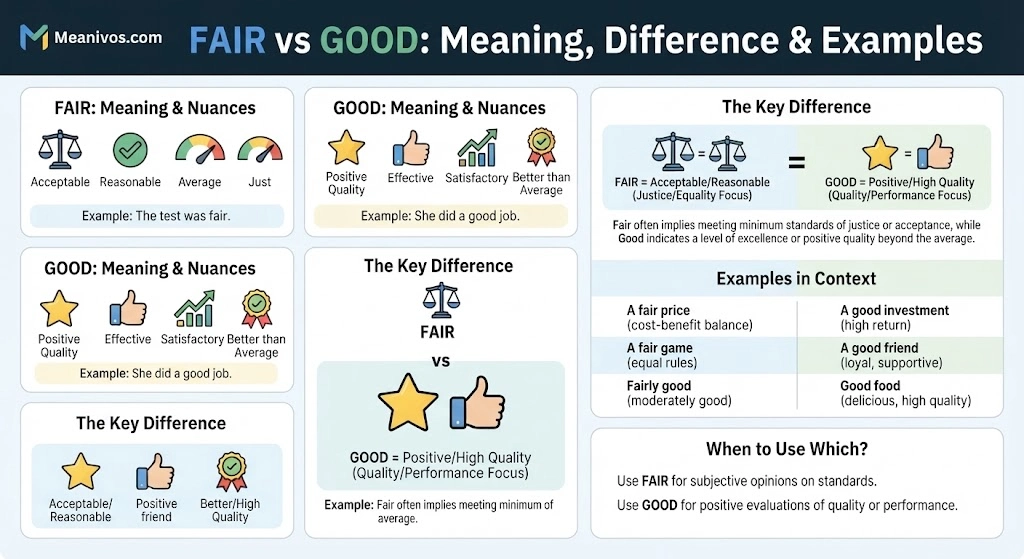
FAIR = reasonable / acceptable / just
GOOD = positive / satisfactory / high quality
When rating quality:
Fair < Good
But when talking about justice:
Fair ≠ Good
This distinction makes the two words much easier to use correctly.
People Also Ask
A:Usually, yes, when both words are being used to rate quality. A common scale is poor → fair → good → very good → excellent. But fair can have other meanings, such as just or impartial.
A:It can be. Fair may mean acceptable or reasonably good, but it can also mean just, equal, impartial, or reasonable. Its tone depends heavily on context.
A:Sometimes. In quality ratings, fair can mean neither very good nor very bad. However, it can also mean reasonable, impartial, equal, or rule-compliant.
A:Yes. In expressions such as a fair idea or a fair chance, fair can mean reasonably good or reasonable, although not necessarily excellent.
A:No. When describing the condition of an item, good condition normally indicates a better state than fair condition.
Conclusion
Fair vs good is not simply a question of which word is “better.”
When the two words are used as quality ratings, good is generally stronger than fair:
Poor → Fair → Good → Very Good → Excellent
But fair has a much broader range of meanings.
It can mean acceptable, moderate, reasonable, just, impartial, equal, according to the rules, or good but not excellent, depending on the context.
Meanwhile, good commonly describes something that is satisfactory, enjoyable, positive, suitable, successful, capable, or of high quality.
So the best rule to remember is:
Use “fair” when you mean reasonable, impartial, equal, or acceptable; use “good” when you want to express stronger positive quality or approval.
And remember that phrases can change the meaning:
- fair price = reasonable price
- good price = favourable price
- fair chance = reasonable possibility
- good chance = stronger possibility
- fair deal = equitable agreement
- good deal = favourable bargain
- fair enough = reasonable; I understand
- good enough = sufficient
Once you look at the context rather than the individual word, the difference becomes much clearer.
In short: fair can be good in some contexts, but good is generally stronger when you are rating quality.
Note: The exact meaning and strength of these words can vary according to context, rating system, region, and conversational tone.