Ingrained vs Engrained: Which Word Is Right?
Ingrained or engrained? If you have ever paused while writing an email, essay, article or report because you were unsure which spelling to use, you are not alone.
The two forms look and sound very similar, but there is an important difference in modern usage and frequency.
The short answer is simple:
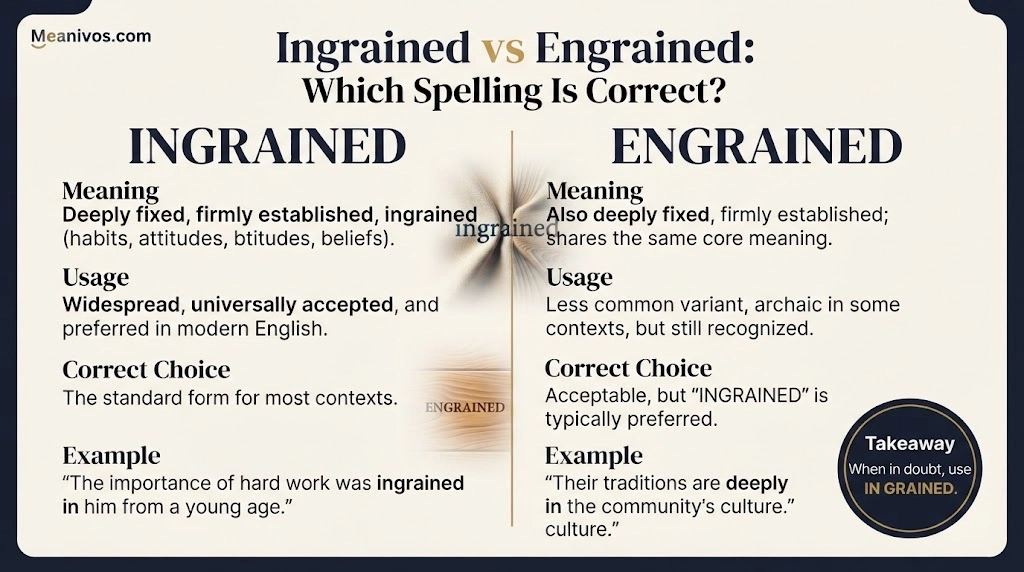
Ingrained is the standard and preferred spelling in modern English. However, engrained is also a recognised, less common variant.
Merriam-Webster lists engrained as a less common variant of ingrained, while Oxford lists engrained as an alternative form. Collins likewise recognises both forms.
So, calling an engraving simply “wrong” is too absolute. At the same time, the two spellings are not equally common.
If you are writing for school, university, business, journalism or a general audience, ingrained is normally the safest choice.
This guide explains the difference, meaning, history, grammar, examples, common mistakes and the easiest way to remember which spelling to use.
Ingrained or Engrained: Quick Answer
| Word | Status | Meaning | Best choice? |
| ingrained | Standard and common | Deeply fixed, established or embedded | Yes |
| engrained | Less common variant | Essentially the same meaning | Usually no |
| engraved | Different word | Carved or marked into a surface | No |
For example:
- Preferred: Her habit of checking everything twice is deeply ingrained.
- Recognised but less common: Her habit of checking everything twice is deeply engrained.
The practical rule is:
When in doubt, use “ingrained.”
What Does “Ingrained” Mean?
Ingrained is an adjective meaning deeply fixed, firmly established, deeply rooted or difficult to change.
It is commonly used for:
- habits
- beliefs
- attitudes
- values
- behaviours
- traditions
- fears
- prejudices
- assumptions
- cultural practices
- ways of thinking
Oxford defines ingrained as something, such as a habit or attitude, that has existed for a long time and is therefore difficult to change. It also uses the word for dirt that is below a surface and difficult to remove.
Merriam-Webster describes “ingrained” in two related ways: it can describe something deeply fixed in a person’s nature, or something worked deeply into grain or fibre.
Ingrained in simple English
A very simple definition is:
Ingrained means something has become so deeply established that changing or removing it is difficult.
For example:
Waking up early is an ingrained habit for Sarah.
This means Sarah has followed the habit for so long that waking up early feels natural to her.
Another example:
His fear of public speaking is deeply ingrained.
This means the fear is firmly established rather than being a temporary feeling.
What Does “Engrained” Mean?
Engrained is a recognised alternative or less common form of ingrained.
In most contexts, it carries the same basic meaning: deeply fixed, established, embedded or difficult to change.
Oxford lists engrained as an alternative form of ingrained and gives the same broad meanings for long-established habits or attitudes and dirt beneath a surface.
Collins also lists ingrained or engrained and defines the word in senses including deeply impressed or instilled and worked into fibre, grain or pores.
Therefore, this statement is more accurate than saying “engrained is wrong”:
Engrained is a legitimate but less common variant; ingrained is the preferred modern form.
Dictionary.com also currently lists engrained as meaning ingrained and provides examples of contemporary usage.

Ingrained vs Engrained: What Is the Difference?
The main difference is spelling preference and frequency, rather than a major difference in meaning.
Ingrained
Ingrained is the normal form most readers expect.
You will commonly see expressions such as:
- an ingrained habit
- an ingrained belief
- an ingrained attitude
- an ingrained fear
- an ingrained prejudice
- ingrained behaviour
- ingrained values
- deeply ingrained traditions
Engrained
Engrained is an alternative form that appears much less frequently.
Dictionaries recognise it, but writers should generally choose “ingrained” unless they have a specific reason to use the less common variant.
The practical difference
| Situation | Better choice |
| Academic essay | ingrained |
| Business report | ingrained |
| Professional email | ingrained |
| Website article | ingrained |
| Exam | ingrained |
| Everyday writing | ingrained |
| Quoting an older source | Keep the original spelling |
| Reproducing a title exactly | Keep the original spelling |
| Encountering the word in published material | Understand it as a variant |
So while both forms can be encountered, ingrained is the safer default.
Is “Engrained” a Correct Word?
Yes—with an important qualification.
It would be inaccurate to say that engrained is never a word.
Merriam-Webster explicitly identifies engrained as a less common variant, and Oxford lists it as an alternative form.
The better distinction is:
Ingrained: standard, familiar and preferred.
Engrained: recognised, but less common.
This matters because language dictionaries record actual usage and variant forms. A word does not necessarily become “incorrect” simply because another spelling is much more common.
However, if your goal is clear modern writing, there is little practical advantage in choosing engrained over ingrained.
Why Is “Ingrained” More Common?
The answer becomes easier when you look at the word’s history.
Ingrained comes from the verb ingrain, which is connected with the idea of working something deeply into grain or fibre.
The physical idea is useful as a metaphor.
Imagine dye penetrating deeply into fabric. Once the colour has become part of the fibres, removing it is difficult.
English later extended this idea to things that become deeply established in the mind, character or behaviour.
That gives us expressions such as:
deeply ingrained beliefs
ingrained habits
The ingrained attitudes
ingrained traditions
Collins dates the word’s origin to the late sixteenth or early seventeenth century and connects it with ingrain. Merriam-Webster records an early use of ingrained in 1599.
This physical-to-figurative development explains why the word works naturally for both material substances and ideas or behaviour.
Ingrained Meaning in Simple English
If you need the shortest possible definition:
Ingrained means deeply fixed or established and difficult to change.
For example:
“Respect for elders was ingrained in him from childhood.”
Simple meaning:
Respect for elders became a deeply established part of his behaviour.
Another example:
“The company has an ingrained culture of punctuality.”
Simple meaning:
Being punctual is a deeply established part of the company’s culture.
How to Use “Ingrained” in a Sentence
Ingrained normally works as an adjective.
Here are common patterns.
Ingrained habits
Checking her phone every morning became an ingrained habit.
His habit of taking notes is deeply ingrained.
An ingrained habit is a behaviour that has become established through repetition.
Ingrained beliefs
Her belief in hard work is deeply ingrained.
Some ingrained beliefs are difficult to reconsider.
An ingrained belief is an idea that has become firmly established in someone’s thinking.
Ingrained behaviour
The behaviour had become so ingrained that he rarely noticed it.
This suggests the behaviour has become almost automatic.
Ingrained attitudes
The organisation is trying to change ingrained attitudes towards remote work.
Here, the word describes attitudes that have existed for a long time.
Ingrained culture
Hospitality is deeply ingrained in the local culture.
This means hospitality is an established and important part of that culture.
Ingrained fears
Her fear of failure was deeply ingrained.
The fear has become deeply established and is not easily removed.
Ingrained values
Honesty was an ingrained value in his family.
The value was deeply established Ingrained vs Engrained in the family’s way of life.
“Deeply Ingrained” vs “Deeply Engrained”
This is one of the most important phrases behind the search.
Deeply ingrained
Deeply ingrained is the preferred expression.
Examples:
- deeply ingrained habits
- deeply ingrained beliefs
- deeply ingrained attitudes
- deeply ingrained traditions
- deeply ingrained fears
- deeply ingrained values
- deeply ingrained behaviour
Oxford specifically gives deeply among the common collocations associated with ingrained.
Deeply engrained
You may encounter deeply engrained, and it is understandable because engrained is a recognised variant.
However, it is much less familiar.
For polished modern writing:
Use “deeply ingrained.”
Example:
Years of practice made the routine deeply ingrained.
This sounds natural and conventional to modern readers.
“Ingrained In” vs “Ingrained Into”
Both constructions can occur, but they are not equally natural in every context.
Ingrained in
Ingrained in is especially common when Ingrained vs Engrained describing something firmly established within a person, group, culture, system or society.
Examples:
The community deeply values the tradition.
His long-standing habit shapes his daily behaviour.
Society has deeply embedded these ideas in its culture.
Her parents instilled discipline in her from childhood.
This pattern is strongly established in dictionary examples and collocations. Oxford lists ingrained in somebody/something as a Ingrained vs Engrained normal construction.
Ingrained into
You can also encounter ingrained into, especially when the wording emphasises the process of something becoming embedded.
For example:
The values were ingrained into the children from an early age.
However, in many everyday sentences, ingrained in will sound more natural.
Quick rule
If you are unsure, choose:
The ingrained in
Ingrained vs Engraved: Are They the Same?
No.
This is an important distinction.
Ingrained
Means:
deeply fixed, established or embedded.
Example:
The lesson became ingrained in her memory.
Engraved
Usually means:
cut, carved or permanently marked into a physical surface.
Example:
Their names were engraved on the trophy.
The words look similar, but their meanings are different.
Easy comparison
| Word | Main meaning | Example |
| ingrained | Deeply fixed or established | The habit was ingrained in him. |
| engrained | Variant of ingrained | The habit was engrained in him. |
| engraved | Carved or marked into a surface | Her name was engraved on the ring. |
Remember:
Ingrained = deeply fixed.
Engraved = carved or marked.
Common Mistakes With Ingrained and Engrained
Mistake 1: Saying “engrained” is always wrong
This is the biggest mistake.
Major dictionaries recognise engrained as an alternative or less common form.
So avoid making the absolute claim that it is “not a word.”
Mistake 2: Treating both spellings as equally common
The opposite extreme is also misleading.
Although engrained is recognised, ingrained is the normal choice for modern general writing.
Mistake 3: Confusing engrained with engraved
These are different words.
Incorrect:
His attitude was engraved in his personality.
Better:
His attitude was ingrained in his personality.
Mistake 4: Assuming the pronunciation solves the problem
The two spellings are pronounced alike or very similarly in ordinary English, so listening alone will not tell you which spelling to type.
Mistake 5: Using ingrained for every physical mark
Ingrained can describe dirt that has worked into a surface, but it does not mean every kind of physical marking.
Use:
- engraved for carved writing
- etched for a marked surface
- carved for material cut into a shape
- ingrained for something deeply embedded or established
Ingrained Synonyms
Depending on the context, useful synonyms include:
- deep-rooted
- deep-seated
- firmly established
- embedded
- fixed
- entrenched
- rooted
- established
- firmly held
- persistent
- habitual
Example:
Her ingrained belief was difficult to change.
Possible alternative:
Her deeply rooted belief was difficult to change.
The words are related, but they are not perfect substitutes in every sentence.
- Explore More: https://meanivos.com/chatgpt-vs-gemini/
Ingrained Antonyms
Possible opposites include:
- temporary
- superficial
- unfamiliar
- flexible
- changeable
- undeveloped
- unsettled
- new
For example:
His fear was deeply ingrained.
An opposite idea could be:
His concern was temporary and easily overcome.
The best antonym Ingrained vs Engrained depends on what ingrained describes.
How to Remember the Correct Spelling
A simple memory trick is to focus on “in.”
Think:
Something ingrained is deeply IN something.
Examples:
She has deeply embedded the belief in her mind.
His habit shapes his behaviour.
The culture has deeply rooted the tradition in its practices.
The repeated association between ingrained and in can make the spelling easier to remember.
Another useful connection is:
ingrain → ingrained
The base word is ingrain.
So when you need the adjective, think:
ingrain + ed = ingrained
Is Ingrained British or American English?
Ingrained is standard in both British and American English.
This is not primarily a spelling difference like:
- colour / color
- centre / center
- organise / organize
Instead, engrained is a less common alternative form.
Oxford provides ingrained and engrained as related forms, while Collins also records both.
Therefore, international writers can safely use:
ingrained
in British, American and general international English.
Can “Ingrained” Describe Dirt?
Yes.
Spelling articles sometimes overlook this important meaning.
Ingrained dirt is dirt that has worked into or below a surface and is therefore difficult to remove.
For example:
The carpet had ingrained dirt all over its surface.
The old tiles had ingrained grease and dust.
Oxford specifically records the physical sense of dirt being under a surface and difficult to get rid of.
The historical meaning of the word comes Ingrained vs Engrained from the idea of working something deeply into grain or fibre.
30 Examples of “Ingrained” in Sentences
- Good manners became ingrained during childhood.
- Waking early is an ingrained habit for him.
- Her belief in hard work is deeply ingrained.
- The tradition is ingrained in the local culture.
- Fear of failure can become deeply ingrained.
- The company has an ingrained way of doing things.
- His attitude towards work is deeply ingrained.
- The behaviour became ingrained over many years.
- These customs are ingrained in the community.
- The lesson became ingrained in her memory.
- Their respect for education is deeply ingrained.
- An ingrained habit can be difficult to break.
- The prejudice was deeply ingrained in society.
- Her confidence was not yet an ingrained trait.
- The safety procedure became ingrained through repeated practice.
- Hospitality is deeply ingrained in the family.
- His ingrained assumptions affected his decision.
- The routine became so ingrained that he stopped thinking about it.
- The culture has an ingrained respect for tradition.
- Her ingrained fear made the situation harder.
- Discipline became an ingrained part of his daily routine.
- These attitudes are deeply ingrained in the organisation.
- The habit was ingrained from an early age.
- His ingrained response was to remain calm.
- Their values are deeply ingrained in the company’s culture.
- Years of practice made the technique ingrained.
- The idea became ingrained in public thinking.
- An ingrained routine can feel completely natural.
- The old assumptions remain deeply ingrained.
- Her love of reading became an ingrained habit.
When Should You Use “Ingrained”?
Use ingrained when you are describing something that has become deeply established.
It works especially well with:
Habits
an ingrained habit
Beliefs
an ingrained belief
Attitudes
an ingrained attitude
Values
ingrained values
Culture
ingrained cultural traditions
Behaviour
ingrained behaviour
Fear
an ingrained fear
Prejudice
deeply ingrained prejudice
Memory
ingrained in memory
The word can describe something positive, negative or neutral.
Positive
Her ingrained sense of responsibility made her dependable.
Negative
His ingrained prejudice was difficult to overcome.
Neutral
The routine became ingrained over many years.
When Might You Encounter “Engrained”?
You may encounter engrained in:
- published material
- older texts
- dictionaries
- historical writing
- contemporary writing that uses the variant
- online articles
- quotations and reproduced material
Current dictionary evidence shows that the form Ingrained vs Engrained is not merely imaginary. Oxford lists it as an alternative, Merriam-Webster calls it less common, and Collins cross-references it with ingrained.
That does not mean you need to choose it yourself.
If you are creating new content, ingrained remains the clearest default.
Ingrained or Engrained: Which One Should You Use?
Here is the easiest decision rule:
Use “ingrained” when:
- writing an essay
- taking an English exam
- preparing a report
- writing an email
- publishing an article
- writing academic content
- communicating professionally
- creating website content
- writing for an international audience
Use “engrained” only when:
- reproducing a source exactly
- discussing the variant itself
- preserving an original spelling
- you have a specific stylistic or historical reason
For almost every normal writing situation:
Choose ingrained.
Related Topical Cluster Ideas
1: Commonly Confused Spellings
- Ingrained vs engrained
- Requester vs requestor
- Tear vs tare
- Peak vs peek vs pique
- Forest vs Forrest
- Moment vs momment
2: “Which Is Correct?” Searches
- Is it an effect or an effect?
- Advice or advice?
- Practice or practise?
- Ensure or insure?
- Compliment or complement?
3: Word Meaning Guides
- What does ingrained mean?
- What does deep-seated mean?
- What does embedded mean?
- What does entrenched mean?
- What does inherent mean?
People Also Ask
A:Ingrained is the standard and preferred modern spelling. Engrained is also recognised as a less common variant by major dictionaries.
A:Yes. Engrained is a recognised variant of ingrained, although it is less common. Oxford and Merriam-Webster both provide evidence for the form.
A:Not necessarily. It can be a legitimate variant. However, ingrained is generally the better choice in modern standard writing.
A:Ingrained means deeply fixed, firmly established or difficult to change. It can describe habits, beliefs, attitudes, behaviours and traditions. It can also describe dirt that has become difficult to remove because it has worked into a surface.
A:Deeply ingrained is the preferred and more familiar expression. Deeply engrained can be encountered because engrained is a recognised variant, but ingrained is the safer choice.
Final Verdict
The answer is more nuanced than simply saying that one spelling is “right” and the other is “wrong.”
Ingrained is the standard, familiar and preferred spelling in modern English.
Engrained is a recognised but less common variant.
Merriam-Webster explicitly lists engrained as a less common variant, while Oxford and Collins also recognise the alternative form.
So if you are writing an essay, email, report, article, exam answer or professional document, choose:
For example:
Good habits become deeply ingrained through regular practice.
The important point is that engrained is not simply nonsense or an invented spelling. It exists in English, but ingrained is the more conventional choice for modern readers.
The one-line rule
When in doubt, use “ingrained.”