Reevaluation or Re-evaluation? Meaning, Grammar Rules & Examples
Have you ever paused while writing and wondered whether Reevaluation Or Re-Evaluation is the correct spelling? You’re not alone. Students, professionals, writers, and even experienced editors often hesitate when adding the prefix re- to words that already begin with a vowel.
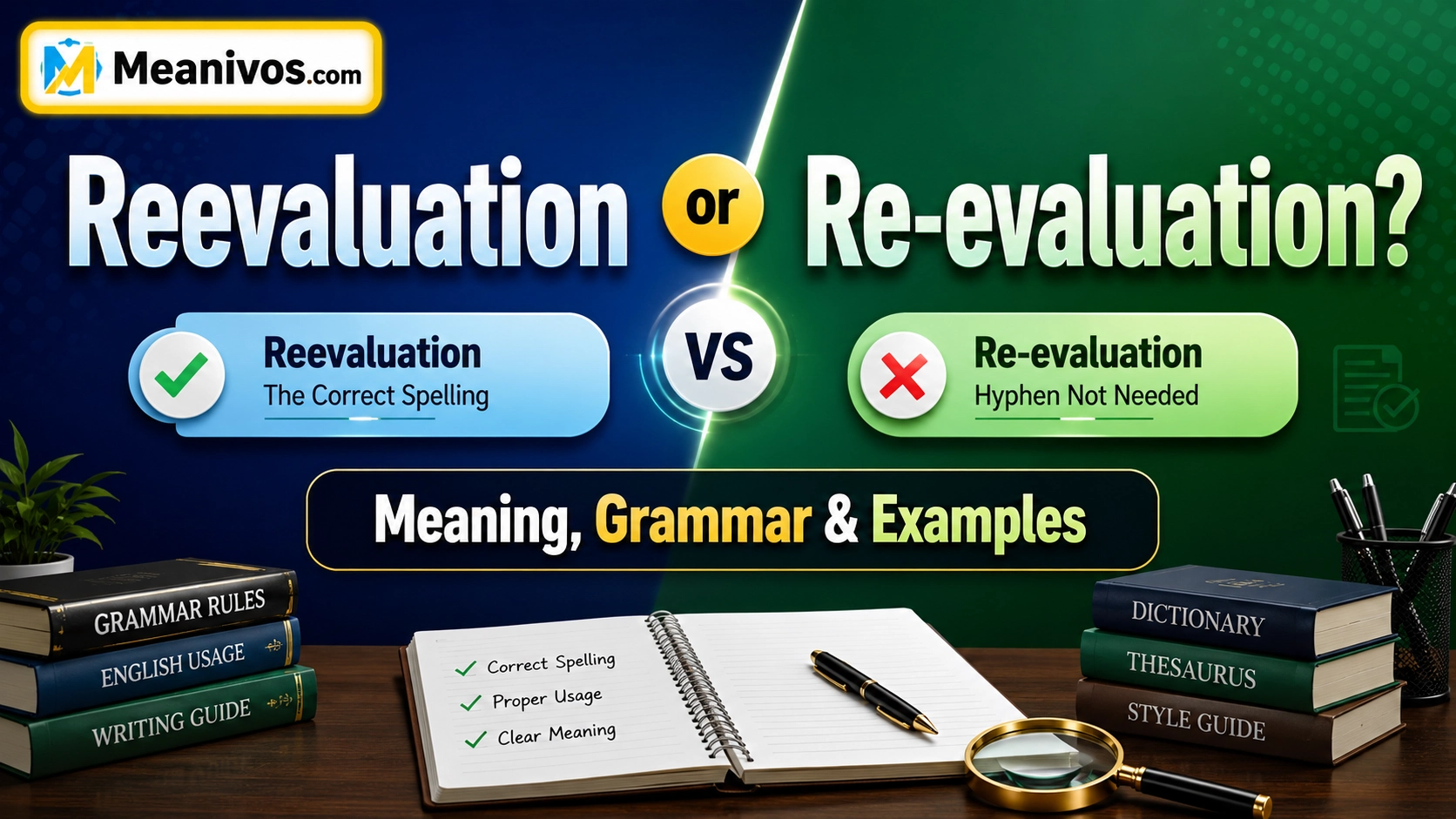
The good news is that both reevaluation and re-evaluation are recognised spellings. However, the preferred form depends on the dictionary, style guide, and the level of clarity you want in your writing.
In modern American English, reevaluation (without a hyphen) has become increasingly common because many compound words gradually lose their hyphens over time. Meanwhile, re-evaluation remains widely accepted, especially when a hyphen improves readability or follows a particular editorial style.
This complete guide explains the meaning of both spellings, their differences, grammar rules, pronunciation, examples, style guide recommendations, and when each form is most appropriate. By the end, you’ll know exactly which spelling to choose in academic, business, and everyday writing.
What Does “Reevaluation or Re-evaluation” Mean?
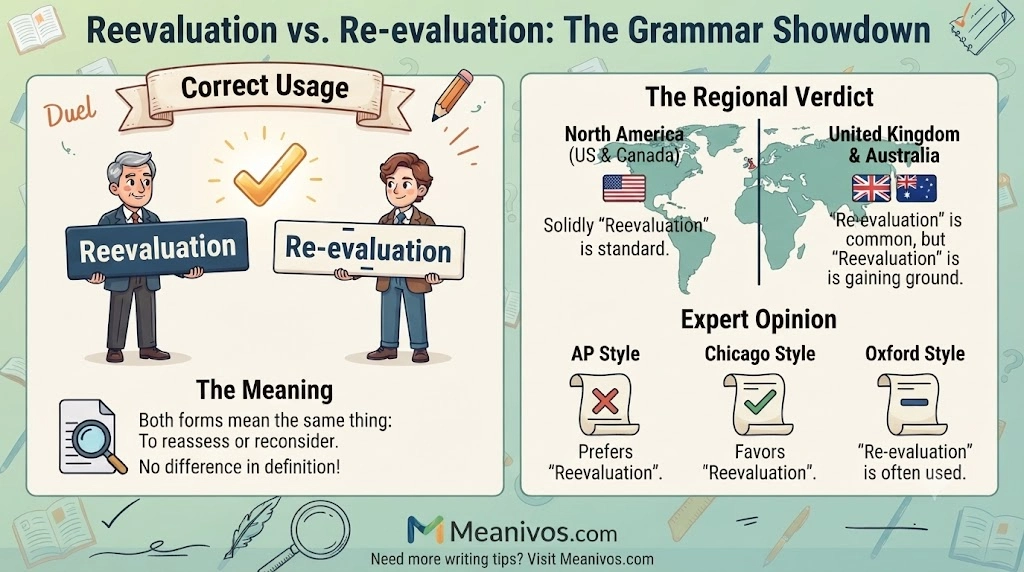
Reevaluation and re-evaluation have the same meaning. Both refer to the process of examining, reviewing, or assessing something again after new information, additional experience, or changing circumstances.
Featured Snippet Answer
Reevaluation (also spelled re-evaluation) means reviewing, assessing, or judging something again to determine whether a previous decision, opinion, or conclusion should change. Both spellings are correct, although reevaluation is more common in modern American English, while re-evaluation is sometimes preferred for readability or according to specific style guides.
Dictionary-Style Definition
Reevaluation (noun)
The act of evaluating something again to reach a new or updated conclusion.
Quick Meaning Summary
| Feature | Reevaluation | Re-evaluation |
| Meaning | Evaluating something again | Evaluating something again |
| Correct? | Yes | Yes |
| American English | More common | Accepted |
| British English | Used | Used |
| Formal Writing | Preferred by many modern publications | Accepted when clarity is needed |
| Pronunciation | Same | Same |
| Meaning Difference | None | None |
Reevaluation vs Re-evaluation
At first glance, the two spellings appear different, but they represent the same word.
The only distinction is the hyphen.
- Reevaluation combines the prefix re- with evaluation into a single word.
- Re-evaluation keeps the prefix separate with a hyphen.
This difference is stylistic rather than semantic. Neither spelling changes the meaning of the word.
Example
- The company announced a reevaluation of its hiring policy.
- The company announced a re-evaluation of its hiring policy.
Both sentences are grammatically correct and mean exactly the same thing.
Which Spelling Is Correct?
The simple answer is:
Both are correct.
However, usage varies depending on the publication, style guide, and audience.
In many modern dictionaries and publications, reevaluation is becoming the preferred spelling because English often removes hyphens from established compound words over time.
Writers may still choose re-evaluation if they believe the hyphen makes the word easier to read or if they are following a house style that retains hyphens after the prefix re-.
If you’re writing for one organisation or publication, consistency is more important than choosing one form over the other.
American English vs British English
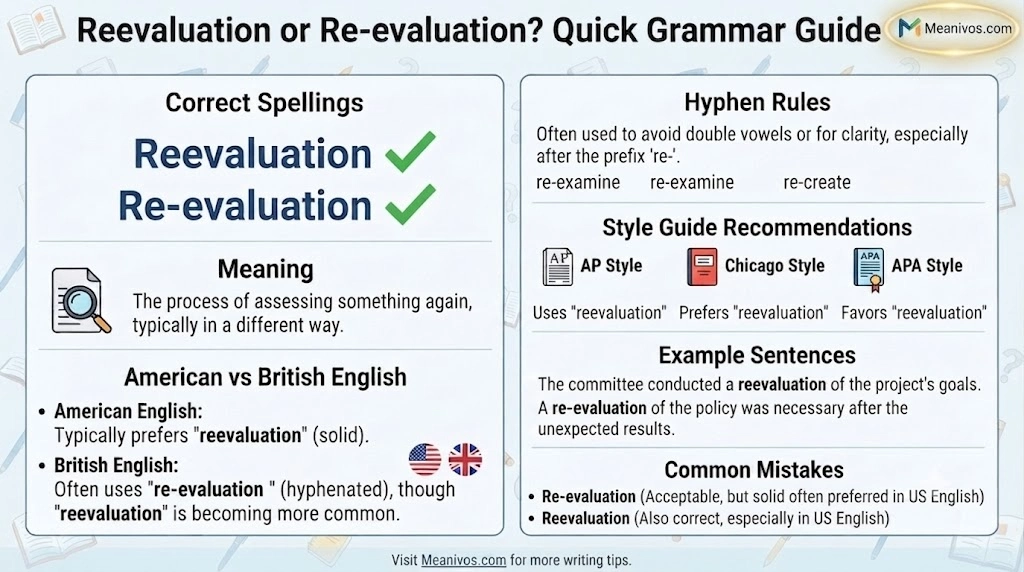
Although both forms are accepted on both sides of the Atlantic, usage trends differ slightly.
| American English | British English |
| Often prefers reevaluation | Uses both forms |
| Hyphens are removed more frequently in modern publications | Hyphens may be retained slightly more often for readability |
| Common in business and academic writing | Common in publishing and educational writing |
In practice, readers in both regions will understand either spelling.
What Do Major Style Guides and Dictionaries Say?
Different reference sources may favour one spelling or allow both:
| Source | General Guidance |
| Merriam-Webster | Lists reevaluation as the primary form while recognising re-evaluation as a variant. |
| Cambridge Dictionary | Focuses on re-evaluate as the verb and recognises the noun in standard usage. |
| Oxford English Dictionary | Accepts both forms, with preferences varying by editorial context. |
| Collins Dictionary | Recognises both spellings in modern English. |
| AP Stylebook | Generally favours closed compounds unless a hyphen improves clarity. |
| Chicago Manual of Style | Advises closing many re- compounds but retaining a hyphen where confusion or awkward pronunciation may arise. |
Practical tip: If your school, employer, or publisher has a style guide, follow it consistently. Otherwise, choose one spelling and use it throughout your document.
Grammar Rules for Reevaluation and Re-evaluation
Understanding why both spellings are correct starts with learning how the prefix “re-“ works in English grammar.
The prefix re- means “again” or “back.” It is added to verbs and nouns to show that an action happens a second time.
Examples:
- Rewrite = write again
- Rebuild = build again
- Reconsider = consider again
- Reevaluate = evaluate again
When re- is added to evaluation, the result can appear in two accepted forms:
- Reevaluation
- Re-evaluation
Both are grammatically correct.
Why Do Some Words Keep the Hyphen?
English has gradually removed hyphens from many compound words.
For example:
| Older Form | Modern Form |
| On-line | Online |
| Co-operate | Cooperate |
| To-day | Today |
The same trend affects reevaluation.
Many publishers now prefer the closed form because it reflects modern usage.
When Should You Use the Hyphen?
Although the closed form is increasingly common, there are situations where a hyphen improves readability.
Use re-evaluation when:
- A style guide requires it.
- The word looks confusing without a hyphen.
- Your publication consistently hyphenates re- words.
- You want to emphasise the separation between the prefix and the root word.
Example:
The committee requested a re-evaluation of the proposal.
Without the hyphen, the meaning remains the same:
The committee requested a reevaluation of the proposal.
When Should You Use “Reevaluation” ?
In most modern writing, reevaluation is the preferred choice because:
- It follows the trend of closed compounds.
- It appears in many American dictionaries.
- It creates cleaner, simpler writing.
- It matches modern editorial preferences.
Example:
The teacher scheduled a reevaluation of the student’s progress.
Common Hyphenation Rules for “Re-” Words
Most re- words do not need a hyphen.
Examples:
- Rebuild
- Repaint
- Rewrite
- Recalculate
- Reorganise
- Reconsider
- Reevaluate
However, a hyphen is often used when it:
1. Prevents Confusion
Example:
- Re-cover (cover again)
- Recover (get well)
These words have different meanings.
2. Avoids Difficult Pronunciation
Sometimes a hyphen makes the word easier to read.
Example:
- Re-enter
- Re-elect
- Re-examine
Because two vowels meet, many style guides retain the hyphen.
3. Follows House Style
Many newspapers, universities, and publishers have their own editorial rules.
Always follow the required style guide when writing professionally.
Is “Reevaluation” One Word?
Yes.
Reevaluation is a single-word noun.
It combines:
- Prefix: re-
- Root: evaluation
- Explore More:https://meanivos.com/cyc-meaning-in-text/
Together, they create one accepted compound noun.
Is “Re-evaluation” Also Correct?
Yes.
Adding a hyphen does not change the meaning.
The difference is purely stylistic.
Both forms are accepted in English.
Pronunciation
Both spellings are pronounced exactly the same.
IPA (UK):
/ˌriː ɪˌvæljuˈeɪʃən/
IPA (US):
/ˌriː ɪˌvæljuˈeɪʃən/
Simple pronunciation:
ree-ee-val-yoo-AY-shun
The hyphen has no effect on pronunciation.
Origin and History
The word comes from two parts:
Re-
A Latin prefix meaning:
- Again
- Back
- Once more
Evaluation
Derived from the French and Latin roots relating to value and assessment.
Originally, many English publishers preferred:
Re-evaluation
As English evolved, closed compounds became increasingly common.
Today, many dictionaries and publishers recognise:
Reevaluation
as the preferred modern spelling.
Why Has “Reevaluation” Become More Popular?
English naturally simplifies spelling over time.
Many words that once used hyphens no longer do.
Examples include:
- Online
- Website
- Cooperation
- Reevaluation
This makes writing cleaner while preserving the same meaning.
Formal vs Informal Usage
| Situation | Best Choice |
| Academic essays | Reevaluation |
| Business reports | Reevaluation |
| Research papers | Reevaluation |
| Company Documents | Reevaluation |
| Publications following a hyphen style | Re-evaluation |
| Personal writing | Either |
Academic Writing Examples
The researcher conducted a reevaluation of the original findings.
A complete reevaluation was required after new evidence emerged.
The professor requested a re-evaluation of the final project.
The committee approved the reevaluation process.
Business Writing Examples
The company announced a reevaluation of employee benefits.
Management ordered a reevaluation of operational costs.
Investors welcomed the reevaluation of the expansion strategy.
The financial re-evaluation improved budgeting accuracy.
Everyday Examples
I think this decision needs a reevaluation.
The doctor recommended a re-evaluation next month.
After hearing both sides, the judge ordered a reevaluation.
We completed a reevaluation of the travel plans.
The school scheduled a re-evaluation for next week.
30 Real-Life Example Sentences
Education
- The teacher completed a reevaluation of every assignment.
- Students requested a reevaluation of their grades.
- The university approved the reevaluation.
- A re-evaluation improved the final report.
- The examiner began a reevaluation immediately.
Business
- The CEO ordered a reevaluation of company goals.
- Sales required another reevaluation.
- Investors welcomed the reevaluation.
- The audit led to a re-evaluation.
- Costs changed after the reevaluation.
Healthcare
- Doctors recommended a reevaluation.
- The patient returned for a re-evaluation.
- Symptoms required reevaluation.
- Medical records underwent reevaluation.
- Treatment changed after the reevaluation.
Law
- The judge ordered a reevaluation.
- Lawyers requested a re-evaluation.
- The evidence required reevaluation.
- Officials completed a reevaluation.
- The verdict followed a reevaluation.
Everyday Life
- We need a reevaluation of our plans.
- The budget deserves reevaluation.
- After discussion, a reevaluation seemed necessary.
- Everyone agreed on a re-evaluation.
- Careful reevaluation prevented mistakes.
Workplace
- Managers completed a reevaluation.
- HR scheduled a re-evaluation.
- Employee performance needed reevaluation.
- Annual reevaluation improved productivity.
- Regular reevaluation supports better decisions.
Common Mistakes to Avoid
Mistake 1: Thinking One Form Is Wrong
Many writers assume only one spelling is correct.
Truth: Both reevaluation and re-evaluation are accepted.
Mistake 2: Mixing Spellings
Incorrect:
- The report required a reevaluation.
- Later, the re-evaluation was approved.
Choose one spelling and use it consistently throughout your document.
Mistake 3: Adding Unnecessary Spaces
Incorrect:
Re evaluation
Correct:
Reevaluation
Re-evaluation
Mistake 4: Confusing the Verb and Noun
Verb:
We will Reevaluate the proposal.
Noun:
The reevaluation begins tomorrow.
Expert Writing Tips
- Choose one spelling and stay consistent.
- Follow your organisation’s style guide.
- Use reevaluation for modern, streamlined writing.
- Use re-evaluation if your publication prefers hyphenated compounds or if it improves readability.
- Proofread carefully to avoid switching between forms.
People Also Ask
A:Yes. Both “reevaluation” and “re-evaluation” are correct spellings. They have the same meaning and can be used interchangeably. Modern American English often prefers reevaluation (without a hyphen), while some publishers and style guides still use re-evaluation for clarity.
A:In modern English, reevaluation is generally more common, especially in American publications. However, re-evaluation remains widely accepted and may appear in academic, legal, or editorial writing depending on the preferred style guide.
A:Yes. Reevaluation is a single-word compound noun formed by combining the prefix re- with evaluation. Many dictionaries recognise it as the preferred modern spelling.
A:No. The hyphen does not change the meaning. Both spellings refer to the act of evaluating something again after considering new information or circumstances.
A:Here are a few examples:
The manager ordered a reevaluation of the marketing strategy.
After reviewing the evidence, the court requested a re-evaluation of the case.
The patient returned for a reevaluation after six weeks of treatment.
A:Yes. Both reevaluation and re-evaluation are suitable for formal writing, including academic papers, business reports, government documents, and professional communication.
A:The verb forms are:
Reevaluate (preferred modern spelling)
Re-evaluate (accepted variant)
Examples:
We need to reevaluate our budget.
The committee agreed to re-evaluate the proposal.
A:Absolutely. If you’re writing for a university, company, or publication, follow its preferred style guide. If no style guide is required, choose one spelling and use it consistently throughout your document.
Related Words
Readers often search for similar terms when learning about reevaluation. Understanding these related words can help you choose the most accurate expression.
| Word | Meaning |
| Evaluation | Assessing something |
| Assessment | Measuring quality or performance |
| Review | Looking at something again |
| Reconsideration | Thinking again about a decision |
| Examination | Careful inspection |
| Analysis | Detailed study |
| Appraisal | Professional assessment |
| Inspection | Close examination |
| Audit | Formal review |
| Revision | Making changes after review |
Synonyms for Reevaluation
Depending on the context, you can use:
- Reassessment
- Review
- Reconsideration
- Fresh assessment
- New evaluation
- Critical review
- Re-examination
- Second assessment
- Further analysis
- Updated review
Antonyms
The opposite of reevaluation may include:
- Acceptance
- Confirmation
- Approval
- Final decision
- Validation
- Endorsement
Reevaluation vs Similar Words
| Word | Meaning | Same as Reevaluation? |
| Evaluation | First assessment | No |
| Reevaluation | Assessment again | Yes |
| Review | General examination | Partly |
| Reconsideration | Thinking again | Similar |
| Revision | Making changes | Different |
| Reassessment | Assessing again | Very similar |
When Should You Use “Reevaluation”?
Choose reevaluation when:
- Writing modern American English.
- Following contemporary editorial standards.
- You prefer a cleaner, closed-compound spelling.
- No style guide requires a hyphen.
When Should You Use “Re-evaluation”?
Choose re-evaluation when:
- A publisher or employer requires hyphenated re- compounds.
- You believe the hyphen improves readability.
- You are following a house style that retains hyphens.
Writing Tips for Students and Professionals
To make your writing look polished and consistent:
- Decide on one spelling before you start writing.
- Check your school’s or employer’s style guide.
- Avoid switching between spellings in the same document.
- Proofread carefully for consistency.
- Use grammar-checking tools to catch accidental variations.
High-Authority References
For readers who want to explore further, you can cite or reference respected language resources such as:
- Merriam-Webster Dictionary
- Cambridge Dictionary
- Oxford English Dictionary (OED)
- Collins Dictionary
- AP Stylebook
- The Chicago Manual of Style
These sources provide reliable guidance on English spelling, grammar, and editorial conventions.
Conclusion
Choosing between Reevaluation and re-evaluation doesn’t have to be confusing. Both spellings are correct and mean the act of evaluating something again. The difference lies in editorial preference rather than meaning.
In modern American English, reevaluation has become the more common closed-compound form, while re-evaluation remains an accepted alternative, especially when a style guide or publisher prefers hyphenated words.
The most important rule is consistency. Once you choose one spelling, use it throughout your document. By understanding the grammar rules, hyphenation guidelines, and style recommendations explained in this guide, you can write with greater confidence in academic, business, and everyday contexts.
Whether you’re proofreading an essay, preparing a professional report, or simply improving your English, knowing when and why to use reevaluation or re-evaluation will help make your writing clearer and more polished.