Watch Your Six Meaning: Origin, Slang & Examples
Have you ever heard someone say “watch your six” and wondered why the number six has anything to do with your back?
The phrase “Watch Your Six” means “watch your back.” It tells someone to stay alert and pay attention to what may be happening behind them. In a literal situation, it can mean looking out for danger approaching from the rear. In casual conversation, it can simply mean “be careful,” “stay aware,” or “watch out.”
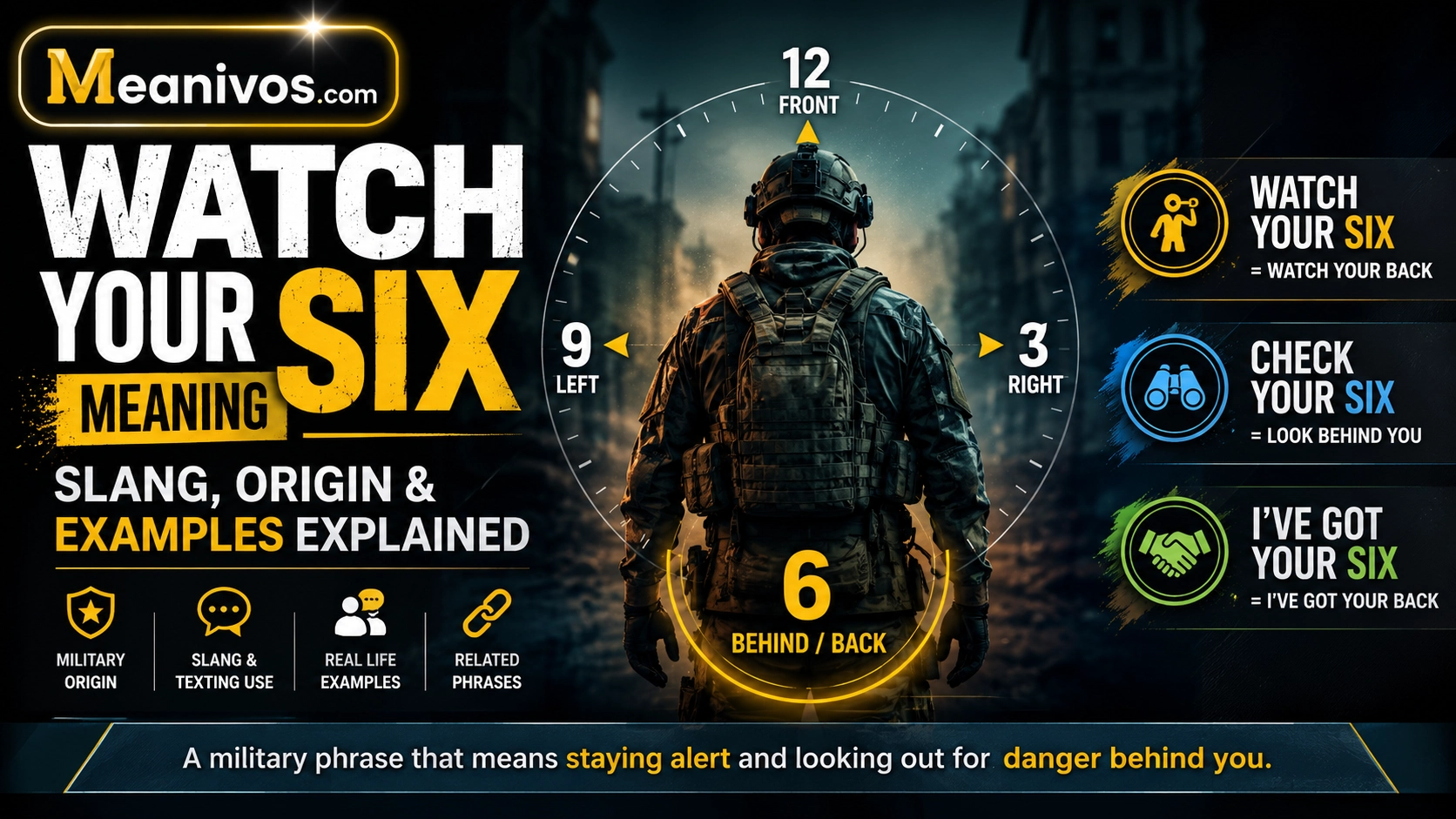
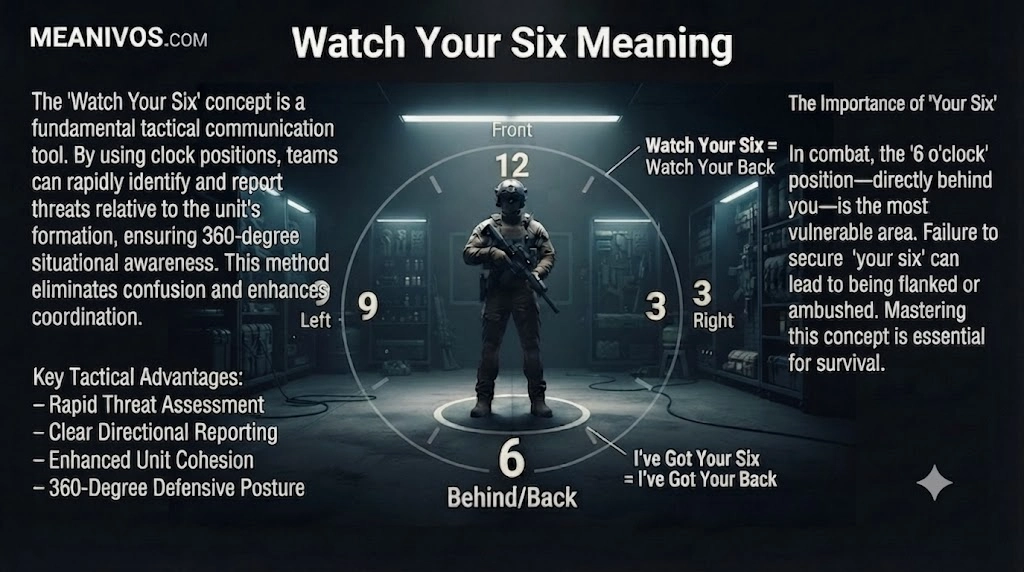
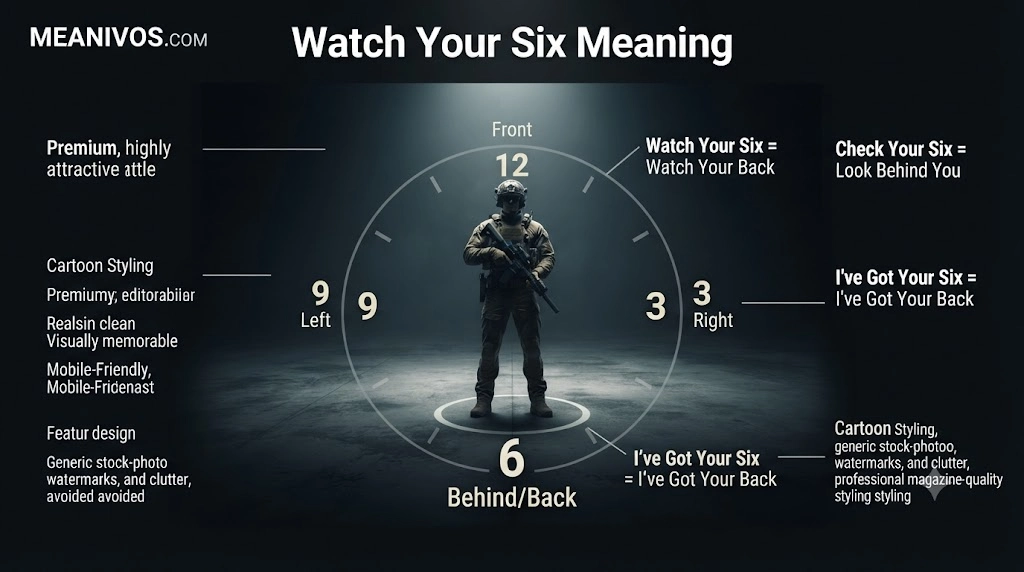
The unusual wording comes from a clock-position system associated with military and aviation communication. Imagine yourself standing at the centre of a clock and facing 12 o’clock. The 6 o’clock position is directly behind you. That makes your “six” your rear or back.
The phrase is now used far beyond military settings. You may encounter it in text messages, gaming, action films, television, law-enforcement contexts, casual conversations, and online communities.
This guide explains the watch your six meaning, why six represents your back, its military connection, texting and gaming uses, related expressions such as “I’ve got your six” and “check your six,” and how to understand the phrase based on context.
What Does “Watch Your Six” Mean?
“Watch your six” means “watch your back,” “look behind you,” or “stay alert to possible danger from behind.”
The word “six” refers to the 6 o’clock position on an imaginary clock.
If you imagine yourself at the centre of a clock facing 12 o’clock:
- 12 o’clock = directly in front
- 3 o’clock = directly right
- 6 o’clock = directly behind
- 9 o’clock = directly left
So, your six = the area behind you.
The expression can be literal or figurative.
For example:
“Watch your six. Someone is coming up behind you.”
Here, the meaning is literal: look behind you and stay alert.
But:
“Watch your six at that new job.”
may simply mean:
“Be careful. Not everyone may have your best interests in mind.”
The surrounding situation and the speaker’s tone determine how serious the phrase is.
Quick Meaning Summary
| Expression | Meaning | Typical tone |
| Watch your six | Watch your back / stay alert behind you | Tactical, informal |
| Check your six | Look or check behind you | Tactical, direct |
| I’ve got your six | I’ve got your back | Supportive |
| Got your six | I’m covering/supporting you | Supportive |
| On your six | Behind you | Tactical |
| Cover my six | Protect or watch my rear | Tactical |
| Watch your back | Be careful of danger or betrayal | Informal |
| Watch out | Pay attention to danger | Very common |
| Stay alert | Remain aware | Neutral |
The most important distinction is simple:
Watch your six = watch your back.
I’ve got your six = I’ve got your back.
Why Does “Six” Mean Your Back?
The answer is the clock-face direction system.
Imagine a clock laid flat around you. You are standing in the middle and facing the 12.
Your relative directions can then be described using the clock numbers:
| Clock position | Relative direction |
| 12 o’clock | Front |
| 1–2 o’clock | Front-right |
| 3 o’clock | Right |
| 4–5 o’clock | Rear-right |
| 6 o’clock | Directly behind |
| 7–8 o’clock | Rear-left |
| 9 o’clock | Left |
| 10–11 o’clock | Front-left |
This makes it possible to communicate a direction Watch Your Six Meaning quickly without using a long explanation.
Instead of saying:
“There is something directly behind you.”
someone can say:
“It’s at your six.”
The same system explains phrases such as:
- at your six = directly behind you
- on your six = behind you
- watch your six = watch behind you
- check your six = look behind you
- cover my six = protect my rear
- I’ve got your six = I’m covering your rear
The clock-position explanation is one of the most consistently supported parts of the phrase’s history.
What Is the Military Meaning of “Watch Your Six”?
In military and tactical language, “watch your six” refers to being alert to what is behind you.
The rear can be a vulnerable direction because a person naturally tends to focus on what is directly ahead. In a team situation, one person may move forward while another watches the rear.
For example:
“Move ahead. I’ll watch your six.”
This can mean:
“You focus on what is ahead while I monitor what is behind you.”
The expression is strongly associated with military and aviation terminology. Military sources also describe related expressions such as “got your six” as meaning that someone’s rear is covered.
However, it is important to distinguish the language concept from any particular historical story about the phrase.
The clock-position system is well established. The exact origin Watch Your Six Meaning date of the wording “watch your six” is less certain.
Is “Watch Your Six” Military Slang?
Yes. “Watch your six” is commonly associated with military slang and tactical communication.
Its meaning is closely connected with the military use of clock positions to describe relative directions.
It is especially familiar in contexts involving:
- military personnel
- aviation
- fighter pilots
- tactical teams
- law enforcement
- action films
- military television shows
- video games
- veteran communities
- casual conversations influenced by military language
Modern civilian speakers may use the phrase even when they have no military background.
That is because military expressions often spread into popular culture. “Watch your six” is now understandable to many people simply as a colourful way of saying “watch your back.”
Origin and History of “Watch Your Six”
The safest explanation of the phrase’s origin starts with military and aviation clock-position terminology.
The basic concept is straightforward: the direction an individual or aircraft is facing can be treated as 12 o’clock, making 6 o’clock the direction directly behind it. Sources describing the expression commonly connect this usage with military aviation.
You will often see the phrase specifically attributed to World War I fighter pilots. Some sources present that connection as the beginning of the expression.
However, that specific claim should be treated with caution.
There is a difference between saying:
“The phrase is connected to military aviation clock terminology.”
and saying:
“The exact phrase was definitely invented by World War I pilots.”
The first statement is much more defensible based on the available sources.
A useful way to understand the development is:
clock-position language → 6 o’clock = rear → “your six” = your back → “watch your six” = watch your back
The expression later became familiar outside military Watch Your Six Meaning environments through popular culture, entertainment, gaming, and everyday speech.
Is “Watch Your Six” a Threat?
Not necessarily.
By itself, “watch your six” is generally a warning rather than a threat.
It can mean:
- Be careful.
- Watch behind you.
- Stay alert.
- Pay attention to your surroundings.
- Someone could be approaching from behind.
- Be prepared for trouble.
For example:
“Watch your six—I think someone is following us.”
That is clearly a warning.
But:
“You better watch your six.”
could sound more aggressive if it is said during an argument.
So, context and tone matter.
Friendly use
“Watch your six at the new office. The politics are crazy.”
Meaning:
Be careful and stay aware of what is happening around you.
Serious warning
“Watch your six. There’s someone behind you.”
Meaning:
Look behind you because there may be immediate danger.
Aggressive use
“You better watch your six.”
Depending on the situation, this could sound like a threat.
The phrase itself does not automatically communicate hostile intent.
What Does “Watch Your Six” Mean in Texting?
In texting, “watch your six” usually means “watch your back,” “be careful,” or “stay alert.”
Because text messages lack vocal tone and facial expression, context becomes particularly important.
Texting example 1: Genuine warning
A: “I’m meeting those guys tonight.”
B: “Watch your six.”
Meaning:
Be careful and watch out for trouble.
Texting example 2: Workplace advice
A: “I finally got promoted.”
B: “Congrats! Watch your six though 😂”
Meaning:
Be successful, but stay aware of office politics and competition.
Texting example 3: Gaming
A: “I’m pushing the building.”
B: “Watch your six!”
Meaning:
Watch behind you because an enemy could attack from the rear.
Texting example 4: Playful use
A: “I’m taking the last slice.”
B: “Watch your six 😂”
Here, the expression is obviously humorous.
Therefore, in texting, “watch your six” does not automatically mean someone is threatening you.
“Watch Your Six” Meaning in Slang
As slang, “watch your six” is an informal way to tell someone to stay alert or protect themselves from something behind them.
Its slang flavour comes from its military/tactical roots.
Compared with the ordinary phrase “be careful,” it sounds more:
- tactical
- Dramatic
- confident
- informal
- military-inspired
- action-oriented
For example:
“Watch your six around those guys.”
may simply mean:
“Be careful around those people.”
In slang and casual conversation, the phrase can therefore become broader than its literal meaning.
It may refer to:
- physical danger
- social conflict
- workplace competition
- betrayal
- online arguments
- gaming enemies
- unexpected problems
“Watch Your Six” vs. “Watch Your Back”
These expressions are very close, but they have different flavours.
Watch your six
Meaning: Be alert to what is behind you.
It has a stronger military, aviation, or tactical flavour.
Watch your back
Meaning: Be careful about danger, trouble, or betrayal.
It is much more common in ordinary conversation.
Compare:
“Watch your six.”
This sounds tactical.
“Watch your back around him.”
This sounds more like a warning about a person’s Watch Your Six Meaning behaviour or possible betrayal.
The two expressions can overlap, but “watch your six” has the more specific directional origin.
“Watch Your Six” vs. “Watch Out”
“Watch out” is a much broader warning.
For example:
“Watch out! The car is coming!”
This means there is immediate danger.
By contrast:
“Watch your six!”
specifically points toward the rear/behind you.
So:
- Watch out = pay attention to danger.
- Watch your six = pay attention to what is behind you.
What Does “I’ve Got Your Six” Mean?
“I’ve got your six” means “I’ve got your back.”
This is one of the most important related expressions.
Notice the difference:
Watch your six.
You should watch your rear.
But:
I’ve got your six.
I am watching or covering your rear.
In other words, “I’ve got your six” is usually reassuring or supportive.
For example:
“Go ahead. I’ve got your six.”
This means:
“Go ahead. I’ll watch your back.”
In everyday life, it can become completely figurative:
“Don’t worry about the presentation. I’ve got your six.”
The speaker is not necessarily talking about physical protection. They may mean:
“I support you, and I’ll back you up if something goes wrong.”
Military.com similarly explains “got your six” as watching someone’s back and connects the expression to the military clock-position system.
What Does “Check Your Six” Mean?
“Check your six” means “look behind you” or “check what is happening behind you.”
It is closely related to “watch your six.”
The difference is mainly emphasis.
Watch your six
Focuses on remaining alert to the rear.
Check your six
Often sounds more like an instruction to look at or inspect the rear.
For example:
“Check your six. Someone is coming up behind us.”
That means:
Look behind you.
Military and aviation contexts use this clock-position idea to Watch Your Six Meaning communicate relative direction quickly.
“Watch Your Six” vs. “Got Your Six”
These phrases can easily confuse new readers.
“Watch your six”
Means:
Watch your back.
It is usually a warning or instruction.
“Got your six”
Means:
I’ve got your back.
It is generally reassurance or support.
Compare:
“Watch your six.”
Be alert behind you.
“I’ve got your six.”
I’m watching your rear / I’m backing you up.
That small change completely changes the Watch Your Six Meaning speaker’s role.
What Does “Your Six” Mean?
“Your six” is shorthand for the area directly behind you.
It comes from the clock-position concept.
If you are facing 12:
- 12 = front
- 3 = right
- 6 = rear
- 9 = left
Therefore:
your six = your rear = your back
You may encounter related expressions such as:
- On your six = behind you
- At your six = at your rear
- Watch your six = watch behind you
- Check your six = look behind you
- Cover my six = protect my rear
- I’ve got your six = I’ve got your back
Watch Your Six in Gaming
“Watch your six” is particularly useful in team-based action and shooter games.
Gaming rewards short, fast communication.
Instead of saying:
“There might be another player approaching from behind you.”
a teammate can simply say:
“Watch your six!”
The message is immediately understandable to players familiar with tactical vocabulary.
Gaming example
Player 1: “I’m moving toward the objective.”
Player 2: “Watch your six.”
Meaning:
Be careful because an opponent could approach from behind.
Another example:
Player 1: “I’ll take the front.”
Player 2: “Got it. I’ve got your six.”
Meaning:
I’ll cover the rear.
This is one reason military terminology has remained familiar even among people with no military experience.
Watch Your Six in Movies and TV
The phrase has a naturally tactical sound, which makes it common in:
- War Films
- action movies
- military dramas
- police shows
- spy thrillers
- aviation stories
- video games
- superhero/action entertainment
When a character says:
“Watch your six!”
viewers generally understand that someone may be approaching from behind.
The expression is useful for screenwriters because it communicates direction, danger, teamwork, and urgency in only three words.
It also helps establish a character as someone familiar with tactical or military language.
Watch Your Six in Everyday Conversation
You do not have to be a soldier or pilot to understand or use the phrase.
In everyday conversation, it can be used figuratively.
For example:
“Watch your six at that new company.”
This could mean:
Be careful about office politics.
Or:
“Watch your six when dealing with that guy.”
This may mean:
Be cautious because he could cause problems or betray you.
Or:
“Watch your six walking home.”
This can simply mean:
Stay alert and be careful.
The more casual the context, the more likely the phrase is being used Watch Your Six Meaning figuratively rather than as literal tactical terminology.
Is “Watch Your Six” Formal or Informal?
“Watch your six” is informal.
It is appropriate for contexts such as:
- conversations with friends
- gaming
- casual messages
- military-themed discussions
- entertainment
- informal team communication
It is usually not the clearest choice for formal business or official writing.
Instead, you could say:
- Please stay alert.
- Please be cautious.
- Please remain aware of your surroundings.
- Keep an eye out for potential problems.
- Please be careful.
For a friend or gaming teammate, however, “watch your six” can sound perfectly natural.
20 Examples of “Watch Your Six”
Here are natural examples showing different contexts.
- “Watch your six when you enter that building.”
- “I’ll watch your six while you check the room.”
- “Stay alert and watch your six.”
- “Watch your six; someone is following us.”
- “You should watch your six around those people.”
- “I’m moving ahead—watch my six.”
- “Watch your six! Enemy behind you!”
- “Don’t forget to watch your six during the mission.”
- “I’ve got your six, so keep moving.”
- “Check your six before you turn the corner.”
- “Watch your six while you’re crossing the street.”
- “He told me to watch my six at the new job.”
- “Watch your six; not everyone is on your side.”
- “The squad moved forward with someone watching their six.”
- “I’ll cover the entrance. Watch your six.”
- “You’re going into unfamiliar territory, so watch your six.”
- “Watch your six in that game.”
- “My teammate shouted, ‘Watch your six!’”
- “She warned me to watch my six.”
- “Don’t panic—I’ve got your six.”
- Explore More: https://meanivos.com/can-i-get-a-hoya/
How to Respond to “Watch Your Six”
Your response depends on why the person said it.
Simple responses
- “Got it.”
- “Will do.”
- “Thanks.”
- “I’ll keep an eye out.”
- “Thanks for the warning.”
Friendly response
“Thanks. I’ve got yours too.”
This works especially well when someone is expressing mutual support.
Gaming or tactical response
“Copy that.”
This gives the conversation a military-style feel.
Casual response
“Good looking out.”
This acknowledges that the person gave you a useful warning.
Playful response
“Always 😂”
If the phrase is being used jokingly, a light response may fit better.
If the phrase is said during a serious situation, the Watch Your Six Meaning safest Watch Your Six Meaning interpretation is straightforward: pay attention to what is happening around you, especially behind you.
Is “Watch Your Six” a Positive or Negative Phrase?
The phrase itself is context-dependent.
It is usually neither inherently positive nor inherently negative.
It can be:
Protective
“Watch your six. I’m right behind you.”
This is supportive.
Cautious
“Watch your six around those people.”
This is a warning.
Humorous
“Watch your six—I’m stealing your fries.”
This is playful.
Aggressive
“You better watch your six.”
In an argument, this could sound threatening.
Therefore, the speaker’s tone and situation matter more than the phrase alone.
Does “Watch Your Six” Mean Someone Has Your Back?
No—not by itself.
This distinction is important.
“Watch your six” tells the listener to pay attention to their rear.
“I’ve got your six” tells the listener that the Watch Your Six Meaning speaker is watching or covering their rear.
So:
Watch your six = watch your back.
But:
I’ve got your six = I’ve got your back.
If someone tells you:
“Watch your six.”
they are warning you.
If they tell you:
“I’ve got your six.”
they are reassuring you.
Common Misunderstandings
1. “Six” does not mean the number itself
The six is a directional reference.
It comes from the 6 o’clock position on an imaginary clock.
2. It does not always mean immediate danger
Someone may use it simply to say:
“Be careful.”
3. It is not exclusively military today
The expression has moved into civilian conversation, entertainment, gaming, and other settings.
4. “Watch your six” is not the same as “I’ve got your six”
One tells someone to watch their rear.
The other says the speaker is covering it.
5. The WWI origin should not be treated as certain
Some sources associate the phrase with World War I fighter pilots, but the strongest general explanation is its Watch Your Six Meaning connection with military/aviation clock-position terminology.
Related Expressions and Their Meanings
| Phrase | Simple meaning |
| Watch your six | Watch your back |
| Check your six | Look behind you |
| On your six | Behind you |
| At your six | At your rear |
| Cover my six | Protect my back |
| I’ve got your six | I’ve got your back |
| Got your six | I’m covering/supporting you |
| Watch your back | Be careful |
| Watch out | Pay attention to danger |
| Stay alert | Remain aware |
| Keep your eyes open | Pay close attention |
Watch Your Six vs. Similar Phrases
| Expression | Main idea | Best understood as |
| Watch your six | Be alert behind you | Tactical warning |
| Watch your back | Be alert to trouble/betrayal | Everyday warning |
| Check your six | Look behind you | Direct instruction |
| Watch out | Notice immediate danger | General warning |
| Stay alert | Remain aware | Neutral advice |
| Keep your eyes open | Pay close attention | Casual advice |
| I’ve got your six | I will cover/support you | Reassurance |
The key distinction is that “watch your six” has a specific directional meaning derived from the clock-position concept, while the alternatives may have broader meanings.
When Should You Use “Watch Your Six”?
Use the phrase when the situation is informal and the listener is likely to understand its military/tactical flavour.
Good situations include:
- talking to friends
- playing team-based games
- discussing military terminology
- writing realistic action dialogue
- discussing a military movie
- giving a casual warning
- talking about a situation where someone needs to stay alert
For example:
“Watch your six when you go into that area.”
It sounds natural in casual speech.
For a formal workplace email, however, this is usually clearer:
“Please remain alert to any potential issues.”
The meaning is similar, but the register is different.
When Should You Avoid “Watch Your Six”?
Avoid it when clarity matters more than style and the audience may not know military slang.
For example, if you are writing an official safety notice, “watch your six” could be less clear than:
“Please remain aware of your surroundings.”
Likewise, in formal business communication, “stay alert,” “be cautious,” or a direct explanation is usually preferable.
Is “Watch Your Six” American Slang?
The phrase is strongly associated with American military and popular-culture usage, particularly through military aviation and entertainment.
It is also understandable in other English-speaking contexts.
However, its familiarity may vary depending on:
- country
- age
- military exposure
- gaming experience
- exposure to American films and television
- familiarity with tactical terminology
So it is best described as an informal military-derived expression that has spread into broader English usage.
Watch Your Six in Pop Culture
Military and tactical expressions often become widely known because of entertainment.
“Watch your six” fits naturally into:
- fighter-pilot scenes
- military films
- police dramas
- spy stories
- action games
- tactical shooters
- superhero films
- military novels
Its appeal comes from its compactness.
Instead of:
“Someone might be approaching from behind, so please pay attention.”
a character can simply say:
“Watch your six!”
The audience understands the intended urgency immediately.
What Does “Cover My Six” Mean?
“Cover my six” means “watch or protect my back.”
It is usually used when one person wants another Watch Your Six Meaning person to monitor the area behind them.
For example:
“I’m going through the door. Cover my six.”
Meaning:
“Watch behind me while I move forward.”
The expression follows the same clock-position logic.
My six = behind me.
Therefore:
Cover my six = cover/protect my rear.
What Does “On Your Six” Mean?
“On your six” generally means “behind you.”
For example:
“There’s someone on your sixth.”
means:
“Someone is behind you.”
In a gaming or tactical context, it could refer to an enemy.
In a supportive context, the meaning can be less threatening:
“I’m on your sixth.”
This could simply mean:
“I’m directly behind you.”
The exact meaning again depends on context.
What Does “At Your Six” Mean?
“At your six” means “at the position directly behind you.”
For example:
“Enemy at your six!”
means:
“There is an enemy directly behind you.”
The expression is based on the same clock-face system used for relative direction.
Does “Watch Your Six” Mean “Be Careful”?
Yes, it can.
In casual or figurative use, “watch your six” can function as a colourful way to say “be careful.”
However, the more precise meaning is:
Be alert to what is happening behind you.
That distinction is useful.
“Be careful” is general.
“Watch your six” specifically evokes the rear/behind-you direction.
Does “Watch Your Six” Mean “Watch Your Back”?
Yes. That is the closest everyday translation.
If you see:
“Watch your six.”
you can generally understand it as:
“Watch your back.”
The phrase is simply more tactical and military-flavoured.
Is “Watch Your Six” an Idiom?
It can reasonably be described as an idiomatic expression because the intended meaning is not obvious from the literal words alone.
Someone unfamiliar with the phrase could reasonably ask:
“Why would I watch number six?”
The answer is that “six” is being used metaphorically as the 6 o’clock direction.
That directional meaning gives the expression its idiomatic sense.
People Also Askr
A:“Watch your six” means “watch your back” or “stay alert to what is happening behind you.” The six refers to the 6 o’clock position, which is directly behind you when 12 o’clock is treated as the front.
A:The phrase uses a clock-position system. If you imagine yourself at the centre of a clock facing 12, then 6 o’clock is directly behind you.
A:Yes. It is strongly associated with military and aviation terminology and has spread into law-enforcement contexts, gaming, entertainment, and casual speech.
A:“I’ve got your six” means “I’ve got your back.” It usually means the speaker is watching, protecting, or supporting someone from behind.
A:“Check your six” means “look behind you” or “check what is happening behind you.” It is closely related to “watch your six.”
Conclusion
“Watch Your Six” means “watch your back.” The phrase comes from the clock-position system, where 6 o’clock represents the area directly behind you. It is strongly associated with military and aviation language but is now also common in gaming, movies, texting, and casual conversation.
Remember the key differences: “watch your six” means to stay alert behind you, “check your six” means to look behind you, and “I’ve got your six” means “I’ve got your back” or “I’ll support you.”
Whether used as a serious warning, friendly advice, or playful slang, the meaning depends on the context and tone. So, when someone tells you to “watch your six,” they are usually reminding you to stay alert, be careful, and pay attention to what may be happening behind you.