ChatGPT vs Gemini: Which AI Is Better in 2026?
If you are comparing ChatGPT vs Gemini, the short answer is simple: there is no universal winner.
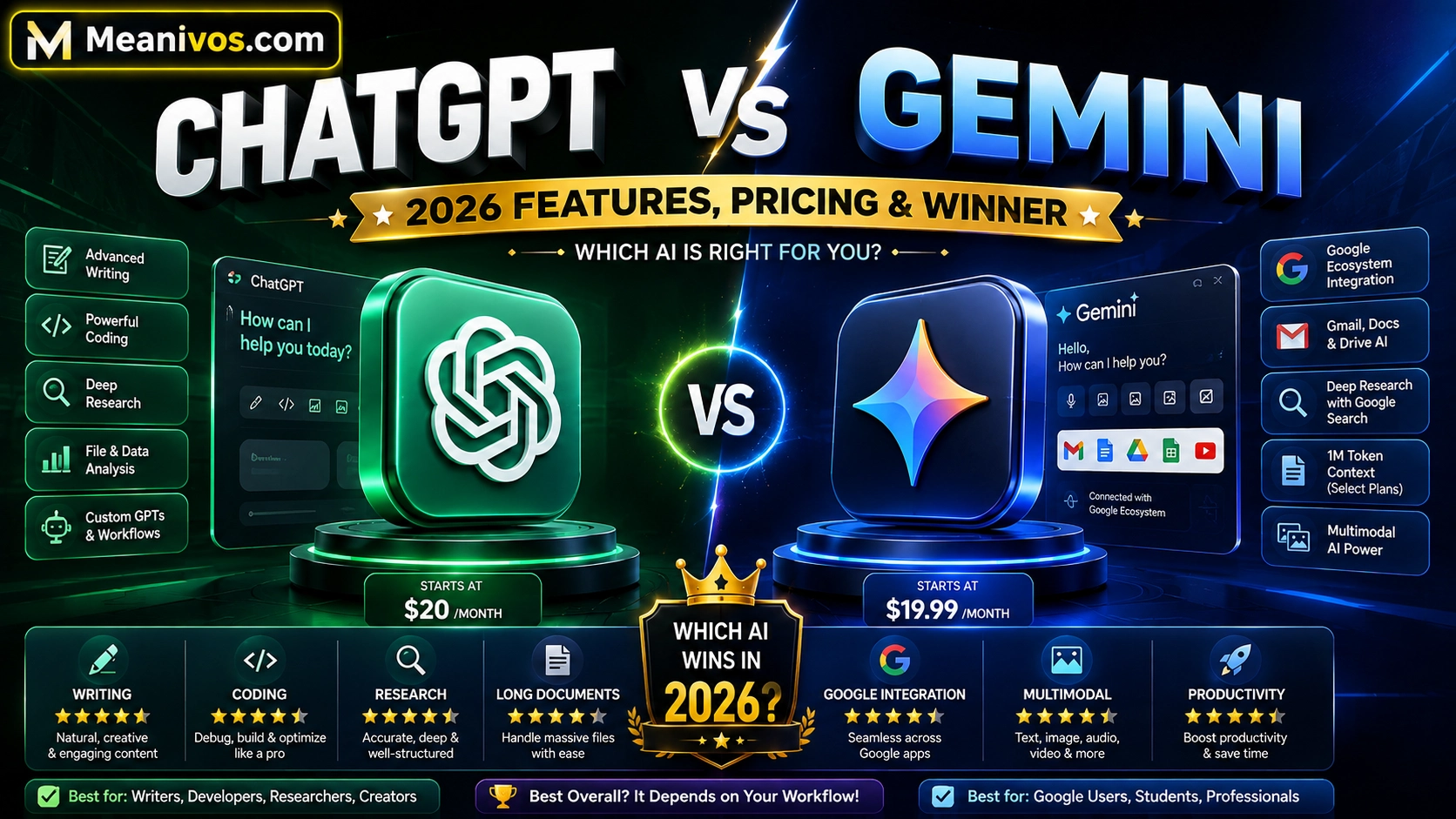
ChatGPT is particularly strong as a flexible, standalone AI workspace for writing, coding, analysis, research and repeatable workflows. Gemini is especially attractive for people who already live inside Google’s ecosystem, including Search, Gmail, Drive, Docs, Android and other Google services.
The gap between the two has also become much smaller. In 2026, both platforms can handle writing, coding, research, file analysis, multimodal tasks and everyday questions at a high level. The better choice depends less on which chatbot has the biggest headline benchmark and more on what you actually need AI to do.
OpenAI’s current GPT-5.6 family includes Sol, Terra and Luna, with GPT-5.6 Sol positioned for demanding coding, research, knowledge-work, computer-use and design tasks. OpenAI also expanded GPT-5.6 Luna access to Free and Go users in August 2026.
Google’s current Gemini ecosystem similarly offers advanced models and increasingly deep integration across Google’s products. Google AI plans now combine Gemini access with services such as Gmail, Drive, Photos, Docs and other Google products.
So instead of asking only “Is ChatGPT better than Gemini?”, ask a more useful question:
Which AI is better for the work I need to do?
This guide compares ChatGPT and Gemini across writing, coding, research, students, SEO, business, long documents, multimodal tasks, pricing, privacy, accuracy and everyday productivity.
ChatGPT vs Gemini: Quick Answer
Choose ChatGPT if you want a flexible AI workspace for writing, coding, analysis, research, structured workflows and general-purpose knowledge work.
Choose Gemini if your workflow is heavily connected to Google Search, Gmail, Drive, Docs, Android and Google’s wider AI ecosystem.
If you Choose both if you regularly switch between general AI work and Google-connected research or productivity.
OpenAI’s latest ChatGPT updates emphasise focused answers, factual reliability and adjustable reasoning, while Google’s Gemini plans emphasise deep integration with Google apps, large context and multimodal capabilities.
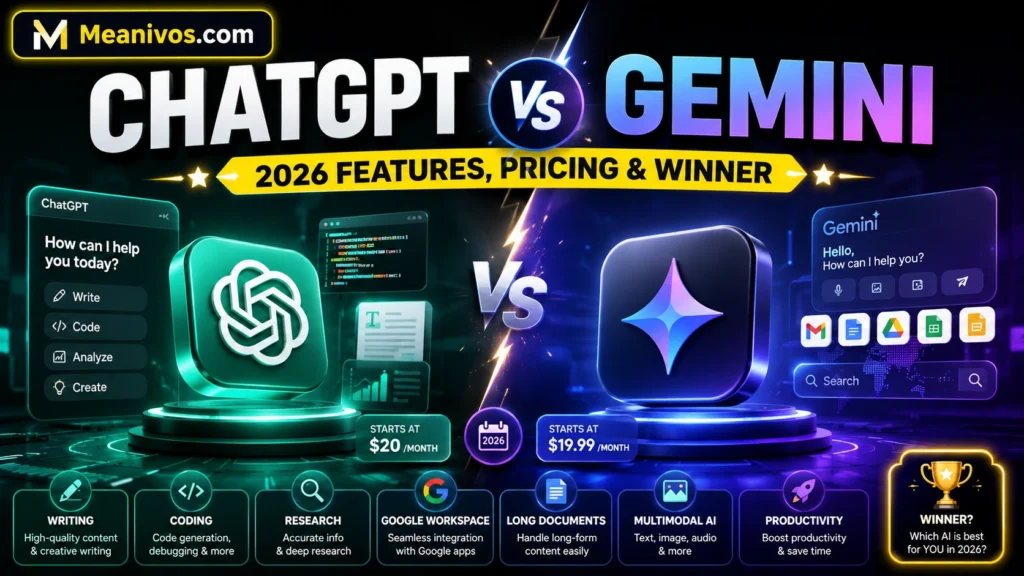
The 30-second decision
| If you mainly need… | Better starting choice |
| General AI assistance | ChatGPT |
| Long-form writing | ChatGPT |
| Complex coding | ChatGPT |
| Structured analysis | ChatGPT |
| Google Workspace | Gemini |
| Gmail and Google Docs workflows | Gemini |
| Very large document context | Gemini |
| Google-connected research | Gemini |
| General research | Either |
| Students | Either |
| SEO and content creation | ChatGPT |
| Android/Google ecosystem | Gemini |
| Best combination | Use both |
This is a workflow-based recommendation, not a scientific claim that one model is permanently superior.
ChatGPT vs Gemini at a Glance
| Category | ChatGPT | Gemini | Best fit |
| General-purpose AI | Excellent | Excellent | Task-dependent |
| Writing | Excellent | Excellent | ChatGPT for many workflows |
| Coding | Excellent | Excellent | ChatGPT edge for complex workflows |
| Research | Excellent | Excellent | Depends on sources |
| Google Workspace | Good | Excellent | Gemini |
| Long documents | Excellent | Excellent | Gemini for very large contexts |
| Multimodal work | Excellent | Excellent | Task-dependent |
| File analysis | Excellent | Excellent | Task-dependent |
| Image generation | Excellent | Excellent | Task-dependent |
| Voice | Excellent | Excellent | Task-dependent |
| Custom workflows | Excellent | Strong | ChatGPT |
| Google ecosystem | Limited compared with Gemini | Excellent | Gemini |
| Standalone productivity | Excellent | Excellent | ChatGPT |
| Students | Excellent | Excellent | Workflow-dependent |
| Developers | Excellent | Excellent | Task-dependent |
| Overall winner | — | — | No universal winner |
The supplied competitor research reaches the same strategic conclusion: the strongest article should explain why a tool wins for a particular task rather than simply declaring a universal winner.
What Is ChatGPT?
ChatGPT is OpenAI’s general-purpose AI assistant.
It can be used for tasks such as:
- Writing
- Rewriting
- Brainstorming
- Coding
- Research
- Data analysis
- File analysis
- Planning
- Learning
- Problem solving
- Creative work
- Structured knowledge work
In 2026, OpenAI’s GPT-5.6 family represented a major part of the current ChatGPT model landscape. OpenAI describes GPT-5.6 Sol as its flagship model for complex coding, knowledge work, research, cybersecurity, science, computer use and design.
An August 2026 ChatGPT update also made GPT-5.6 Luna the default model for Free and Go users while updating GPT-5.6 Sol for eligible paid users.
That makes ChatGPT particularly interesting for users who want one environment for many different types of work.
What Is Google Gemini?
Gemini is Google’s family of generative AI models and its AI assistant experience.
Its biggest strategic advantage is not simply the underlying model. It is the connection between Gemini and Google’s wider ecosystem.
Depending on plan, region and feature availability, Gemini can work alongside services and products such as:
- Google Search
- Gmail
- Google Drive
- Google Docs
- Google Photos
- Google Workspace
- Android
- Google AI Studio
- Deep Research
- Google’s creative AI tools
Google’s current AI plans explicitly bundle Gemini with Google services and storage. Google AI Pro, for example, includes expanded Gemini access alongside Gmail, Docs, Vids, Drive and other services.
That creates a major distinction:
ChatGPT is compelling as a standalone AI workspace.
Gemini is compelling as an AI layer across Google’s ecosystem.
ChatGPT vs Gemini: Key Differences
1. AI Models and Reasoning
The model names matter, but they should not be treated as permanent rankings.
OpenAI’s GPT-5.6 family currently includes Sol, Terra and Luna. OpenAI positions Sol as the flagship option, while Terra and Luna focus more heavily on efficiency and cost.
OpenAI’s current ChatGPT documentation says GPT-5.6 Sol is designed for complex coding, knowledge work, research, science, computer use and design.
Google’s Gemini ecosystem similarly provides different model and plan levels rather than one fixed “Gemini” experience.
Verdict: Neither “ChatGPT” nor “Gemini” is a single model. Always compare the specific model, plan and feature being used.
2. Writing Quality
Both tools can produce high-quality writing.
ChatGPT is particularly useful for:
- Long-form articles
- Rewriting
- Tone adaptation
- Brainstorming
- Structured content
- Marketing copy
- Technical explanations
- Iterative editing
One of ChatGPT’s biggest strengths is the workflow.
You can move through:
Draft → critique → rewrite → optimise → fact-check → final
That makes it useful for writers who want to repeatedly refine the same piece.
Gemini is particularly useful when:
- The source material is connected to Google
- You work heavily in Google Docs
- You need to work with large amounts of information
- Your writing workflow already lives inside Google’s ecosystem
Winner for writing
ChatGPT gets the edge for general writing workflows.
Gemini becomes highly attractive for Google-connected writing and large source collections.
ChatGPT vs Gemini for Coding
Coding is one of the most important areas in this comparison.
OpenAI positions GPT-5.6 Sol for complex coding and longer-running workflows. Its GPT-5.6 documentation also specifically identifies coding as a core use case.
Gemini is also a serious developer tool, particularly when Google’s development ecosystem is involved.
ChatGPT is a strong choice for:
- Debugging
- Code explanation
- Refactoring
- Architecture discussions
- Complex programming problems
- Iterative development
- Agent-style coding workflows
- Reviewing existing code
Gemini is a strong choice for:
- Google Cloud workflows
- Android-related development
- Google ecosystem development
- Multimodal development tasks
- Working with very large code or document contexts
Which is better for coding?
For complex, iterative coding, ChatGPT gets the edge.
For Google-oriented development workflows, Gemini can be the better fit.
The important point is that coding quality changes rapidly with model updates, so developers should test the exact model and environment they intend to use.
ChatGPT vs Gemini for Students
Students do not necessarily need the same AI tool as professional developers.
ChatGPT can help students with:
- Explaining difficult concepts
- Creating study plans
- Brainstorming
- Writing feedback
- Coding
- Step-by-step learning
- Revision questions
- Summarising material
- Practising concepts
Gemini can help students with:
- Google Workspace
- Large documents
- Research
- Multimodal learning
- Google-connected workflows
- Working alongside Docs and other Google services
Which is better for students?
There is no universal winner.
Choose ChatGPT if you want a flexible AI tutor and writing/problem-solving workspace.
Choose Gemini if your academic workflow already revolves around Google’s ecosystem.
The best approach is to use AI to understand and practise material rather than simply submitting AI-generated work as your own.
ChatGPT vs Gemini for Research
Research is more complicated than asking which chatbot “knows more.”
The real questions are:
- Where does the information come from?
- Can the AI access current sources?
- Can it work with your documents?
- Does it show sources?
- Can you verify important claims?
Gemini’s Deep Research features can use Google Search and, where supported, information from services such as Gmail and Drive.
ChatGPT also supports web-based research workflows and file-based analysis.
Gemini advantage
Google-connected research.
ChatGPT advantage
General research, analysis and broader AI workflows.
Important rule
Never assume either chatbot is automatically correct.
For important facts, statistics, legal information, medical information, academic claims or business decisions, check the original source.
ChatGPT vs Gemini for Long Documents
This is one area where the difference can be substantial.
Google’s current Gemini documentation lists a 1 million-token context window for Google AI Pro and AI Ultra in Gemini Apps. The same documentation lists 32K without an AI plan and 128K for Google AI Plus.
A large context window can be useful when you need to work with:
- Books
- Reports
- Research papers
- Large PDFs
- Codebases
- Contracts
- Long transcripts
- Multiple documents
Winner for very large context
Gemini has a notable advantage where its 1-million-token Gemini Apps context allowance applies.
However, context size alone does not guarantee better answers. Retrieval quality, instructions, document structure and the actual task still matter.
ChatGPT vs Gemini for SEO and Content Creation
For SEO professionals, the question is not simply:
“Which AI writes better?”
A better question is:
“Which AI helps me build a better content workflow?”
ChatGPT is useful for:
- Keyword clustering
- Search-intent analysis
- Content outlines
- Semantic keyword expansion
- Article drafting
- Content rewriting
- FAQ generation
- Internal-link planning
- Schema ideas
- Content briefs
- Editing
Gemini is useful for:
- Google-centric workflows
- Research
- Large source documents
- Google Docs workflows
- Analysing large amounts of information
Best choice for SEO
ChatGPT gets the edge for end-to-end content workflows.
But SEO professionals should never rely on AI alone for ranking decisions. Search results, competitors, first-party sources and actual user behaviour still matter.
ChatGPT vs Gemini for Business
Businesses need more than a chatbot.
They need:
- Security
- Collaboration
- Data controls
- Workflow integration
- Administration
- Automation
- Document handling
- Coding
- Research
OpenAI’s current Business offering includes ChatGPT and Codex access plus integrations with tools such as Microsoft 365, Google Drive, Slack, GitHub, Linear and Figma. OpenAI also states that business data is not used for training by default under the Business offering.
Google’s AI plans are deeply integrated with Google’s productivity ecosystem, including Gmail, Drive and Docs.
- Explore More: https://meanivos.com/google-vs-microsoft/
Best choice for business
Choose ChatGPT if your company wants a broad AI workspace that connects to multiple tools.
Choose Gemini if your organisation already runs heavily on Google Workspace.
ChatGPT vs Gemini for Developers
Developers should compare more than chatbot responses.
Consider:
- Coding ability
- Context
- Agent workflows
- API availability
- Cost
- Latency
- Tool calling
- IDE integration
- Documentation quality
- Reliability
OpenAI’s GPT-5.6 family is designed for coding and agentic workflows, while Google’s Gemini ecosystem increasingly targets development workflows and Google-oriented tooling.
Developer verdict
ChatGPT: strong choice for complex coding and iterative development.
Gemini: strong choice for Google-centric development and very large-context workflows.
For production applications, benchmark both against your own real workload rather than relying on a public leaderboard.
ChatGPT vs Gemini for Images and Creative Work
Modern AI assistants are no longer limited to text.
Both ecosystems now extend into:
- Image generation
- Image understanding
- Audio
- Video
- Voice
- Multimodal analysis
- Creative workflows
Google’s current AI plans include access to image, music and video generation capabilities, while OpenAI continues expanding ChatGPT’s multimodal capabilities.
Which is better?
There is no permanent winner.
For creative professionals, compare the actual output you need:
- realism
- typography
- editing
- consistency
- style control
- video quality
- audio quality
- workflow speed
ChatGPT vs Gemini for Voice
Both platforms increasingly support conversational voice experiences.
The difference is more about ecosystem and workflow than simply asking which voice sounds more natural.
Choose the platform that works best with:
- Your phone
- Your existing apps
- Your preferred assistant
- Your files
- Your research workflow
- Your productivity system
ChatGPT vs Gemini: Google Search and Web Research
This is one of Gemini’s strongest strategic advantages.
Google can connect Gemini to the wider Google information ecosystem, and its Deep Research experience can use Google Search as a research source.
ChatGPT also offers web-based research capabilities.
The practical difference
If your question is deeply connected to:
Google Search + Gmail + Drive + Docs
Gemini becomes especially attractive.
If you want:
research + writing + analysis + coding + custom workflows
ChatGPT is often the more natural standalone environment.
ChatGPT vs Gemini: Google Workspace Integration
This is probably the easiest category to decide.
If your daily workflow is:
Gmail → Docs → Drive → Sheets → Google Search → Android
then Gemini has an obvious ecosystem advantage.
Google’s current AI Pro offering includes Gemini integration with Gmail, Docs, Vids and other Google services, alongside Drive storage.
Winner: Gemini
For users deeply invested in Google Workspace, Gemini is usually the more natural choice.
ChatGPT vs Gemini: Context Window
Context window refers to how much information an AI model can process within a given interaction.
Google currently documents up to 1 million tokens for Gemini Apps on AI Pro and AI Ultra.
That makes Gemini especially interesting for very large source collections.
But remember:
Bigger context ≠ automatically better answers.
A model still needs to identify the relevant information, understand the task and reason correctly over the supplied material.
ChatGPT vs Gemini: Free Plans
Both companies offer free access, but the exact limits and available models/features can change.
OpenAI says the free version of ChatGPT is available to everyone, while paid plans provide additional capabilities and access depending on plan.
Google similarly provides Gemini access without a Google AI subscription, with paid tiers increasing usage and feature availability.
Which free AI is better?
For a casual user:
Try both.
Your personal experience matters because free limits, model routing and feature availability can differ by account, region and time.
ChatGPT Plus vs Google AI Pro
This is a more meaningful comparison for paying individual users.
Google AI Pro currently bundles Gemini access with 5 TB of Google storage and expanded access to Gemini features, while Google’s AI plans also integrate with services such as Gmail and Docs.
ChatGPT’s paid plans focus more directly on expanding the ChatGPT experience and associated AI tools.
Choose ChatGPT’s paid ecosystem if:
- AI is your primary productivity tool
- You write frequently
- You code frequently
- You perform research and analysis
- You want a broad standalone AI environment
Choose Google AI Pro if:
- You already pay for Google storage
- You use Gmail heavily
- You work in Google Docs
- You depend on Google Drive
- You want Gemini integrated across Google services
The better subscription is often the one that replaces more of the tools you already pay for.
ChatGPT vs Gemini: Pricing and Value
Pricing changes frequently, so static comparison articles can become inaccurate quickly.
Google currently lists Google AI Plus, Pro and Ultra plans, with different storage, usage limits and AI capabilities. Google AI Pro is currently listed at $19.99/month in the U.S., while Google AI Plus is listed at $9.99/month. Availability and pricing vary by market.
OpenAI likewise offers multiple ChatGPT plans, and its Business pricing currently starts at $20 per user per month when billed annually, with monthly billing listed at $25 per user per month. Consumer pricing is separate.
Important
Prices, limits and included features can change.
If you publish exact prices on Meanivos, add a visible “last verified” date and update the article whenever either company changes its plans.
ChatGPT vs Gemini: Accuracy
This is one of the most misunderstood comparisons.
Neither AI should be treated as an infallible database.
A model can produce:
- incorrect facts
- outdated information
- misunderstood context
- unsupported conclusions
- fabricated citations
OpenAI’s August 2026 update specifically highlights improvements to factual reliability in GPT-5.6 Sol.
But improved reliability does not mean perfect accuracy.
Best practice
For important claims:
AI answer → original source → verification → final decision
This is especially important for health, law, finance, academic research and business decisions.
ChatGPT vs Gemini: Which Is Faster?
Speed depends on:
- Model
- Reasoning level
- Server load
- Prompt complexity
- Tool usage
- Internet access
- Subscription
- Region
OpenAI’s GPT-5.6 family includes different capability/cost tiers, while Google similarly offers different Gemini access levels through its plans.
Therefore, avoid making a permanent claim that either platform is “the fastest.”
For everyday work, the difference users notice may come more from the selected model and task complexity than from the brand.
ChatGPT vs Gemini: Privacy and Data
Privacy should be evaluated using the exact product and plan you are using.
Do not assume that consumer and business products have identical data policies.
OpenAI’s Business documentation states that business data is not used for training by default and describes additional security and administration controls.
Google also provides different policies and controls across its consumer and business offerings.
Before uploading sensitive information, check:
- Data retention
- Training settings
- Enterprise controls
- Account type
- Workspace policies
- Third-party integrations
- Human review policies
- Regional requirements
For confidential company information, use the appropriate business or enterprise offering and follow your organisation’s data policy.
When ChatGPT Is Better
ChatGPT is often the better choice when you need:
- A standalone AI workspace
- Long-form writing
- Iterative editing
- Complex coding
- Structured analysis
- Brainstorming
- Research
- Custom workflows
- General productivity
- Repeatable knowledge-work processes
OpenAI’s current GPT-5.6 positioning specifically emphasises coding, knowledge work, research, computer use and design.
Choose ChatGPT if your workflow sounds like:
“I want one AI that can help me think, write, analyse, code and refine my work.”
When Gemini Is Better
Gemini is often the better choice when you need:
- Google Search Integration
- Gmail integration
- Google Drive
- Google Docs
- Google Workspace
- Android ecosystem integration
- Very large context
- Google-connected research
- Google’s wider AI services
Google’s current AI plans are designed around this broader ecosystem rather than Gemini as an isolated chatbot.
Choose Gemini if your workflow sounds like:
“Most of my digital life is already inside Google, and I want AI built into it.”
Why Using Both Can Be Better
This is the section many basic comparison articles miss.
You do not necessarily need to choose one.
A powerful workflow can look like:
Gemini → research and Google-connected source discovery
↓
ChatGPT → organise and analyse
↓
ChatGPT → draft
↓
Gemini → cross-check Google-connected information
↓
Human → final verification
For example, a content creator could use Gemini to explore a large set of Google-connected sources, ChatGPT to structure the article and refine the writing, then manually verify important claims.
The goal is not to create an AI competition.
The goal is to produce better work.
A Practical ChatGPT vs Gemini Test You Can Run
If you want a genuinely evidence-based answer for your own workflow, test both tools with the same prompts.
Use at least these 10 tasks:
- Write a 1,000-word article.
- Debug a realistic coding problem.
- Summarise a long PDF.
- Solve a difficult reasoning problem.
- Research a current topic.
- Analyse an image.
- Create an SEO content brief.
- Rewrite content in three tones.
- Analyse a spreadsheet.
- Answer a set of everyday questions.
For each test, record:
- Exact prompt
- Model
- Plan
- Response time
- Output quality
- Accuracy
- Strengths
- Weaknesses
- Number of corrections required
- Overall winner
This methodology is much more useful than saying “AI X is smarter.”
The supplied research also recommends this transparent testing approach because it can turn a normal comparison page into a genuine comparison resource.
ChatGPT vs Gemini: Which One Should You Choose?
Use this decision tree.
Choose ChatGPT if:
You are a writer → ChatGPT
There are a programmer → ChatGPT
You need a flexible standalone AI → ChatGPT
There regularly create and refine content → ChatGPT
You want broad knowledge-work workflows → ChatGPT
Choose Gemini if:
You live in Google Workspace → Gemini
There rely heavily on Gmail and Drive → Gemini
You want Google-connected research → Gemini
There frequently process very large contexts → Gemini
You use Google’s wider AI ecosystem → Gemini
Choose both if:
You are an advanced AI user → Both
Using multiple models can provide a second opinion, different reasoning approaches and access to different ecosystems.
ChatGPT vs Gemini: Our Final Verdict
So, ChatGPT vs Gemini: which AI is better in 2026?
The most honest answer is:
ChatGPT is the better all-around standalone AI workspace for many users, particularly for complex writing, coding, analysis, research and repeatable workflows. Gemini is the stronger choice for users deeply invested in Google Search, Gmail, Drive, Docs, Android and Google’s wider AI ecosystem.
Neither deserves a permanent “winner” badge.
The better choice depends on your workflow.
If you want one flexible AI environment for writing, coding, research and analysis, start with ChatGPT.
Your work already happens inside Google, Gemini may fit more naturally.
If you use AI professionally and can afford both, using ChatGPT and Gemini together may provide the best overall workflow.
The biggest mistake is choosing based solely on benchmark scores or marketing claims.
Instead, ask:
Which AI saves me the most time and produces the best results for the tasks I actually do?
That is the comparison that matters.
Topical Cluster Ideas
1: AI Comparisons
- ChatGPT vs Gemini
- ChatGPT vs Claude
- ChatGPT vs Copilot
- ChatGPT vs Perplexity
- Gemini vs Claude
2: AI for Work
- Best AI for writing
- Best AI for coding
- Best AI for students
- Best AI for research
- Best AI for SEO
3: AI Explained
- What is ChatGPT?
- What is Gemini?
- What is generative AI?
- How do AI chatbots work?
- What is multimodal AI?
People Also Ask
A:For many general-purpose workflows, ChatGPT is an excellent choice, particularly for writing, coding, analysis and standalone AI productivity. Gemini can be better for Google-connected workflows and very large contexts.
A:Gemini can be better when your workflow depends heavily on Google Search, Gmail, Drive, Docs and other Google services. It is not universally better at every task.
A:There is no universal winner. ChatGPT is often stronger for standalone knowledge work, while Gemini has a major advantage inside Google’s ecosystem.
A:Yes. OpenAI provides a free version of ChatGPT, although available models, limits and features vary by plan and can change over time.
A:Gemini can be used without a Google AI subscription, while paid Google AI plans increase usage and unlock additional capabilities.
Conclusion
The ChatGPT vs Gemini debate does not have one permanent winner. Both are powerful AI assistants, but they are designed around different strengths and workflows.
ChatGPT is an excellent choice for users who want a flexible, standalone AI workspace for writing, coding, research, analysis, brainstorming and everyday productivity. Gemini is particularly valuable for users who are deeply connected to Google Search, Gmail, Google Drive, Docs, Android and the wider Google ecosystem.
If you are still unsure, the best approach is simple: choose the AI that fits your workflow rather than choosing based on popularity or benchmark scores alone. For many advanced users, using both ChatGPT and Gemini together can provide even greater value.
Ultimately, the best AI is the one that helps you work faster, think more clearly and achieve better results. Since both platforms continue to evolve, revisit their features, pricing and capabilities before making a long-term decision.