Chefs or Cheves: Which Is Correct? The Plural of Chef Explained
If you are wondering whether the correct plural is Chefs or Cheves, the answer is simple:
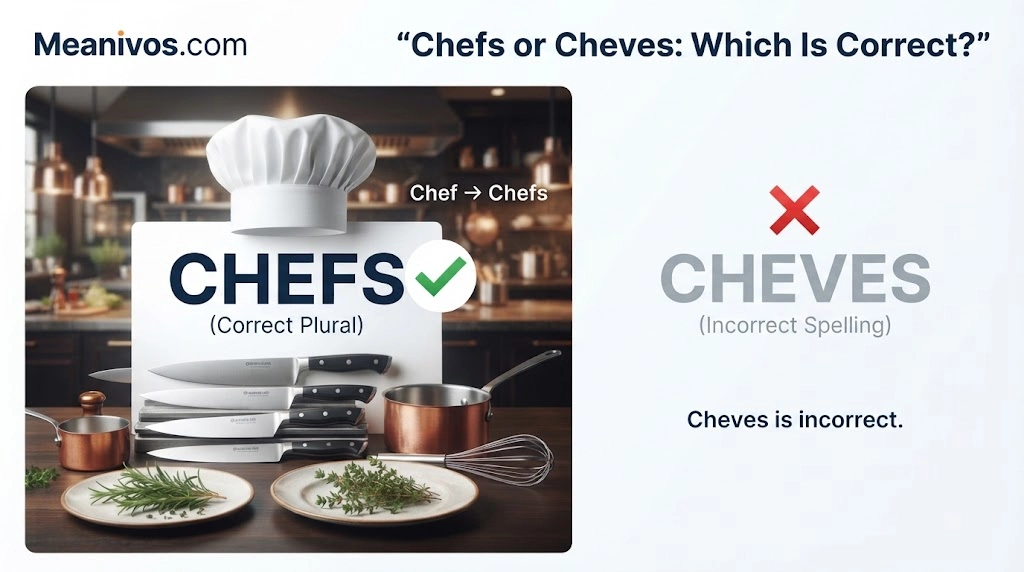
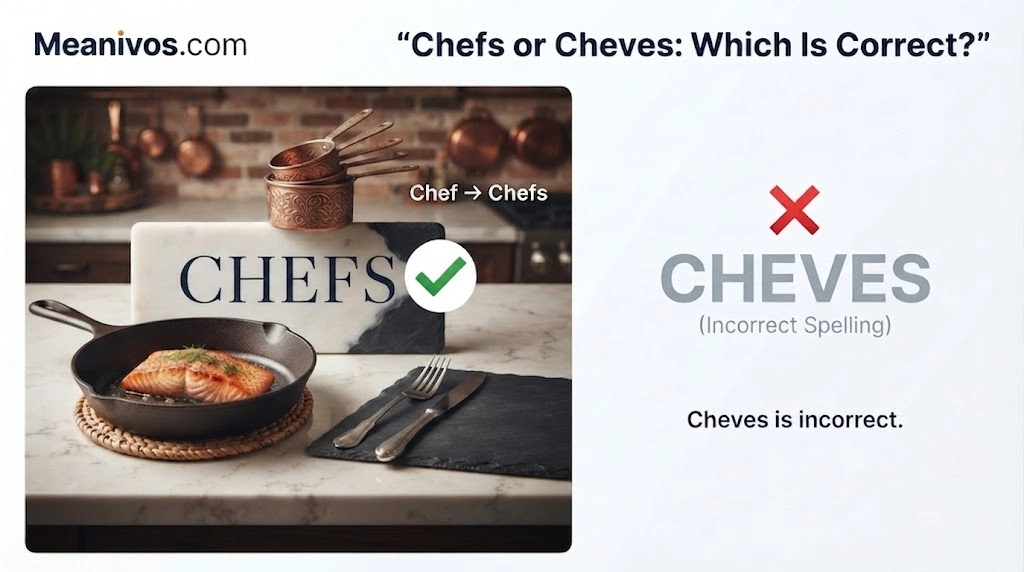
Chefs is correct. Cheves is not the standard English plural of chef.
The singular form is chef, and the plural form is chefs.
- One chef
- Two chefs
- Several chefs
- A team of chefs
You simply add -s to chef. You do not change the final f to v.
This can feel confusing because English has several nouns that change -f or -fe to -ves in the plural. For example, knife becomes knives, leaf becomes leaves, and wife becomes wives. However, that pattern does not apply to every noun ending in f or fe.
Major dictionaries confirm the standard plural chefs. Merriam-Webster lists chefs as the plural of chef, while Collins also gives chefs as the plural form.
So, if you are writing about more than one professional cook, write chefs, not cheves.
Quick Answer: Chefs or Cheves?
| Form | Correct? | Use |
| chef | ✅ | Singular |
| chefs | ✅ | Plural |
| chef’s | ✅ | Singular possessive |
| chefs’ | ✅ | Plural possessive |
| cheves | ❌ | Not the standard plural of chef |
The simple rule
chef → chefs
Not:
chef → cheves ❌
For example:
The restaurant hired three experienced chefs.
Not:
The restaurant hired three experienced cheves. ❌
Why Is the Plural of Chef “Chefs”?
The noun chef takes the regular plural ending -s.
Simply add s:
chef + s = chefs
There is no spelling change to the final f.
Merriam-Webster defines chef as a skilled professional cook and specifically notes its plural as chefs. Collins likewise lists chefs as the plural form.
This means you do not need a special plural spelling for chef.
Compare:
- chef → chefs
- book → books
- restaurant → restaurants
- cook → cooks
- teacher → teachers
The spelling pattern is straightforward.
Why Do People Think “Cheves” Might Be Correct?
The confusion comes from a genuine English spelling pattern.
Some nouns ending in -f or -fe form their plurals with -ves.
For example:
- leaf → leaves
- knife → knives
- wife → wives
- life → lives
- wolf → wolves
- shelf → shelves
- loaf → loaves
Because learners see this pattern, it is easy to assume that every word ending in f should behave in the same way.
That would produce:
chef → cheves
But English does not work that mechanically.
Some nouns ending in f take -s instead.
For example:
- chef → chefs
- roof → roofs
- chief → chiefs
- proof → proofs
- belief → beliefs
- cliff → cliffs
Grammar Monster also identifies chef → chefs among the nouns ending in f/fe that take the regular -s plural.
The important lesson is:
Not every English noun ending in f changes to ves.
Does Every Word Ending in -F Change to -VES?
No.
There is no universal English rule saying that every noun ending in f must become -ves in the plural.
Here is a useful comparison.
Words That Commonly Use -VES
| Singular | Plural |
| leaf | leaves |
| knife | knives |
| wife | wives |
| life | lives |
| wolf | wolves |
| shelf | shelves |
| half | halves |
| thief | thieves |
| loaf | loaves |
| calf | calves |
Words That Usually Add -S
| Singular | Plural |
| chef | chefs |
| roof | roofs |
| proof | proofs |
| chief | chiefs |
| belief | beliefs |
| cliff | cliffs |
| handkerchief | handkerchiefs |
| gulf | gulfs |
Some nouns have variation depending on the word and variety of English. For example, scarf can have the plural scarfs or scarves in different usage contexts. This is another reason not to treat f → ves as an automatic rule.
For chef, however, the standard plural is straightforward:
chef → chefs
Chef vs. Knife vs. Leaf: Why Are the Plurals Different?
Consider these three nouns:
- chef → chefs
- knife → knives
- leaf → leaves
All three contain the letter f, but they do not form their plurals in the same way.
That is because English plural spelling reflects historical development, word origin and established usage. Modern speakers cannot always predict a noun’s plural simply by looking at its final letter.
So this reasoning is incorrect:
knife → knives
leaf → leaves
therefore chef → cheves
Instead, learn the established plural of each word.
For chef, the standard form is confirmed by major dictionaries:
chef → chefs.
What Does “Chef” Mean?
A chef is a professional cook, especially a person who works in or manages a professional kitchen.
Merriam-Webster defines chef as a skilled professional cook and specifically includes someone in charge of a professional kitchen. Collins defines a chef as a cook in a restaurant or hotel.
Examples include:
The chef prepared a seasonal menu.
She works as a chef at a London restaurant.
The head chef trained the kitchen staff.
The plural chefs refers to more than one chef:
Several chefs competed in the culinary competition.
Chef vs. Chefs: Singular and Plural
The difference between chef and chefs is simple.
Chef = One Person
Use chef when you mean one person.
The chef prepared dinner.
Our chef created today’s special.
That chef works in a busy restaurant.
Chefs = Two or More People
Use chefs when you mean more than one person.
The chefs prepared dinner.
Several chefs attended the food festival.
The restaurant employs five chefs.
Easy Memory Rule
One = chef
Two or more = chefs
Chef’s vs. Chefs’: What Is the Difference?
Another common mistake involves Chef’s and chefs’.
These forms are not ordinary plurals. They are possessive forms.
Chef’s = Singular Possessive
Chef’s means something belongs to or is associated with one chef.
Examples:
The chef’s knife was sharp.
I liked the chef’s recipe.
The chef’s kitchen was spotless.
Here, the apostrophe + s shows possession by one chef.
Chefs’ = Plural Possessive
Chefs’ refers to something belonging to or associated with multiple chefs.
Examples:
The chefs’ recipes were published in a cookbook.
The chefs’ kitchens were inspected.
Chefs’ competition attracted thousands of viewers.
The apostrophe comes after the s because chefs is already plural.
Quick Comparison
| Form | Meaning | Example |
| chef | one chef | The chef is cooking. |
| chefs | more than one | The chefs are cooking. |
| chef’s | belonging to one chef | The chef’s recipe is popular. |
| chefs’ | belonging to several chefs | The chefs’ recipes are popular. |
| cheves | incorrect standard plural | Do not use it. |
This distinction is particularly useful when writing restaurant descriptions, food articles, recipes, essays or professional content.
How Do You Pronounce Chef and Chefs?
The singular chef is pronounced approximately:
/ʃef/
It sounds roughly like “shef.”
The plural chefs is pronounced:
/ʃefs/
The final s is pronounced as an /s/ sound.
So:
- chef → /ʃef/
- chefs → /ʃefs/
The plural does not require you to change the pronunciation of the main word.
Dictionary sources also record the Chefs or Cheves pronunciation of chef as /ʃɛf/ or /ʃef/ depending on transcription conventions.
Examples of “Chef” in Sentences
Here are some natural examples of the singular form:
- The chef prepared a three-course meal.
- Our chef specialises in French cuisine.
- The chef created a new dessert.
- She became a chef after culinary school.
- The restaurant hired an experienced chef.
- The chef inspected every dish.
- The head chef welcomed the new staff.
- The chef changed the menu for summer.
- A talented chef can transform simple ingredients.
- The chef served the main course at eight.
Examples of “Chefs” in Sentences
Use chefs when referring to multiple people:
- Several chefs attended the culinary festival.
- The chefs prepared dishes from different countries.
- The restaurant employs experienced chefs.
- Famous chefs often publish cookbooks.
- The chefs worked together on the menu.
- Three chefs judged the competition.
- The chefs shared their cooking techniques.
- Young chefs competed for the award.
- The hotel’s chefs prepared a special dinner.
- The chefs discussed the new menu.
Is “Cheves” a Word?
If your question is specifically whether cheves is the standard English plural of chef, the answer is no.
The standard plural is:
chefs
Not:
cheves
For example:
The restaurant hired five chefs. ✅
Not:
The restaurant hired five cheves. ❌
The spelling cheves may appear as an isolated string, name or in other contexts, but it is not the standard plural form of the English noun chef.
For ordinary English writing, use chefs.
- Explore More: https://meanivos.com/coachs-or-coaches/
What Is the Origin of the Word “Chef”?
The history of chef helps explain why the word looks different from many traditional English words.
The English culinary noun comes from French chef, originally meaning head, chief or leader. Etymonline traces the culinary English sense to French chef, short for chef de cuisine, literally “head of the kitchen.” It ultimately connects with Latin caput, meaning “head.”
The culinary sense entered English in the nineteenth century.
Interestingly, the French word itself also uses chefs as a plural in the relevant noun sense.
However, you do not need to understand the French history to remember the English plural.
The modern English form is simply:
chef → chefs
Is “Chef” a Regular or Irregular Noun?
For ordinary English pluralisation, chef behaves as a regular countable noun.
Its plural is formed by adding -s:
chef → chefs
Compare:
- book → books
- table → tables
- restaurant → restaurants
- chef → chefs
This differs from irregular nouns such as:
- child → children
- man → men
- woman → women
- mouse → mice
It also differs from certain -f/-fe nouns that use -ves:
- knife → knives
- wife → wives
- leaf → leaves
The most useful way to remember chef is therefore:
chef + s = chefs
What Is the Plural of “Chef de Partie”?
You may also encounter the French culinary expression chef de partie.
Its plural is commonly written:
chefs de partie
For example:
The restaurant employs three chefs de partie.
A chef de partie is a chef responsible for a particular section or station within a professional kitchen.
The important point is that chefs remains the plural of chef in this expression.
Do Not Confuse “Chef” With “Chef-d’oeuvre”
The word chef also appears in the French-derived expression chef-d’oeuvre, meaning a masterpiece or an artist’s greatest work.
This is a completely different word from the culinary noun Chef.
Its plural is chefs-d’oeuvre, not simply chefs. Cambridge records chefs-d’oeuvre as the plural form.
So:
- chef → chefs
- chef-d’oeuvre → chefs-d’oeuvre
Do not confuse the two.
Common Mistakes With “Chef”
Mistake 1: Writing “Cheves”
Incorrect:
The restaurant has three cheves.
Correct:
The restaurant has three chefs.
Mistake 2: Assuming Every -F Word Becomes -VES
Incorrect assumption:
leaf → leaves, so chef → cheves.
Correct understanding:
English has several different plural patterns, and chef → chefs.
Mistake 3: Confusing “Chefs” and “Chef’s”
Incorrect:
The chefs recipe was excellent.
If one chef owns the recipe, write:
The chef’s recipe was excellent.
Mistake 4: Confusing “Chefs” and “Chefs’”
If several chefs are associated with the recipes, write:
The chefs’ recipes were published.
Mistake 5: Treating “Cheves” as an Alternative Plural
In standard English writing, do not use cheves as an alternative spelling of chefs.
Use:
chefs
Chef, Chefs, Chef’s or Chefs’?
Here is the easiest reference to save:
| Form | Function | Example |
| chef | Singular | The chef is cooking. |
| chefs | Plural | The chefs are cooking. |
| chef’s | Singular possessive | The chef’s knife is sharp. |
| chefs’ | Plural possessive | The chefs’ knives are sharp. |
| cheves | Incorrect standard plural | Avoid this form. |
If you remember these four standard forms, most common mistakes disappear.
How to Remember “Chef → Chefs”
Use the simplest possible memory trick:
Chef + S
Imagine one person working in a restaurant kitchen:
chef
Now imagine several people working together:
chef + s = chefs
Do not:
- remove the f
- replace f with v
- add ves
Just add s.
Remember:
ONE CHEF
TWO CHEFS
NEVER “CHEVES”
Why Does the F-to-VES Rule Cause So Many Mistakes?
English spelling contains many historical patterns that learners often turn into simple rules.
For example, students learn:
- knife → knives
- life → lives
- wife → wives
- leaf → leaves
They may then assume:
“Words ending in f become ves.”
But this is only a partial pattern.
Other words clearly demonstrate the limitation:
- roof → roofs
- chief → chiefs
- proof → proofs
- belief → beliefs
- chef → chefs
Grammar Monster similarly explains that nouns ending in f do not all follow one identical plural rule.
Therefore, the safest approach is to learn the plural form of commonly used words individually.
For chef, there is no uncertainty:
chef → chefs
Quick Grammar Recap
Here is everything you need to know in one place:
- Plural of chef: chefs
- Incorrect plural: cheves
- Singular: chef
- Plural: chefs
- Singular possessive: chef’s
- Plural possessive: chefs’
- Pronunciation of chef: /ʃef/
- Pronunciation of chefs: /ʃefs/
- Plural rule: add -s
- Word origin: French
- Meaning: professional cook, especially one responsible for a professional kitchen
People Also Ask
A:Cheves is correct. The plural of chef is formed by adding -s. Cheves is not the standard English plural.
A:The plural form is chefs.
Example:
The restaurant employs several chefs.
A:Not as the standard plural of chef. In normal English writing, use chefs.
A:Because chef does not follow the -f → -ves pattern used by words such as leaf → leaves and knife → knives. Its standard plural is chefs.
A:Some English nouns ending in -f or -fe developed plural forms using -ves. However, this pattern does not apply to every noun ending in those letters.
Final Answer
The correct spelling is chefs.
Chef → chefs
You simply add -s to form the plural. You do not change the f to v.
Although words such as leaf → leaves, knife → knives, and wolf → wolves use the -ves pattern, that pattern does not apply to every English noun ending in f.
So write:
The restaurant hired five chefs. ✅
Not:
The restaurant hired five cheves. ❌
For quick reference:
One chef. Two chefs. Never “cheves.”
Major dictionary sources, including Merriam-Webster and Collins, confirm chefs as the plural form.Y