Lay vs Lie: The Ultimate Guide to Rules, Differences & Examples
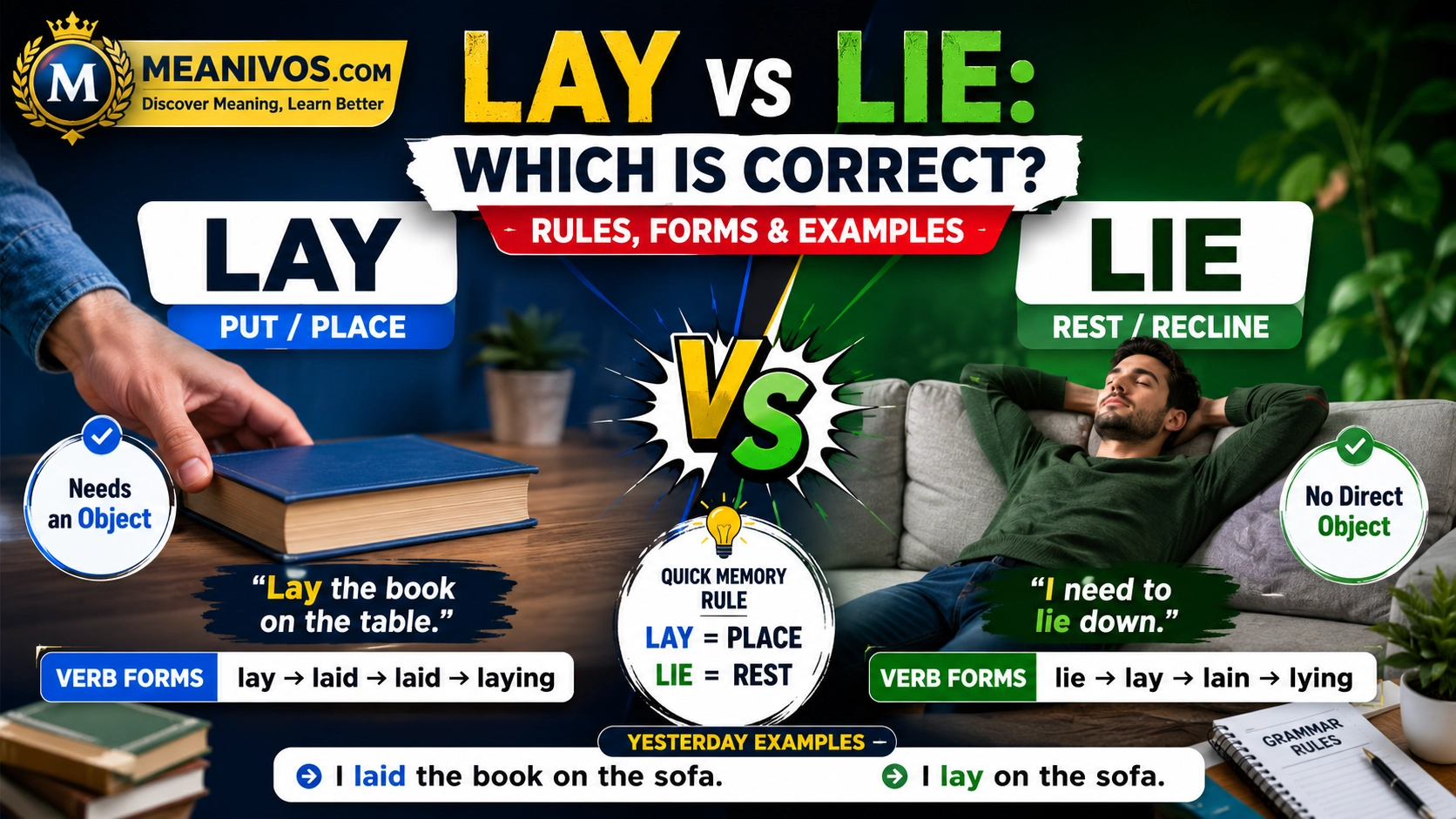
Lay vs Lie is one of the most confusing word pairs in English grammar. The basic difference seems simple: lay means to put or place something, while lie means to rest or recline. But the confusion gets much worse when the verbs change tense.
The biggest problem is this:
Lay is the present tense of one verb, but it is also the past tense of another verb: lie.
For example:
- I lie on the sofa every evening.
- I lay on the sofa yesterday.
- I lay the book on the table.
- I laid the book on the table yesterday.
All four sentences are correct.
The easiest rule is:
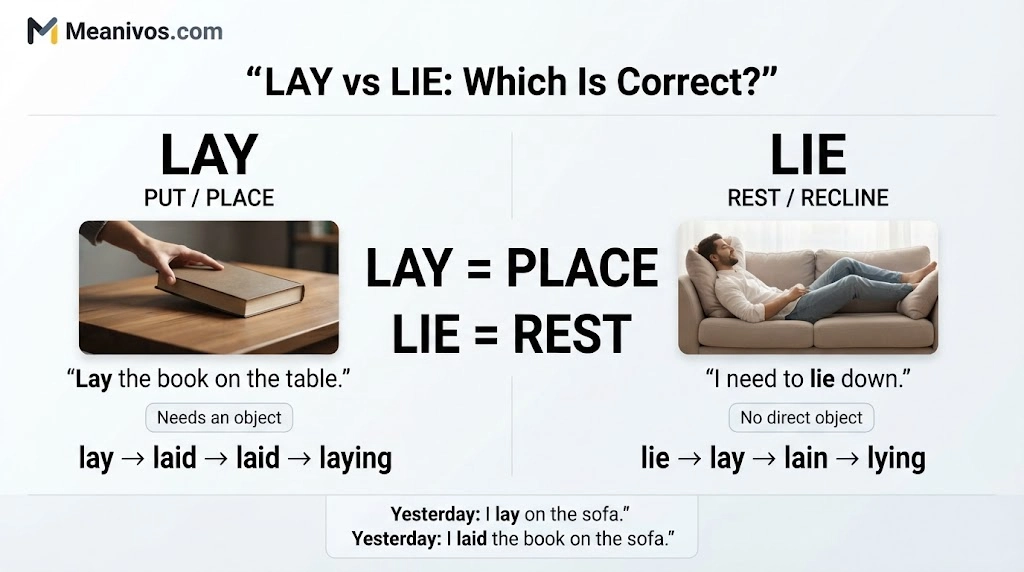
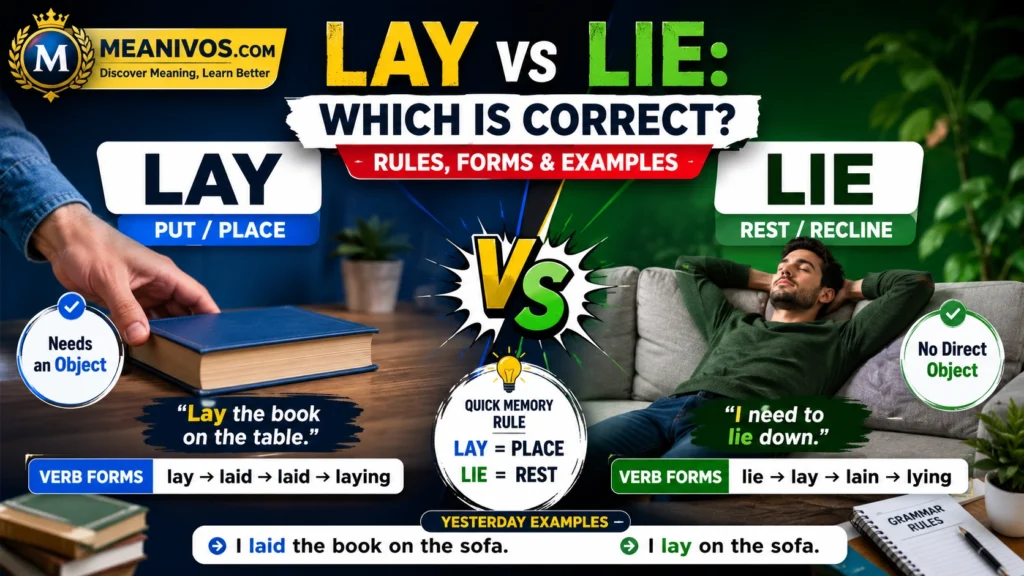
LAY = put or place something.
LIE = rest or recline.
There is one important catch: lay requires an object, while lie in the reclining sense does not. Cambridge and Merriam-Webster both centre their explanations on this distinction.
Once you understand the object rule and memorise the verb forms, lay vs lie becomes much easier.
Lay vs Lie: The Quick Answer
If you only need the answer, remember this:
| Word | Meaning | Need an object? | Example |
| lay | put or place | Yes | Lay the book here. |
| lie | rest or recline | No | I need to lie down. |
| laid | past of lay | Yes | She laid the book down. |
| lay | past of lie | No | She lay on the sofa. |
| lain | past participle of lie | No | She has lain there for hours. |
| laying | -ing form of lay | Usually yes | He is laying the tiles. |
| lying | -ing form of lie | No | He is lying on the floor. |
The simplest memory rule is:
You lay something down, but you lie down yourself.
Cambridge specifically identifies lay as a verb that takes an object and lie as a verb that does not. It also lists laid as the past form of lay and lay as the past form of lie.
What Is the Difference Between Lay and Lie?
The main difference is whether the verb has a direct object.
Lay means “put” or “place”
Lay is normally a transitive verb. A transitive verb acts on an object.
For example:
- Lay the book on the desk.
- Please lay the keys on the table.
- She laid the baby in the cot.
- He is laying the tiles.
- They laid the foundation.
Ask:
Lay what?
The answer is the object.
Lay the book on the desk.
Lay what?
The book.
Therefore, lay is correct.
Lie means “rest” or “recline”
Lie is normally intransitive when it means to rest, recline or remain in a horizontal position.
Examples:
- I need to lie down.
- She is lying on the sofa.
- The dog lies beside the fireplace.
- We lay on the beach yesterday.
- The papers are lying on the desk.
There is no direct object being placed.
You are simply describing the position of the subject.
This object distinction is also confirmed by Cambridge, Merriam-Webster and Grammarly.
The Easiest Test: Ask “Lay What?”
When you cannot decide between lay and lie, ask yourself:
Lay what?
If you can answer the question, lay is usually the correct verb.
Example 1
Please lay the phone on the table.
Lay what?
The phone.
So:
Please lay the phone on the table. ✓
Example 2
I want to lie on the sofa.
Lie what?
There is no object.
You are reclining yourself.
So:
I want to lie on the sofa. ✓
Another useful test is substitution.
If put or place works, choose lay.
If recline works, choose a lie.
- Lay the jacket on the chair.
- Put the jacket on the chair. ✓
- I will lie on the chair.
- I will recline on the chair. ✓
This “put versus recline” method is also recommended by established grammar references.
What Does “Lay” Mean?
The verb lay commonly means to put, place or set something somewhere.
Examples:
- Lay the papers on my desk.
- Lay your coat on the chair.
- Lay the cards on the table.
- Lay the blanket on the grass.
- Please lay the baby gently on the bed.
In each example, something is being placed somewhere.
Other meanings of “lay”
Lay has other meanings too.
For example:
- Birds lay eggs.
- Workers lay cables.
- Builders lay foundations.
- Someone may lay blame on another person.
- A writer may lay emphasis on an important point.
For the lay vs lie grammar problem, however, the most important meaning is:
Lay = put or place something.
What Does “Lie” Mean?
The verb lie can mean to rest, recline or be in a horizontal position.
Examples:
- I like to lie on the beach.
- She is lying on the sofa.
- The dog is lying on the floor.
- He lay on the grass yesterday.
- The village lies in a valley.
Notice that the subject is not placing another object somewhere.
The subject is simply resting or existing in a position.
Lie can also mean “tell an untruth”
There is another completely different verb lie.
This lie means to say something that is not true.
Its forms are:
lie → lied → lied
Examples:
- I never lie to my parents.
- He lied about his age.
- She has lied to me before.
This is different from the reclining verb:
lie → lay → lain
Cambridge explicitly distinguishes these two meanings and their different verb forms.
Lay vs Lie Verb Forms
This is the part that causes the most confusion.
Forms of “lie” meaning recline
| Form | Verb |
| Present | lie |
| Third person | lies |
| -ing form | lying |
| Past | lay |
| Past participle | lain |
Think:
lie → lay → lain → lying
Examples:
- I lie on the sofa every evening.
- She lies on the bed.
- I am lying on the floor.
- Yesterday, I lay on the beach.
- I have lain here for an hour.
Forms of “lay” meaning place
| Form | Verb |
| Present | lay |
| Third person | lays |
| -ing form | laying |
| Past | laid |
| Past participle | laid |
Think:
lay → laid → laid → laying
Examples:
- I lay the book on the desk.
- She lays the baby in the cot.
- He is laying the tiles.
- She laid the papers on the table.
- They have laid the foundation.
These patterns agree with the forms provided by Cambridge and Merriam-Webster.
Why Is the Past Tense So Confusing?
The biggest reason people confuse lay and lie is that lay is the past tense of lie.
Look carefully:
Lie = recline
Present:
I lie on the sofa.
Past:
I lay on the sofa yesterday.
Lay = place
Present:
I lay the book on the sofa.
Past:
I laid the book on the sofa yesterday.
So the two patterns are:
lie → lay → lain
and
lay → laid → laid
That overlap is the heart of the problem.
Merriam-Webster specifically highlights this tense overlap as one of the reasons the pair is so difficult.
Lay Down vs Lie Down
This is one of the most common lay vs lie questions.
“I need to lie down.”
Use lie down when you mean recline or rest.
Examples:
- I need to lie down.
- She wants to lie down for a while.
- I’m going to lie down after lunch.
- He decided to lie down on the sofa.
- You should lie down and rest.
Why?
Because you are reclining.
There is no direct object.
“Lay the book down.”
Use lay down when an object is being placed.
Examples:
- Lay the book down.
- Lay the phone down.
- Lay your bags down.
- She laid the baby down.
- Please lay the papers down carefully.
Here, something is being placed.
Compare the two
I need to lie down. ✓
Lay the book down. ✓
I need to lay down. — Common in informal speech, but lie down is the standard choice when the intended meaning is “recline.”
Lie the book down. ✗
The nonstandard use of lay for “recline” is widespread in casual English, but established references recommend lie in standard formal writing.
Laying vs Lying
Another common question is:
Is it laying or lying?
The basic rule is:
Laying = placing something.
Lying = resting or reclining.
When to use “laying”
Use laying when there is an object.
Examples:
- She is laying the plates on the table.
- He is laying the baby in the crib.
- They are laying the carpet.
- We are laying the books on the shelf.
- The workers are laying cables.
Ask:
Laying what?
If you can answer, laying is likely correct.
When to use “lying”
Use lying when the subject is resting or reclining.
Examples:
- She is lying on the bed.
- He is lying on the sofa.
- The dog is lying on the floor.
- I am lying in the sun.
- They are lying on the grass.
Never write “lieing”
The correct spelling is:
lying
Not:
lieing
The final -e in lie changes before -ing, producing lying. Cambridge and Grammarly both give lying as the correct form.
- Explore More: https://meanivos.com/etc-or-ect/
Laid vs Lain
The Laid and lain are often mixed up because both relate to lay and lie.
Laid
Laid is the past tense and past participle of lay meaning “place.”
Examples:
- She laid the book on the table.
- He laid the baby in the cot.
- They laid the foundation.
- I have laid the papers on your desk.
The key idea is:
Something was placed.
Lain
Lain is the past participle of lie meaning “recline” or “rest.”
Examples:
- She has lain on the bed all morning.
- The dog has lain beside the fire for hours.
- The book has lain untouched on the desk.
- He had lain awake all night.
The key idea is:
Someone or something has remained in a position.
Easy memory trick
LAY → LAID
LIE → LAIN
Cambridge notes that lain is the past participle of the reclining verb lie and is relatively formal or uncommon in everyday speech.
Lay vs Lie in the Present Tense
Present-tense sentences are usually easier.
Use “lay” when placing something
- I lay the keys on the table.
- We lay the plates out for dinner.
- She lays the baby in the crib.
- They lay bricks every day.
Use “lie” when resting or existing in a position
- I lie on the sofa.
- She lies on the bed.
- The dog lies near the door.
- The village lies in a valley.
Compare
I lay the blanket on the grass.
The blanket is being placed.
I lie on the blanket.
I am reclining.
Lay vs Lie in the Past Tense
The past tense is where many mistakes happen.
Lie → lay
If lie means “recline,” its past tense is lay.
- Today: I lie on the sofa.
- Yesterday: I lay on the sofa.
- Today: She lies in bed.
- Yesterday: She lay in bed.
- Today: The dog lies by the fire.
- Yesterday: The dog lay by the fire.
Lay → laid
If lay means “place,” its past tense is laid.
- Today: I lay the book on the table.
- Yesterday: I laid the book on the table.
- Today: She lays the baby in the crib.
- Yesterday: She laid the baby in the crib.
The crucial difference
I lay on the beach yesterday. ✓
Here, lay is the past tense of lie.
I laid my towel on the beach yesterday. ✓
Here, laid is the past tense of lay.
Lay vs Lie in Perfect Tenses
Perfect tenses make lain especially important.
Present perfect
For lie:
I have lain here for two hours.
For lay:
I have laid the book on the table.
Past perfect
For lie:
She had lain on the sofa all afternoon.
For lay:
She had laid the papers on the desk.
Future perfect
For lie:
By noon, I will have lain here for three hours.
For lay:
By noon, I will have laid all the documents on the table.
The important distinction is:
lie → lain
but:
lay → laid
Lay vs Lie in Bed
This is one of the most useful real-life examples.
Present
Correct:
I am lying in bed. ✓
Not:
I am laying in bed.
Why?
Because you are resting in bed rather than placing something.
Past
Correct:
I lay in bed all morning. ✓
Not:
I laid in bed all morning.
Here, lay is the past tense of lie.
With an object
Correct:
I laid the baby in bed. ✓
Now baby is the object being placed.
Compare:
I lay in bed.
with:
I laid the baby in bed.
This single comparison demonstrates the main rule.
Lay vs Lie on the Couch
The same rule applies to a couch.
Resting
- I want to lie on the couch.
- She is lying on the couch.
- He lay on the couch yesterday.
Placing something
- Lay the blanket on the couch.
- She laid the cushions on the couch.
- He is laying the clothes on the couch.
Ask:
Who or what is being placed?
If there is an object being placed, use the lay family.
If the subject is simply resting, use the lie family.
Lay vs Lie on the Floor
Resting or existing
- I need to lie on the floor.
- The dog is lying on the floor.
- She lay on the floor for ten minutes.
- The books lie on the floor.
Notice that lie can describe an object that is already in a position:
The books lie on the floor.
The books are not actively placing themselves there.
They simply are there.
Actively placing something
Please lay the books on the floor.
Now someone is putting the books there, so lay is correct.
Lay vs Lie on the Beach
Consider these three sentences:
I want to lie on the beach. ✓
You are reclining.
Yesterday, I lay on the beach. ✓
This is the past tense of lie.
I laid my towel on the beach. ✓
You placed the towel.
This is why context and tense matter so much.
Common Lay vs Lie Mistakes
Mistake 1: “I am laying down.”
If you mean that you are reclining, standard formal English uses:
I am lying down. ✓
Mistake 2: “I laid down yesterday.”
If you mean that you reclined yesterday, use:
I lay down yesterday. ✓
Remember:
lie → lay
Mistake 3: “The dog is laying on the floor.”
If the dog is resting:
The dog is lying on the floor. ✓
Mistake 4: “She laid on the bed.”
If she was reclining:
She lay on the bed. ✓
Mistake 5: “He lied on the sofa.”
If he was reclining:
He lay on the sofa. ✓
Lied means he told an untruth.
Mistake 6: “The book is laying on the table.”
If the book is simply resting there:
The book is lying on the table. ✓
If someone is actively putting it there:
She is laying the book on the table. ✓
“I Lay Down” vs “I Laid Down”
This deserves special attention because both expressions can sound natural in conversation.
Recline now
I lie down.
Recline in the past
I lay down yesterday.
Place something now
I lay the book down.
Place something in the past
I laid the book down yesterday.
| Meaning | Correct form |
| Recline now | I lie down. |
| Recline yesterday | I lay down. |
| Place something now | I lay it down. |
| Place something yesterday | I laid it down. |
This four-line pattern is one of the most useful ways to master the distinction.
Is “Lay Down” Ever Used to Mean “Lie Down”?
Yes.
You may frequently hear people say:
“I’m going to lay down.”
This use is common in informal speech, particularly in American English, but traditional standard grammar recommends Lie Down when the intended meaning is “recline.” Thesaurus.com similarly describes this use as common but nonstandard and recommends avoiding it in formal contexts.
So in:
- academic writing
- professional writing
- school assignments
- formal emails
- edited articles
- business communication
the safest choice is:
I am going to lie down.
Lay vs Lie vs Lied
There are actually two different verbs spelled lie.
Lie = recline
Its forms are:
lie → lay → lain
Example:
I lay on the bed yesterday.
Meaning:
I reclined on the bed yesterday.
Lie = tell an untruth
Its forms are:
lie → lied → lied
Example:
He lied to me yesterday.
Meaning:
He told me something untrue.
Compare:
I lay on the bed.
= I reclined on the bed.
I lied to my friend.
= I told my friend something untrue.
Do not confuse lay and lied. They belong to different verbs.
Is “Layed” a Word?
For the standard verb lay meaning “put or place,” the past form is:
laid
Not:
layed
Correct:
She laid the book on the desk.
Incorrect in standard English:
She laid the book on the desk.
Cambridge specifically gives laid, not layed, as the standard past form.
Is “Lieing” Correct?
No.
The correct -ing form of lie meaning “recline” is:
lying
Example:
The dog is lying on the floor.
Not:
lieing
The spelling change is one reason lying can look unusual, but it is the standard form.
A Simple Decision Tree for Lay vs Lie
When you are unsure, use these steps.
Step 1: Is something being placed?
If yes:
LAY
Example:
Lay the keys on the table.
Step 2: Is someone or something resting or reclining?
If yes:
LIE
Example:
Lie on the sofa.
Step 3: Is the sentence in the past?
If the verb means recline:
LAY
Example:
I lay on the sofa yesterday.
If the verb means place:
LAID
Example:
I laid the book on the sofa yesterday.
Step 4: Is it a perfect tense?
For lie/recline:
LAIN
For lay/place:
LAID
Easy Memory Tricks for Lay vs Lie
Trick 1: LAY = PLACE
Think:
LAY = PLACE
If you can replace the verb with place, use lay.
Lay the book here.
→ Place the book here.
Trick 2: LIE = RECLINE
Think:
LIE = RECLINE
I need to lie down.
→ I need to recline.
Trick 3: Memorise the two sequences
The most reliable method is to memorise:
Lie – Lay – Lain
and:
Lay – Laid – Laid
If you know those two sequences, most tense-related questions become much easier.
Lay vs Lie Examples
Here are additional examples to reinforce the difference.
Correct examples with “lay”
- Lay the book on the table.
- Please lay the blanket on the grass.
- She laid the keys beside the door.
- He laid the baby in the cot.
- They laid the foundation.
- I am laying the plates on the table.
- She has laid the documents on my desk.
- The workers are laying new cables.
Correct examples with “lie”
- I want to lie down.
- She is lying on the sofa.
- The dog lies near the door.
- He lay on the grass.
- We lay on the beach all afternoon.
- The papers are lying on the desk.
- She has lain awake all night.
- The village lies in a valley.
Lay vs Lie: The Complete Cheat Sheet
| Situation | Correct form | Example |
| Place something now | lay | Lay the book here. |
| Recline now | lie | I need to lie down. |
| Place something in the past | laid | She laid the book down. |
| Recline in the past | lay | She lay on the bed. |
| Place something with -ing | laying | He is laying the tiles. |
| Recline with -ing | lying | He is lying on the floor. |
| Recline with perfect tense | lain | He has lain there all day. |
| Tell an untruth | lie / lied | He lied to me. |
Lay vs Lie Practice Quiz
Test yourself before checking the answers.
1. I need to ___ down for a few minutes.
A. lay
B. lie
2. Please ___ the book on the desk.
A. lay
B. lie
3. Yesterday, she ___ on the beach all afternoon.
A. lay
B. laid
4. He ___ the baby gently in the cot.
A. lay
B. laid
5. The dog is ___ on the floor.
A. laying
B. lying
6. She is ___ the plates on the table.
A. laying
B. lying
7. I have ___ awake all night.
A. laid
B. lain
8. He ___ about where he had been.
A. lay
B. lied
Answers
- lie
- lay
- lay
- laid
- lying
- laying
- lain
- lied
If you can answer these correctly, you understand the central difference between the verbs.
People Also Ask
A:Think LAY = PLACE and LIE = RECLINE. If you can replace the verb with “put” or “place,” use lay. If you mean “rest” or “recline,” use lie.
A:Because lay is the past tense of lie when lie means “recline.” Therefore, “I lay down yesterday” means “I reclined yesterday.”
A:Laid is the past tense of lay, and “lay down” is also widely used informally to mean “recline.” In standard formal English, however, I lay down is preferred for the past tense of lie.
A:Laid belongs to lay and normally involves placing an object. Lain is the past participle of lie meaning recline or remain in a position.
A:No. Lying can be the -ing form of lie meaning “recline,” as in “She is lying on the sofa,” or the -ing form of lie meaning “tell an untruth,” as in “He is lying to me.”
Final Takeaway
You do not need to memorise dozens of complicated grammar rules.
Start with these two:
LAY = PUT or PLACE something.
LIE = REST or RECLINE.
Then memorise the verb patterns:
Lie
lie → lay → lain → lying
Lay
lay → laid → laid → laying
And remember these four sentences:
I lie down now.
We lay down yesterday.
I lay the book down now.
I laid the book down yesterday.
The reason lay vs Lie feels so difficult is that the past tense of lie is lay, while lay is also the present form of the verb meaning “place.” That overlap is the source of much of the confusion. Cambridge and Merriam-Webster both explain the verbs through their object requirements and tense forms.
So when you are unsure, ask yourself:
Am I placing something, or am I resting?
Placing → lay.
Resting/reclining → lie.
Then check the tense.
Once you understand that pattern, lay, lie, laid, lain, laying and lying stop looking like six unrelated words and start working as two connected verb systems.