Tear vs Tare: Quick Answer
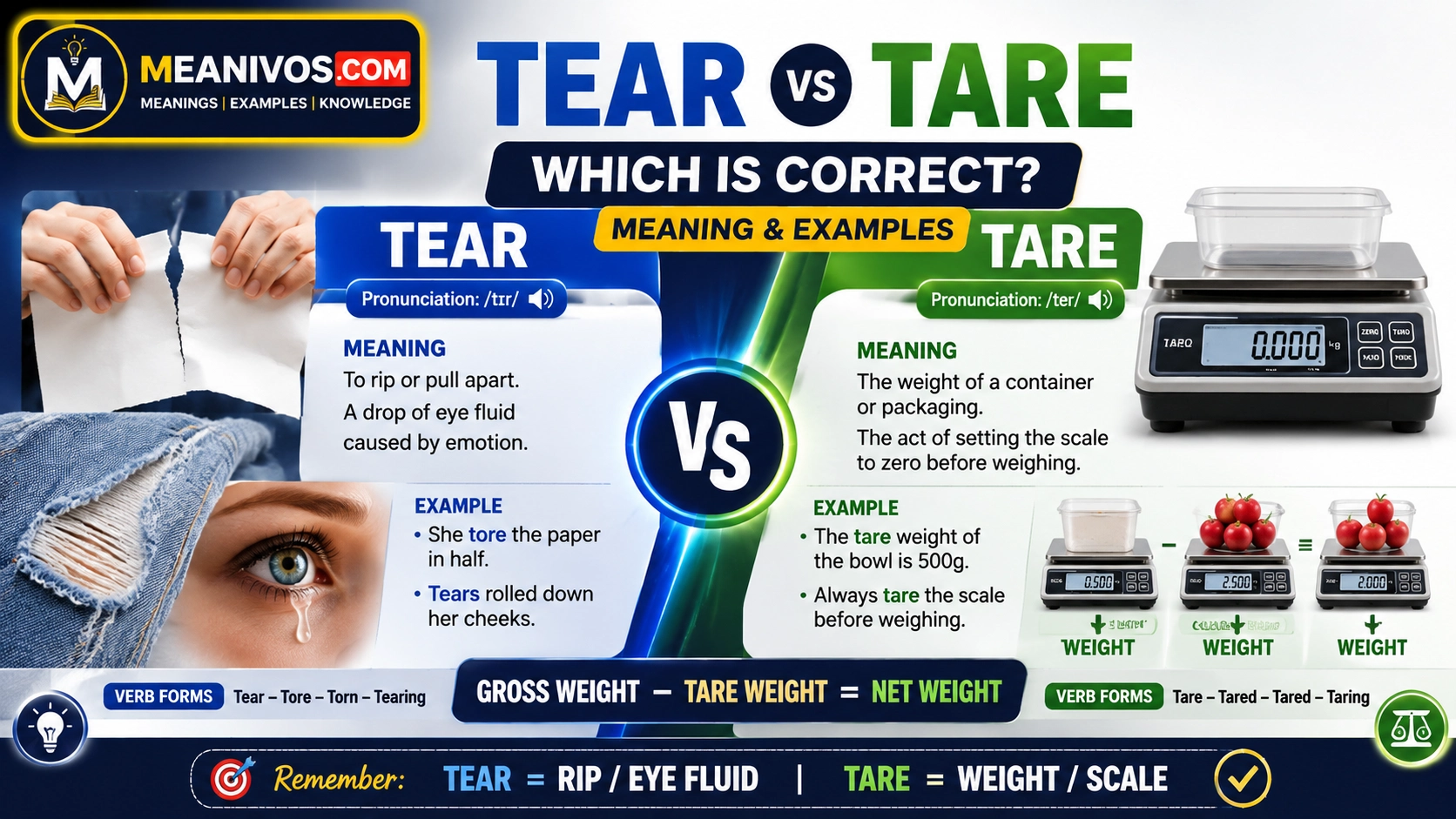
Tear and tare are different English words with different meanings.
The Tear can mean to rip or pull something apart, a rip or hole in something, a drop of liquid from the eye, or, in another use, to move very quickly.
Tare most commonly refers to the weight of an empty container, vehicle, or packaging. It is also a verb meaning to determine the tare or adjust a scale so the container’s weight is excluded. Tare also has a separate plant-related meaning.
The easiest rule is:
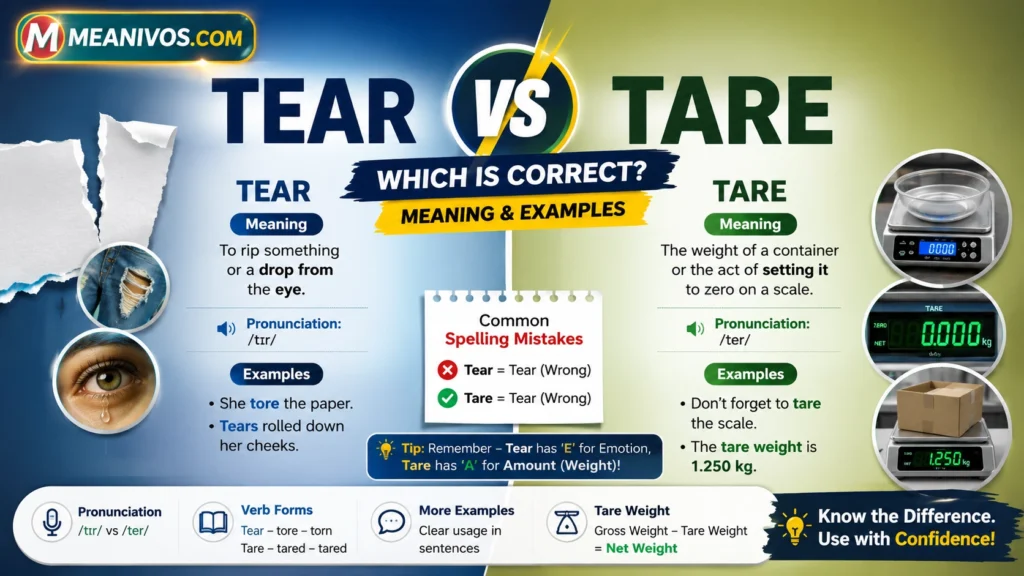
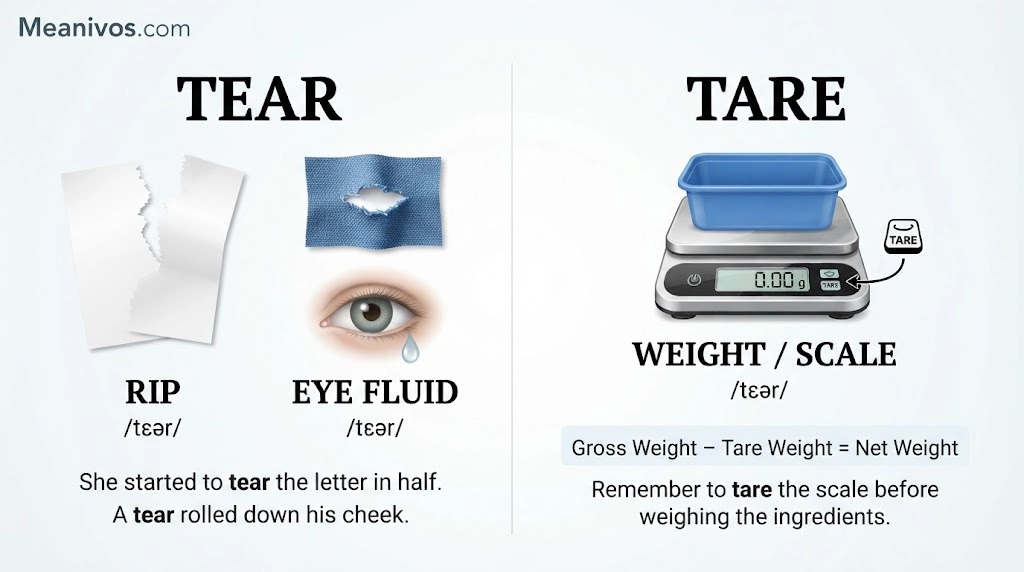
Tear = rip, damage, or a drop from the eye.
Tare = container weight or weighing.
Examples:
- Tear the paper carefully.
- There is a tear in my jacket.
- A tear rolled down her cheek.
- Check the tare weight of the container.
- Tare the scale before adding the ingredients.
Although the ripping sense of tear and tare can sound alike, they are not interchangeable.
Tear vs Tare at a Glance
| Word | Main meaning | Part of speech | Example |
| Tear | To rip or pull apart | Verb | Tear the paper. |
| Tear | A rip or hole | Noun | There is a tear in the shirt. |
| Tear | Liquid from the eye | Noun | A tear rolled down her cheek. |
| Tear | Move quickly | Verb | The car came tearing down the road. |
| Tare | Empty container or vehicle weight | Noun | The tare weight is 2 kg. |
| Tare | Account for container weight | Verb | Tare the scale first. |
| Tare | A type of vetch/plant | Noun | Tare is a plant name. |
Cambridge lists tear as a verb meaning to pull something apart, a noun meaning a hole caused by tearing, and a noun referring to liquid from the eye. It also records a separate verb meaning to move very quickly.
Merriam-Webster similarly lists multiple entries for tear, including ripping, a hole or flaw, a rapid rush, and the liquid produced by the eye.
What Is the Difference Between Tear and Tare?
The biggest difference is meaning and context.
Use tear when you are talking about ripping, damaging, dividing, or crying.
Use tare when you are talking about weighing, packaging, containers, or adjusting a scale.
Compare:
Please tear the paper in half.
Here, tear means “rip.”
Now compare:
The tare weight of the container is 3 kilograms.
Here, tare refers to the empty container’s weight.
The two words can sound alike in one pronunciation of tear, but their meanings are completely different.
What Does Tear Mean?
Tear is a much more common word than tare and has several meanings.
The most important meanings for this comparison are:
- To rip or pull something apart.
- A rip or hole in material.
- A drop of liquid from the eye.
- To move quickly.
- Several related figurative and idiomatic uses.
The spelling stays tear, but pronunciation can change depending on the meaning.
Tear as a Verb: To Rip or Pull Apart
When tear means “rip,” it describes pulling something apart or pulling pieces away from it.
Examples:
- Don’t tear the page.
- Please tear the paper in half.
- Be careful because the fabric can tear easily.
- I accidentally tore my shirt.
- She tore the letter into pieces.
- The dog tore the cushion.
- The strong wind tore the sign from the wall.
Cambridge defines this sense as pulling something apart or pulling pieces off it.
This is the sense you need when asking:
“Do I tear paper or tare paper?”
The answer is:
You tear paper.
Tear Verb Forms: Tear, Tore, Torn
One important reason learners search for tear vs tare is that tare is not the past tense of tear.
The verb forms are:
| Form | Word | Example |
| Base | tear | I tear the paper. |
| Third person | tears | She tears the page. |
| Past | tore | He tore the paper. |
| Past participle | torn | The paper was torn. |
| Present participle | tearing | She is tearing the paper. |
The correct pattern is:
tear → tore → torn
Cambridge explicitly lists tore and torn as the past and past participle forms.
Incorrect
I tared the paper yesterday. ❌
Correct
I tore the paper yesterday. ✅
Tare is a separate word. It is not the past tense of tear.
Tear as a Noun: A Rip or Hole
The Tear can also be a noun.
In this sense, it means a hole, opening, or damaged area created by tearing.
Examples:
- There is a tear in my shirt.
- I found a tear in the curtain.
- The bag has a small tear.
- There is a large tear in the page.
- The jacket has a tear near the sleeve.
Cambridge defines this noun sense as a hole in paper, cloth, or another material where it has been torn.
So these two sentences use the same word in different grammatical roles:
I tear the paper. — verb
There is a tear in the paper. — noun
Tear as a Noun: A Drop From the Eye
There is another tear that has a completely different meaning.
A tear can be a drop of salty liquid that comes from the eye.
Examples:
- A tear rolled down her cheek.
- She wiped away a tear.
- His eyes filled with tears.
- The speech brought tears to her eyes.
- She fought back a tear.
- The movie made him cry tears of happiness.
Cambridge defines this sense as a drop of salty liquid flowing from the eye, often because of emotion or pain.
Merriam-Webster likewise defines this tear as fluid secreted by the lacrimal gland.
Why Does Tear Have Two Pronunciations?
This is one of the most important parts of the tear vs tare question.
English has two common words spelled tear with different meanings and pronunciations.
Tear = rip
Pronounced approximately:
/teər/ in many British pronunciations
/ter/ in many American pronunciations
This is the tear that sounds like tare.
Tear = liquid from the eye
Pronounced approximately:
/tɪər/ in British English
/tɪr/ in American English
So:
tear = “tair” → rip
tear = “teer” → liquid from the eye
tare = “tair” → container weight
Cambridge separates these pronunciations in its dictionary entries.
Tear as a Verb: To Move Quickly
There is another meaning of Tear that is easy to overlook.
Informally, tear can mean to move very quickly or rush.
Examples:
- The car came tearing down the road.
- He went tearing across the field.
- She came tearing into the room.
- The children went tearing around the garden.
- The fire truck came tearing down the street.
Cambridge records this as an informal verb meaning to move very quickly.
This meaning has nothing to do with tare.
Other Common Uses of Tear
Because tear is a highly flexible word, it appears in many expressions.
Tear apart
To destroy, separate, or divide.
The disagreement threatened to tear the family apart.
Tear down
To demolish or destroy a structure.
They tore down the old building.
Tear up
To rip something into pieces.
She tore up the letter.
Tear into
To attack or criticise someone or something strongly.
The reviewer tore into the new policy.
Tear away
To pull away or leave something.
He could hardly tear himself away from the game.
These expressions all use tear, not tare.
What Does Tare Mean?
Tare is a standard English word, but it is much more specialised than tear.
Its most familiar meaning relates to weight and measurement.
Cambridge defines tare as the weight of an empty vehicle or container, which is deducted from the combined weight to determine the net weight of the goods. It also uses the term for packaging material whose weight is excluded from the product’s net weight.
Merriam-Webster also defines tare as a deduction from gross weight to account for the weight of the container.
What Is Tare Weight?
Tare weight is the weight of an empty container, vehicle, package, or similar item before its contents are counted.
For example:
- Box + product = 10 kg
- Empty box = 2 kg
- Product = 8 kg
Therefore:
Gross weight = 10 kg
Tare weight = 2 kg
Net weight = 8 kg
The basic formula is:
Net Weight = Gross Weight − Tare Weight
This is why the phrase tare weight appears in shipping, logistics, manufacturing, retail, packaging, transportation, and weighing.
Gross Weight vs Tare Weight vs Net Weight
These three terms are closely connected.
| Term | Meaning | Example |
| Gross weight | Product plus container/package | 10 kg |
| Tare weight | Empty container/package | 2 kg |
| Net weight | Product without container/package | 8 kg |
The relationship is:
10 kg − 2 kg = 8 kg
Therefore:
Gross − Tare = Net
This is one of the easiest ways to understand why tare is used in shipping and weighing.
Tare as a Verb
Tare is not only a noun.
It can also be a verb.
To tare something means to determine or account for its tare weight. With a scale, it commonly means adjusting the scale so that the container’s weight is excluded from the displayed measurement.
Merriam-Webster explicitly lists tared and taring as verb forms and defines the verb as determining the tare or adjusting a scale to Tear vs Tar reduce the displayed weight to zero when an empty container is placed on it.
Examples:
- Tare the scale before adding flour.
- The technician tared the balance before measuring the sample.
- The machine automatically tares the container.
- The operator is taring the scale.
- The vessel was tared before the experiment.
What Does Tare Mean on a Digital Scale?
If you have used a kitchen scale, you may have seen a button labelled:
TARE
The button is used to remove the container’s weight from the measurement.
For example:
- Put an empty bowl on the scale.
- The scale shows 300 g.
- Press TARE.
- The scale returns to 0 g.
- Add flour.
- The displayed weight represents Tear vs Tar the flour rather than the bowl.
So if someone says:
“Tare the scale before adding the ingredients.”
they mean:
Set the scale so the container’s weight is excluded.
Tare in Shipping and Logistics
Tare is especially important in shipping and transportation.
A shipping container has its own weight before cargo is added.
The container plus cargo gives the gross weight.
The empty container’s weight is the tare weight.
The cargo itself represents the net weight.
For example:
Container + cargo = 30,000 kg
Container tare = 4,000 kg
Cargo net weight = 26,000 kg
This distinction matters because Tear vs Tar shipping records, transport regulations, invoices, and cargo calculations may depend on accurate weights.
Tare in Science and Laboratory Measurements
The word tare is also common in scientific and laboratory contexts.
A technician may place an empty vessel on a laboratory balance and tare the balance before adding a chemical sample.
For example:
The laboratory balance was tared before the sample was added.
This allows the measurement to represent the sample rather than the vessel.
So tare is not limited to kitchen scales. It is part of the wider vocabulary of accurate measurement.
Tare as a Plant
There is another legitimate meaning of tare that many simplified grammar articles leave out.
Tare can refer to a plant or plants in the vetch group.
Merriam-Webster lists tare as a noun Tear vs Tar referring to the seed of a vetch and to several vetches. It also records another agricultural meaning involving a weed of grain fields, especially in biblical contexts.
This is a completely separate meaning from tare weight.
For most modern users, the weighing sense is far more relevant. However, including the plant meaning makes a dictionary-style Tear vs Tar explanation more complete.
Is Tare a Real Word?
Yes.
Tare is a legitimate English word with multiple dictionary meanings.
The most common modern meaning is connected with weight and measurement.
Merriam-Webster also records the plant meaning and gives the historical development of the weighing-related noun through Tear vs Tar Middle French and Old Italian from Arabic.
So if you have ever wondered whether tare is simply a misspelling of tear, the answer is no.
Both are correctly spelled words.
They simply mean different things.
Tear vs Tare Pronunciation
The pronunciation question deserves special attention because it is the main reason these words are confused.
| Word | Meaning | Approximate pronunciation |
| tear | rip | “tair” |
| tare | container weight | “tair” |
| tear | eye fluid | “teer” |
Therefore, tear is a particularly tricky word because its pronunciation changes with its meaning.
The ripping sense of tear and tare are homophones Tear vs Tar in standard pronunciation patterns, while the eye-fluid sense of tear is pronounced differently.
Are Tear and Tare Homophones?
Yes, but with an important qualification.
The tear meaning “rip” and tare have the Tear vs Tar same pronunciation in common English pronunciation, while their spellings and meanings are different.
That makes them homophones.
For example:
Tear the paper.
and:
Check the tare weight.
The words sound alike when spoken, but the Tear vs Tar context tells you which spelling is required.
However, the tear meaning “a drop from the eye” has a different pronunciation.
So it is more precise to say:
The ripping sense of tear and tare are homophones.
- Explore More: https://meanivos.com/google-vs-chatgpt/
Tear or Tare: Which One Should You Use?
Use this simple decision guide.
If you mean “rip”
Use tear.
Tear the paper.
If you mean “a rip or hole”
Use tear.
There is a tear in the shirt.
If you mean “a drop from the eye”
Use tear.
A tear rolled down her cheek.
If you mean “empty container weight”
Use tare.
The tare weight is 2 kg.
If you mean “adjust a scale”
Use tare.
Tare the scale before weighing the ingredients.
If you mean the plant
Use tare.
The word tare can also refer to certain vetch plants.
Tear Weight or Tare Weight?
The correct phrase is:
Tare weight ✅
Not:
Tear weight ❌
This is one of the most common spelling mistakes associated with these words.
Tare weight refers to the weight of the Tear vs Tar empty container, vehicle, or packaging that is excluded when calculating net weight.
For example:
The tare weight of the container is 1,500 kg.
The word tear would be Tear vs Tar incorrect in this context.
Do You Tear Paper or Tare Paper?
You tear paper.
Correct:
I tore the paper in half.
Incorrect:
I tared the paper in half.
Why?
Because tear means to pull something apart.
Tare relates to weight, weighing, or the separate plant meaning.
A useful substitution test is:
If you can replace the word with rip, choose tear.
For example:
Tear the paper.
becomes:
Rip the paper.
The meaning remains clear.
Is “Tare” the Past Tense of “Tear”?
No.
This is a common misconception.
The past tense of tear meaning “rip” is:
tore
The past participle is:
torn
Therefore:
I tear the paper.
I tore the paper.
Its have torn the paper.
Not:
I tare the paper.
I tared the paper. ❌
Tare is an independent word.
Common Tear vs Tare Mistakes
Mistake 1: Tear weight
Incorrect:
The package has a tear weight of 4 kg.
Correct:
The package has a tare weight of 4 kg.
Mistake 2: Tare the paper
Incorrect:
Please tare the paper.
Correct:
Please tear the paper.
Mistake 3: Tared instead of tore
Incorrect:
She tared the letter into pieces.
Correct:
She tore the letter into pieces.
Mistake 4: Tare instead of tear
Incorrect:
The dog tared the cushion.
Correct:
The dog tore the cushion.
Mistake 5: Tear instead of tare
Incorrect:
Press the tear button on the scale.
Correct:
Press the tare button on the scale.
Why Do People Confuse Tear and Tare?
There are several reasons.
1. They sound alike
The ripping sense of tear and tare are pronounced alike.
2. Their spellings are very similar
Only one letter changes:
tear
tare
3. Both are real words
A spell-checker may not identify the error because both spellings are valid English words.
4. Tare is less common
Most people encounter tear far more frequently in everyday English.
5. Tear has multiple meanings
Tear can refer to ripping, a rip, eye fluid, movement, and various idiomatic expressions.
That makes it particularly easy to Tear vs Tar misunderstand when heard rather than read.
Tear vs Tare vs Rip
It is also useful to distinguish tear from rip.
Tear and rip can both describe pulling something apart.
For example:
Tear the paper.
Rip the paper.
Both are natural sentences.
However, tare cannot replace either word when you mean ripping.
Quick comparison
| Word | Meaning | Example |
| Tear | Pull apart | Tear the paper. |
| Rip | Tear apart, often forcefully | Rip the paper. |
| Tare | Account for container weight | Tare the scale. |
So:
Tear = rip
but:
Tare ≠ tear
Tear vs Tare in Everyday English
Consider these situations.
Situation 1: A damaged shirt
There is a tear in my shirt.
Correct because the shirt has a rip.
Situation 2: A kitchen scale
Put the bowl on the scale and press tare.
Correct because the scale needs to exclude the bowl’s weight.
Situation 3: A crying person
She wiped away a tear.
Correct because this refers to eye fluid.
Situation 4: A shipping container
The tare weight is listed on the document.
Correct because the term refers to the Tear vs Tar empty container’s weight.
Situation 5: A piece of paper
He tore the paper in half.
Correct because tore is the past tense of tear.
Tear vs Tare Examples
Examples With Tear
- Please tear the paper carefully.
- She tore the envelope open.
- The old book’s pages tear easily.
- There is a tear in my jacket.
- The dog tore the cushion.
- He tore the letter into pieces.
- The wind tore the flag.
- I noticed a small tear in the bag.
- She wiped away a tear.
- The film brought tears to his eyes.
- The car came tearing down the road.
- The disagreement tore the group apart.
Examples With Tare
- Check the tare weight first.
- Tare the scale before adding the flour.
- The empty box has a tare of 500 grams.
- The shipping document lists the container’s tare weight.
- The laboratory balance was tared before measurement.
- The scale automatically calculates the tare.
- Remove the tare weight to find the net weight.
- The operator tared the container before weighing it.
- The package’s gross weight includes its tare.
- The empty vehicle’s weight is its tare weight.
Tear vs Tare Sentence Test
If you are unsure which spelling to use, look at the sentence’s context.
“Please ___ the paper.”
The answer is:
tear
Because you mean “rip.”
“The ___ weight of the box is 1 kg.”
The answer is:
tare
Because you mean the empty box’s weight.
“She wiped away a ___.”
The answer is:
tear
Because you mean liquid from the eye.
“Please ___ the scale.”
The answer is:
tare
Because you mean adjust the scale.
“He ___ the page yesterday.”
The answer is:
tore
Because it is the past tense of tear.
Easy Memory Trick for Tear vs Tare
Use two simple associations:
TEAR = RIP
If something is being ripped, choose tear.
If you are weighing a container or resetting a scale, choose tare.
Another way to remember it:
TARE → TARE BUTTON → SCALE
TEAR → TORN PAPER → RIP
This is much easier than trying to memorise long dictionary definitions.
Tear vs Tare: Grammar Guide
| Word | Noun? | Verb? | Main contexts |
| Tear | Yes | Yes | Ripping, damage, crying, speed |
| Tare | Yes | Yes | Weight, scales, packaging |
| Tare | Yes | — | Plant / agricultural meaning |
One important correction to several simplified Tear vs Tar online explanations is that tare is not only a noun. Merriam-Webster explicitly records a verb form: tared; taring.
Similarly, tear is not limited to ripping. Dictionaries recognise multiple meanings and grammatical uses.
Tear vs Tare in British and American English
The core spelling distinction is the same in British and American English:
- tear = rip
- tear = eye fluid
- tare = empty-container or vehicle weight
- tare = adjust a scale
Pronunciation symbols can differ slightly between dictionary conventions and accents, but the essential distinction remains.
Cambridge provides both UK and US pronunciation information for these words.
Origin of Tear and Tare
The two words are not simply different spellings of one original modern word.
Their histories are separate.
Merriam-Webster traces the ripping-related tear to Middle English and Old English roots associated with pulling apart or destroying. The eye-related tear has a separate Germanic history connected with the word for eye fluid.
Tare, in its weighing sense, has a different history. Merriam-Webster traces it through Middle French and Old Italian tara to Arabic ṭarḥa, associated with something removed or deducted. This history fits its modern use because tare weight is deducted from gross weight.
This is a useful reminder that words that Tear vs Tar sound alike do not necessarily share an origin.
A More Technical Look at Tare Weight
The relationship between gross, tare, and net weight can be expressed mathematically:
Net Weight = Gross Weight − Tare Weight
You can also rearrange the formula:
Gross Weight = Net Weight + Tare Weight
and:
Tare Weight = Gross Weight − Net Weight
Example
Suppose:
- Gross weight = 25 kg
- Tare weight = 5 kg
Then:
25 kg − 5 kg = 20 kg
Therefore:
Net weight = 20 kg
This is why confusing tear and tare in a shipping or Tear vs Tar measurement context can create a genuine accuracy problem.
When “Tare” Appears on Packaging
You may see words such as:
- Tare
- Tare weight
- Gross weight
- Net weight
- Net mass
- Container weight
These terms are related to measurement.
If a package weighs 5 kg including the packaging and the packaging weighs 500 g, the product’s net weight is 4.5 kg.
The packaging is part of the gross Tear vs Tar weight but excluded from the net weight.
That excluded packaging weight is the tare.
Common Expressions With Tear
Some common phrases contain tear, not tare.
Wear and tear
This means damage caused by ordinary use over time.
The sofa shows signs of wear and tear.
Tear apart
The controversy tore the organisation apart.
Tear down
The old structure was torn down.
Tear up
She tore up the old document.
Tear into
The critic tore into the proposal.
None of these expressions use tare.
What About “Tares” in the Bible?
The plural tares can appear in biblical and agricultural contexts.
This is related to the plant sense of tare, not to the modern weighing term.
Merriam-Webster records tare as a weed of grain fields, particularly in biblical contexts, as well as a vetch-related plant.
Therefore, if you encounter tares in a religious or historical text, do not automatically assume it means “container weight.”
Context matters.
Common Questions About Tear vs Tare
Is it tear or tare?
It depends on the meaning.
Use tear for ripping, a rip or hole, or a drop from the eye. Use tare for container weight, packaging weight, or Tear vs Tar adjusting a weighing scale.
Do you tear or tare paper?
You tear paper.
For example:
She tore the paper in half.
Tare is not the word used for ripping paper.
Is it tear weight or tare weight?
The correct phrase is tare weight.
Tare weight is the weight of the empty container, vehicle, or packaging that is accounted for when calculating net weight.
Is tare a real English word?
Yes. Tare is a standard English word with several Tear vs Tar dictionary meanings, including container weight, a weighing-related verb, and certain plant meanings.
What is the past tense of tear?
The past tense of tear meaning “rip” is tore.
The past participle is torn.
tear → tore → torn
Is “teared” correct?
Not when you mean “ripped.”
Use:
tore
rather than:
teared
For example:
He tore the paper.
Can tare be a verb?
Yes.
Tare can be used as a verb meaning to determine the tare or adjust a scale to account for the container’s weight.
What does tare mean on a kitchen scale?
It means to reset or adjust the scale so the container’s weight is excluded from the measurement.
For example, you can place a bowl on the scale and press TARE before adding ingredients.
Are tear and tare homophones?
The ripping sense of tear and tare are homophones because they share a pronunciation but have different spellings and meanings.
The eye-fluid tear has a different Tear vs Tar pronunciation.
What is the easiest way to remember tear vs tare?
Remember:
TEAR = RIP
TARE = SCALE
That simple association will solve most spelling questions.
People Also Ask: Tear vs Tare
A:Tear usually means to rip something, a rip in something, or a drop from the eye. Tare usually refers to the weight of an empty container or the act of accounting for that weight on a scale.
A:Yes. The correct verb is tear.
Tear the paper.
Its past tense is tore:
She tore the paper.
A:In shipping, tare refers to the weight of the empty container or vehicle. It is deducted from gross weight to determine the net weight of the goods.
A:The tare function allows a scale to exclude the weight of a container. After placing the empty container on the scale, pressing TARE can reset the display to zero.
A:No.
Tare is the container or packaging weight.
Net weight is the weight of the actual contents.
The formula is:
Net = Gross − Tare
Topical Cluster Ideas
1: Confusing English Words
- Tear vs Tare
- Peak vs Peek vs Pique
- Requester vs Requestor
- Forrest vs Forest
- Pre vs Post
- Moment vs Momment
2: Homophones
- Common English Homophones
- Homophones vs Homographs
- Homonyms vs Homophones
- How to Identify Homophones
- Common Homophone Spelling Mistakes
3: Grammar & Word Usage
- Irregular Verb Forms
- Noun vs Verb Word Pairs
- Common English Grammar Mistakes
- Commonly Confused Words
- Correct Word Choice in English
Five-Second Tear vs Tare Test
When you are unsure, ask:
Is something being ripped?
TEAR
Is there a rip or hole?
TEAR
Is someone crying?
TEAR
Is something moving very quickly?
TEAR
Is a container being weighed?
TARE
Is a scale being reset?
TARE
Is the empty packaging weight being deducted?
TARE
Is the word referring to the plant?
TARE
That covers the major Tear vs Tar modern uses.
Tear vs Tare: Final Comparison
| Question | Correct word |
| Should I ___ this paper? | tear |
| There is a ___ in my shirt. | tear |
| She wiped away a ___. | tear |
| He ___ the page yesterday. | tore |
| The paper has been ___. | torn |
| What is the empty box’s weight? | tare weight |
| Press the ___ button. | tare |
| ___ the scale before weighing. | tare |
| What is gross weight minus tare? | net weight |
| Is tare a real word? | Yes |
Final Verdict
The difference between tear and tare is simple once you connect each word with its context.
Use tear when you mean to rip or pull something apart, a rip or hole, or a drop of liquid from the eye. It can also describe moving quickly in informal English.
Use tare when you mean the weight of an empty container, vehicle, or packaging, or when you adjust a scale to account for that weight. It also has a separate plant-related meaning.
The easiest memory trick is:
Tear = rip.
Tare = scale.
So you tear paper, but you tare a scale.
You can have a tear in your jacket, but a shipping container has a tare weight.
And if you are talking about the past tense of tear, remember:
tear → tore → torn
Once you understand these distinctions, tear vs tare becomes a straightforward spelling and vocabulary choice rather than a confusing homophone pair.